
BuddhistCatholicContemplativeEvangelicalGeneral ChristianHinduJewishLatter-day SaintMuslimNew VisionsProgressive Christian
Beliefs
- Buddhist
- Catholic
- Contemplative
- Evangelical
- General Christian
- Hindu
- Jewish
- Latter-day Saint
- More Voices
- Muslim
- New Visions
- Pagan
- Progressive Christian
Topics
- Religion News
- Food and Religion
- Sports and Religion
- Religious Art
- Religious Music and Entertainment
- Religious Events
- History and Religion
- Style and Religion
- Politics and Religion
- Women in Religion
- Recreation Outdoors and Religion
- Business Finance and Religion
- Careers Workplace and Religion
- Education and Religion
- Family Parenting and Religion
- Health Fitness and Religion
- Home and Religion
- Relationships and Religion
- Technology and Religion
- Travel and Religion
Columnists
- Buddhist Columnists
- Business Finance and Religion Columnists
- Careers Workplace and Religion Columnists
- Catholic Columnists
- Contemplative Columnists
- Education and Religion Columnists
- Evangelists Columnists
- Family Parenting and Religion Columnists
- General Christian Columnists
- Health Fitness and Religion Columnists
- Hindu Columnists
- History and Religion Columnists
- Home and Religion Columnists
- Jewish Columnists
- More Voices Columnists
- Latter Day Columnists
- Muslim Columnists
- New Visions Columnists
- Nonreligious Columnists
- Pagan Columnists
- Politics and Religion Columnists
- Progressive Columnists
- Recreation Outdoors and Religion Columnists
- Relationships and Religion Columnists
- Religion News Columnists
- Religious Art Columnists
- Religious Events Columnists
- Religious Music and Entertainment Columnists
- Sports and Religion Columnists
- Style and Religion Columnists
- Technology and Religion Columnists
- Travel and Religion Columnists
- Women in Religion Columnists
Resource Library
- 2026 Calendar
- Library of World Religions
- The 100 Most Holy Places on Earth
- Patheos Answers
- Podcasts
- Videos
- Faith Leaders Database
- Anglican Episcopalian
- Bahai
- Baptist
- Buddhism
- Christianity
- Confucianism
- Eastern Orthodoxy
- Hinduism
- Holiness and Pentecostal
- ISKCON
- Islam
- Judaism
- Lutheran
- Methodist
- The Church of Jesus Christ of Latter-day Saints
- New Age
- Paganism
- Presbytarian and Reformed
- Protestantism
- Religion Behind the Scenes
- Roman Catholic
- Scientology
- Shia Islam
- Sikhism
- Sufism
- Sunni Islam
- Taoism
- Zen
- See all religions
Research Tools
 Ad-Free & Subscriber Log-In Subscription Support
Ad-Free & Subscriber Log-In Subscription Support
Follow Patheos 

- Trending:
- Forgiveness
- |
- Marriage
- |
- Consciousness
- |
- Death Penalty
- |
- Election
- |
- Halloween
 Catholic News
- Home
- Catholic
- Religion News
- What makes Vivaldi unique among composers? He was a priest.
What makes Vivaldi unique among composers? He was a priest.
Last updated on: August 6, 2017 at 10:02 pm by CNA Daily News
What makes Vivaldi unique among composers? He was a priest. 2017-08-06T22:02:00+00:00 CNA Daily News
Patheos Explore the world's faith through different perspectives on religion and spirituality! Patheos has the views of the prevalent religions and spiritualities of the world.
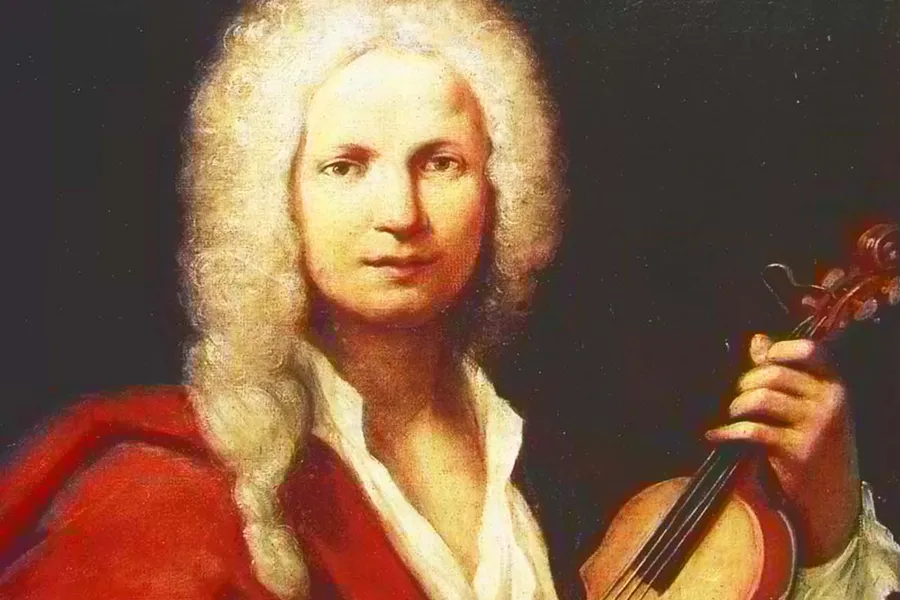
Venice, Italy, Aug 6, 2017 / 04:02 pm (CNA/EWTN News).- While Antonio Vivaldi's “Four Seasons” echoes in concert halls and elevators around the world, for some, his greatest masterpieces are not the scores resonating spring, summer, fall and winter, but rather his sacred music.
Although less known, Vivaldi's sacred music compositions, according to a researcher and expert on the musician's life, is probably his greatest contribution to music – featuring an altogether unprecedented combination of deep spirituality and the contemporary trends of the time.
And this profound personal spirituality was rooted in what is likely a little-known fact for many: Antonio Vivaldi was a Catholic priest.
“I'm going to give you the most bizarre idea. Think of the Pope, who represents priests, spiritual things, and then you've got Jimmy Hendrix, a superb guitarist. You put them together and you've got Vivaldi,” British researcher Micky White told CNA Aug. 1.
It's a combination altogether “bizarre,” she said. “Vivaldi the priest, deeply spiritual, comes out in his music. Jimmy Hendrix Vivaldi you've heard in the Four Seasons; it's the most bizarre piece of music.”
“It's timely, a priest wrote it,” and it's meshed with the modern style of the day – a combination of two things that are essentially “polls apart,” she said. “That's what makes him stand out among anybody. Bach wasn't a priest, Mozart wasn't a priest, nor was Beethoven, but Vivaldi was.
In listening to Vivaldi, it's obvious that he was a very faith-filled man, she said, “you hear it in his music, you listen to it.”
White, who left a thriving greeting card company in England and moved to Venice to pursue an increasing interest in researching Vivaldi's life, has become an expert and point of reference on the musician.
Not only has she published a book, “Antonio Vivaldi: A Life in Documents,” as the fruit of her research, but she was a consultant for a new display on his life called “Viva Vivaldi: The Four Seasons Mystery.”
The exhibit, located just behind St. Mark's Basilica in Venice, provides attendees with an indoor video-mapping show done with immersive HD images, surround sound and scent special effects such as scent and wind. It opened to the public May 13 at the Diocesan Museum, and will stay open during 2018.
One of the most famous Baroque composers, Antonio Lucio Vivaldi, affectionately known by many in his time as “the Red Priest” due to his auburn locks, was born in Venice in 1678.
His father, who was an instrumental figure in his life (pun intended), was a professional violinist, and taught his son how to play as a young child. The two then went on tour together throughout Venice, giving Vivaldi an extensive knowledge and even mastery of the violin from a young age.
In 1693, at the age of 15, he began studying for the priesthood. He was ordained in 1703 at the age of 25, and shortly after was appointed chaplain and Violin Master at a local orphanage called the Pio Ospedale della Pieta, or the Devout Hospital of Mercy.
The orphanage, called the “Pieta,” was founded in 1492 by a poor friar as a home for abandoned babies. Young children were typically raised by older girls already at the center, and while the boys were taught a specific trade and ousted at the age of 15, the girls were trained as musicians if they had the ability. If not, they were taught a different trade, such as reading or sewing.
The most talented of the girls stayed on and became members of the hospitals renown orchestra and choir. Vivaldi worked at the hospital from 1703-1715, when he was voted off the faculty. He was voted back in 1723, and remained until 1740, composing some of his most famous works during that time.
However, after just a year of being a priest, Vivaldi requested a dispensation form celebrating Mass due to his poor health. From birth he had been afflicted with a serious, unknown, health condition thought to be a form of asthma.
All that is known about the mysterious illness comes from the letter Vivaldi wrote asking for the dispensation, in which he referred to it as a “tightness of the chest.”
According to White, “it would have been very hard for Vivaldi to give up saying Mass. It would have been his own decision, a decision of nobody but himself, and he also gave up a good salary.”
She pointed to rumors alleging that he had been kicked out of the priesthood or even excommunicated, saying they “are so ignorant and so stupid,” because if one actually looks to the facts, the rumors are “not proven.”
She also addressed rumors that Vivaldi had abused the choir girls as the reason he was kicked off the Pieta faculty in 1715. These rumors, she said, “not only are they not true, they're impossible.”
Not only would Vivaldi have never been welcomed back in 1723, but many of the girls who remained in the orchestra stayed until they were 70 or even 80 years old. The hospital was also overseen by several governors, so had there been abuse, Vivaldi would have been kicked out right away, “so that doesn't add up,” White said.
People often make assumptions about the past or judge by their opinions, telling others that “'it must be like this' or 'so and so said that,'” White said, adding that when this happens “you go from bad to worse.”
But when she first started digging into her research on Vivaldi and putting the information into context, “then everything made sense,” she said, because “research is a matter of fact, it's not a matter of opinion, and it's not a matter of ideas, it's fact.”
She insisted that his priesthood was likely an essential element of his music. Even after stepping down from his liturgical duties, Vivaldi never stopped being a priest, White said. “Once a priest always a priest.”
“He was ordained, he was a priest his whole life (and) his spirituality comes out in his music, all you have to do is listen and you'll hear it.”
Although in poor health, Vivaldi made great strides in his musical career. He continued to write a variety of compositions, and received many commissions from all over Italy and Europe, for which he traveled frequently.
During one jaunt in 1722, Vivaldi moved to Rome, where he was invited to play for Pope Benedict XIII before moving back to Venice in 1725.
The various pieces he wrote throughout his career include several different types of concertos – from violin to orchestra – arias, sonatas, operas and sacred music.
But according to White, while the Four Seasons, written around 1721, and his many operas are what made Vivaldi rise to fame in his day, “sacred music is on another plane compared all the other compositions. It's the empire of composition itself that comes from faith.”
Among the sacred scores written by Vivaldi are the Gloria, the Credo, the Stabat Mater, the Magnificat, Dixit Dominus and Laetatus sum, among others. The “Laetatus sum,” specifically, was written by Vivaldi at the age of 13 in 1691.
White said that while these are the known liturgical and sacred works, “there's a lot, lot missing.”
Given his 38 year career at the hospital, there are likely many, many works of Vivaldi that have never been discovered, she said. For example, “I'm sure that he wrote full Masses, absolutely positive,” but they are likely all lost.
Despite the success he enjoyed during his career, Vivaldi died in poverty in Vienna July 28, 1741. He had moved to the Austrian country after meeting Emperor Charles VI, to whom he had dedicated his Opus 9 work, in 1728.
The emperor was so impressed with Vivaldi's work that he gave the musician the title of Knight, a gold medal and an invitation to Vienna. However, the emperor died shortly after Vivaldi's arrival several years later, and with no royal connection or steady income, Vivaldi became impoverished and died from an infection at the age of 63.
According to White, the greatest legacy that Vivaldi left can be summed up in one word: “music.”
“Music comes out of him, it doesn't come out of his brain, it just pours out of him. It's like a waterfall,” she said.
While his sacred and classical music might seem outdated in a society enthralled with artists such as Beyonce, Taylor Swift and Justin Bieber, White said Vivaldi is so versatile in his style that he can mesh with well with contemporary music as well as the older
“Vivaldi could do a rock concert quite easily, and Vivaldi can appeal to everyone,” she said. “Vivaldi, he's alone, he's absolutely unique. You talk about the Baroque style, and the romantic style…Vivaldi cuts that whole suede.”
With the “tremendous energy” present in his music, Vivaldi is truly one of a kind and is difficult to imitate, she said. “He doesn't fit anywhere, and he fits everywhere.”
Previous Post

August 6, 2017
Want peace and love? Remember to pray, Pope Francis says
Next Post
August 7, 2017 Pope Francis offers prayers after deadly Nigeria attack
Browse Our Archives
Select a Category Americas Asia - Pacific Europe Middle East - Africa Uncategorized US Vatican
Select a Month November 2017 October 2017 September 2017 August 2017 July 2017 June 2017 May 2017 April 2017 March 2017 February 2017 January 2017 December 2016 November 2016 October 2016 September 2016 August 2016 July 2016 June 2016 May 2016 April 2016 March 2016 February 2016 January 2016 December 2015 November 2015 October 2015 September 2015 August 2015 July 2015 June 2015 May 2015 April 2015 March 2015 February 2015 January 2015 December 2014 November 2014 October 2014 September 2014 August 2014 July 2014 June 2014 May 2014 April 2014 March 2014 February 2014 January 2014 December 2013 November 2013 October 2013 September 2013 August 2013 July 2013 June 2013 May 2013 April 2013 March 2013 February 2013 January 2013 December 2012 November 2012 October 2012 September 2012 August 2012 July 2012 June 2012 May 2012
TAKE THE
Religious Wisdom Quiz
According to Hebrews, without what is it impossible to please God?
Select your answer to see how you score.
Love Obedience Sacrifice Faith
Related posts from Catholic News

Sixty Vincentians martyred during Spanish Civil War to...

Filipinos gather in Rome to promote bishop's beatification...

UK bishop calls for prayers as MPs urge...

On All Souls' Day, Pope Francis prays for...
TRENDING AT PATHEOS Catholic

Rejecting Doom: Christian Hope And Human Action
Christianity is a religion of hope. We are to have hope and...

It’s What Comes From Within Which Matters
One of the most difficult things for us to understand is why...

Why I Choose the Eucharist Over the Sermon
Choose the Eucharist, Not the Sermon What are we supposed to get...

5 Design Elements Found in Spiritually Rooted Homes
Putting Spirituality Into Home Decor Our homes are more than our living...

Credo: A Story of God Told with the...
About 10 years ago, I began to imagine a personal "Credo" that...

The Anatomy of Divine Revelation in Catholic Thought
The claim that God has made Himself known to human beings is...
view all Catholic blogs
Ad-Free & Subscriber Log-In Subscription Support
- About Us
- 2026 Calendar
- Videos
- Podcasts
- Library of World Religions
- Faith In Media Tracker
- Advertise With Us
- Write for Us
- Privacy Policy
- Terms of Service
- Do Not Sell My Data
- Contact Us
- Radiant Digital
- Manage Newsletter Subscriptions
- Unsubscribe From Notifications
- Sitemap
Copyright 2008-2026, Patheos. All rights reserved.
Subscription Support Ad-Free & Subscriber Log-In
Follow Patheos