
BuddhistCatholicContemplativeEvangelicalGeneral ChristianHinduJewishLatter-day SaintMuslimNew VisionsProgressive Christian
Beliefs
- Buddhist
- Catholic
- Contemplative
- Evangelical
- General Christian
- Hindu
- Jewish
- Latter-day Saint
- More Voices
- Muslim
- New Visions
- Pagan
- Progressive Christian
Topics
- Religion News
- Food and Religion
- Sports and Religion
- Religious Art
- Religious Music and Entertainment
- Religious Events
- History and Religion
- Style and Religion
- Politics and Religion
- Women in Religion
- Recreation Outdoors and Religion
- Business Finance and Religion
- Careers Workplace and Religion
- Education and Religion
- Family Parenting and Religion
- Health Fitness and Religion
- Home and Religion
- Relationships and Religion
- Technology and Religion
- Travel and Religion
Columnists
- Buddhist Columnists
- Business Finance and Religion Columnists
- Careers Workplace and Religion Columnists
- Catholic Columnists
- Contemplative Columnists
- Education and Religion Columnists
- Evangelists Columnists
- Family Parenting and Religion Columnists
- General Christian Columnists
- Health Fitness and Religion Columnists
- Hindu Columnists
- History and Religion Columnists
- Home and Religion Columnists
- Jewish Columnists
- More Voices Columnists
- Latter Day Columnists
- Muslim Columnists
- New Visions Columnists
- Nonreligious Columnists
- Pagan Columnists
- Politics and Religion Columnists
- Progressive Columnists
- Recreation Outdoors and Religion Columnists
- Relationships and Religion Columnists
- Religion News Columnists
- Religious Art Columnists
- Religious Events Columnists
- Religious Music and Entertainment Columnists
- Sports and Religion Columnists
- Style and Religion Columnists
- Technology and Religion Columnists
- Travel and Religion Columnists
- Women in Religion Columnists
Resource Library
- 2026 Calendar
- Library of World Religions
- The 100 Most Holy Places on Earth
- Patheos Answers
- Podcasts
- Videos
- Faith Leaders Database
- Anglican Episcopalian
- Bahai
- Baptist
- Buddhism
- Christianity
- Confucianism
- Eastern Orthodoxy
- Hinduism
- Holiness and Pentecostal
- ISKCON
- Islam
- Judaism
- Lutheran
- Methodist
- The Church of Jesus Christ of Latter-day Saints
- New Age
- Paganism
- Presbytarian and Reformed
- Protestantism
- Religion Behind the Scenes
- Roman Catholic
- Scientology
- Shia Islam
- Sikhism
- Sufism
- Sunni Islam
- Taoism
- Zen
- See all religions
Research Tools
 Ad-Free & Subscriber Log-In Subscription Support
Ad-Free & Subscriber Log-In Subscription Support
Follow Patheos 

- Trending:
- Forgiveness
- |
- Marriage
- |
- Consciousness
- |
- Death Penalty
- |
- Election
- |
- Halloween
 Catholic News
- Home
- Catholic
- Religion News
- The rise of the ‘alt-right’ – how should the Church respond?
The rise of the ‘alt-right’ – how should the Church respond?
Last updated on: August 24, 2017 at 9:02 am by CNA Daily News
The rise of the ‘alt-right’ – how should the Church respond? 2017-08-24T09:02:00+00:00 CNA Daily News
Patheos Explore the world's faith through different perspectives on religion and spirituality! Patheos has the views of the prevalent religions and spiritualities of the world.
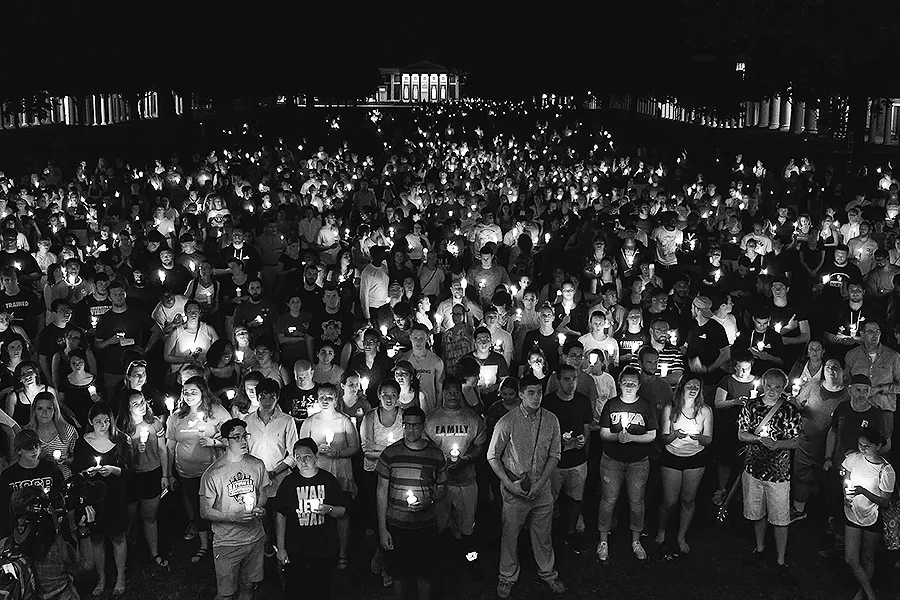
Washington D.C., Aug 24, 2017 / 03:02 am (CNA/EWTN News).- People are probably familiar with white supremacist groups like neo-Nazis and the Ku Klux Klan – both of which made an appearance at the violent rallies in Charlottesville, Virginia that shocked the nation and the world.
But what of the self-described “alt-right” movement, which drew a younger crowd and appears to espouse some of the same tenets? Is it just the same white nationalism, re-manifested?
And, what is white nationalism, exactly? Although there’s intense historical and contemporary disagreement over which ethnicities count as “white,” the phrase could be summed up as an ideology which holds that there is a distinct white “race.” What’s more, white nationalists advocate for the protection and advancement of so-called “white” nations and cultures against perceived threats like miscegenation, immigration and multiculturalism.
While some of the ideologies behind white nationalism are rooted in 18th and early 19th century racial politics, a large portion of the movement’s rhetoric stems from the rise of nationalism as a political model, along with common conceptions of race and eugenics popular at the end of the 19th and early 20th centuries.
The “alt-right” movement, centered on nationalism and far right-wing politics, was named so in 2010 by self-avowed white nationalist Richard Spencer, and includes many white nationalist members.
The movement has coalesced online around an ever-evolving lexicon of memes and jokes, a focus on preserving what they call “white identity,” and vocal resistance to that identity’s perceived threats – including from immigrants, feminists, Muslims and Jews.
Alt-right blogger voxday described how he thinks the movement conceives of its goals, pointing out its “philosophy of offense” and nationalism. At “alt-right” events and in “alt-right” webspace, overtly racist terms like “The Daily Shoah” – referencing the Holocaust – and “cuck” (short for “cuckhold” – a vulgar term for miscegenation), find their way into the lexicon of terms used next to frog cartoons and Twitter screen caps.
Phillip de Mahy, a Ph.D. student studying at the Catholic University of America, researches online communities and explained some of the trends that mark the alt-right movement.
One of the most important aspects of the movement, he told CNA, is its shifting set of beliefs and alliances. “If you look at the message boards,” de Mahy explained, “there’s lots of disagreement about who’s in or out.” The tactics and political goals of the movement as a whole are also difficult to define with precision, he said.
“There’s many people in the alt-right who will say this is just the logical extension of the Republican platform,” de Mahy said, noting that in many cases, the alt-right supports many of the same policies or actions of conventional Republicans on issues like immigration or foreign policy.
However, what differentiates the two groups, he says, are the reasons that the alt-right and other white nationalist groups have for supporting these positions. They do so to “bring about the racial purity of the nation,” he said.
“I don’t think there’s many people that would identify with the movement who would have any trouble saying that, euphemistically, it’s White Identity politics or Pro-White politics, which is, in reality, White Nationalism,” de Mahy clarified.
However, according to “Ignatius,” a former writer for Breitbart who spent time observing the alt-right, the history of the movement is slightly more complex. What differentiates the alt-right from other racist groups, he said, is its use of the internet and internet culture.
“If you look at its origins and growth, it's almost entirely from internet forums, based on internet memes, and consequentially it has the infectious nature of the memes,” he said in a written response to CNA.
Historically, the alt-right has organized around this culture which has accepted a range of controversial anti-feminist, anti-Islam, anti-immigration and white nationalist beliefs.
However, Ignatius pointed out, many Catholics who have political beliefs that could be considered alt-right “realize the evil of racism, how race is such a malleable and meaningless concept, how opposed, to Church teaching it is.”
And many of these people have been drawn to the movement by its strong denunciation of perceived problems within modern society, he said. However, even for those who don’t initially hold racist views themselves, the alt-right could still prove dangerous, Ignatius noted.
In many places in the movement, it is “more permissible for someone to be slightly racist” than it is for them to promote monarchist or feudalist ideals, he said. Thus, when some casual members of the group’s internet meme culture seek an ideological home in the alt-right, “it's incredibly easy to slip into all forms of horrendous racism,” he warned.
“The alt-right requires one to sublimate religion to race in a lot of ways, hence calling the pope a ‘cuck,’” or “disliking” Guinean cardinal Robert Sarah, he said.
Furthermore, many members of the alt-right who were focused on other forms of nationalism but who were not racist have left the movement in the wake of the 2016 election, he said.
During the presidential election, groups like “traditionalists, white nationalists, libertarians, civic nationalists” all coalesced, but since then “non-overtly-racist civic nationalists” have left the movement. This has allowed the more openly white nationalist elements to define what the alt-right is, both within online communities and to the outside world,” Ignatius said.
“Although I've said that the alt right is nebulous to the point where it's hard to call them universally racists, it's accurate to say it's a racist movement.”
There are other morally reprehensible beliefs held by some in the alt-right, he noted, particularly support for abortion in non-white communities and the belief in paganism of some members.
In an April 2016 article for Radix Journal – a publication started by Richard Spencer – Aylmer Fisher pushed back against what he called the “pro-life temptation.”
Fisher argued that the pro-life position is “dysgenic” because it does not oppose birth among populations that are more likely to be below the poverty line and more likely to be of African-American or Hispanic heritage.
“Not only is the pro-life movement dysgenic,” Fisher wrote, “but its justifications rely on principles we generally reject. The alt-right is skeptical, to say the least, of concepts like ‘equality’ and ‘human rights,’ especially as bases for policy. The unborn fetus has no connection to anyone else in the community.”
He criticized pro-lifers, saying that those who are interested in “banning abortion because it’s ‘racist’ or adopting children from Africa, are the ultimate cuckservatives.”
While it’s unclear how seriously most members of the alt-right promote abortion, or how many support abortion access, it’s been a “consistent” topic of conversation among some of the group’s most vocal leaders and on some message boards, de Mahy said.
“They’re very explicit about the fact that this is a form of eugenics and that’s a good thing,” he said. Ultimately, “the alt-right would consider themselves to be pro-white and differing on the specifics of how to realize the furthering of the White Race. They would disagree about whether some things are pragmatic,” he said of support for abortion.
And while some members of the alt-right are Christian and while some see the Christian legacy – like historic Christian Europe – as a foundation for their worldview, others just see it as a vehicle for carrying their racist agenda. Or, they despise Christianity altogether.
“A lot of these people are very explicitly Atheist,” de Mahy said. “The overarching understanding of religion is largely instrumentalist.”
Some argue that Christianity is a compromised belief system because it is not defined by ethnic ties, and they find an alternative in paganism – particularly Nordic paganism – and its ties to the historic peoples of European descent.
Joseph Pearce, a senior editor at the Augustine Institute, has written a book about his previous involvement in the white supremacist movement and his subsequent conversion, “Race With the Devil: My Journey from Racial Hatred to Rational Love.” He recently wrote an opinion piece in the National Catholic Register, “Charlottesville Through the Eyes of an ex-White Supremacist.”
In his youth, Pearce had joined a white supremacist party in Great Britain, edited a white supremacist magazine, and was involved in violent street encounters with political opponents. Pearce twice spent time in prison, yet began reading St. Thomas Aquinas, Blessed John Henry Newman, and other Catholic authors during his second prison term on his path to conversion.
But why might young people be attracted to the white supremacist movement? Pearce told CAN that he joined it the because of “pride.” This also motivates other young men who are joining the movement today, he said, because “we live in a culture which is antithetical to Christianity, because it elevates pride.”
Younger generations are “all about self-identity now, basically constructing a cosmos in conformity with your own desires, wishes, prejudices,” he said. And they are looking to “tribalism,” which racism is a part of, because that offers a collective sense of pride.
“I think that tribalism’s on the rise because we’re not teaching generations these days about virtue, about Christianity, about humility, about love being laying down your life for the beloved, which is the other, including your enemy,” he said.
“We’re producing whole generations of people who are animated and motivated by pride, and racial pride will be one of those manifestations.”
For those who seriously believe in white nationalism, Catholics must forcefully condemn their beliefs but pray for their souls, Pearce said.
“I was a white supremacist. I went to prison twice. I was demonized by the culture, perhaps rightly so,” he said. “Certainly my ideas should have been demonized by the culture.”
“But I was a human being, and I wasn’t beyond the reach of the love of God, because God reached me in the prison cell,” he said, noting that his conversion began while he was serving his second prison sentence at the age of 24.
For one who is part of the white nationalist movement, we must be “hoping that he can be brought to the love of Christ and brought to conversion,” Pearce said. “God laid down his life for sinners, and we’re all sinners.”
Previous Post

August 24, 2017
Chilean court sidesteps constitution, paves way for legal abortion
Next Post
August 24, 2017 Mo. governor right to halt execution, Catholic conference says
Browse Our Archives
Select a Category Americas Asia - Pacific Europe Middle East - Africa Uncategorized US Vatican
Select a Month November 2017 October 2017 September 2017 August 2017 July 2017 June 2017 May 2017 April 2017 March 2017 February 2017 January 2017 December 2016 November 2016 October 2016 September 2016 August 2016 July 2016 June 2016 May 2016 April 2016 March 2016 February 2016 January 2016 December 2015 November 2015 October 2015 September 2015 August 2015 July 2015 June 2015 May 2015 April 2015 March 2015 February 2015 January 2015 December 2014 November 2014 October 2014 September 2014 August 2014 July 2014 June 2014 May 2014 April 2014 March 2014 February 2014 January 2014 December 2013 November 2013 October 2013 September 2013 August 2013 July 2013 June 2013 May 2013 April 2013 March 2013 February 2013 January 2013 December 2012 November 2012 October 2012 September 2012 August 2012 July 2012 June 2012 May 2012
TAKE THE
Religious Wisdom Quiz
Who was Jacob's firstborn son?
Select your answer to see how you score.
Joseph Judah Levi Reuben
Related posts from Catholic News

US bishops' new child protection program aims to...

Wealthy foundation aims to redefine religious freedom—and Christianity,...

Victims of Islamic State in focus at UN...

Catholic University of America offers free tuition to...
TRENDING AT PATHEOS Catholic

Creation, Preservation, and Teleology in Catholic Theology
As I write this, it is very early Monday morning. Like millions...

The Parable Of The Sower And The Word...
One of Christ’s most famous parables is that of the sower who...

Rejecting Doom: Christian Hope And Human Action
Christianity is a religion of hope. We are to have hope and...

Why I Choose the Eucharist Over the Sermon
Choose the Eucharist, Not the Sermon What are we supposed to get...

5 Design Elements Found in Spiritually Rooted Homes
Putting Spirituality Into Home Decor Our homes are more than our living...

Credo: A Story of God Told with the...
About 10 years ago, I began to imagine a personal "Credo" that...
view all Catholic blogs
Ad-Free & Subscriber Log-In Subscription Support
- About Us
- 2026 Calendar
- Videos
- Podcasts
- Library of World Religions
- Faith In Media Tracker
- Advertise With Us
- Write for Us
- Privacy Policy
- Terms of Service
- Do Not Sell My Data
- Contact Us
- Radiant Digital
- Manage Newsletter Subscriptions
- Unsubscribe From Notifications
- Sitemap
Copyright 2008-2026, Patheos. All rights reserved.
Subscription Support Ad-Free & Subscriber Log-In
Follow Patheos