
BuddhistCatholicContemplativeEvangelicalGeneral ChristianHinduJewishLatter-day SaintMuslimNew VisionsProgressive Christian
Beliefs
- Buddhist
- Catholic
- Contemplative
- Evangelical
- General Christian
- Hindu
- Jewish
- Latter-day Saint
- More Voices
- Muslim
- New Visions
- Pagan
- Progressive Christian
Topics
- Religion News
- Food and Religion
- Sports and Religion
- Religious Art
- Religious Music and Entertainment
- Religious Events
- History and Religion
- Style and Religion
- Politics and Religion
- Women in Religion
- Recreation Outdoors and Religion
- Business Finance and Religion
- Careers Workplace and Religion
- Education and Religion
- Family Parenting and Religion
- Health Fitness and Religion
- Home and Religion
- Relationships and Religion
- Technology and Religion
- Travel and Religion
Columnists
- Buddhist Columnists
- Business Finance and Religion Columnists
- Careers Workplace and Religion Columnists
- Catholic Columnists
- Contemplative Columnists
- Education and Religion Columnists
- Evangelists Columnists
- Family Parenting and Religion Columnists
- General Christian Columnists
- Health Fitness and Religion Columnists
- Hindu Columnists
- History and Religion Columnists
- Home and Religion Columnists
- Jewish Columnists
- More Voices Columnists
- Latter Day Columnists
- Muslim Columnists
- New Visions Columnists
- Nonreligious Columnists
- Pagan Columnists
- Politics and Religion Columnists
- Progressive Columnists
- Recreation Outdoors and Religion Columnists
- Relationships and Religion Columnists
- Religion News Columnists
- Religious Art Columnists
- Religious Events Columnists
- Religious Music and Entertainment Columnists
- Sports and Religion Columnists
- Style and Religion Columnists
- Technology and Religion Columnists
- Travel and Religion Columnists
- Women in Religion Columnists
Resource Library
- 2026 Calendar
- Library of World Religions
- The 100 Most Holy Places on Earth
- Patheos Answers
- Podcasts
- Videos
- Faith Leaders Database
- Anglican Episcopalian
- Bahai
- Baptist
- Buddhism
- Christianity
- Confucianism
- Eastern Orthodoxy
- Hinduism
- Holiness and Pentecostal
- ISKCON
- Islam
- Judaism
- Lutheran
- Methodist
- The Church of Jesus Christ of Latter-day Saints
- New Age
- Paganism
- Presbytarian and Reformed
- Protestantism
- Religion Behind the Scenes
- Roman Catholic
- Scientology
- Shia Islam
- Sikhism
- Sufism
- Sunni Islam
- Taoism
- Zen
- See all religions
Research Tools
 Ad-Free & Subscriber Log-In Subscription Support
Ad-Free & Subscriber Log-In Subscription Support
Follow Patheos 

- Trending:
- Forgiveness
- |
- Marriage
- |
- Consciousness
- |
- Death Penalty
- |
- Election
- |
- Halloween
 Catholic News
- Home
- Catholic
- Religion News
- Russia, West must put peace before partisan interests – Cardinal Parolin
Russia, West must put peace before partisan interests – Cardinal Parolin
Last updated on: August 1, 2017 at 6:08 am by CNA Daily News
Russia, West must put peace before partisan interests – Cardinal Parolin 2017-08-01T06:08:00+00:00 CNA Daily News
Patheos Explore the world's faith through different perspectives on religion and spirituality! Patheos has the views of the prevalent religions and spiritualities of the world.
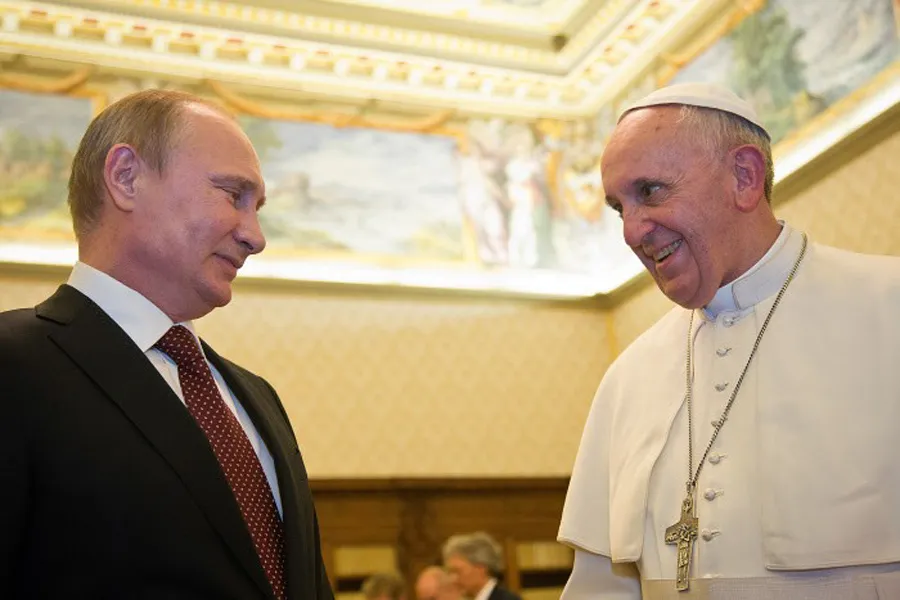
Vatican City, Aug 1, 2017 / 12:08 am (CNA/EWTN News).- If problems between Russia and Western countries are going to be resolved, the two must overcome differences and concern for personal interests in order to achieve peace, Cardinal Pietro Parolin said Thursday.
“The question of peace and search for a solution to the various crises underway should be placed above any national or in any case partisan interest,” the Vatican Secretary of State said ahead of a planned trip to Moscow in August.
“I am convinced that it is part of the Holy See’s mission to insist on this aspect.”
Cardinal Parolin, the Vatican’s top diplomat, spoke about the Holy See’s mission in Russia in an interview with the Italian newspaper “Il Sole 24 ore,” published July 27.
Earlier Parolin told Italian media that he will be visiting Moscow sometime in late August, though the trip and exact dates have not yet been announced by the Vatican. It is believed the visit will include meetings with Russian President Vladimir Putin and leaders of the Russian Orthodox Church, the Vatican diplomat told journalists in June.
Speaking about Russia’s influence in the world, Cardinal Parolin noted that though there has been a period of uncertainty around Russia’s position on various issues, the country has always been part of the international scene.
Often, he said, we emphasize the differences between Russia and various Western countries as if “they were different worlds,” but in this context “the challenge is to contribute to a better reciprocal understanding between those who risk presenting themselves as opposite poles.”
“Here there can be no victors or defeated. Indulging your own specific interests, which is one of the characteristics in this age of return to nationalisms, distracts you from seeing how the possibility of a catastrophe is not averted on its own.”
This effort doesn’t mean the kind of compromise that leads to one side yielding its position to the position of the other, he underlined, but rather “a patient, constructive, frank, and at the same time, respectful dialogue.”
This kind of dialogue, he emphasized, is even more important for those questions at the origin of current conflicts and those that risk inflaming further tension.
The cardinal gave a few examples to show that the Holy See has always been invested in Russia and in Eastern Europe generally, such as the visit to Rome by Tsar Nicholas I in 1845, where he had two meetings with Gregory XVI.
Two years later he drew up an agreement with Bl. Pius IX. “The local Churches stood alongside their people, also in the dramatic moments of the persecutions,” he said.
“It is not just its being at the borders of Europe that makes Eastern Europe important, but also its historic role in terms of civilization, culture and Christian faith.”
The Holy See’s consideration of Eastern Europe is “long-running,” he emphasized, even in the most difficult times, the Church’s approach to diplomacy being always one of peace.
“The Holy See does not seek anything for itself. It is not present here and then there to not lose on any side. Its attempt is one that is humanly difficult but evangelically unavoidable, so that nearby worlds return to dialogue and stop being torn apart, by hate even before the bombs.”
Asked about the new administration in the United States, in particular President Donald Trump, and the international responsibility of the U.S., Cardinal Parolin said we cannot rush, but that “time is needed to judge.”
“We hope,” he noted, “that the United States – and the other actors of the international scene – will not divert from their international responsibility on various themes which up to now has been historically exerted” – particularly those surrounding new climate challenges, poverty and ongoing conflicts.
As regards conflict and the new challenges found also in places like Venezuela and China, Cardinal Parolin said that they “call for unprecedented and creative responses, but in the end the aim of the Church has always been the same, and it is by nature pastoral: bring God to man and man to God.”
“Specifically, the Catholic Church asks that it is guaranteed the right to freely profess one’s faith for the benefit of everyone and for harmony in society,” he continued. “Catholics wish to live their faith serenely in their respective countries like good citizens, working toward the positive development of the national community.”
Previous Post

July 31, 2017
Unborn babies can detect different languages, new study says
Next Post
August 1, 2017 Why the drafting of 'Humanae Vitae' matters, 50 years later
Browse Our Archives
Select a Category Americas Asia - Pacific Europe Middle East - Africa Uncategorized US Vatican
Select a Month November 2017 October 2017 September 2017 August 2017 July 2017 June 2017 May 2017 April 2017 March 2017 February 2017 January 2017 December 2016 November 2016 October 2016 September 2016 August 2016 July 2016 June 2016 May 2016 April 2016 March 2016 February 2016 January 2016 December 2015 November 2015 October 2015 September 2015 August 2015 July 2015 June 2015 May 2015 April 2015 March 2015 February 2015 January 2015 December 2014 November 2014 October 2014 September 2014 August 2014 July 2014 June 2014 May 2014 April 2014 March 2014 February 2014 January 2014 December 2013 November 2013 October 2013 September 2013 August 2013 July 2013 June 2013 May 2013 April 2013 March 2013 February 2013 January 2013 December 2012 November 2012 October 2012 September 2012 August 2012 July 2012 June 2012 May 2012
TAKE THE
Religious Wisdom Quiz
Which region did the Israelites wander in for 40 years after leaving Egypt?
Select your answer to see how you score.
Judea Moab Galilee The Wilderness
Related posts from Catholic News

How do we help trafficking victims re-enter society?...

More than just giving – World Day of...

New book reveals details of John Paul I’s...

Despite reports, Pope Francis isn’t opening the door...
TRENDING AT PATHEOS Catholic

Rejecting Doom: Christian Hope And Human Action
Christianity is a religion of hope. We are to have hope and...

It’s What Comes From Within Which Matters
One of the most difficult things for us to understand is why...

Why I Choose the Eucharist Over the Sermon
Choose the Eucharist, Not the Sermon What are we supposed to get...

5 Design Elements Found in Spiritually Rooted Homes
Putting Spirituality Into Home Decor Our homes are more than our living...

Credo: A Story of God Told with the...
About 10 years ago, I began to imagine a personal "Credo" that...

The Anatomy of Divine Revelation in Catholic Thought
The claim that God has made Himself known to human beings is...
view all Catholic blogs
Ad-Free & Subscriber Log-In Subscription Support
- About Us
- 2026 Calendar
- Videos
- Podcasts
- Library of World Religions
- Faith In Media Tracker
- Advertise With Us
- Write for Us
- Privacy Policy
- Terms of Service
- Do Not Sell My Data
- Contact Us
- Radiant Digital
- Manage Newsletter Subscriptions
- Unsubscribe From Notifications
- Sitemap
Copyright 2008-2026, Patheos. All rights reserved.
Subscription Support Ad-Free & Subscriber Log-In
Follow Patheos