
BuddhistCatholicContemplativeEvangelicalGeneral ChristianHinduJewishLatter-day SaintMuslimNew VisionsProgressive Christian
Beliefs
- Buddhist
- Catholic
- Contemplative
- Evangelical
- General Christian
- Hindu
- Jewish
- Latter-day Saint
- More Voices
- Muslim
- New Visions
- Pagan
- Progressive Christian
Topics
- Religion News
- Food and Religion
- Sports and Religion
- Religious Art
- Religious Music and Entertainment
- Religious Events
- History and Religion
- Style and Religion
- Politics and Religion
- Women in Religion
- Recreation Outdoors and Religion
- Business Finance and Religion
- Careers Workplace and Religion
- Education and Religion
- Family Parenting and Religion
- Health Fitness and Religion
- Home and Religion
- Relationships and Religion
- Technology and Religion
- Travel and Religion
Columnists
- Buddhist Columnists
- Business Finance and Religion Columnists
- Careers Workplace and Religion Columnists
- Catholic Columnists
- Contemplative Columnists
- Education and Religion Columnists
- Evangelists Columnists
- Family Parenting and Religion Columnists
- General Christian Columnists
- Health Fitness and Religion Columnists
- Hindu Columnists
- History and Religion Columnists
- Home and Religion Columnists
- Jewish Columnists
- More Voices Columnists
- Latter Day Columnists
- Muslim Columnists
- New Visions Columnists
- Nonreligious Columnists
- Pagan Columnists
- Politics and Religion Columnists
- Progressive Columnists
- Recreation Outdoors and Religion Columnists
- Relationships and Religion Columnists
- Religion News Columnists
- Religious Art Columnists
- Religious Events Columnists
- Religious Music and Entertainment Columnists
- Sports and Religion Columnists
- Style and Religion Columnists
- Technology and Religion Columnists
- Travel and Religion Columnists
- Women in Religion Columnists
Resource Library
- 2026 Calendar
- Library of World Religions
- The 100 Most Holy Places on Earth
- Patheos Answers
- Podcasts
- Videos
- Faith Leaders Database
- Anglican Episcopalian
- Bahai
- Baptist
- Buddhism
- Christianity
- Confucianism
- Eastern Orthodoxy
- Hinduism
- Holiness and Pentecostal
- ISKCON
- Islam
- Judaism
- Lutheran
- Methodist
- The Church of Jesus Christ of Latter-day Saints
- New Age
- Paganism
- Presbytarian and Reformed
- Protestantism
- Religion Behind the Scenes
- Roman Catholic
- Scientology
- Shia Islam
- Sikhism
- Sufism
- Sunni Islam
- Taoism
- Zen
- See all religions
Research Tools
 Ad-Free & Subscriber Log-In Subscription Support
Ad-Free & Subscriber Log-In Subscription Support
Follow Patheos 

- Trending:
- Forgiveness
- |
- Marriage
- |
- Consciousness
- |
- Death Penalty
- |
- Election
- |
- Halloween
 Catholic News
- Home
- Catholic
- Religion News
- Is it weird that Catholics venerate relics? Here’s why we do
Is it weird that Catholics venerate relics? Here’s why we do
Last updated on: November 1, 2017 at 9:02 am by CNA Daily News
Is it weird that Catholics venerate relics? Here’s why we do 2017-11-01T09:02:00+00:00 CNA Daily News
Patheos Explore the world's faith through different perspectives on religion and spirituality! Patheos has the views of the prevalent religions and spiritualities of the world.
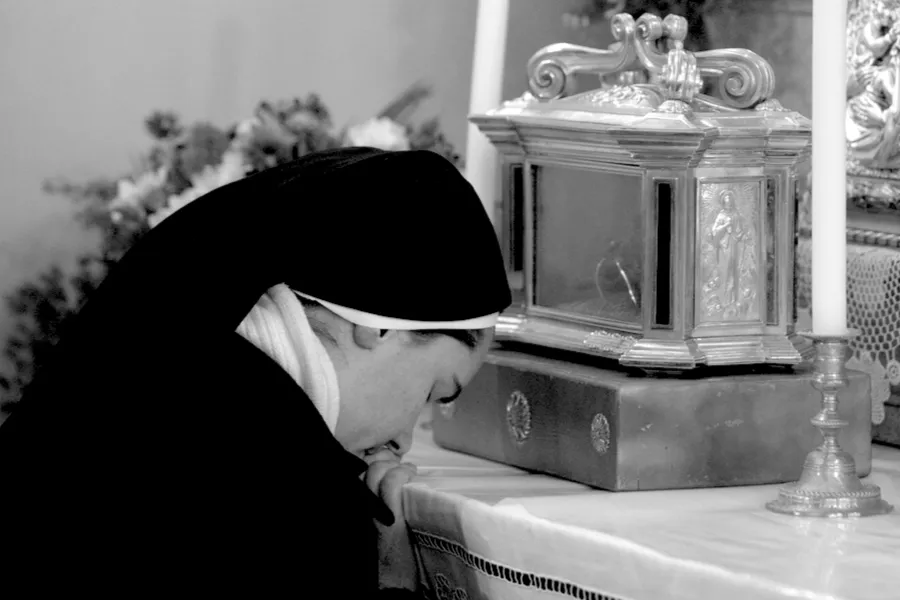
Houston, Texas, Nov 1, 2017 / 03:02 am (CNA/EWTN News).- “We are many parts, but we are all one body,” says the refrain of a popular '80s Church hymn, based on the words of 1 Cor. 12:12.
While we are one body in Christ, if you happen to be a Catholic saint, the many parts of your own body might be spread out all over the world.
Take, for example, St. Catherine of Siena.
A young and renowned third-order Dominican during the Middle Ages, she led an intense life of prayer and penance and is said to have single-handedly ended the Avignon exile of the successors of Peter in the 14th century.
When she died in Rome, her hometown of Siena, Italy, wanted her body. Realizing they would probably get caught if they took her whole corpse, the Siena thieves decided that it would be safer if they just took her head.
When they were stopped on their way out by guards outside of Rome, they said a quick prayer, asking for St. Catherine of Siena’s intercession. The guards opened the bag and did not find the dead head of St. Catherine, but a bag full of rose petals. Once the thieves were back in Siena, Catherine’s head re-materialized, one of the many miracles attributed to the saint.
The head of St. Catherine of Siena was placed in a reliquary in the Basilica of St. Dominic in Siena, where it can still be venerated today, along with her thumb. Her body remains in Rome, her foot is venerated in Venice.
From the Shroud of Turin, or the finger of St. Thomas, to the miraculous blood of St. Januarius, or the brain of St. John Bosco, the Catholic Church keeps and venerates many curious but nevertheless holy artifacts, known as relics, from Jesus and the saints.
To the outsider, the tradition of venerating relics (particularly of the corporeal persuasion) may seem like an outlandishly morbid practice.
But the roots of the tradition pre-date Jesus, and the practice is based in Scripture and centuries of Church teaching.
While it’s one of the most fascinating traditions of the Church, it can also be one of the most misunderstood.
Father Carlos Martins, CC, is a Custos Reliquiarum, which is an ecclesiastically appointed Curate of Relics with the authority to issue relics.
He is a member of Companions of the Cross, and the head of Treasures of the Church, a ministry that aims to give people an experience of the living God through an encounter with the relics of his saints in the form of an exposition. The ministry brings expositions of various relics throughout North America by invitation.
In the following interview with CNA, Fr. Martins answers questions and dispels some common misunderstandings about the tradition of relics.
First of all, what is a relic?
Relics are physical objects that have a direct association with the saints or with Our Lord. They are usually broken down into three classes:
First class relics are the body or fragments of the body of a saint, such as pieces of bone or flesh.
Second class relics are something that a saint personally owned, such as a shirt or book (or fragments of those items).
Third class relics are those items that a saint touched or that have been touched to a first, second, or another third class relic of a saint.
The word relic means “a fragment” or “remnant of a thing that once was but now is no longer.” Thus, we find in antique shops “Civil War relics” or “Relics of the French Revolution.” Obviously, we are not talking about these kinds of relics but rather sacred relics.
Where did the Catholic tradition of venerating saints’ relics come from?
Scripture teaches that God acts through relics, especially in terms of healing. In fact, when surveying what Scripture has to say about sacred relics, one is left with the idea that healing is what relics “do.”
When the corpse of a man was touched to the bones of the prophet Elisha the man came back to life and rose to his feet (2 Kings 13:20-21).
A woman was healed of her hemorrhage simply by touching the hem of Jesus’ cloak (Matthew 9:20-22).
The signs and wonders worked by the Apostles were so great that people would line the streets with the sick so that when Peter walked by at least his shadow might ‘touch’ them (Acts 5:12-15).
When handkerchiefs or aprons that had been touched to Paul were applied to the sick, the people were healed and evil spirits were driven out of them (Acts 19:11-12).
In each of these instances God has brought about a healing using a material object. The vehicle for the healing was the touching of that object. It is very important to note, however, that the cause of the healing is God; the relics are a means through which He acts. In other words, relics are not magic. They do not contain a power that is their own; a power separate from God.
Any good that comes about through a relic is God’s doing. But the fact that God chooses to use the relics of saints to work healing and miracles tells us that He wants to draw our attention to the saints as “models and intercessors” (Catechism of the Catholic Church, 828).
When did the veneration of relics begin?
It was present from the earliest days of Christianity, during the Apostolic age itself. The following is an account written by the Church in Smyrna (modern day Izmir, Turkey) when its bishop, St. Polycarp was burned alive:
“We adore Christ, because He is the Son of God, but the martyrs we love as disciples and imitators of the Lord. So we buried in a becoming place Polycarp’s remains, which are more precious to us than the costliest diamonds, and which we esteem more highly than gold.”
(Acts of St. Polycarp, composed approx. 156 AD)
Polycarp was a significant figure. He was converted by John the Apostle, who had baptized him and subsequently ordained him a bishop. Thus we see that from its outset the Church practiced devotion to the remains of the martyrs.
What is the spiritual significance of relics?
I think that St. Jerome put it best when he said:
“We do not worship relics, we do not adore them, for fear that we should bow down to the creature rather than to the creator. But we venerate the relics of the martyrs in order the better to adore him whose martyrs they are.” (Ad Riparium, i, P.L., XXII, 907).
We venerate relics only for the sake of worshiping God.
When we collect relics from the body of a saint, what part of the body do we use?
Any part of the saint’s body is sacred and can be placed in a reliquary. Any and every bone may be used. In addition, flesh, hair, and sometimes blood, are also used. Sometimes everything from the tomb is dispersed from it. Sometimes a tomb is preserved.
At what point in the canonization process are items or body parts considered official relics by the Church?
Before the beatification takes place, there is a formal rite whereby the relics are identified and moved (the official word is “translated”) into a church, a chapel, or an oratory. Put simply, the grave is exhumed and the mortal remains are retrieved.
Only the Church has the juridical power to formally recognize the sanctity of an individual. When the Church does this – through beatification and canonization – their relics receive the canonical recognition as being sacred relics.
There is an importance difference between beatification and canonization. Beatification is the declaration by the Church that there is strong evidence that the person in question is among the blessed in heaven. Nevertheless, beatification permits only local devotion. That is, devotion in the country in which the individual lived and died. When Mother Teresa was beatified, for instance, only in India and in her native Albania was her devotion permitted. Her Mass could not be celebrated, for example, in the United States, nor could her relics be placed within its altars.
Whereas beatification permits local devotion, canonization, on the other hand, mandates universal devotion. It grants to the canonized individual the rights of devotion throughout the universal Church.
The Church allows saints’ body parts to be scattered for relics, but forbids the scattering of ashes of the deceased who are cremated. Why is that?
Every person has a right to a burial. This means that the community has a duty to bury the dead.
Every human society and culture throughout time has felt this duty. The dead have always been buried, and archaeology has never discovered a human community that did not practice this. One could rightly say, therefore, that burying the dead forms part of our human cultural DNA.
The theological term for this instinct is natural law. Nature has imprinted a law within the human heart that manifests itself in the practice of burying the dead as a final act of love and devotion, or at least an act of respect and propriety.
It should be no surprise, then, that the Church lists as one of the corporal works of mercy burying the dead. Grace does not destroy nature but perfects it.
There is flexibility in the kind of burial. Remains may be buried in the ground, in the sea, or above ground within, for example, a cave or columbarium. The point is that a burial occurs within a single place, such that it can be said that the person “occupies” the place as a final location of rest. The human heart longs for this. We see people arriving at graves and speaking to the grave as if they were speaking to the deceased. And they do so differently than they might speak to the dead at home. At the grave, they speak to the dead as if they are in a place.
For this reason, among others, the Church has always taught not only that it is completely beneath the dignity of human body to have its remains “scattered,” but also completely beneath basic human sensibilities. People need a place to encounter and meet the dead in their physicality.
Nevertheless, the saints, as members of the body of Christ, have a right to have their remains venerated. And this right, flowing from their dignity as members of the Body of Christ, supersedes their right to have their remains remain in burial.
What is the proper way to keep relics? Are lay Catholics allowed to have first class relics in their homes?
Relics are very precious. They are not something that was alive at one time and is now dead. In the case of first class relics, we are talking about flesh that is awaiting the general resurrection, where the soul of a saint will be reunited with his physical remains.
As such, the way we treat relics is of the utmost importance. Ideally, relics should be kept in a Church or chapel where they can be made available for public veneration.
The highest honor the Church can give to a relic is to place it within an altar, where the Mass may be celebrated over it. This practice dates from the earliest centuries of the Church. In fact, the sepulchers of the martyrs were the most prized altars for the liturgy.
As an alternative to encasing them within altars, they may be installed within a devotional niche where people may venerate them. Such shrines are important as they afford people a deeper experience of intimacy with the saint.
The Church does not forbid the possession of relics by lay persons. They may even keep them in their homes. However, because of the many abuses that have been committed concerning relics, the Church will no longer issue relics to individuals – not even to clergy.
These abuses included failing to give them proper devotion (neglect), careless mistreatment of them, discarding them, and in some cases, even selling them. The abuses were not necessarily committed by the person to whom the Church had originally bequeathed the relics. But when such persons became deceased, and the relics were passed on by inheritance, they were often subject to great vulnerability. With the eclipse of the Christian culture in the western world, faith can no longer be taken for granted, even among the children of the most devout people.
Thus, to protect relics, the Church only issues them to Churches, chapels, and oratories.
How important is the authenticity of the relic? How does the Church go about determining authenticity of very old relics from the beginning of the Church?
The authenticity is critically important.
But for the ancient saints, determining identity is much easier than you might think. It was tradition to build a church over top of a saint’s grave. That is why St. Peter's Basilica is where it is, or why St. Paul Outside the Walls is there. Both encompass the tomb for the saint, which is located directly beneath the altar.
Modern archaeology has only affirmed what the ancient tradition has believed.
…
This article was originally published on CNA Aug. 11, 2017.
Previous Post

August 11, 2017
Aleppo's Melkite archbishop looks to rebuild city from the ashes
Next Post
August 11, 2017 German nun renowned for treating lepers in Pakistan dies at 87
Browse Our Archives
Select a Category Americas Asia - Pacific Europe Middle East - Africa Uncategorized US Vatican
Select a Month November 2017 October 2017 September 2017 August 2017 July 2017 June 2017 May 2017 April 2017 March 2017 February 2017 January 2017 December 2016 November 2016 October 2016 September 2016 August 2016 July 2016 June 2016 May 2016 April 2016 March 2016 February 2016 January 2016 December 2015 November 2015 October 2015 September 2015 August 2015 July 2015 June 2015 May 2015 April 2015 March 2015 February 2015 January 2015 December 2014 November 2014 October 2014 September 2014 August 2014 July 2014 June 2014 May 2014 April 2014 March 2014 February 2014 January 2014 December 2013 November 2013 October 2013 September 2013 August 2013 July 2013 June 2013 May 2013 April 2013 March 2013 February 2013 January 2013 December 2012 November 2012 October 2012 September 2012 August 2012 July 2012 June 2012 May 2012
TAKE THE
Religious Wisdom Quiz
How many books are in the New Testament?
Select your answer to see how you score.
22 66 27 39
Related posts from Catholic News

US bishops' new child protection program aims to...

Wealthy foundation aims to redefine religious freedom—and Christianity,...

Victims of Islamic State in focus at UN...

Catholic University of America offers free tuition to...
TRENDING AT PATHEOS Catholic

Rejecting Doom: Christian Hope And Human Action
Christianity is a religion of hope. We are to have hope and...

It’s What Comes From Within Which Matters
One of the most difficult things for us to understand is why...

Why I Choose the Eucharist Over the Sermon
Choose the Eucharist, Not the Sermon What are we supposed to get...

5 Design Elements Found in Spiritually Rooted Homes
Putting Spirituality Into Home Decor Our homes are more than our living...

Credo: A Story of God Told with the...
About 10 years ago, I began to imagine a personal "Credo" that...

The Anatomy of Divine Revelation in Catholic Thought
The claim that God has made Himself known to human beings is...
view all Catholic blogs
Ad-Free & Subscriber Log-In Subscription Support
- About Us
- 2026 Calendar
- Videos
- Podcasts
- Library of World Religions
- Faith In Media Tracker
- Advertise With Us
- Write for Us
- Privacy Policy
- Terms of Service
- Do Not Sell My Data
- Contact Us
- Radiant Digital
- Manage Newsletter Subscriptions
- Unsubscribe From Notifications
- Sitemap
Copyright 2008-2026, Patheos. All rights reserved.
Subscription Support Ad-Free & Subscriber Log-In
Follow Patheos