
BuddhistCatholicContemplativeEvangelicalGeneral ChristianHinduJewishLatter-day SaintMuslimNew VisionsProgressive Christian
Beliefs
- Buddhist
- Catholic
- Contemplative
- Evangelical
- General Christian
- Hindu
- Jewish
- Latter-day Saint
- More Voices
- Muslim
- New Visions
- Pagan
- Progressive Christian
Topics
- Religion News
- Food and Religion
- Sports and Religion
- Religious Art
- Religious Music and Entertainment
- Religious Events
- History and Religion
- Style and Religion
- Politics and Religion
- Women in Religion
- Recreation Outdoors and Religion
- Business Finance and Religion
- Careers Workplace and Religion
- Education and Religion
- Family Parenting and Religion
- Health Fitness and Religion
- Home and Religion
- Relationships and Religion
- Technology and Religion
- Travel and Religion
Columnists
- Buddhist Columnists
- Business Finance and Religion Columnists
- Careers Workplace and Religion Columnists
- Catholic Columnists
- Contemplative Columnists
- Education and Religion Columnists
- Evangelists Columnists
- Family Parenting and Religion Columnists
- General Christian Columnists
- Health Fitness and Religion Columnists
- Hindu Columnists
- History and Religion Columnists
- Home and Religion Columnists
- Jewish Columnists
- More Voices Columnists
- Latter Day Columnists
- Muslim Columnists
- New Visions Columnists
- Nonreligious Columnists
- Pagan Columnists
- Politics and Religion Columnists
- Progressive Columnists
- Recreation Outdoors and Religion Columnists
- Relationships and Religion Columnists
- Religion News Columnists
- Religious Art Columnists
- Religious Events Columnists
- Religious Music and Entertainment Columnists
- Sports and Religion Columnists
- Style and Religion Columnists
- Technology and Religion Columnists
- Travel and Religion Columnists
- Women in Religion Columnists
Resource Library
- 2026 Calendar
- Library of World Religions
- The 100 Most Holy Places on Earth
- Patheos Answers
- Podcasts
- Videos
- Faith Leaders Database
- Anglican Episcopalian
- Bahai
- Baptist
- Buddhism
- Christianity
- Confucianism
- Eastern Orthodoxy
- Hinduism
- Holiness and Pentecostal
- ISKCON
- Islam
- Judaism
- Lutheran
- Methodist
- The Church of Jesus Christ of Latter-day Saints
- New Age
- Paganism
- Presbytarian and Reformed
- Protestantism
- Religion Behind the Scenes
- Roman Catholic
- Scientology
- Shia Islam
- Sikhism
- Sufism
- Sunni Islam
- Taoism
- Zen
- See all religions
Research Tools
 Ad-Free & Subscriber Log-In Subscription Support
Ad-Free & Subscriber Log-In Subscription Support
Follow Patheos 

- Trending:
- Forgiveness
- |
- Marriage
- |
- Consciousness
- |
- Death Penalty
- |
- Election
- |
- Halloween
 Catholic News
- Home
- Catholic
- Religion News
- In Christ, Mary brings new joy and meaning to mankind, Pope says
In Christ, Mary brings new joy and meaning to mankind, Pope says
Last updated on: August 15, 2017 at 10:26 am by CNA Daily News
In Christ, Mary brings new joy and meaning to mankind, Pope says 2017-08-15T10:26:00+00:00 CNA Daily News
Patheos Explore the world's faith through different perspectives on religion and spirituality! Patheos has the views of the prevalent religions and spiritualities of the world.
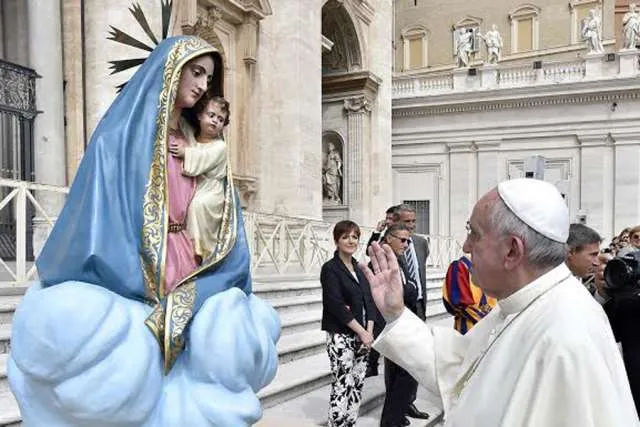
Vatican City, Aug 15, 2017 / 04:26 am (CNA/EWTN News).- On the Feast of the Assumption, Pope Francis said that in bringing Christ to the world, Mary also provides the joy and grace of her Son, which not only sustain us in difficulty, but are primarily intended for the weak and humble.
“Carrying Jesus, the Madonna also brings us a new joy, full of meaning; she brings us a new ability to pass with faith through the most painful and difficult moments; she brings us the capacity for mercy, forgiveness, understanding and supporting one another,” the Pope said Aug. 15.
Mary, he said, “is the model of faith and virtue,” and in contemplating her Assumption into Heaven, we give her thanks “because she always precedes us on the pilgrimage of life and of faith.”
We are also able to ask that she “guard us and sustain us, that we may have a strong faith, joyful and merciful; that she help us to be holy, to met her, one day, in paradise,” he said.
Pope Francis spoke to pilgrims present for a special Angelus address given for the Solemnity of the Assumption of Mary into Heaven, which is celebrated annually Aug. 15.
The dogma of the Assumption of Mary – also called the “Dormition of Mary” in the Eastern Churches – teaches that when Mary's earthly life ended, God assumed her body and soul into heaven.
The Assumption of Mary was a widely-held tradition even in the early centuries of the Church, and was a frequent meditation in the writings of saints throughout the centuries. However, it wasn't until 1950 that it was made an infallible teaching by Pope Pius XII in the Apostolic Constitution Munificentissimus Deus, officially defining the dogma of the Assumption.
In his Angelus speech honoring the feast, Pope Francis turned to the day's Gospel reading from Luke, in which Mary visits her cousin Elizabeth, who is miraculously pregnant with John the Baptist, despite her advanced age.
He noted how when Mary arrived to her cousin, having gone “in haste,” Elizabeth immediately proclaims the first words of the traditional “Hail Mary” prayer, saying “Blessed are you among women, and blessed is the fruit of your womb.”
In this moment, the greatest gift that Mary brought not just to Elizabeth, but to the whole world, “is Jesus, who already lives in her,” Francis said.
“And he lives not only by faith and waiting, as in many other women in the Old Testament: from the Virgin Mary Jesus took on human flesh, for his mission of salvation.”
The Pope then noted how preceding the encounter, Elisabeth and her husband Zechariah were filled with sadness by the fact that they couldn't have children. However, in place of this “now there is the joy of a child on the way: a child who will become the great John the Baptist, precursor of the Messiah.”
And when Mary arrives, this joy “overflows and bursts from their hearts,” he said, “because the invisible but real presence of Jesus fills all meaning: life, family, the salvation of the people…everything!”
Mary herself expresses this joy when she speaks the “stupendous prayer” of the Magnificat, which is “a song of joy to God who works great things through humble people, unknown to the world, like Mary herself, like her spouse Joseph, and also like the village in which they lived, Nazareth.”
In off-the-cuff remarks, the Pope pointed to “the great things the Lord does in the world with the humble, because humility is like a void that leaves room for God.”
The humble person “is strong because they are humble, not because they are powerful,” he said, and urged those present to ask themselves “how is my humility?” and to reflect on the answer.
Going on, Francis said the Magnificat prayer is an expression of God's mercy and fidelity, as well as his plan for salvation, which he carries out with “the little ones and the poor, with those who have faith in him” and trust in his Word, as Mary did.
Jesus' arrival to Elizabeth and Zechariah through Mary brings not only a climate of joy and communion, but also “a climate of faith which leads to hope, prayer and praise,” the Pope said, noting that the same thing can happen for each person today.
Francis closed his address asking Mary to bring to each person and their families and communities, “that immense gift, that unique grace which we must always ask for before and above all other graces that are also in our heart: the grace that is Jesus Christ!”
After leading pilgrims in the Angelus, the Pope offered a special prayer for all those who are suffering due to various global situations.
He entrusted to Mary and her intercession “the anxieties and pains of the peoples who in many parts of the world suffer due to natural disasters, social tensions or conflicts,” asking that she obtain for them “consolation and a future of peace and harmony!”
In addition to the various conflicts raging throughout the world, the Pope's words come after one woman lost her life and several others were injured when a car rammed into a group of protesters at a white supremacist rally in Charlottesville, Va. earlier this week, adding fuel to what were already-escalated racial tensions in the United States.
Previous Post

August 15, 2017
Holy Snakes! A Marian feast day's strange, stunning miracle
Next Post
August 15, 2017 Abortion-pill reversal: The next frontier of informed-consent laws?
Browse Our Archives
Select a Category Americas Asia - Pacific Europe Middle East - Africa Uncategorized US Vatican
Select a Month November 2017 October 2017 September 2017 August 2017 July 2017 June 2017 May 2017 April 2017 March 2017 February 2017 January 2017 December 2016 November 2016 October 2016 September 2016 August 2016 July 2016 June 2016 May 2016 April 2016 March 2016 February 2016 January 2016 December 2015 November 2015 October 2015 September 2015 August 2015 July 2015 June 2015 May 2015 April 2015 March 2015 February 2015 January 2015 December 2014 November 2014 October 2014 September 2014 August 2014 July 2014 June 2014 May 2014 April 2014 March 2014 February 2014 January 2014 December 2013 November 2013 October 2013 September 2013 August 2013 July 2013 June 2013 May 2013 April 2013 March 2013 February 2013 January 2013 December 2012 November 2012 October 2012 September 2012 August 2012 July 2012 June 2012 May 2012
TAKE THE
Religious Wisdom Quiz
True or False: Hebrews states that without holiness no one will see the Lord.
Select your answer to see how you score.
FALSE TRUE
Related posts from Catholic News

How do we help trafficking victims re-enter society?...

More than just giving – World Day of...

New book reveals details of John Paul I’s...

Despite reports, Pope Francis isn’t opening the door...
TRENDING AT PATHEOS Catholic

Creation, Preservation, and Teleology in Catholic Theology
As I write this, it is very early Monday morning. Like millions...

The Parable Of The Sower And The Word...
One of Christ’s most famous parables is that of the sower who...

Rejecting Doom: Christian Hope And Human Action
Christianity is a religion of hope. We are to have hope and...

Why I Choose the Eucharist Over the Sermon
Choose the Eucharist, Not the Sermon What are we supposed to get...

5 Design Elements Found in Spiritually Rooted Homes
Putting Spirituality Into Home Decor Our homes are more than our living...

Credo: A Story of God Told with the...
About 10 years ago, I began to imagine a personal "Credo" that...
view all Catholic blogs
Ad-Free & Subscriber Log-In Subscription Support
- About Us
- 2026 Calendar
- Videos
- Podcasts
- Library of World Religions
- Faith In Media Tracker
- Advertise With Us
- Write for Us
- Privacy Policy
- Terms of Service
- Do Not Sell My Data
- Contact Us
- Radiant Digital
- Manage Newsletter Subscriptions
- Unsubscribe From Notifications
- Sitemap
Copyright 2008-2026, Patheos. All rights reserved.
Subscription Support Ad-Free & Subscriber Log-In
Follow Patheos