
BuddhistCatholicContemplativeEvangelicalGeneral ChristianHinduJewishLatter-day SaintMuslimNew VisionsProgressive Christian
Beliefs
- Buddhist
- Catholic
- Contemplative
- Evangelical
- General Christian
- Hindu
- Jewish
- Latter-day Saint
- More Voices
- Muslim
- New Visions
- Pagan
- Progressive Christian
Topics
- Religion News
- Food and Religion
- Sports and Religion
- Religious Art
- Religious Music and Entertainment
- Religious Events
- History and Religion
- Style and Religion
- Politics and Religion
- Women in Religion
- Recreation Outdoors and Religion
- Business Finance and Religion
- Careers Workplace and Religion
- Education and Religion
- Family Parenting and Religion
- Health Fitness and Religion
- Home and Religion
- Relationships and Religion
- Technology and Religion
- Travel and Religion
Columnists
- Buddhist Columnists
- Business Finance and Religion Columnists
- Careers Workplace and Religion Columnists
- Catholic Columnists
- Contemplative Columnists
- Education and Religion Columnists
- Evangelists Columnists
- Family Parenting and Religion Columnists
- General Christian Columnists
- Health Fitness and Religion Columnists
- Hindu Columnists
- History and Religion Columnists
- Home and Religion Columnists
- Jewish Columnists
- More Voices Columnists
- Latter Day Columnists
- Muslim Columnists
- New Visions Columnists
- Nonreligious Columnists
- Pagan Columnists
- Politics and Religion Columnists
- Progressive Columnists
- Recreation Outdoors and Religion Columnists
- Relationships and Religion Columnists
- Religion News Columnists
- Religious Art Columnists
- Religious Events Columnists
- Religious Music and Entertainment Columnists
- Sports and Religion Columnists
- Style and Religion Columnists
- Technology and Religion Columnists
- Travel and Religion Columnists
- Women in Religion Columnists
Resource Library
- 2026 Calendar
- Library of World Religions
- The 100 Most Holy Places on Earth
- Patheos Answers
- Podcasts
- Videos
- Faith Leaders Database
- Anglican Episcopalian
- Bahai
- Baptist
- Buddhism
- Christianity
- Confucianism
- Eastern Orthodoxy
- Hinduism
- Holiness and Pentecostal
- ISKCON
- Islam
- Judaism
- Lutheran
- Methodist
- The Church of Jesus Christ of Latter-day Saints
- New Age
- Paganism
- Presbytarian and Reformed
- Protestantism
- Religion Behind the Scenes
- Roman Catholic
- Scientology
- Shia Islam
- Sikhism
- Sufism
- Sunni Islam
- Taoism
- Zen
- See all religions
Research Tools
 Ad-Free & Subscriber Log-In Subscription Support
Ad-Free & Subscriber Log-In Subscription Support
Follow Patheos 

- Trending:
- Forgiveness
- |
- Marriage
- |
- Consciousness
- |
- Death Penalty
- |
- Election
- |
- Halloween
 Catholic News
- Home
- Catholic
- Religion News
- For Pope Francis, ‘the liturgical reform is irreversible’
For Pope Francis, ‘the liturgical reform is irreversible’
Last updated on: August 24, 2017 at 6:49 pm by CNA Daily News
For Pope Francis, ‘the liturgical reform is irreversible’ 2017-08-24T18:49:00+00:00 CNA Daily News
Patheos Explore the world's faith through different perspectives on religion and spirituality! Patheos has the views of the prevalent religions and spiritualities of the world.
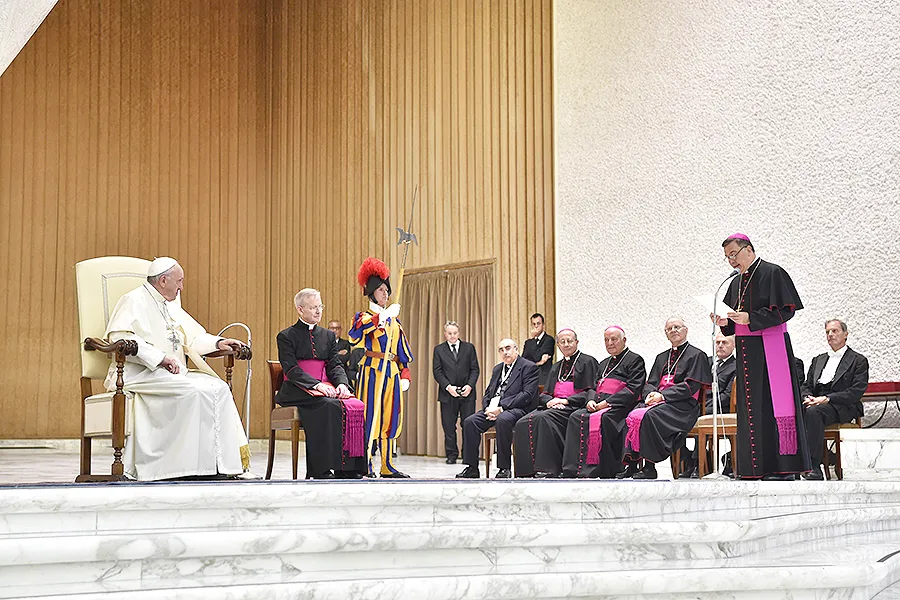
Vatican City, Aug 24, 2017 / 12:49 pm (CNA/EWTN News).- On Thursday Pope Francis told a group of Italian liturgists that while the process of implementing the liturgical reform following Vatican II has been a long and at times bumpy task, the reform is “irreversible.”
“After this magisterium, after this long journey we can affirm with certainty and with magisterial authority that the liturgical reform is irreversible,” the Pope said Aug. 24 at the Vatican's Paul VI Hall to participants in the Italian National Liturgical Week.
The week, which this year is exploring the theme “A living liturgy for a living Church”, is organized by the Center for Liturgical Action.
Pope Francis noted that the center has existed for 70 years, and recalled the history of the 20th century liturgical movement, saying that “in the history of the liturgy, events have occurred which are substantial and not superficial.”
“There are two directly related events, the Council and the reform, which did not blossom suddenly, but after long preparation,” Francis said.
He referenced steps taken both by St. Pius X, who aimed to restore Gregorian chant with his 1903 motu proprio Tra le sollecitudini and who formed a commission on liturgical renewal ten years later; and by Venerable Pius XII, who introduced a revised psalter, attenuated the Eucharistic fast, allowed some use of the vernacular in ritual, and reformed Holy Week.
Francis also referred to Ven. Pius XII's 1947 encyclical on the sacred liturgy, Mediator Dei. In that document the late Pope had said, among other things, that “one would be straying from the straight path were he to wish the altar restored to its primitive tableform” and that the assertion that priests cannot offer Mass at different altars at the same time is among “certain exaggerations and over-statements which are not in agreement with the true teaching of the Church.”
These culminated, Francis argued, in Vatican II's constitution on the sacred liturgy, Sacrosanctum Concilium, “whose lines of general reform respond to real needs and to the concrete hope of a renewal; it desired a living liturgy for a Church completely vivified by the mysteries celebrated.”
He asserted that the direction traced by the Second Vatican Council “took form according to the principle of respect for sound tradition and legitimate progress in the liturgical books promulgated by Blessed Paul VI.”
The application of these changes is a lengthy process and is still ongoing, he said, noting that this is in part because “it is not enough to reform the liturgical books; the mentality of the people must be reformed as well.”
The reformation of liturgical texts “introduced a process that demands time, faithful reception, practical obedience, and wise implementation” not only from ordained ministers, but from all who participate in the liturgy, he said. “In truth, we know, the liturgical education of pastors and the faithful is a challenge to be faced ever anew.”
Seeming to acknowledge the varied reception of the liturgical reforms which followed Vatican II, he quoted from a 1977 address of Bl. Paul VI to a consistory of cardinals declaring that “The time has now come definitely to leave aside divisive ferments.”
“And today, there is still work to do in this direction, in particular rediscovering the reasons for the decisions made with the liturgical reform, overcoming unfounded and superficial readings, partial receptions, and practices that disfigure it,” he declared.
“It is not a matter of rethinking the reform by reviewing its choices, but of knowing better the underlying reasons, even through historical documentation, of internalizing its inspirational principles and of observing the discipline that governs it.”
This comes as Cardinal Robert Sarah, prefect of the Congregation for Divine Worship, has in recent years called a “reform of the reform” a “spiritual necessity”, saying its possibility or desirability cannot be dismissed and that “that there has been an increasing amount of critical study by faithful sons and daughters of the Church asking whether what was in fact produced truly implemented the aims of [Sacrosanctum Concilium], or whether in reality they went beyond them.”
Having iterated the irreversibility of the liturgical reform, Pope Francis then turned to the theme of the liturgical week, “ A living liturgy for a living Church”.
The Church sought a liturgy that was “alive” and helped the Church to become “fully enlivened by the celebrated mysteries,” he said.
Quoting Sacrosanctum Concilium, he said faithful shouldn't go to the liturgy “as strangers or silent spectators; on the contrary, through a good understanding of the rites and prayers they should take part in the sacred action conscious of what they are doing, with devotion and full collaboration.”
Pope Francis then outlined three key points to living the liturgy, which he said is centered on Christ, involves the entire people of God, and serves as a school of Christian life.
The liturgy “is alive” thanks to the sacrifice of Christ, who through his death and resurrection gave us new life, the Pope said, explaining that without “the real presence of the mystery of Christ, there is no liturgical vitality.”
“As without a heartbeat there is no human life, so without the beating heart of Christ no liturgical action exists,” he said.
Going on, Francis said the liturgy is also a source of life “for the entire people of the Church,” and because of this, her nature is in fact “popular” and not “clerical,” since it's ultimately an action “for the people, but also by the people.”
Even in her many liturgical prayers the Church recalls that the liturgy itself is an action of God for the good of the people, but it's also an action from the people, “who listen to God” and praise him through the various signs they perform.
The Church, he said, gathers together all those whose heart is open to hearing the Gospel, including “the small and the great, the rich and the poor, children and elderly, healthy and sick, the just and sinners.” Thus, in Christ the liturgical assembly surpasses “every boundary of age, race, language and nation.”
In fact, the Pope said the “popular” scope of the liturgy “reminds us that it is inclusive and not exclusive, advocating communion with all but without being homologous.”
Finally, Francis said the liturgy serves as a “school of Christian life,” which initiates a process of “transforming the way of thinking and acting, and not filling a bag of it's own ideas about God.”
“The liturgy is life and not an idea to understand,” he said. Nor is it “a doctrine to understand or a rite to complete.”
“It's naturally also this but in another way, it's essentially different: it's a source of life and light for our journey of faith.”
Pope Francis closed his address by telling attendees that the Church is only truly alive if she “brings life, is mother and is missionary, going out to meet the other, urging to service without pursuing worldly powers that make it sterile.”
He also noted that the “richness” of the liturgy extends beyond the Roman Rite, and pointed to the liturgical “harmony” the Catholic Church shares with Eastern rites.
“The harmony of the ritual traditions, from East to West, by the breath of the same Spirit gives voice to the one prayer for Christ, with Christ and in Christ, for the glory of the Father and for the salvation of the world,” he said.
Francis closes his speech noting that in the effort to promote liturgical reform, “fatigue is not lacking, but neither is joy!” and asked participants to help not only pastors, but all who participate in the liturgy, “to cooperate so that the liturgy is the source and culmination of the vitality of the Church.”
Elise Harris contributed to this report.
Previous Post

August 24, 2017
Firebomb is latest in series of attacks against iconic Chilean church
Next Post
August 24, 2017 Why hasn't the Trump administration dropped the HHS mandate?
Browse Our Archives
Select a Category Americas Asia - Pacific Europe Middle East - Africa Uncategorized US Vatican
Select a Month November 2017 October 2017 September 2017 August 2017 July 2017 June 2017 May 2017 April 2017 March 2017 February 2017 January 2017 December 2016 November 2016 October 2016 September 2016 August 2016 July 2016 June 2016 May 2016 April 2016 March 2016 February 2016 January 2016 December 2015 November 2015 October 2015 September 2015 August 2015 July 2015 June 2015 May 2015 April 2015 March 2015 February 2015 January 2015 December 2014 November 2014 October 2014 September 2014 August 2014 July 2014 June 2014 May 2014 April 2014 March 2014 February 2014 January 2014 December 2013 November 2013 October 2013 September 2013 August 2013 July 2013 June 2013 May 2013 April 2013 March 2013 February 2013 January 2013 December 2012 November 2012 October 2012 September 2012 August 2012 July 2012 June 2012 May 2012
TAKE THE
Religious Wisdom Quiz
How many days are in a week?
Select your answer to see how you score.
Twelve Seven Ten Five
Related posts from Catholic News

How do we help trafficking victims re-enter society?...

More than just giving – World Day of...

New book reveals details of John Paul I’s...

Despite reports, Pope Francis isn’t opening the door...
TRENDING AT PATHEOS Catholic

Rejecting Doom: Christian Hope And Human Action
Christianity is a religion of hope. We are to have hope and...

It’s What Comes From Within Which Matters
One of the most difficult things for us to understand is why...

Why I Choose the Eucharist Over the Sermon
Choose the Eucharist, Not the Sermon What are we supposed to get...

5 Design Elements Found in Spiritually Rooted Homes
Putting Spirituality Into Home Decor Our homes are more than our living...

Credo: A Story of God Told with the...
About 10 years ago, I began to imagine a personal "Credo" that...

The Anatomy of Divine Revelation in Catholic Thought
The claim that God has made Himself known to human beings is...
view all Catholic blogs
Ad-Free & Subscriber Log-In Subscription Support
- About Us
- 2026 Calendar
- Videos
- Podcasts
- Library of World Religions
- Faith In Media Tracker
- Advertise With Us
- Write for Us
- Privacy Policy
- Terms of Service
- Do Not Sell My Data
- Contact Us
- Radiant Digital
- Manage Newsletter Subscriptions
- Unsubscribe From Notifications
- Sitemap
Copyright 2008-2026, Patheos. All rights reserved.
Subscription Support Ad-Free & Subscriber Log-In
Follow Patheos