
BuddhistCatholicContemplativeEvangelicalGeneral ChristianHinduJewishLatter-day SaintMuslimNew VisionsProgressive Christian
Beliefs
- Buddhist
- Catholic
- Contemplative
- Evangelical
- General Christian
- Hindu
- Jewish
- Latter-day Saint
- More Voices
- Muslim
- New Visions
- Pagan
- Progressive Christian
Topics
- Religion News
- Food and Religion
- Sports and Religion
- Religious Art
- Religious Music and Entertainment
- Religious Events
- History and Religion
- Style and Religion
- Politics and Religion
- Women in Religion
- Recreation Outdoors and Religion
- Business Finance and Religion
- Careers Workplace and Religion
- Education and Religion
- Family Parenting and Religion
- Health Fitness and Religion
- Home and Religion
- Relationships and Religion
- Technology and Religion
- Travel and Religion
Columnists
- Buddhist Columnists
- Business Finance and Religion Columnists
- Careers Workplace and Religion Columnists
- Catholic Columnists
- Contemplative Columnists
- Education and Religion Columnists
- Evangelists Columnists
- Family Parenting and Religion Columnists
- General Christian Columnists
- Health Fitness and Religion Columnists
- Hindu Columnists
- History and Religion Columnists
- Home and Religion Columnists
- Jewish Columnists
- More Voices Columnists
- Latter Day Columnists
- Muslim Columnists
- New Visions Columnists
- Nonreligious Columnists
- Pagan Columnists
- Politics and Religion Columnists
- Progressive Columnists
- Recreation Outdoors and Religion Columnists
- Relationships and Religion Columnists
- Religion News Columnists
- Religious Art Columnists
- Religious Events Columnists
- Religious Music and Entertainment Columnists
- Sports and Religion Columnists
- Style and Religion Columnists
- Technology and Religion Columnists
- Travel and Religion Columnists
- Women in Religion Columnists
Resource Library
- 2026 Calendar
- Library of World Religions
- The 100 Most Holy Places on Earth
- Patheos Answers
- Podcasts
- Videos
- Faith Leaders Database
- Anglican Episcopalian
- Bahai
- Baptist
- Buddhism
- Christianity
- Confucianism
- Eastern Orthodoxy
- Hinduism
- Holiness and Pentecostal
- ISKCON
- Islam
- Judaism
- Lutheran
- Methodist
- The Church of Jesus Christ of Latter-day Saints
- New Age
- Paganism
- Presbytarian and Reformed
- Protestantism
- Religion Behind the Scenes
- Roman Catholic
- Scientology
- Shia Islam
- Sikhism
- Sufism
- Sunni Islam
- Taoism
- Zen
- See all religions
Research Tools
 Ad-Free & Subscriber Log-In Subscription Support
Ad-Free & Subscriber Log-In Subscription Support
Follow Patheos 

- Trending:
- Forgiveness
- |
- Marriage
- |
- Consciousness
- |
- Death Penalty
- |
- Election
- |
- Halloween
 Catholic News
- Home
- Catholic
- Religion News
- Excavation sheds light on importance of ancient city near Rome
Excavation sheds light on importance of ancient city near Rome
Last updated on: August 4, 2017 at 9:01 am by CNA Daily News
Excavation sheds light on importance of ancient city near Rome 2017-08-04T09:01:00+00:00 CNA Daily News
Patheos Explore the world's faith through different perspectives on religion and spirituality! Patheos has the views of the prevalent religions and spiritualities of the world.
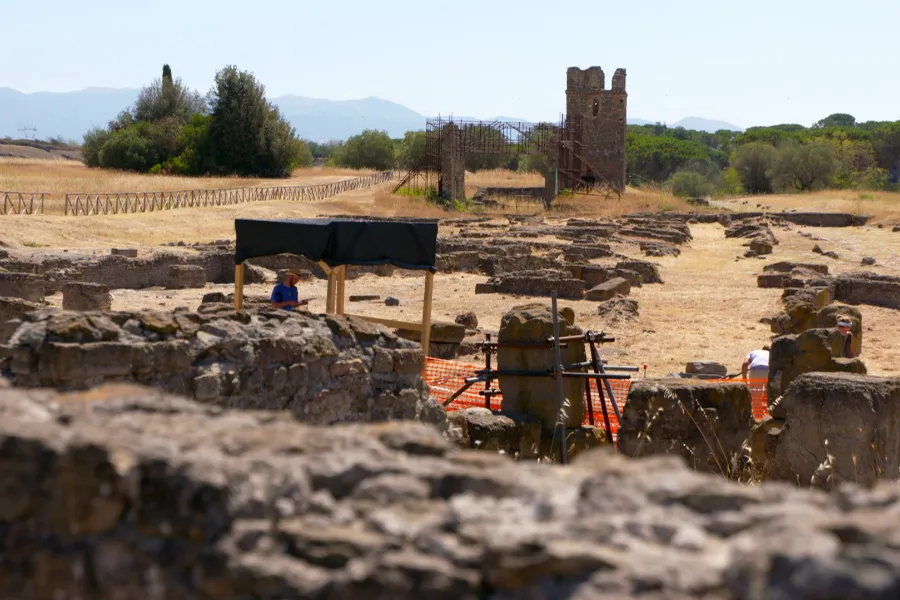
Rome, Italy, Aug 4, 2017 / 03:01 am (CNA/EWTN News).- Just eleven miles east of Rome lies the site of excavations of another ancient city, one which thrived in the last few centuries before Christ, but, overshadowed by Rome, eventually died out – though not before having its own thriving Christian community.
The city, Gabii, was first occupied by small groups of settlers in the early Iron Age (9th-8th century B.C.). It eventually grew into a full-fledged city with walls and large public buildings, peaking around the 3rd and 2nd centuries B.C.
Evidence shows that it then began to shrink, probably because of competition from Rome, but archeologists working on the site have recently uncovered the remains of a tower of a church, and believe the city to have been a center for Christianity, if an unusual one, in the early centuries of the Church.
“We know that there was a thriving Christian community and that it had a bishop as early as the 5th century, which is kind of unusual for a community of this size,” said Nicola Terrenato, a professor for the University of Michigan and coordinator of the excavations.
“So it probably means that even if it was a small community it was considered very important because of the glory that Gabii had in the past,” he told CNA.
The Diocese of Gabii was suppressed in 1060, but it was made a titular see in the late 20th century. The Titular Bishop of Gabii is currently Sebastian Taltavull Anglada, who is auxiliary bishop of Barcelona.
Because Rome has been continuously inhabited, the city exists in layers upon layers of construction and reconstruction over the years. These many layers can make it hard to investigate and map the early growth of the city. Gabii, by contrast, died out sometime in the 9th or 10th century AD.
Because the two cities emerged around the same time, researching Gabii and what it looked like when first formed can shed light on the beginnings of the city of Rome as well.
“We chose Gabii for excavation for a variety of reasons. This is a site that had not been excavated previously, so you had a whole city that you can investigate. But even more importantly, this is a site that really illustrates well the birth and the decline of the ancient city,” Terrenato said.
One of the goals of the excavations, however, is to find out if Gabii had a bishop’s residence and a cathedral in the early part of the Middle Ages. Whether there was ever a cathedral is still an unsolved question, but the excavations did uncover a church dedicated to St. Primitivus, an early Christian martyr in Rome.
The bell tower of the church, converted into a watchtower later in the Middle Ages, is still visible at the site. Excavations have also revealed a large stone-block construction, which is an early example of the Roman monumental architecture.
“This is a stone that Gabii was famous for in antiquity,” Terrenato said. “A high quality volcanic tufa was quarried inside the city and initially outside the city and beautiful buildings could be built out of beautiful blocks.”
“It was even used in the Forum of Augustus in Rome and the city probably thrived on a trade of this kind of stone.”
Another conspicuous ruin remaining is that of an ancient temple, attributed to Juno. In the late 1700s an archaeologist uncovered a large cache of statues at Gabii, many of which are now in the Louvre after they were carried off from Rome by Napoleon.
Besides the nearly 40 statues and busts from Gabii at the Louvre, there is also an ancient altar called “Altar of the Twelve Gods” dating to the 1st century AD.
New excavations were launched in 2007 by the multi-institutional Gabii Project, led by Nicola Terrenato and the University of Michigan, which collaborates with Yale University, the University of Glasgow, Charlton University, and the University of Dallas.
Professors from these institutions bring both undergraduate and graduate students to the site to learn and work, Terrenato explained. On average there are around 70 people on-site each day.
One of these is Andrew Johnston, an assistant professor of classics and history at Yale, who first began working at the site while a graduate student and who now leads trench excavations.
“So in addition to the research questions that drive us here at the Gabii project, one of our priorities is to train the next generation of North American archaeologists,” he said.
“One of our goals is to train students in a wide range of methodologies and tools of modern archaeology,” he continued.
Not just working at the site, “but also in various labs supervised by specialists in ceramics, osteology, zooarchaeology, environmental archaeology, to teach students about all of the kinds of evidence and data that we are hoping to collect as we excavate – not just exposing the architecture like this, but looking for other kinds of evidence that can tell us about wide range of activities that were taking place at the city in antiquity.”
Previous Post

August 4, 2017
Over half of UK women who sought abortion last year used contraceptives
Next Post
August 4, 2017 Vatican urges Venezuela to suspend constitutional revision
Browse Our Archives
Select a Category Americas Asia - Pacific Europe Middle East - Africa Uncategorized US Vatican
Select a Month November 2017 October 2017 September 2017 August 2017 July 2017 June 2017 May 2017 April 2017 March 2017 February 2017 January 2017 December 2016 November 2016 October 2016 September 2016 August 2016 July 2016 June 2016 May 2016 April 2016 March 2016 February 2016 January 2016 December 2015 November 2015 October 2015 September 2015 August 2015 July 2015 June 2015 May 2015 April 2015 March 2015 February 2015 January 2015 December 2014 November 2014 October 2014 September 2014 August 2014 July 2014 June 2014 May 2014 April 2014 March 2014 February 2014 January 2014 December 2013 November 2013 October 2013 September 2013 August 2013 July 2013 June 2013 May 2013 April 2013 March 2013 February 2013 January 2013 December 2012 November 2012 October 2012 September 2012 August 2012 July 2012 June 2012 May 2012
TAKE THE
Religious Wisdom Quiz
What did Jesus heal on a man lowered through a roof in Capernaum?
Select your answer to see how you score.
Dumbness Blindness Paralysis Leprosy
Related posts from Catholic News

Sixty Vincentians martyred during Spanish Civil War to...

Filipinos gather in Rome to promote bishop's beatification...

UK bishop calls for prayers as MPs urge...

On All Souls' Day, Pope Francis prays for...
TRENDING AT PATHEOS Catholic

Creation, Preservation, and Teleology in Catholic Theology
As I write this, it is very early Monday morning. Like millions...

The Parable Of The Sower And The Word...
One of Christ’s most famous parables is that of the sower who...

Rejecting Doom: Christian Hope And Human Action
Christianity is a religion of hope. We are to have hope and...

Why I Choose the Eucharist Over the Sermon
Choose the Eucharist, Not the Sermon What are we supposed to get...

5 Design Elements Found in Spiritually Rooted Homes
Putting Spirituality Into Home Decor Our homes are more than our living...

Credo: A Story of God Told with the...
About 10 years ago, I began to imagine a personal "Credo" that...
view all Catholic blogs
Ad-Free & Subscriber Log-In Subscription Support
- About Us
- 2026 Calendar
- Videos
- Podcasts
- Library of World Religions
- Faith In Media Tracker
- Advertise With Us
- Write for Us
- Privacy Policy
- Terms of Service
- Do Not Sell My Data
- Contact Us
- Radiant Digital
- Manage Newsletter Subscriptions
- Unsubscribe From Notifications
- Sitemap
Copyright 2008-2026, Patheos. All rights reserved.
Subscription Support Ad-Free & Subscriber Log-In
Follow Patheos