
BuddhistCatholicContemplativeEvangelicalGeneral ChristianHinduJewishLatter-day SaintMuslimNew VisionsProgressive Christian
Beliefs
- Buddhist
- Catholic
- Contemplative
- Evangelical
- General Christian
- Hindu
- Jewish
- Latter-day Saint
- More Voices
- Muslim
- New Visions
- Pagan
- Progressive Christian
Topics
- Religion News
- Food and Religion
- Sports and Religion
- Religious Art
- Religious Music and Entertainment
- Religious Events
- History and Religion
- Style and Religion
- Politics and Religion
- Women in Religion
- Recreation Outdoors and Religion
- Business Finance and Religion
- Careers Workplace and Religion
- Education and Religion
- Family Parenting and Religion
- Health Fitness and Religion
- Home and Religion
- Relationships and Religion
- Technology and Religion
- Travel and Religion
Columnists
- Buddhist Columnists
- Business Finance and Religion Columnists
- Careers Workplace and Religion Columnists
- Catholic Columnists
- Contemplative Columnists
- Education and Religion Columnists
- Evangelists Columnists
- Family Parenting and Religion Columnists
- General Christian Columnists
- Health Fitness and Religion Columnists
- Hindu Columnists
- History and Religion Columnists
- Home and Religion Columnists
- Jewish Columnists
- More Voices Columnists
- Latter Day Columnists
- Muslim Columnists
- New Visions Columnists
- Nonreligious Columnists
- Pagan Columnists
- Politics and Religion Columnists
- Progressive Columnists
- Recreation Outdoors and Religion Columnists
- Relationships and Religion Columnists
- Religion News Columnists
- Religious Art Columnists
- Religious Events Columnists
- Religious Music and Entertainment Columnists
- Sports and Religion Columnists
- Style and Religion Columnists
- Technology and Religion Columnists
- Travel and Religion Columnists
- Women in Religion Columnists
Resource Library
- 2026 Calendar
- Library of World Religions
- The 100 Most Holy Places on Earth
- Patheos Answers
- Podcasts
- Videos
- Faith Leaders Database
- Anglican Episcopalian
- Bahai
- Baptist
- Buddhism
- Christianity
- Confucianism
- Eastern Orthodoxy
- Hinduism
- Holiness and Pentecostal
- ISKCON
- Islam
- Judaism
- Lutheran
- Methodist
- The Church of Jesus Christ of Latter-day Saints
- New Age
- Paganism
- Presbytarian and Reformed
- Protestantism
- Religion Behind the Scenes
- Roman Catholic
- Scientology
- Shia Islam
- Sikhism
- Sufism
- Sunni Islam
- Taoism
- Zen
- See all religions
Research Tools
 Ad-Free & Subscriber Log-In Subscription Support
Ad-Free & Subscriber Log-In Subscription Support
Follow Patheos 

- Trending:
- Forgiveness
- |
- Marriage
- |
- Consciousness
- |
- Death Penalty
- |
- Election
- |
- Halloween
 Catholic News
- Home
- Catholic
- Religion News
- Amid nationwide controversy, St Junipero Serra statue vandalized in L.A.
Amid nationwide controversy, St Junipero Serra statue vandalized in L.A.
Last updated on: August 22, 2017 at 6:03 am by CNA Daily News
Amid nationwide controversy, St Junipero Serra statue vandalized in L.A. 2017-08-22T06:03:00+00:00 CNA Daily News
Patheos Explore the world's faith through different perspectives on religion and spirituality! Patheos has the views of the prevalent religions and spiritualities of the world.
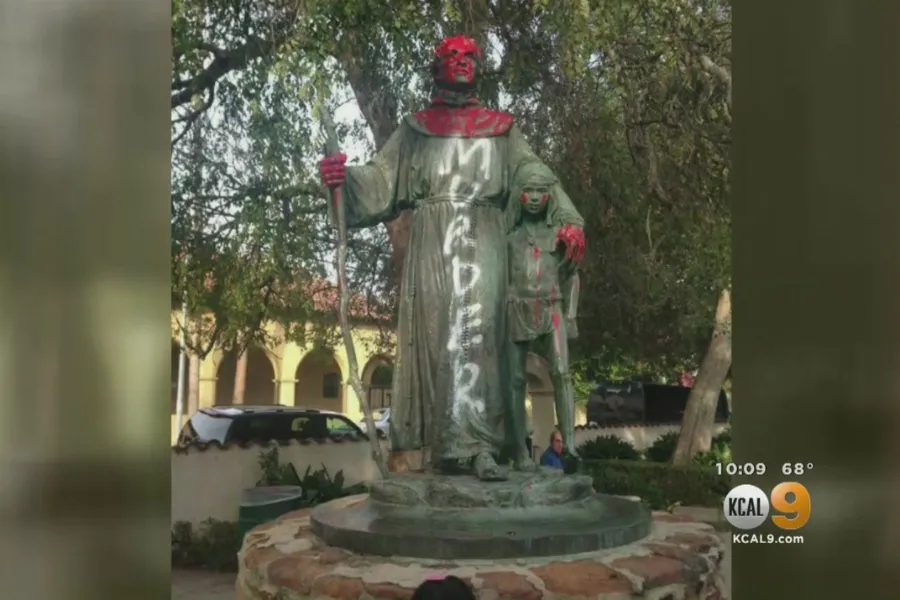
Los Angeles, Calif., Aug 22, 2017 / 12:03 am (CNA/EWTN News).- A statue of St. Junipero Serra in a Los Angeles public park appeared to have been vandalized last week in a time of national debate about historical statues.
The statue portrays the Franciscan friar in a favorable light, with his arm on the shoulder of an indigenous child. The park is across the street from the Mission San Fernando in Mission Hills community of Los Angeles. The mission was founded by Fr. Fermin Lasuen, another Franciscan, in 1797.
A picture of the statue was circulated on social media, showing it spray-painted red with the word “murder” written on the priest in white.
City officials did not confirm to Los Angeles news station CBS2 that the photo was authentic or that the statue was cleaned. However, a CBS2 reporter at the scene said there was red paint on the arm of the priest’s statue and a swastika on the statue of the child.
St. Junipero, a Franciscan missionary from Spain, founded nine Catholic missions in California in the late 1700s. His missions helped convert many native Californians to Christianity and taught them new technologies.
Most of the missions he founded would go on to become the centers of major cities in the state, as did other Franciscan-founded missions. The priest carried on his work despite a painful wound to his leg.
He died in 1784 at Mission San Carlos Borroméo del Carmelo in what is now California
St. John Paul II beatified Father Serra in 1988. Pope Francis canonized the priest Sept. 23, 2015 in Washington, D.C.
“He was excited about blazing trails, going forth to meet many people, learning and valuing their particular customs and ways of life,” Pope Francis said. “He learned how to bring to birth and nurture God’s life in the faces of everyone he met; he made them his brothers and sisters.”
“Junipero sought to defend the dignity of the native community, to protect it from those who had mistreated and abused it. Mistreatment and wrongs which today still trouble us, especially because of the hurt which they cause in the lives of many people,” the Pope added.
In Los Angeles last week, passerby Cristian Mendoza criticized the vandalism.
“Everyone’s entitled to their own public opinions and thoughts,” Mendoza told CBS2. “But once it gets to this level I don’t think it’s right.”
CBS2 quoted another passerby, Christian Ramirez, who said he thought the statue should be taken down and replaced with a statue he thought would show “appreciation to the native people that live here.” He suggested it represented a “violent history.”
Several California legislators have unsuccessfully pushed to remove the statue of St. Junipero Serra from the U.S. Capitol’s National Statuary Hall.
Some of St. Junipero Serra’s critics object to the forced confinement of some indigenous peoples in the missions he founded, as well as corporal punishment inflicted there, saying they are causes to dismiss the saint. Some also criticize his association with Spanish colonialism.
His defenders note St. Junipero Serra’s defense of native peoples at a time when Spanish soldiers and other officials could easily abuse them. At one point, he opposed the death sentence for a man who had killed one of his fellow missionaries in an uprising.
Many native peoples attended his burial and openly wept at his death.
The vandalism of the saint’s statue comes amid controversy over the fate of statues honoring leading figures of the Confederate States of America and the Reconstruction era.
In Charlottesville, Virginia, several hundred demonstrators gathered from around the country on Aug. 11 to protest the removal of a statue of General Robert E. Lee from a city park. The rally drew white supremacists, neo-Nazis, and Ku Klux Klan members. Many waved the Confederate battle flag and at least one demonstrator waved a Nazi flag.
The demonstration was set to continue the next day, attracting many counter-protesters. Both groups skirmished with each other, leading authorities to declare the assembly unlawful and to order the crowds to disperse.
An hour later, one rally attendee, 20-year-old James Alex Fields, allegedly drove into a crowd of counter-protesters, killing 32-year-old Heather Heyer and seriously injuring several others.
The incident prompted many peaceful responses, as well as some attacks on Confederate statues and other public monuments.
A statue of St. Joan of Arc had been vandalized in New Orleans by an unknown person or persons sometime in late April or early May, with graffiti reading “tear it down.” It followed controversy in the city about the removal of monuments to the Confederacy and the Reconstruction era.
In Baltimore, the oldest U.S. statue of the explorer Christopher Columbus, erected in 1792, was also vandalized this month. A video posted to YouTube claiming responsibility for the incident blamed Columbus for “a centuries-old wave of terrorism, murder, genocide, rape, slavery, ecological degradation and capitalist exploitation of labor in the Americas.”
Many such statues were set up by U.S. Catholics in the late 19th and early 20th centuries to mark his role in opening the New World to Europeans, at a time when many leading Americans denigrated Catholic figures.
Previous Post

August 21, 2017
Parolin in Russia: Vatican diplomacy has a key role in global debate
Next Post
August 22, 2017 In wake of violence, archbishop urges Catholics to foster racial peace
Browse Our Archives
Select a Category Americas Asia - Pacific Europe Middle East - Africa Uncategorized US Vatican
Select a Month November 2017 October 2017 September 2017 August 2017 July 2017 June 2017 May 2017 April 2017 March 2017 February 2017 January 2017 December 2016 November 2016 October 2016 September 2016 August 2016 July 2016 June 2016 May 2016 April 2016 March 2016 February 2016 January 2016 December 2015 November 2015 October 2015 September 2015 August 2015 July 2015 June 2015 May 2015 April 2015 March 2015 February 2015 January 2015 December 2014 November 2014 October 2014 September 2014 August 2014 July 2014 June 2014 May 2014 April 2014 March 2014 February 2014 January 2014 December 2013 November 2013 October 2013 September 2013 August 2013 July 2013 June 2013 May 2013 April 2013 March 2013 February 2013 January 2013 December 2012 November 2012 October 2012 September 2012 August 2012 July 2012 June 2012 May 2012
TAKE THE
Religious Wisdom Quiz
What does "Pentecost" mean in Greek?
Select your answer to see how you score.
Fire from Heaven Harvest Fiftieth Holy Day
Related posts from Catholic News

US bishops' new child protection program aims to...

Wealthy foundation aims to redefine religious freedom—and Christianity,...

Victims of Islamic State in focus at UN...

Catholic University of America offers free tuition to...
TRENDING AT PATHEOS Catholic

Creation, Preservation, and Teleology in Catholic Theology
As I write this, it is very early Monday morning. Like millions...

The Parable Of The Sower And The Word...
One of Christ’s most famous parables is that of the sower who...

Rejecting Doom: Christian Hope And Human Action
Christianity is a religion of hope. We are to have hope and...

Why I Choose the Eucharist Over the Sermon
Choose the Eucharist, Not the Sermon What are we supposed to get...

5 Design Elements Found in Spiritually Rooted Homes
Putting Spirituality Into Home Decor Our homes are more than our living...

Credo: A Story of God Told with the...
About 10 years ago, I began to imagine a personal "Credo" that...
view all Catholic blogs
Ad-Free & Subscriber Log-In Subscription Support
- About Us
- 2026 Calendar
- Videos
- Podcasts
- Library of World Religions
- Faith In Media Tracker
- Advertise With Us
- Write for Us
- Privacy Policy
- Terms of Service
- Do Not Sell My Data
- Contact Us
- Radiant Digital
- Manage Newsletter Subscriptions
- Unsubscribe From Notifications
- Sitemap
Copyright 2008-2026, Patheos. All rights reserved.
Subscription Support Ad-Free & Subscriber Log-In
Follow Patheos