
BuddhistCatholicContemplativeEvangelicalGeneral ChristianHinduJewishLatter-day SaintMuslimNew VisionsProgressive Christian
Beliefs
- Buddhist
- Catholic
- Contemplative
- Evangelical
- General Christian
- Hindu
- Jewish
- Latter-day Saint
- More Voices
- Muslim
- New Visions
- Pagan
- Progressive Christian
Topics
- Religion News
- Food and Religion
- Sports and Religion
- Religious Art
- Religious Music and Entertainment
- Religious Events
- History and Religion
- Style and Religion
- Politics and Religion
- Women in Religion
- Recreation Outdoors and Religion
- Business Finance and Religion
- Careers Workplace and Religion
- Education and Religion
- Family Parenting and Religion
- Health Fitness and Religion
- Home and Religion
- Relationships and Religion
- Technology and Religion
- Travel and Religion
Columnists
- Buddhist Columnists
- Business Finance and Religion Columnists
- Careers Workplace and Religion Columnists
- Catholic Columnists
- Contemplative Columnists
- Education and Religion Columnists
- Evangelists Columnists
- Family Parenting and Religion Columnists
- General Christian Columnists
- Health Fitness and Religion Columnists
- Hindu Columnists
- History and Religion Columnists
- Home and Religion Columnists
- Jewish Columnists
- More Voices Columnists
- Latter Day Columnists
- Muslim Columnists
- New Visions Columnists
- Nonreligious Columnists
- Pagan Columnists
- Politics and Religion Columnists
- Progressive Columnists
- Recreation Outdoors and Religion Columnists
- Relationships and Religion Columnists
- Religion News Columnists
- Religious Art Columnists
- Religious Events Columnists
- Religious Music and Entertainment Columnists
- Sports and Religion Columnists
- Style and Religion Columnists
- Technology and Religion Columnists
- Travel and Religion Columnists
- Women in Religion Columnists
Resource Library
- 2026 Calendar
- Library of World Religions
- The 100 Most Holy Places on Earth
- Patheos Answers
- Podcasts
- Videos
- Faith Leaders Database
- Anglican Episcopalian
- Bahai
- Baptist
- Buddhism
- Christianity
- Confucianism
- Eastern Orthodoxy
- Hinduism
- Holiness and Pentecostal
- ISKCON
- Islam
- Judaism
- Lutheran
- Methodist
- The Church of Jesus Christ of Latter-day Saints
- New Age
- Paganism
- Presbytarian and Reformed
- Protestantism
- Religion Behind the Scenes
- Roman Catholic
- Scientology
- Shia Islam
- Sikhism
- Sufism
- Sunni Islam
- Taoism
- Zen
- See all religions
Research Tools
 Ad-Free & Subscriber Log-In Subscription Support
Ad-Free & Subscriber Log-In Subscription Support
Follow Patheos 

- Trending:
- Forgiveness
- |
- Marriage
- |
- Consciousness
- |
- Death Penalty
- |
- Election
- |
- Halloween
 Catholic News
- Home
- Catholic
- Religion News
- Friends, colleagues remember the ‘gentleman’ Joaquin Navarro-Valls
Friends, colleagues remember the ‘gentleman’ Joaquin Navarro-Valls
Last updated on: July 9, 2017 at 3:16 pm by CNA Daily News
Friends, colleagues remember the ‘gentleman’ Joaquin Navarro-Valls 2017-07-09T15:16:00+00:00 CNA Daily News
Patheos Explore the world's faith through different perspectives on religion and spirituality! Patheos has the views of the prevalent religions and spiritualities of the world.
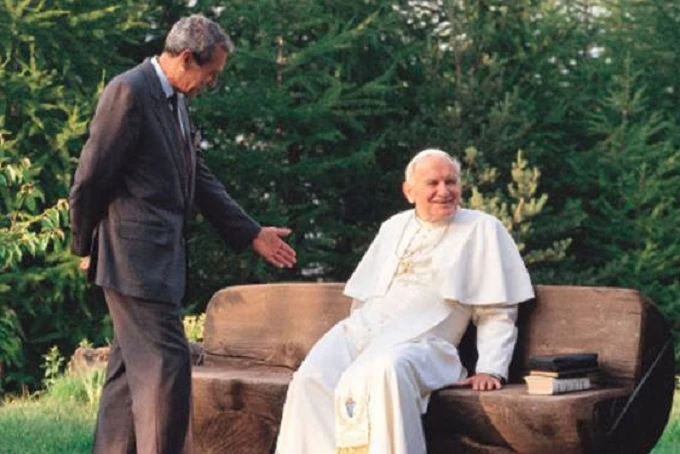
Vatican City, Jul 9, 2017 / 09:16 am (CNA/EWTN News).- During his 22 years as spokesman for St. John Paul II, Dr. Joaquin Navarro-Valls became somewhat of a legend in the Vatican – not only for his keen professional abilities and insight into the Pope's mind, but also for his genuine kindness and deep spiritual life.
In a word, most who knew the late Spanish layman, who died earlier this week, have referred to him as a “gentleman” who was elegant, professional, kind and incredibly savvy.
Fr. John Wauck, a longtime friend of Navarro-Valls, described him as “an old-school gentleman and a consummate professional – capable, discreet, committed, loyal.”
Likewise, Greg Burke, current Director of the Holy See Press Office, said after announcing news of Navarro's passing on Twitter that “Joaquin Navarro embodied what Ernest Hemingway defined as courage: grace under pressure.”
Burke said that he had met Navarro-Valls while working as a correspondent for Time Magazine the same year that the publication had named St. John Paul II “Man of the Year.”
In dealing with the Pope's spokesman, Burke said “I expected to find a man of faith, but I found a man of faith who was also a first class professional” that was already well known and respected by his peers in the communications world.
“I didn't always agree with Navarro, but he always behaved like a Christian gentlemen – and those can be hard to find these days,” Burke said.
Navarro-Valls was born in Cartagena, Spain in 1936. He studied medicine at the Universities in Granada and Barcelona, and worked as a professional psychiatrist and teaching medicine before obtaining degrees in journalism and communications.
He joined Opus Dei after meeting its founder St. Josemaria Escriva, continuing to collaborate with the founder in Rome, where he moved in 1970.
In Rome he was a correspondent for the Spanish newspaper ABC and was twice elected president of the Rome-based Foreign Press Association in Italy.
He was the first lay journalist to hold the position of Director of the Vatican Press Office, which he was appointed to by Pope St. John Paul II in 1984. He served through the Pope’s death and two years into the pontificate of Benedict XVI before retiring in 2006.
After, he served as president of the advisory board of the Opus Dei-affiliated Campus Biomedical University in Rome until his death.
In his tenure at the Vatican Press Office spanning more than two decades, Navarro-Valls helped to modernize Vatican communications, especially as technology advanced. As Burke said, “he lived through the fax to the age of the internet.”
In 1992, he used $2 million to equip the press office with up-to-date technology and to modernize the facilities. He also streamlined the distribution of materials by making archives, documents and the Pope's activities accessible online.
He died in Rome July 5 surrounded by fellow members of Opus Dei after battling terminal cancer. His funeral was held Thursday, July 6 at 11a.m. at the basilica of Sant'Eugenio, and was celebrated by the Vicar General of Opus Dei, Bishop Mariano Fazio.
Mario Biasetti, a journalist under the last five popes and a friend and colleague of Navarro-Valls, said he was a professional journalist, and it showed in everything he did.
Even when a colleague or a journalist would ask him a tough question, “it didn’t faze him,” Biasetti said. “He would tell you exactly what happened, but he would do it with a smile.”
“Joachin Navarro was a very well thought of man all-around. He had no difficulty to speak with anybody, whether officially or not officially.”
Biasetti traveled on many papal trips with John Paul II, and Navarro was always there and always by his side, he said. He was also always willing to pitch in and “always came through” for journalists with whatever they needed.
For Burke, one of the key things that stood out about Navarro-Valls is that he was someone who would work “shoulder-to-shoulder with the rest of us,” who “knew the world” and was good with languages.
Burke noted that before coming to the Vatican, Navarro worked as a correspondent, “and his colleagues from around the globe clearly recognized his merits, electing him President of the Stampa Estera in Rome.”
“I remember watching Navarro closely during the U.N. Population Conference in Cairo – one of the best examples of what Pope Francis calls ideological colonization. It was fascinating to see someone who was defending the faith, but he wasn’t on the defensive. He was leading the fight.”
Asked about what, if any, advice he had given Burke on doing the job, the spokesman said the advice he got “was more personal than professional, such as ‘don't neglect your interior life, and make sure you pray – you'll need it in this job.’”
This attention to the spiritual life is something that was also obvious to others who worked with Navarro. In Biasetti's words, the Spaniard “was a journalist, yes, but he was also a churchman.”
Fr. Wauck, a professor of the Institutional Church Communications faculty at the Pontifical University of the Holy Cross in Rome and a fellow member of Opus Dei, recalled that this spiritual dynamic was evident even in Navarro's work.
The priest said that when he thinks of Navarro, the first thing that comes to mind is “the conversion of the Time magazine reporter Wilton Wynn,” a well-known old-time reporter in the Middle East and Rome during John Paul II's pontificate.
“Naturally, it was the vibrant Christian example of the Pope that attracted Wilton to the faith, but his long friendship with Navarro-Valls played a key part as well,” Wauck said, adding that Navarro-Valls “maintained an affectionate concern for Wilton’s spiritual well-being for the rest of his life.”
Another memory the priest recalled is “a small act of kindness” that took place over the summer some 15 years ago.
Fr. Wauck said that he had mentioned, in passing, in front of Navarro, that he had broken his swimming goggles. “The next day, I found a new pair on my desk, and they were much better than the ones I’d broken.”
Fr. Federico Lombardi, Navarro-Valls' immediate successor as Director of the Holy See Press Office, also reflected on his relationship with his late predecessor, calling to mind Navarro's character and impact on Vatican communications.
Lombardi recalled meeting Navarro after coming to Rome in 1991 to take on the role as Director of Programming for Vatican Radio.
After meeting and working alongside the Spaniard, particularly when the Pope traveled abroad, it immediately became clear that he was “a stable and important component” of the papal entourage, “but also likeable, friendly and cordial,” Lombardi said.
“Naturally I already knew him for his fame as a brilliant and competent 'spokesman' for the Pope,” he said, noting that the official title for someone in Navarro's position is “Director of the Holy See Press Office.”
However, in the case of Navarro-Valls, spokesman “was an entirely appropriate name.”
Even if this wasn't the official description of his duty – which was rather "Director of the Press Office" – it must be said that in his case it was an entirely appropriate name given the close relationship he had with John Paul II.
According to Lombardi, it was Navarro himself who often stressed that it was “absolutely necessary to have – and to indeed have – a direct relationship with the Pope, in order to know his thinking and line of thought with surety and clarity, and to be able to present himself to the world, to the Press Office and to public opinion as an authoritative interpreter of that thought, and not just hearsay.”
Throughout Navarro's lengthy tenure working in the Vatican, there was absolutely “no doubt” that “he was very close to the Pope, so close that he must be considered one of the most important figures of that extraordinary pontificate.”
This, Lombardi said, is “not only because of his evident public visibility, but also for his role as intervention and advice. Certainly John Paul II had great confidence in him and held his service in high esteem.”
Burke, who is Lombardi's successor as Director of the Holy See Press Office, referred to this relationship when he announced Navarro’s passing, posting a photo of him standing next to John Paul II with a big smile.
<blockquote class="twitter-tweet" data-lang="en"><p lang="tl" dir="ltr">Joaquin Navarro, 1936-2017.<br>Keep Smiling. <a href="https://t.co/VCqL4GH5sS">pic.twitter.com/VCqL4GH5sS</a></p>— Greg Burke (@GregBurkeRome) <a href="https://twitter.com/GregBurkeRome/status/882672100091322370">July 5, 2017</a></blockquote>
<script async src="//platform.twitter.com/widgets.js" charset="utf-8"></script>
“I tweeted out a photo of Navarro-Valls and John Paul II smiling together, saying ‘Navarro, keep smiling.’ But I actually took that quote from John Paul II,” he said.
It was after a meeting between the Pope and the editors of Time Magazine, Burke explained. Navarro was standing off to the side a little, but smiling, happy with how things had gone and Pope St. John Paul II, noticing, said to him in English: “keep smiling.”
“You could tell that they had a very, very good relationship,” he said.
When it came to Navarro's professional abilities, Lombardi said that at U.N. conferences the Spaniard would end up playing a primary and even diplomatic role, thanks to his “experience and communicative ability.”
“His intelligence, elegance and relational abilities were prominent. To that is added a great knowledge of languages and a true genius in presenting news and information content in a brilliant, attractive and concise way,” Lombardi said.
These are all gifts that made Navarro “an ideal person as a point of reference in the Vatican for the international information providers, but also for relations” with people in the public, communications and political spheres.
As both a layman and a consecrated member of Opus Dei, Navarro could be counted on as a competent and respected professional, but also as someone “whose dedication and faithful love of the Church could really be counted on, for the effective availability of both time and heart.”
For Lombardi, the lengthy duration of Navarro's service as Director of the Press Office, his authoritativeness, efficiency and the quality of his work make his tenure “an age that will likely remain unique in the history of the Press Office and of Vatican communications.”
“Certainly, the dimension of communications and public relations in the immense pontificate of John Paul II cannot in any way be independent of Dr. Navarro's work and personality,” he said. “It was an invaluable service to the Church.”
Lombardi voiced his gratitude to Navarro, specifically for the “courtesy and attention” he showed during the time they worked together.
“I always considered him a teacher in the way of carrying out his service and I never would have imagined to be called to succeed him,” Lombardi said, adding that his predecessor was “totally inimitable.”
“In the context of a different pontificate I tried to interpret and carry out the task assigned to me as best as I knew how, but preserving, for what was possible, his precious legacy,” he said.
Lombardi and Navarro remained friends even after the latter stepped down. For Lombardi, his predecessor was always “an example of a discreet, true and deep spiritual life, fully integrated with his work, a model of dedication to the service of the Pope and the Church, a teacher in communications.”
“Even for me – as I already said, but I willingly repeat – he was inimitable.”
Previous Post

July 9, 2017
When times are tough, turn to Jesus, Pope says
Next Post
July 9, 2017 Holy tattoo! A 700-year old Christian tradition thrives in Jerusalem
Browse Our Archives
Select a Category Americas Asia - Pacific Europe Middle East - Africa Uncategorized US Vatican
Select a Month November 2017 October 2017 September 2017 August 2017 July 2017 June 2017 May 2017 April 2017 March 2017 February 2017 January 2017 December 2016 November 2016 October 2016 September 2016 August 2016 July 2016 June 2016 May 2016 April 2016 March 2016 February 2016 January 2016 December 2015 November 2015 October 2015 September 2015 August 2015 July 2015 June 2015 May 2015 April 2015 March 2015 February 2015 January 2015 December 2014 November 2014 October 2014 September 2014 August 2014 July 2014 June 2014 May 2014 April 2014 March 2014 February 2014 January 2014 December 2013 November 2013 October 2013 September 2013 August 2013 July 2013 June 2013 May 2013 April 2013 March 2013 February 2013 January 2013 December 2012 November 2012 October 2012 September 2012 August 2012 July 2012 June 2012 May 2012
TAKE THE
Religious Wisdom Quiz
What does James say we should be quick to do and slow to do?
Select your answer to see how you score.
Quick to forgive, slow to judge Quick to pray, slow to doubt Quick to listen, slow to speak and slow to become angry Quick to obey, slow to question
Related posts from Catholic News

How do we help trafficking victims re-enter society?...

More than just giving – World Day of...

New book reveals details of John Paul I’s...

Despite reports, Pope Francis isn’t opening the door...
TRENDING AT PATHEOS Catholic

Creation, Preservation, and Teleology in Catholic Theology
As I write this, it is very early Monday morning. Like millions...

The Parable Of The Sower And The Word...
One of Christ’s most famous parables is that of the sower who...

Rejecting Doom: Christian Hope And Human Action
Christianity is a religion of hope. We are to have hope and...

Why I Choose the Eucharist Over the Sermon
Choose the Eucharist, Not the Sermon What are we supposed to get...

5 Design Elements Found in Spiritually Rooted Homes
Putting Spirituality Into Home Decor Our homes are more than our living...

Credo: A Story of God Told with the...
About 10 years ago, I began to imagine a personal "Credo" that...
view all Catholic blogs
Ad-Free & Subscriber Log-In Subscription Support
- About Us
- 2026 Calendar
- Videos
- Podcasts
- Library of World Religions
- Faith In Media Tracker
- Advertise With Us
- Write for Us
- Privacy Policy
- Terms of Service
- Do Not Sell My Data
- Contact Us
- Radiant Digital
- Manage Newsletter Subscriptions
- Unsubscribe From Notifications
- Sitemap
Copyright 2008-2026, Patheos. All rights reserved.
Subscription Support Ad-Free & Subscriber Log-In
Follow Patheos