
BuddhistCatholicContemplativeEvangelicalGeneral ChristianHinduJewishLatter-day SaintMuslimNew VisionsProgressive Christian
Beliefs
- Buddhist
- Catholic
- Contemplative
- Evangelical
- General Christian
- Hindu
- Jewish
- Latter-day Saint
- More Voices
- Muslim
- New Visions
- Pagan
- Progressive Christian
Topics
- Religion News
- Food and Religion
- Sports and Religion
- Religious Art
- Religious Music and Entertainment
- Religious Events
- History and Religion
- Style and Religion
- Politics and Religion
- Women in Religion
- Recreation Outdoors and Religion
- Business Finance and Religion
- Careers Workplace and Religion
- Education and Religion
- Family Parenting and Religion
- Health Fitness and Religion
- Home and Religion
- Relationships and Religion
- Technology and Religion
- Travel and Religion
Columnists
- Buddhist Columnists
- Business Finance and Religion Columnists
- Careers Workplace and Religion Columnists
- Catholic Columnists
- Contemplative Columnists
- Education and Religion Columnists
- Evangelists Columnists
- Family Parenting and Religion Columnists
- General Christian Columnists
- Health Fitness and Religion Columnists
- Hindu Columnists
- History and Religion Columnists
- Home and Religion Columnists
- Jewish Columnists
- More Voices Columnists
- Latter Day Columnists
- Muslim Columnists
- New Visions Columnists
- Nonreligious Columnists
- Pagan Columnists
- Politics and Religion Columnists
- Progressive Columnists
- Recreation Outdoors and Religion Columnists
- Relationships and Religion Columnists
- Religion News Columnists
- Religious Art Columnists
- Religious Events Columnists
- Religious Music and Entertainment Columnists
- Sports and Religion Columnists
- Style and Religion Columnists
- Technology and Religion Columnists
- Travel and Religion Columnists
- Women in Religion Columnists
Resource Library
- 2026 Calendar
- Library of World Religions
- The 100 Most Holy Places on Earth
- Patheos Answers
- Podcasts
- Videos
- Faith Leaders Database
- Anglican Episcopalian
- Bahai
- Baptist
- Buddhism
- Christianity
- Confucianism
- Eastern Orthodoxy
- Hinduism
- Holiness and Pentecostal
- ISKCON
- Islam
- Judaism
- Lutheran
- Methodist
- The Church of Jesus Christ of Latter-day Saints
- New Age
- Paganism
- Presbytarian and Reformed
- Protestantism
- Religion Behind the Scenes
- Roman Catholic
- Scientology
- Shia Islam
- Sikhism
- Sufism
- Sunni Islam
- Taoism
- Zen
- See all religions
Research Tools
 Ad-Free & Subscriber Log-In Subscription Support
Ad-Free & Subscriber Log-In Subscription Support
Follow Patheos 

- Trending:
- Forgiveness
- |
- Marriage
- |
- Consciousness
- |
- Death Penalty
- |
- Election
- |
- Halloween
 Catholic News
- Home
- Catholic
- Religion News
- Bishop Barron: How to evangelize the ‘nones’
Bishop Barron: How to evangelize the ‘nones’
Last updated on: July 4, 2017 at 5:54 pm by CNA Daily News
Bishop Barron: How to evangelize the ‘nones’ 2017-07-04T17:54:00+00:00 CNA Daily News
Patheos Explore the world's faith through different perspectives on religion and spirituality! Patheos has the views of the prevalent religions and spiritualities of the world.
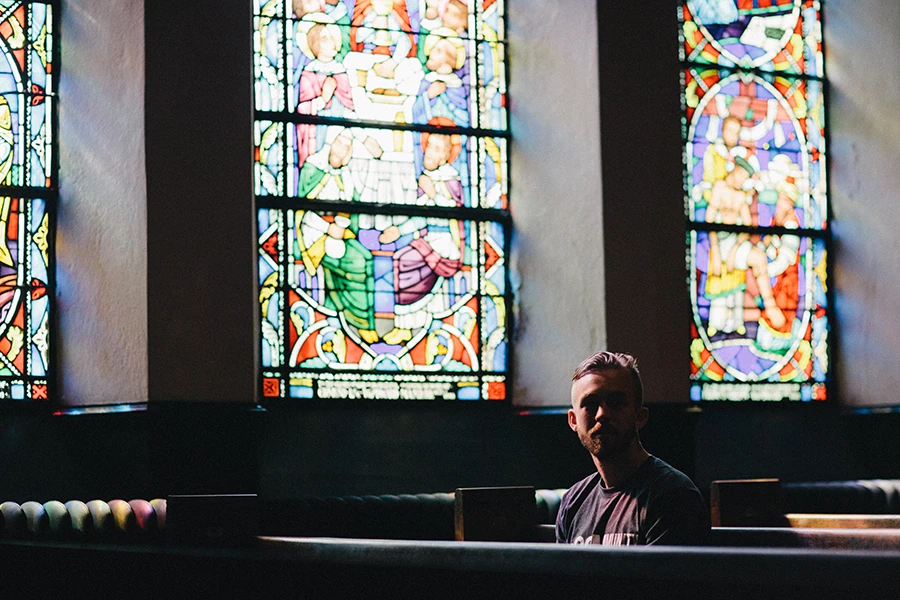
Orlando, Fla., Jul 4, 2017 / 11:54 am (CNA/EWTN News).- The way we evangelize should grab the world by the shoulders and shake it out of its apathy, Bishop Robert Baron told a crowd of Catholic leaders Tuesday.
Evangelization is especially urgent as the 'nones' – the number of the population who do not identify with a religion, continues to grow, he said.
Bishop Baron, auxiliary bishop of the Archdiocese of Los Angeles and well-known evangelizer for Word on Fire, addressed the crowd of Catholic bishops and leaders gathered at the Catholic Convocation in Orlando, Florida through a live video feed on July 4, the last day of the gathering.
“We do have a fight on our hands, but the great saints of our church have always loved a good fight, and we should too.”
In a talk entitled “Equipping Evangelizers”, the bishop with more than 15 years of evangelizing experience said that there are three main challenges and three main opportunities that Catholic evangelists face today.
1. The first challenge: Scientism
The culture’s embrace of “scientism”, or the philosophical belief that the only valuable knowledge is scientific knowledge, is one of the great challenges that evangelists face today, Bishop Barron said.
“Let me be clear: the Catholic Church has nothing against the sciences, the church stands with the sciences at their best,” he said. “What the Church opposes is scientism, or the reduction of all knowledge to the scientific form of knowledge.”
Actually, scientism as a philosophy is self-refuting, he noted.
“Scientism is not discoverable through the scientific method. Where did you empirically verify and test through experimentation that only scientific knowledge is valuable? Scientism is a philosophical position and therefore self-refuting,” he said.
But it can be challenge for evangelizers, who are speaking to the world about God.
“When we (as a culture) isolate ourselves from all references to the transcendent, we do damage to the human heart, we do damage to the human spirit,” he said.
2. The second challenge: The culture of “meh”
There’s a rampant apathy in today’s society, especially among young people, who have been formed not to embrace anything as objectively true, Bishop Barron said.
“If there is no objective truth, no objective value, what that produces is a culture of ‘meh’, or as the kids say, ‘whatever’” Bishop Barron said.
But objective truths and values form a firm foundation that sends us on mission, he said, pointing to an example used by St. John Henry Newman, who said a river gets its energy and verve from its firm foundation.
“Knock down the banks, and what’s going to happen? That river is going to open up into a big, lazy lake. Placid, with no energy, no purpose,” Bishop Barron said.
“Our society today is like a big lazy lake, all of us floating individually, tolerating each other, not getting in each other’s way, but without energy, without purpose.”
But evangelization, the declaration of the good news of Jesus, is the antithesis of this apathy, he said.
“Once you’ve been grasped by the power of God…you know where to go and you do it with energy.”
3. The third challenge: The culture of self-determination
What was once a fringe philosophical idea known as voluntarism, which stemmed from philosophers like Nietzsche and other recent existentialists, is now mainstream thought among the millennial generation in the United States, Bishop Barron said.
The core belief of this philosophy, embraced widely by young people, is that freedom defines identity, he noted.
“My freedom comes first, and then I determine essence, who I am, the meaning of my life. It’s all based on my freedom – my sexualtiy, my gender, purpose of my life is all up to me,” he explained.
But to evangelize is to say that “your life is not about you, your life is not up to you,” Bishop Barron said. “Remember the ecstatic expression of St. Paul: it is no longer I who live, but Christ who lives in mean. When you’ve been seized by the power of Jesus Christ, your little ego-drama becomes pretty unimportant,” he said.
The Bishop then presented three opportunities for evangelization based on the three transcendentals: truth, goodness and beauty.
1. The first opportunity: An intelligent truth
“I hate dumbed-down Catholicism,” Bishop Barron emphatically told the audience.
“What do I mean by that? It puts a huge stress on the superficial, the ‘banners and balloons Catholicism’ as I call it. We are a smart religion. When we don’t express Catholicism in a smart way, people fall away,” he said.
In particular, the Bishop urged catechists, apologists and evangelists to equip themselves with a good grasp on one of the great arguments for the existence of God. Young people often don’t have a robust understanding of God beyond a vague and irrelevant deity, he noted.
His favorite argument is based on contingency – that existence flows from God, and everything on the world gets its existence from him, because nothing created itself.
“The God that I’m talking about sustains the whole universe moment to moment the way a singer sustains a song. Continual creation – that’s the God the great Church talks about, that we must convey to our young people,” he said.
2. The second opportunity: The goodness of radical Christians
When the Christian life is embraced fully and radically, it’s goodness stands out to the world, Bishop Barron said.
The best example of this in the 20th century was Mother Teresa, who evangelized the world by her radical witness of goodness – caring for others indiscriminately, he said.
Throughout the history of the Church, he said, it was the “goodness and radicality of the Christian life that got the attention of the world,” through great saints like Benedict, Dominic and Francis.
“We need to recover what all these great figures found – this splendidly radical form of the Christian life. When it’s lived publicly, it evangelizes,” he said.
3. The third opportunity: Authentic beauty
Perhaps the best opportunity from which to start evangelization is with the authentic, objective beauty of the faith, Bishop Barron said.
And he’s not just talking about something subjectively satisfying like, say, deep-dish Chicago pizza, he said.
“The objectively valuable and beautiful is not like that, it’s something so intrinsically good and beautiful that it seizes us, it stops us in our tracks – something called aesthetic arrest,” he said.
It’s an easy place to start evangelizing because it’s as simple as “show, don’t tell.”
“Just show people the beauty of Catholicism – show them Cathedrals, show them the Sistine Chapel, show them Mother Teresa’s sisters at work. Don’t tell them what to think and how to behave, show the beauty of Catholicism, and that has an evangelical power,” he said.
“There’s nothing more beautiful than the dying and rising of Jesus Christ,” he said, and the apostles in the New Testament communicate this with a “grab-you-by-the-shoulders” urgency.
“These are people who have been seized by something so powerful and so overwhelming that they want to grab the world by the shoulders and tell them about it,” he said. “We need to be filled with the same ‘grab-you-by-the-shoulders’ enthusiasm” about the beauty of our faith, he added.
“Yes we face obstacles, but the saints always loved a good fight, and we should love a good fight too, because we go forth with this great truth, goodness, and beauty of Jesus Christ.”
Previous Post

July 4, 2017
Pope Francis: World hunger is a result of indifference and selfishness
Next Post
July 4, 2017 Cardinal DiNardo: To be active, we have to learn to be contemplative
Browse Our Archives
Select a Category Americas Asia - Pacific Europe Middle East - Africa Uncategorized US Vatican
Select a Month November 2017 October 2017 September 2017 August 2017 July 2017 June 2017 May 2017 April 2017 March 2017 February 2017 January 2017 December 2016 November 2016 October 2016 September 2016 August 2016 July 2016 June 2016 May 2016 April 2016 March 2016 February 2016 January 2016 December 2015 November 2015 October 2015 September 2015 August 2015 July 2015 June 2015 May 2015 April 2015 March 2015 February 2015 January 2015 December 2014 November 2014 October 2014 September 2014 August 2014 July 2014 June 2014 May 2014 April 2014 March 2014 February 2014 January 2014 December 2013 November 2013 October 2013 September 2013 August 2013 July 2013 June 2013 May 2013 April 2013 March 2013 February 2013 January 2013 December 2012 November 2012 October 2012 September 2012 August 2012 July 2012 June 2012 May 2012
TAKE THE
Religious Wisdom Quiz
What structure did people build to try to reach heaven?
Select your answer to see how you score.
Temple of Solomon Ark Altar of Baal Tower of Babel
Related posts from Catholic News

US bishops' new child protection program aims to...

Wealthy foundation aims to redefine religious freedom—and Christianity,...

Victims of Islamic State in focus at UN...

Catholic University of America offers free tuition to...
TRENDING AT PATHEOS Catholic

The Parable Of The Sower And The Word...
One of Christ’s most famous parables is that of the sower who...

Rejecting Doom: Christian Hope And Human Action
Christianity is a religion of hope. We are to have hope and...

Why I Choose the Eucharist Over the Sermon
Choose the Eucharist, Not the Sermon What are we supposed to get...

5 Design Elements Found in Spiritually Rooted Homes
Putting Spirituality Into Home Decor Our homes are more than our living...

Credo: A Story of God Told with the...
About 10 years ago, I began to imagine a personal "Credo" that...

The Anatomy of Divine Revelation in Catholic Thought
The claim that God has made Himself known to human beings is...
view all Catholic blogs
Ad-Free & Subscriber Log-In Subscription Support
- About Us
- 2026 Calendar
- Videos
- Podcasts
- Library of World Religions
- Faith In Media Tracker
- Advertise With Us
- Write for Us
- Privacy Policy
- Terms of Service
- Do Not Sell My Data
- Contact Us
- Radiant Digital
- Manage Newsletter Subscriptions
- Unsubscribe From Notifications
- Sitemap
Copyright 2008-2026, Patheos. All rights reserved.
Subscription Support Ad-Free & Subscriber Log-In
Follow Patheos