
BuddhistCatholicContemplativeEvangelicalGeneral ChristianHinduJewishLatter-day SaintMuslimNew VisionsProgressive Christian
Beliefs
- Buddhist
- Catholic
- Contemplative
- Evangelical
- General Christian
- Hindu
- Jewish
- Latter-day Saint
- More Voices
- Muslim
- New Visions
- Pagan
- Progressive Christian
Topics
- Religion News
- Food and Religion
- Sports and Religion
- Religious Art
- Religious Music and Entertainment
- Religious Events
- History and Religion
- Style and Religion
- Politics and Religion
- Women in Religion
- Recreation Outdoors and Religion
- Business Finance and Religion
- Careers Workplace and Religion
- Education and Religion
- Family Parenting and Religion
- Health Fitness and Religion
- Home and Religion
- Relationships and Religion
- Technology and Religion
- Travel and Religion
Columnists
- Buddhist Columnists
- Business Finance and Religion Columnists
- Careers Workplace and Religion Columnists
- Catholic Columnists
- Contemplative Columnists
- Education and Religion Columnists
- Evangelists Columnists
- Family Parenting and Religion Columnists
- General Christian Columnists
- Health Fitness and Religion Columnists
- Hindu Columnists
- History and Religion Columnists
- Home and Religion Columnists
- Jewish Columnists
- More Voices Columnists
- Latter Day Columnists
- Muslim Columnists
- New Visions Columnists
- Nonreligious Columnists
- Pagan Columnists
- Politics and Religion Columnists
- Progressive Columnists
- Recreation Outdoors and Religion Columnists
- Relationships and Religion Columnists
- Religion News Columnists
- Religious Art Columnists
- Religious Events Columnists
- Religious Music and Entertainment Columnists
- Sports and Religion Columnists
- Style and Religion Columnists
- Technology and Religion Columnists
- Travel and Religion Columnists
- Women in Religion Columnists
Resource Library
- 2026 Calendar
- Library of World Religions
- The 100 Most Holy Places on Earth
- Patheos Answers
- Podcasts
- Videos
- Faith Leaders Database
- Anglican Episcopalian
- Bahai
- Baptist
- Buddhism
- Christianity
- Confucianism
- Eastern Orthodoxy
- Hinduism
- Holiness and Pentecostal
- ISKCON
- Islam
- Judaism
- Lutheran
- Methodist
- The Church of Jesus Christ of Latter-day Saints
- New Age
- Paganism
- Presbytarian and Reformed
- Protestantism
- Religion Behind the Scenes
- Roman Catholic
- Scientology
- Shia Islam
- Sikhism
- Sufism
- Sunni Islam
- Taoism
- Zen
- See all religions
Research Tools
 Ad-Free & Subscriber Log-In Subscription Support
Ad-Free & Subscriber Log-In Subscription Support
Follow Patheos 

- Trending:
- Forgiveness
- |
- Marriage
- |
- Consciousness
- |
- Death Penalty
- |
- Election
- |
- Halloween
 Catholic News
- Home
- Catholic
- Religion News
- Benedict XVI: Cardinal Meisner died a ‘cheerful’ man
Benedict XVI: Cardinal Meisner died a ‘cheerful’ man
Last updated on: July 16, 2017 at 3:16 pm by CNA Daily News
Benedict XVI: Cardinal Meisner died a ‘cheerful’ man 2017-07-16T15:16:00+00:00 CNA Daily News
Patheos Explore the world's faith through different perspectives on religion and spirituality! Patheos has the views of the prevalent religions and spiritualities of the world.
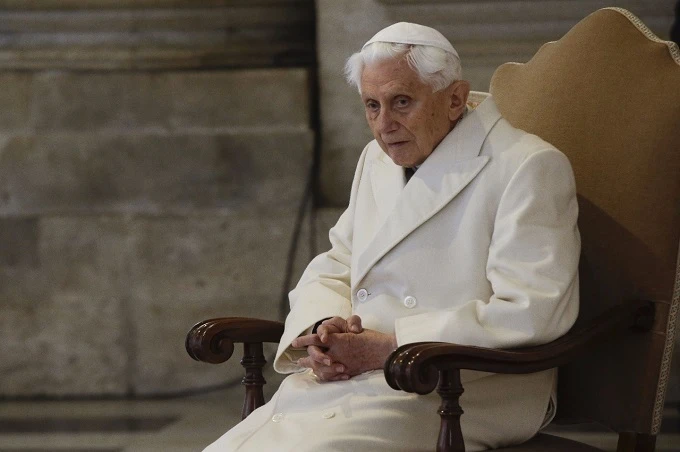
Vatican City, Jul 16, 2017 / 09:16 am (CNA/EWTN News).- In a letter sent for the funeral of the late Cardinal Joachim Meisner, retired Pope Benedict XVI praised the prelate as a passionate pastor, who died a happy man at peace with the Lord and his will for the universal Church.
“What particularly impressed me in my last conversations with the now deceased Cardinal was the serene cheerfulness, the inner joy and the confidence at which he had arrived,” Benedict said in the letter, read aloud by Archbishop Georg Ganswein at the prelate's July 15 funeral in Cologne.
Benedict, who had known Meisner personally, noted that the late prelate, a “passionate shepherd and pastor,” had found it difficult to leave his post in Cologne upon retirement, especially at a time when the Church needs persuasive priests “who resist the dictatorship of the Zeitgeist and who live and think the faith with complete determination.”
“However, what moved me all the more was that, in this last period of his life, he learned to let go and to live all the more deeply with the conviction, that the Lord does not abandon His Church, even when sometimes the boat has taken on so much water as to be on the verge of capsizing.”
Cardinal Meisner, archbishop emeritus of Cologne, died July 5 while on vacation in Bad Füssing, Germany, at the age of 83. His funeral was celebrated July 15 in the cathedral of Cologne.
Archbishop of Cologne from 1989-2014, he retired with the permission of Pope Francis in February 2014, at the age of 80, the same year his age made him ineligible to vote in a conclave.
Meisner, alongside Cardinals Carlo Caffarra, Walter Brandmüller and Raymond Leo Burke, submitted five "dubia," or doubts, about the interpretation of Amoris laetitia to Pope Francis on Sept. 19, 2016.
The letter, made public in November, asked for clarification on Chapter 8 of the document, which touches on the reception of communion for divorced and remarried couples.
In May, the four – dubbed the "dubia cardinals" – sent a letter to the Pope requesting a private audience to discuss the content of the "dubia," since they have not yet received a response.
Cardinal Meisner, considered a leading conservative Catholic figure in Germany, stood in contrast to other German prelates who have propagated one of the more liberal interpretations of Chapter 8 of the post-synodal document.
In his letter, Benedict said that when he first received the news of Cardinal Meisners death, he couldn't believe it, as they had spoken over the phone the day before.
In the conversation, Benedict recalled that Meisner was “audibly grateful” to be on vacation, and to have participated in the beatification ceremony of Bishop Teofilius Matulionis – a Lithuanian priest who was consecrated a bishop in secret during Soviet persecution, and who spent the majority of his episcopate in prison before being poisoned by the USSR – the day before.
For Benedict, Meisner's whole life “was ingrained both with a love for the churches of the neighboring countries to the East, who had suffered under Communist persecution, as well as an appreciation for their holding fast amidst the suffering of those times.”
“Thus it is probably no coincidence that the final visit of his life was dedicated to a Confessor of the Faith from those lands.”
In addition to the beatification and the state of peace he had attained before his death, Benedict said there were two specific reasons the cardinal was so cheerful in his final years.
For one, “he repeatedly told me how it profoundly delighted him to see young people, especially young men, experience the grace of forgiveness in the Sacrament of Confession – the gift of having truly found that life which only God can give them,” Benedict said.
The second thing he cited for putting the cardinal in “a joyful mood” was the “quiet growth of Eucharistic Adoration.”
Benedict recalled how at World Youth Day in Cologne in 2005, Meisner was adament that there be adoration, and a space for “ a silence in which only the Lord speaks to the hearts.”
While some of those in the field of pastoral and liturgical work thought it would be impossible or even “obsolete” to accomplish with such a large group of people, arguing that the Lord desires to be received and not looked at, what happened proved them wrong.
It became abundantly clear, Benedict said, “that you can not eat this bread like it were just some food, and that 'receiving' the Lord in the Eucharistic Sacrament makes demands upon every dimension of our existence – that to receive necessarily also means to adore.”
This became “an interior event, one that remained, not only for the Cardinal, unforgettable. This moment remained ever present, like a great light, within him.”
Benedict concluded his letter noting how on the morning he died, Cardinal Meisner was found in his room with his breviary on his lap.
“He had died whilst in prayer, his gaze fixed on the Lord, in conversation with the Lord,” Benedict said, adding that “the manner of death which was granted to him yet again shows how he lived: gaze fixed to the Lord and conversing with the Lord.”
Previous Post

July 16, 2017
As US hits refugee cap, bishops ask Trump administration to do more
Next Post
July 16, 2017 In new school, Byzantine spirituality meets Montessori method
Browse Our Archives
Select a Category Americas Asia - Pacific Europe Middle East - Africa Uncategorized US Vatican
Select a Month November 2017 October 2017 September 2017 August 2017 July 2017 June 2017 May 2017 April 2017 March 2017 February 2017 January 2017 December 2016 November 2016 October 2016 September 2016 August 2016 July 2016 June 2016 May 2016 April 2016 March 2016 February 2016 January 2016 December 2015 November 2015 October 2015 September 2015 August 2015 July 2015 June 2015 May 2015 April 2015 March 2015 February 2015 January 2015 December 2014 November 2014 October 2014 September 2014 August 2014 July 2014 June 2014 May 2014 April 2014 March 2014 February 2014 January 2014 December 2013 November 2013 October 2013 September 2013 August 2013 July 2013 June 2013 May 2013 April 2013 March 2013 February 2013 January 2013 December 2012 November 2012 October 2012 September 2012 August 2012 July 2012 June 2012 May 2012
TAKE THE
Religious Wisdom Quiz
I used a tent peg and hammer to kill a fleeing enemy commander while he slept. Who am I?
Select your answer to see how you score.
Delilah Deborah Ruth Jael
Related posts from Catholic News

How do we help trafficking victims re-enter society?...

More than just giving – World Day of...

New book reveals details of John Paul I’s...

Despite reports, Pope Francis isn’t opening the door...
TRENDING AT PATHEOS Catholic

The Parable Of The Sower And The Word...
One of Christ’s most famous parables is that of the sower who...

Rejecting Doom: Christian Hope And Human Action
Christianity is a religion of hope. We are to have hope and...

Why I Choose the Eucharist Over the Sermon
Choose the Eucharist, Not the Sermon What are we supposed to get...

5 Design Elements Found in Spiritually Rooted Homes
Putting Spirituality Into Home Decor Our homes are more than our living...

Credo: A Story of God Told with the...
About 10 years ago, I began to imagine a personal "Credo" that...

The Anatomy of Divine Revelation in Catholic Thought
The claim that God has made Himself known to human beings is...
view all Catholic blogs
Ad-Free & Subscriber Log-In Subscription Support
- About Us
- 2026 Calendar
- Videos
- Podcasts
- Library of World Religions
- Faith In Media Tracker
- Advertise With Us
- Write for Us
- Privacy Policy
- Terms of Service
- Do Not Sell My Data
- Contact Us
- Radiant Digital
- Manage Newsletter Subscriptions
- Unsubscribe From Notifications
- Sitemap
Copyright 2008-2026, Patheos. All rights reserved.
Subscription Support Ad-Free & Subscriber Log-In
Follow Patheos