
BuddhistCatholicContemplativeEvangelicalGeneral ChristianHinduJewishLatter-day SaintMuslimNew VisionsProgressive Christian
Beliefs
- Buddhist
- Catholic
- Contemplative
- Evangelical
- General Christian
- Hindu
- Jewish
- Latter-day Saint
- More Voices
- Muslim
- New Visions
- Pagan
- Progressive Christian
Topics
- Religion News
- Food and Religion
- Sports and Religion
- Religious Art
- Religious Music and Entertainment
- Religious Events
- History and Religion
- Style and Religion
- Politics and Religion
- Women in Religion
- Recreation Outdoors and Religion
- Business Finance and Religion
- Careers Workplace and Religion
- Education and Religion
- Family Parenting and Religion
- Health Fitness and Religion
- Home and Religion
- Relationships and Religion
- Technology and Religion
- Travel and Religion
Columnists
- Buddhist Columnists
- Business Finance and Religion Columnists
- Careers Workplace and Religion Columnists
- Catholic Columnists
- Contemplative Columnists
- Education and Religion Columnists
- Evangelists Columnists
- Family Parenting and Religion Columnists
- General Christian Columnists
- Health Fitness and Religion Columnists
- Hindu Columnists
- History and Religion Columnists
- Home and Religion Columnists
- Jewish Columnists
- More Voices Columnists
- Latter Day Columnists
- Muslim Columnists
- New Visions Columnists
- Nonreligious Columnists
- Pagan Columnists
- Politics and Religion Columnists
- Progressive Columnists
- Recreation Outdoors and Religion Columnists
- Relationships and Religion Columnists
- Religion News Columnists
- Religious Art Columnists
- Religious Events Columnists
- Religious Music and Entertainment Columnists
- Sports and Religion Columnists
- Style and Religion Columnists
- Technology and Religion Columnists
- Travel and Religion Columnists
- Women in Religion Columnists
Resource Library
- 2026 Calendar
- Library of World Religions
- The 100 Most Holy Places on Earth
- Patheos Answers
- Podcasts
- Videos
- Faith Leaders Database
- Anglican Episcopalian
- Bahai
- Baptist
- Buddhism
- Christianity
- Confucianism
- Eastern Orthodoxy
- Hinduism
- Holiness and Pentecostal
- ISKCON
- Islam
- Judaism
- Lutheran
- Methodist
- The Church of Jesus Christ of Latter-day Saints
- New Age
- Paganism
- Presbytarian and Reformed
- Protestantism
- Religion Behind the Scenes
- Roman Catholic
- Scientology
- Shia Islam
- Sikhism
- Sufism
- Sunni Islam
- Taoism
- Zen
- See all religions
Research Tools
 Ad-Free & Subscriber Log-In Subscription Support
Ad-Free & Subscriber Log-In Subscription Support
Follow Patheos 

- Trending:
- Forgiveness
- |
- Marriage
- |
- Consciousness
- |
- Death Penalty
- |
- Election
- |
- Halloween
 Catholic News
- Home
- Catholic
- Religion News
- To understand Pope Francis, you have to understand the Jesuits
To understand Pope Francis, you have to understand the Jesuits
Last updated on: June 25, 2017 at 10:00 pm by CNA Daily News
To understand Pope Francis, you have to understand the Jesuits 2017-06-25T22:00:00+00:00 CNA Daily News
Patheos Explore the world's faith through different perspectives on religion and spirituality! Patheos has the views of the prevalent religions and spiritualities of the world.
Rome, Italy, Jun 25, 2017 / 04:00 pm (CNA/EWTN News).- Discernment is one of the words Pope Francis repeats most, especially when speaking to priests and seminarians.
He often expresses his desire for greater formation in discernment – a concept that may seem obscure without an understanding its importance to the Pope's Jesuit formation.
“When a Jesuit says 'discernment,' they’re employing a term that has a very rich spiritual tradition within the Society of Jesus, so you can presume a lot in that,” Fr. Brian Reedy, SJ, told CNA in an interview.
Fr. Reedy is a US Navy Reserve chaplain and is pursuing a doctorate in philosophical theology from the Pontifical Gregorian University. He holds a licentiate in theology from Boston College.
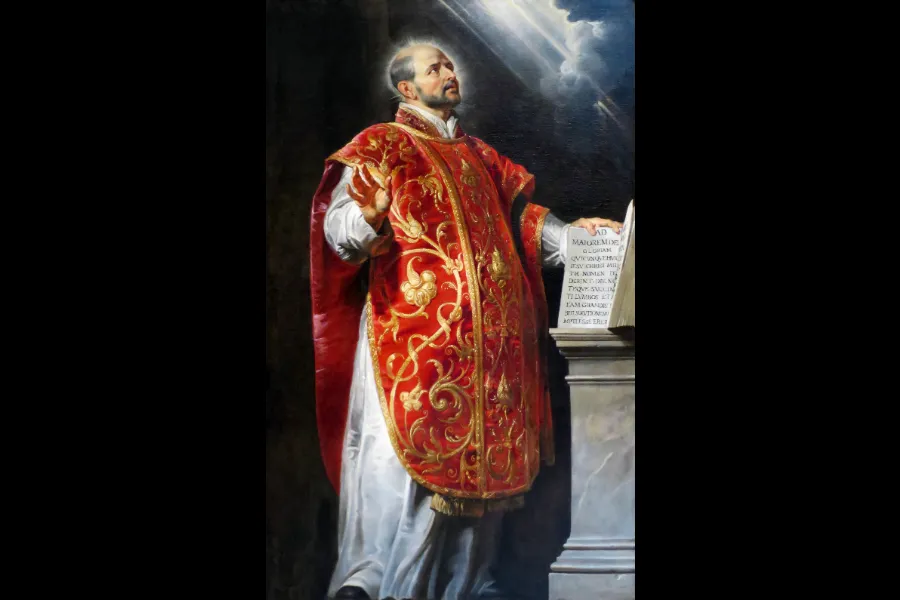
He explained that discernment is something St. Ignatius of Loyola, founder of the Society of Jesus, emphasized profoundly in his Spiritual Exercises, which form the “backbone” of Jesuit spirituality.
In fact, St. Ignatius twice in the spiritual exercises has an extended discourse on how to carry out discernment properly: what it means, what its limitations are, and the rules that govern it.
“One of the things that’s very interesting about discernment is that while it does have a very polyvalent meaning, you can usually presume that when a Jesuit uses the term, when they launch it, it has these rules at least playing the background in their mind,” Reedy said.
So when it comes to Jesuits and discernment, what are the governing rules, and how can we use them to understand Pope Francis?
Rules of Ignatian discernment
One of the first things to keep in mind when it comes to discernment is St. Ignatius' distinction between categories of people, Fr. Reedy said, explaining there are different rules for people take the faith seriously, and those who do not.
“If you are somebody who is living a life where God is not really on the scene and the teachings of the Church aren’t really important you have one set of rules. But the reverse situation for somebody who does take their faith life very seriously and God is at least sought after … then we have a completely different set of rules,” he said.
Another distinction, he said, is between proper and improper objects of discernment, meaning that “some things you can discern and other things you can’t.”
When it comes to the current discussion on marriage, Fr. Reedy noted that in his spiritual exercises, St. Ignatius himself speaks specifically about discerning marriage after you have contracted marriage “as an example of one of the things you can’t legitimately discern.”
This, he said, is because “after you are married, you can no longer legitimately discern being married or not, because you’ve made the decision; it’s not a proper object.”
What can be discerned, by a tribunal, is whether or not the marriage is valid.
“That’s a different question than discerning whether you want to be in a marriage still,” Fr. Reedy said. “For Ignatius that question doesn’t make any sense; in fact, it’s offensive to the process that you would discern changing a state of life that you have already committed yourself to.”
The same thing goes for priesthood and the religious life, he said, explaining that St. Ignatius uses that example because “once you’ve made that commitment, what you discern is how to live the commitment.”
“That’s what you would actually be discerning, because discernment is, fundamentally in Jesuit spirituality, the application of doctrine and teaching to the practical applications in somebody’s life. So it’s making practical that which is theoretical.”
There are then certain “guiding rules” that help in the carrying out of proper discernment.
One of St. Ignatius' rules Fr. Reedy cited is that sin can never be discerned, using the example of committing murder.
“You can’t discern to murder,” he said. “In fact, it’s offensive to the process that you are pretending to discern choosing an absolute evil.”
What can be legitimately discerned is whether or not to kill, because “if you and your family were under immediate threat from somebody, then the father could in the moment discern whether it was possible for him to take lethal action. That’s permitted.”
In terms of Catholic moral theology, Fr. Reedy said it exists between the camp of what is “permitted” and what is “transformative,” and that beyond the permitted sign lies what is “forbidden.”
Things that are forbidden cannot be discerned, and “you only ask to be free from them,” he said. From there, the spectrum goes from what is simply permissible on one side, all the way to what is deeply transformative and engages the world like Christ on the other.
“In that realm, between what is permitted to what is transformative, there’s a lot of discernment of legitimate possibilities of things that are not against reason or against God or the Church,” he said, adding that one can never really discern between good and evil, but “only between relative goods.”
One key rule of discernment that is often forgotten is the guiding principle of “thinking with the Church,” Fr. Reedy said. This means that “whatever you discern, you’re not only thinking about the moral law and how that functions, but also specifically thinking with the Church.”
Francis is a man 'steeped' in Jesuit tradition
Pope Francis “is completely steeped in Jesuit tradition and is a man completely of the exercises,” Fr. Reedy said, explaining that one of the first things he tells people when he speaks about the Pope is that “you can hear the spiritual exercises active in what he says.”
In listening to Pope Francis “you can hear a Jesuit who has contemplated the life of Jesus,” the priest said, noting that Francis' pedagogical or didactic style “is very much patterned on Jesus’, who often gave very oblique and obscure answers to questions.”
Christ did this, he said, “to specifically avoid a kind of legalism that just wants a solid answer that can then be manipulated in some way,” whereas true discernment means “you’re not interested in rules for the sake of rules, (or) tools that can be manipulated or used as weapons; what you’re interested in is finding the best, the truest, the most holy, the most transformative.”
In essence, “you’re always looking for what is the spirit of the law: why does the law exist, what it is, what is it trying to do?”
What can be done is to “have people trained in what the rules are, why they exist, and how to help these people engage that system in a way that can contribute toward their holiness, to their growth in conforming to Christ.”
Fr. Reedy said that for him, one problem he sees in the Church right now is that some people, in their interpretation of the Pope's actions, are “trying to put on the table, calling under the umbrella of discernment, the actual consideration of sins, of evils.”
“I’ve never gotten the sense that that is what Francis is saying,” he reflected, explaining that in his view, given Francis' background, what he is is trying to do is to “train people in this: in the proper camp of moral reasoning, which extends from permitted all the way to transformative, how to help people function there in a way that can be messy, but also prevent them from crossing the line into what is forbidden.”
But what about Francis' ambiguity? Is that a Jesuit thing?
Part of the confusion surrounding Pope Francis' sayings and writings is that his language can frequently be ambiguous and imprecise, leaving people scratching their heads trying to figure out what he actually meant.
But for Fr. Reedy, this isn't a Jesuit quality so much as it is a personal limitation of the Vicar of Christ.
“Francis is a complicated character. He’s not a precise theologian, so I think some of the ambiguity and imprecision just comes from his own training and background, which the Church just has to be patient with,” he said.
Secondly, the priest said that if we reflect on scripture, we see that the Pope uses a style that is very similar to what Christ himself often used, especially when he senses a “Pharisaical attitude.”
“When he senses that somebody’s asking a question in order to pin something down in a way he fears is going to hurt somebody else” Francis gets obscure, he said, explaining that the Pope is “very sensitive” to having doctrine “turned into a weapon of sorts.”
And so was Christ, he said, noting that “Jesus had very harsh words for those people.” Even though the Pharisees were technically faithful, upstanding Jews, “they also had a problem in the way that the viewed law; they saw the law first and the needs of the people second, and Jesus challenged that and so is Pope Francis.”
“I think people should stop pretending that Jesus was crystal-clear when he said things all the time,” Fr. Reedy said, noted that Christ “specifically said at times that he was intentionally being confusing. He would say that he was using parables so those other people over there wouldn’t understand – he would say that.”
However, even though Christ could at times speak cryptically, he was clear when pressed on important topics, such as the Eucharist and the meaning behind his words “this is my body,” and that to enter eternal life his disciples must “eat my flesh and drink my blood.”
So when it comes to Pope Francis, Fr. Reedy said people have to take into account “the Jesus-like way he teaches,” which he said is often at play in the Pope's speeches.
But there is also an element of manipulation when it comes to the Pope's ambiguity which must be addressed.
“I think (the Pope's) ambiguity is being manipulated,” Fr. Reedy said, explaining that in these cases, “I think we need to continue to push for greater clarity.”
This doesn't mean we'll get the clarity immediately, he said, but when it comes to particularly problematic issues “we need clarity. We need a line to be drawn saying we’re not talking about Catholic divorce.”
This isn't referring to somebody “who was in a valid marriage just rupturing that marriage, pretending it’s dissolvable against the explicit words of Jesus, and just starting a new one and saying that’s okay.”
“We’re not talking about that … I don’t think we are, I don’t think the Pope is,” he said, because if we look to the rules of discernment of St. Ignatius of Loyola, “I don’t think we can legitimately discern that.”
“So I’m confident that that’s not what the Pope is saying and I think that we should continue to ask for clarity, but not rush to clarity so that we can feel good about ourselves.”
What is needed, he said, is “to defend the truth so that we can become good.”
Previous Post

June 25, 2017
Christ doesn’t promise freedom from difficulties, Pope says
Next Post
June 26, 2017 Chinese bishop forcibly removed from diocese still missing
Browse Our Archives
Select a Category Americas Asia - Pacific Europe Middle East - Africa Uncategorized US Vatican
Select a Month November 2017 October 2017 September 2017 August 2017 July 2017 June 2017 May 2017 April 2017 March 2017 February 2017 January 2017 December 2016 November 2016 October 2016 September 2016 August 2016 July 2016 June 2016 May 2016 April 2016 March 2016 February 2016 January 2016 December 2015 November 2015 October 2015 September 2015 August 2015 July 2015 June 2015 May 2015 April 2015 March 2015 February 2015 January 2015 December 2014 November 2014 October 2014 September 2014 August 2014 July 2014 June 2014 May 2014 April 2014 March 2014 February 2014 January 2014 December 2013 November 2013 October 2013 September 2013 August 2013 July 2013 June 2013 May 2013 April 2013 March 2013 February 2013 January 2013 December 2012 November 2012 October 2012 September 2012 August 2012 July 2012 June 2012 May 2012
TAKE THE
Religious Wisdom Quiz
Who had Samson's hair cut?
Select your answer to see how you score.
Micah Delilah Medad Jezebel
Related posts from Catholic News

Sixty Vincentians martyred during Spanish Civil War to...

Filipinos gather in Rome to promote bishop's beatification...

UK bishop calls for prayers as MPs urge...

On All Souls' Day, Pope Francis prays for...
TRENDING AT PATHEOS Catholic

Rejecting Doom: Christian Hope And Human Action
Christianity is a religion of hope. We are to have hope and...

It’s What Comes From Within Which Matters
One of the most difficult things for us to understand is why...

Why I Choose the Eucharist Over the Sermon
Choose the Eucharist, Not the Sermon What are we supposed to get...

5 Design Elements Found in Spiritually Rooted Homes
Putting Spirituality Into Home Decor Our homes are more than our living...

Credo: A Story of God Told with the...
About 10 years ago, I began to imagine a personal "Credo" that...

The Anatomy of Divine Revelation in Catholic Thought
The claim that God has made Himself known to human beings is...
view all Catholic blogs
Ad-Free & Subscriber Log-In Subscription Support
- About Us
- 2026 Calendar
- Videos
- Podcasts
- Library of World Religions
- Faith In Media Tracker
- Advertise With Us
- Write for Us
- Privacy Policy
- Terms of Service
- Do Not Sell My Data
- Contact Us
- Radiant Digital
- Manage Newsletter Subscriptions
- Unsubscribe From Notifications
- Sitemap
Copyright 2008-2026, Patheos. All rights reserved.
Subscription Support Ad-Free & Subscriber Log-In
Follow Patheos