
BuddhistCatholicContemplativeEvangelicalGeneral ChristianHinduJewishLatter-day SaintMuslimNew VisionsProgressive Christian
Beliefs
- Buddhist
- Catholic
- Contemplative
- Evangelical
- General Christian
- Hindu
- Jewish
- Latter-day Saint
- More Voices
- Muslim
- New Visions
- Pagan
- Progressive Christian
Topics
- Religion News
- Food and Religion
- Sports and Religion
- Religious Art
- Religious Music and Entertainment
- Religious Events
- History and Religion
- Style and Religion
- Politics and Religion
- Women in Religion
- Recreation Outdoors and Religion
- Business Finance and Religion
- Careers Workplace and Religion
- Education and Religion
- Family Parenting and Religion
- Health Fitness and Religion
- Home and Religion
- Relationships and Religion
- Technology and Religion
- Travel and Religion
Columnists
- Buddhist Columnists
- Business Finance and Religion Columnists
- Careers Workplace and Religion Columnists
- Catholic Columnists
- Contemplative Columnists
- Education and Religion Columnists
- Evangelists Columnists
- Family Parenting and Religion Columnists
- General Christian Columnists
- Health Fitness and Religion Columnists
- Hindu Columnists
- History and Religion Columnists
- Home and Religion Columnists
- Jewish Columnists
- More Voices Columnists
- Latter Day Columnists
- Muslim Columnists
- New Visions Columnists
- Nonreligious Columnists
- Pagan Columnists
- Politics and Religion Columnists
- Progressive Columnists
- Recreation Outdoors and Religion Columnists
- Relationships and Religion Columnists
- Religion News Columnists
- Religious Art Columnists
- Religious Events Columnists
- Religious Music and Entertainment Columnists
- Sports and Religion Columnists
- Style and Religion Columnists
- Technology and Religion Columnists
- Travel and Religion Columnists
- Women in Religion Columnists
Resource Library
- 2026 Calendar
- Library of World Religions
- The 100 Most Holy Places on Earth
- Patheos Answers
- Podcasts
- Videos
- Faith Leaders Database
- Anglican Episcopalian
- Bahai
- Baptist
- Buddhism
- Christianity
- Confucianism
- Eastern Orthodoxy
- Hinduism
- Holiness and Pentecostal
- ISKCON
- Islam
- Judaism
- Lutheran
- Methodist
- The Church of Jesus Christ of Latter-day Saints
- New Age
- Paganism
- Presbytarian and Reformed
- Protestantism
- Religion Behind the Scenes
- Roman Catholic
- Scientology
- Shia Islam
- Sikhism
- Sufism
- Sunni Islam
- Taoism
- Zen
- See all religions
Research Tools
 Ad-Free & Subscriber Log-In Subscription Support
Ad-Free & Subscriber Log-In Subscription Support
Follow Patheos 

- Trending:
- Forgiveness
- |
- Marriage
- |
- Consciousness
- |
- Death Penalty
- |
- Election
- |
- Halloween
 Catholic News
- Home
- Catholic
- Religion News
- Supreme Court rules in favor of church in crucial First Amendment case
Supreme Court rules in favor of church in crucial First Amendment case
Last updated on: June 26, 2017 at 5:32 pm by CNA Daily News
Supreme Court rules in favor of church in crucial First Amendment case 2017-06-26T17:32:00+00:00 CNA Daily News
Patheos Explore the world's faith through different perspectives on religion and spirituality! Patheos has the views of the prevalent religions and spiritualities of the world.
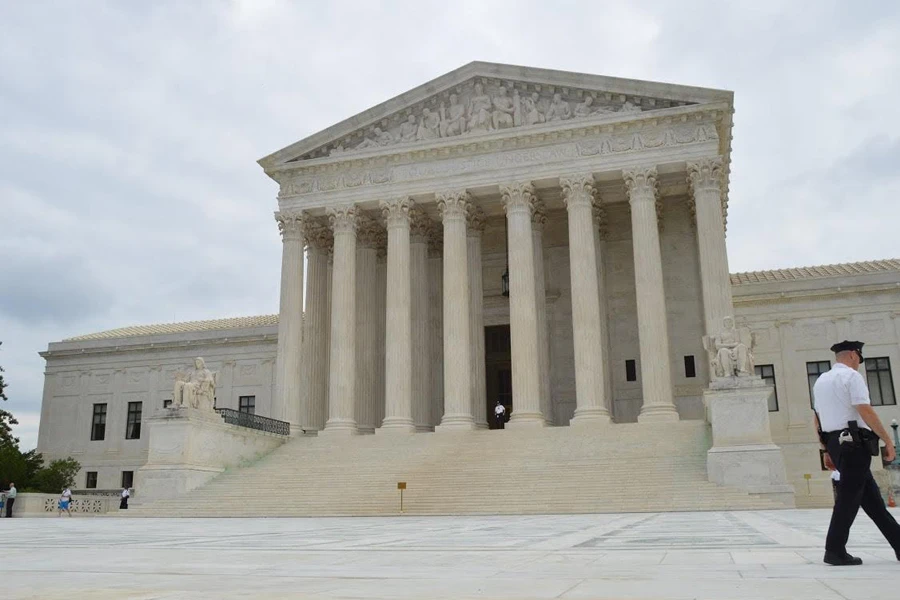
Washington D.C., Jun 26, 2017 / 11:32 am (CNA/EWTN News).- In one of the biggest religious cases of the term, the US Supreme Court on Monday ruled that a church-owned playground can be eligible for a public benefit program.
Chief Justice John Roberts, delivering the opinion of the Court, wrote June 26 that “the exclusion of Trinity Lutheran,” the church at the center of the case, “from a public benefit for which it is otherwise qualified, solely because it is a church, is odious to our Constitution all the same, and cannot stand.”
The decision in Trinity Lutheran Church of Columbia, Inc. v. Comer was about “religious people being treated just like everybody else,” stated Mike Farris, president of Alliance Defending Freedom.
At issue was a playground owned by Trinity Lutheran Church in Columbia, Mo., and operated by the church’s preschool. To resurface the playground for safety reasons, the church had applied for a state reimbursement program that provides rubber surfacing material made from used tires. Trinity Lutheran had ranked the fifth most qualified out of 44 applicants for the program.
The state’s natural resources department ultimately ruled the church ineligible for the program because of its religious status. The Missouri state constitution forbids taxpayer funding of churches. The Eighth U.S. Circuit Court of Appeals sided with the state.
The Supreme Court reversed that ruling and sent it back to the lower courts.
Justices Anthony Kennedy, Samuel Alito, and Elena Kagan joined Chief Justice Roberts’ opinion of the Court that the denial of the church’s eligibility for the program violated the free exercise clause. Justice Stephen Breyer filed an opinion concurring in Chief Justice Roberts' judgement.
Justices Clarence Thomas and Neil Gorsuch joined the Court’s opinion except for a footnote stating that the decision was about “discrimination based on religious identity with respect to playground resurfacing,” and does not “address religious uses of funding or other forms of discrimination.”
“I worry that some might mistakenly read” the footnote to apply only to “‘playground resurfacing’ cases, or only those with some association with children’s safety or health, or perhaps some other social good we find sufficiently worthy,” Gorsuch wrote.
He added that “the general principles here do not permit discrimination against religious exercise—whether on the playground or anywhere else.”
Justices Sonia Sotomayor and Ruth Bader Ginsburg dissented from the Court’s opinion.
The Church had argued that the new surface would be a safety upgrade for the playground operated by its preschool and used by members of the community during non-school hours.
It was used by both church members and non-members, they insisted, and should not be ruled ineligible for a state benefit program available to other entities just because it is owned by a religious institution.
Opposing the church was the ACLU, which had argued that to make the church eligible for state benefits would be an unconstitutional violation of the establishment clause.
Missouri’s denial of the church, however, “goes too far” under precedents of Supreme Court decisions, Chief Justice Roberts wrote, and “violates the Free Exercise Clause.”
The Missouri law was passed during a time when many other states were passing laws barring public funding of sectarian schools, widely viewed at the time to mean Catholic schools and other religious schools that were not part of the public school system. The laws were modeled after the federal Blaine Amendment, proposed in the 1870s and named after Maine Congressman James Blaine. His amendment was proposed, but never passed by Congress.
In oral arguments in the case, justices also discussed the broader constitutionality of religious groups having access to other public benefits, including a Jewish synagogue requesting a security detail.
Catholic leaders applauded Monday’s ruling.
“The Supreme Court is signaling in this decision that the government must stop its growing hostility towards religion and religious institutions, and that antiquated and anti-Catholic Blaine Amendments should not be used as a weapon to discriminate against people of faith,” Maureen Ferguson, senior policy advisor with The Catholic Association, stated.
“For over a century, Blaine Amendments have enshrined into law discrimination against faith-based charities and schools that form an essential part of American society,” Ashley McGuire, senior fellow with The Catholic Association, stated. “In this case, a state Blaine Amendment was used to justify blacklisting a Christian elementary school from a playground safety program solely on religious grounds.”
“Blaine Amendments are anti-Catholic in their origin, and getting rid of them is more than a century overdue,” she added. “Today’s decision demands a more fair and inclusive approach to government programs meant to serve all people."
The decision “will have an effect” in the future, David Cortman, senior counsel with Alliance Defending Freedom, who argued the case for the church before the Court in April, said. “Whenever religious people, organizations, see themselves being discriminated against, this case will be the controlling precedent,” he added.
Members of Congress also weighed in on the decision. House Speaker Paul Ryan (R-Wisc.) called it “an important ruling for religious liberty with profound significance for America’s civil society.”
Sen. James Lankford (R-Okla.), co-chair of the Congressional Prayer Caucus and who filed an amicus brief with colleagues on behalf of Trinity Lutheran in the case, stated that “today’s decision affirms the First Amendment right to the free exercise of religion—to have more than just a belief but to live out your faith without discrimination from the government.”
The case was ultimately between the church and the state’s natural resources department. Missouri’s attorney general recused himself in the case.
Missouri’s governor Eric Greitens (R) had already announced that in the future, religious institutions could be eligible for benefit programs of the natural resources department. However, the Court stated on Monday that “that announcement does not moot this case.”
Justice Sonia Sotomayor, in her dissent, stated that “this case is about nothing less” than the relationship “between church and state.”
“The Court today profoundly changes that relationship by holding, for the first time, that the Constitution requires the government to provide public funds directly to a church,” she added. “Its decision slights both our precedents and our history, and its reasoning weakens this country’s longstanding commitment to a separation of church and state beneficial to both.”
In the majority opinion, Chief Justice Roberts acknowledged that “it is true the Department has not criminalized the way Trinity Lutheran worships or told the Church that it cannot subscribe to a certain view of the Gospel.”
“But, as the Department itself acknowledges, the Free Exercise Clause protects against ‘indirect coercion or penalties on the free exercise of religion, not just outright prohibitions.’” And a church being denied participation in public benefits because of its religious character can be such an “indirect coercion” on the free exercise of religion, he continued.
“In this case, there is no dispute that Trinity Lutheran is put to the choice between being a church and receiving a government benefit. The rule is simple: No churches need apply.”
Previous Post

June 26, 2017
Chinese bishop forcibly removed from diocese still missing
Browse Our Archives
Select a Category Americas Asia - Pacific Europe Middle East - Africa Uncategorized US Vatican
Select a Month November 2017 October 2017 September 2017 August 2017 July 2017 June 2017 May 2017 April 2017 March 2017 February 2017 January 2017 December 2016 November 2016 October 2016 September 2016 August 2016 July 2016 June 2016 May 2016 April 2016 March 2016 February 2016 January 2016 December 2015 November 2015 October 2015 September 2015 August 2015 July 2015 June 2015 May 2015 April 2015 March 2015 February 2015 January 2015 December 2014 November 2014 October 2014 September 2014 August 2014 July 2014 June 2014 May 2014 April 2014 March 2014 February 2014 January 2014 December 2013 November 2013 October 2013 September 2013 August 2013 July 2013 June 2013 May 2013 April 2013 March 2013 February 2013 January 2013 December 2012 November 2012 October 2012 September 2012 August 2012 July 2012 June 2012 May 2012
TAKE THE
Religious Wisdom Quiz
Who is known for teaching that "faith without works is dead"?
Select your answer to see how you score.
James Paul Peter Jude
Related posts from Catholic News

US bishops' new child protection program aims to...

Wealthy foundation aims to redefine religious freedom—and Christianity,...

Victims of Islamic State in focus at UN...

Catholic University of America offers free tuition to...
TRENDING AT PATHEOS Catholic

Creation, Preservation, and Teleology in Catholic Theology
As I write this, it is very early Monday morning. Like millions...

The Parable Of The Sower And The Word...
One of Christ’s most famous parables is that of the sower who...

Rejecting Doom: Christian Hope And Human Action
Christianity is a religion of hope. We are to have hope and...

Why I Choose the Eucharist Over the Sermon
Choose the Eucharist, Not the Sermon What are we supposed to get...

5 Design Elements Found in Spiritually Rooted Homes
Putting Spirituality Into Home Decor Our homes are more than our living...

Credo: A Story of God Told with the...
About 10 years ago, I began to imagine a personal "Credo" that...
view all Catholic blogs
Ad-Free & Subscriber Log-In Subscription Support
- About Us
- 2026 Calendar
- Videos
- Podcasts
- Library of World Religions
- Faith In Media Tracker
- Advertise With Us
- Write for Us
- Privacy Policy
- Terms of Service
- Do Not Sell My Data
- Contact Us
- Radiant Digital
- Manage Newsletter Subscriptions
- Unsubscribe From Notifications
- Sitemap
Copyright 2008-2026, Patheos. All rights reserved.
Subscription Support Ad-Free & Subscriber Log-In
Follow Patheos