
BuddhistCatholicContemplativeEvangelicalGeneral ChristianHinduJewishLatter-day SaintMuslimNew VisionsProgressive Christian
Beliefs
- Buddhist
- Catholic
- Contemplative
- Evangelical
- General Christian
- Hindu
- Jewish
- Latter-day Saint
- More Voices
- Muslim
- New Visions
- Pagan
- Progressive Christian
Topics
- Religion News
- Food and Religion
- Sports and Religion
- Religious Art
- Religious Music and Entertainment
- Religious Events
- History and Religion
- Style and Religion
- Politics and Religion
- Women in Religion
- Recreation Outdoors and Religion
- Business Finance and Religion
- Careers Workplace and Religion
- Education and Religion
- Family Parenting and Religion
- Health Fitness and Religion
- Home and Religion
- Relationships and Religion
- Technology and Religion
- Travel and Religion
Columnists
- Buddhist Columnists
- Business Finance and Religion Columnists
- Careers Workplace and Religion Columnists
- Catholic Columnists
- Contemplative Columnists
- Education and Religion Columnists
- Evangelists Columnists
- Family Parenting and Religion Columnists
- General Christian Columnists
- Health Fitness and Religion Columnists
- Hindu Columnists
- History and Religion Columnists
- Home and Religion Columnists
- Jewish Columnists
- More Voices Columnists
- Latter Day Columnists
- Muslim Columnists
- New Visions Columnists
- Nonreligious Columnists
- Pagan Columnists
- Politics and Religion Columnists
- Progressive Columnists
- Recreation Outdoors and Religion Columnists
- Relationships and Religion Columnists
- Religion News Columnists
- Religious Art Columnists
- Religious Events Columnists
- Religious Music and Entertainment Columnists
- Sports and Religion Columnists
- Style and Religion Columnists
- Technology and Religion Columnists
- Travel and Religion Columnists
- Women in Religion Columnists
Resource Library
- 2026 Calendar
- Library of World Religions
- The 100 Most Holy Places on Earth
- Patheos Answers
- Podcasts
- Videos
- Faith Leaders Database
- Anglican Episcopalian
- Bahai
- Baptist
- Buddhism
- Christianity
- Confucianism
- Eastern Orthodoxy
- Hinduism
- Holiness and Pentecostal
- ISKCON
- Islam
- Judaism
- Lutheran
- Methodist
- The Church of Jesus Christ of Latter-day Saints
- New Age
- Paganism
- Presbytarian and Reformed
- Protestantism
- Religion Behind the Scenes
- Roman Catholic
- Scientology
- Shia Islam
- Sikhism
- Sufism
- Sunni Islam
- Taoism
- Zen
- See all religions
Research Tools
 Ad-Free & Subscriber Log-In Subscription Support
Ad-Free & Subscriber Log-In Subscription Support
Follow Patheos 

- Trending:
- Forgiveness
- |
- Marriage
- |
- Consciousness
- |
- Death Penalty
- |
- Election
- |
- Halloween
 Catholic News
- Home
- Catholic
- Religion News
- Looking forward to 10 years of Summorum Pontificum
Looking forward to 10 years of Summorum Pontificum
Last updated on: June 1, 2017 at 9:04 am by CNA Daily News
Looking forward to 10 years of Summorum Pontificum 2017-06-01T09:04:00+00:00 CNA Daily News
Patheos Explore the world's faith through different perspectives on religion and spirituality! Patheos has the views of the prevalent religions and spiritualities of the world.
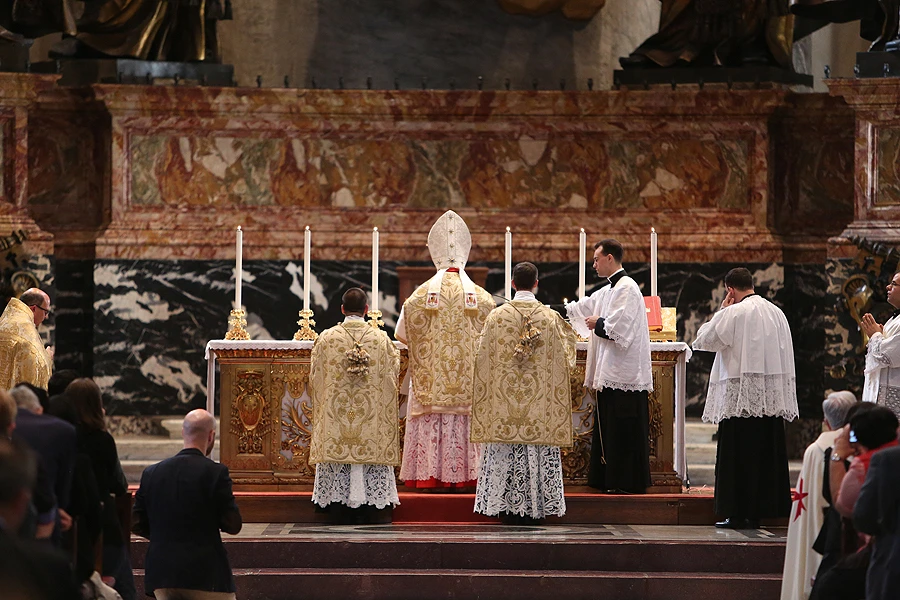
Rome, Italy, Jun 1, 2017 / 03:04 am (CNA/EWTN News).- Ten years after Benedict XVI broadened access to the celebration of the Traditional Latin Mass, the document by which he did so is being hailed as a means of closing the rift of division following liturgical changes made after the Second Vatican Council.
“Sometimes there are these polemics, but I think Benedict tried to overcome these polemics, saying that even in the liturgy there is a certain progress … but clearly in full continuity with the tradition of the Church,” Fr. Vincenzo Nuara, OP, told CNA May 31.
Tensions were heightened after the Second Vatican Council's reforms, and “unfortunately these situations of contrast, of opposition are created” even today, Fr. Nuara said.
In light of this situation, Benedict XVI’s 2007 motu proprio Summorum Pontificum, which widened access to the pre-Vatican II liturgy, “was not an instrument to divide” or throw further fuel on the flames, he said.
Rather, “it was an instrument to unite. To unite, and to bring again that ecclesial peace that’s needed in this time.”
“I see it as a positive instrument, not negative,” Fr. Nuara said. “It’s not an instrument for going backwards. It’s an instrument to reconnect ourselves in continuity” with different ecclesial styles.
Fr. Nuara is president of the association “Priestly Friends of Summorum Pontificum” and founder and spiritual assistant of the “Youth and Tradition” association.
He is also one of the organizers of an upcoming Sept. 14-17 pilgrimage marking the 10th anniversary of Summorum Pontificum, and spoke to journalists at a working breakfast on the event.
The motu proprio was issued July 7, 2007, and went into effect Sept. 14 of that year, the feast of the Exaltation of the Cross.
The document established that the post-Vatican II Roman Missal, first issued by Blessed Paul VI, is the ordinary form of the Roman rite, and that the prior version, last issued by St. John XXIII in 1962 and known as the Traditional Latin Mass or the Tridentine Mass, is the Roman rite's extraordinary form.
In the motu proprio, Benedict noted that the Traditional Latin Mass was never abrogated. He awknowledged clearly the right of all priests of the Roman rite to say Mass using the Roman Missal of 1962, and established that parish priests should be willing say the extraordinary form for groups of the faithful who request it.
Benedict also established that the faithful could have recourse to their bishop or even the Vatican if their requests for celebration of the extraordinary form were not satisfied.
The provisions of Summorum Pontificum for the use of the extraordinary form replaced those of St. John Paul II laid down in Quattuor abhinc annos and Ecclesia Dei.
According to that indult, priests and faithful who wished to celebrate the Traditional Latin Mass had to get permission from their bishop to do so. It could only be for those who requested it, could not normally be said at parish churches, and the bishop could set days and conditions for its celebration.
After the Second Vatican Council, the Missal issued by Bl. Paul VI, also known as the Novus Ordo, was widely adopted. It was widely translated into vernacular languages, and is often celebrated with the priest facing toward the congregation.
However, not a few faithful continued to be attached to the earlier form of the liturgy, and Benedict's motu proprio was considered a generous response to these faithful.
Benedict wrote in the motu proprio that the two forms “will in no way lead to a division” in the Church's belief “for they are two usages of the one Roman rite.”
In his letter to bishops accompanying Summorum Pontificum, Benedict also noted that “the two Forms of the usage of the Roman Rite can be mutually enriching.”
Fr. Nuara reflected that since Summorum Pontificum, “those who have permission to use the ancient form of the liturgy have also at the same time rediscovered the sanctity of the new.”
This mutual enrichment is a discovery Fr. Nuara said he himself has made in his 25 years as a priest, during which he has celebrated both the new and ancient liturgical formulas.
But it is also a discovery “that many (other) priests have made.”
“Benedict is a positive man. Benedict, who reflects as a theologian and a pastor, realized that the ancient form that has grown in the history of the Church for years, can give new impetus to the new form,” he said.
The Mass “is the bridge where they meet, because the Eucharist is the point of encounter … the sacrament of unity,” Fr. Nuara said, adding that what “must be avoided” is that people “take advantage of their particular trend or attention to one or the other liturgy, to create fences of division and separation.”
Benedict himself celebrated the new form of the liturgy “with great dignity,” but before his election as Bishop of Rome was also known to celebrate the ancient liturgy with the same esteem.
What Summorum Pontificum seeks to do, then, is to work for this unity, he said, adding that at 10 years since its publication, his hope is that people from both sides will work toward this goal.
“We want to send, to communicate this message,” he said. “Because the Church is a family, the family of God.”
When the Summorum Pontificum Pilgrimage takes place in September, it will be a privileged time to show this unity, he said.
The event's first day, held at the Pontifical University of St. Thomas Aquinas, will feature keynote addresses from Archbishop Guido Pozzo, secretary of the Pontifical Commission Ecclesia Dei; Cardinal Gerhard Müller, prefect of the Congregation for the Doctrine of the Faith and president of the PCED; and Cardinal Robert Sarah, prefect of the Congregation for Divine Worship.
Pilgrims who come will participate in various other activities throughout the rest of the three days, including adoration and a Eucharistic procession presided over by Archbishop Pozzo on Sept. 16, followed by a Pontifical High Mass said by Cardinal Carlo Caffarra, Archbishop Emeritus of Bologna.
Titled “Summorum Pontificum: A renewed youth for the Church,” the pilgrimage is being organized by the “Priestly Friends of Summorum Pontificum” and “Youth and Tradition” associations in partnership with the Coetus Internationalis Summorum Pontificum.
Speaking of the title in comments to journalists, Fr. Nuara noted that a “truly surprising” phenomenon is that the “true protagonists” of this new “season of the Church … are the youth.”
In his letter accompanying the motu proprio, Benedict had noted that while “it has clearly been demonstrated that young persons too have discovered this liturgical form, felt its attraction and found in it a form of encounter with the Mystery of the Most Holy Eucharist, particularly suited to them.”
“Benedict XVI already in 2007 was aware that the new recipients of this liturgy, loved, desired and also sought, were the youth,” Fr. Nuara said.
Pope Francis has also commented on the fact that many of the enthusiasts for the Traditional Latin Mass are young people who never knew it growing up, but encountered it later.
“Youth can’t be nostalgic for something they didn’t know,” Fr. Nuara said, adding that “this is very nice, because by experience I can say that the youth who draw near to the ancient liturgy of the Church love it” for the reverence and silence of the celebration.
In celebrating the ancient form, “you really understand who is at the center, who the protagonist is,” the priest said, noting that “youth understand very well that this liturgy speaks of … the essential truth of the faith.”
Previous Post

June 1, 2017
Flying on Sunday? Many airport chapels offer Mass
Next Post
June 1, 2017 Planned Parenthood's services are declining...except for abortion
Browse Our Archives
Select a Category Americas Asia - Pacific Europe Middle East - Africa Uncategorized US Vatican
Select a Month November 2017 October 2017 September 2017 August 2017 July 2017 June 2017 May 2017 April 2017 March 2017 February 2017 January 2017 December 2016 November 2016 October 2016 September 2016 August 2016 July 2016 June 2016 May 2016 April 2016 March 2016 February 2016 January 2016 December 2015 November 2015 October 2015 September 2015 August 2015 July 2015 June 2015 May 2015 April 2015 March 2015 February 2015 January 2015 December 2014 November 2014 October 2014 September 2014 August 2014 July 2014 June 2014 May 2014 April 2014 March 2014 February 2014 January 2014 December 2013 November 2013 October 2013 September 2013 August 2013 July 2013 June 2013 May 2013 April 2013 March 2013 February 2013 January 2013 December 2012 November 2012 October 2012 September 2012 August 2012 July 2012 June 2012 May 2012
TAKE THE
Religious Wisdom Quiz
Which book of the Bible contains the most direct prophecies about the Messiah?
Select your answer to see how you score.
Zechariah Isaiah Micah Psalms
Related posts from Catholic News

Sixty Vincentians martyred during Spanish Civil War to...

Filipinos gather in Rome to promote bishop's beatification...

UK bishop calls for prayers as MPs urge...

On All Souls' Day, Pope Francis prays for...
TRENDING AT PATHEOS Catholic

Rejecting Doom: Christian Hope And Human Action
Christianity is a religion of hope. We are to have hope and...

It’s What Comes From Within Which Matters
One of the most difficult things for us to understand is why...

Why I Choose the Eucharist Over the Sermon
Choose the Eucharist, Not the Sermon What are we supposed to get...

5 Design Elements Found in Spiritually Rooted Homes
Putting Spirituality Into Home Decor Our homes are more than our living...

Credo: A Story of God Told with the...
About 10 years ago, I began to imagine a personal "Credo" that...

The Anatomy of Divine Revelation in Catholic Thought
The claim that God has made Himself known to human beings is...
view all Catholic blogs
Ad-Free & Subscriber Log-In Subscription Support
- About Us
- 2026 Calendar
- Videos
- Podcasts
- Library of World Religions
- Faith In Media Tracker
- Advertise With Us
- Write for Us
- Privacy Policy
- Terms of Service
- Do Not Sell My Data
- Contact Us
- Radiant Digital
- Manage Newsletter Subscriptions
- Unsubscribe From Notifications
- Sitemap
Copyright 2008-2026, Patheos. All rights reserved.
Subscription Support Ad-Free & Subscriber Log-In
Follow Patheos