
BuddhistCatholicContemplativeEvangelicalGeneral ChristianHinduJewishLatter-day SaintMuslimNew VisionsProgressive Christian
Beliefs
- Buddhist
- Catholic
- Contemplative
- Evangelical
- General Christian
- Hindu
- Jewish
- Latter-day Saint
- More Voices
- Muslim
- New Visions
- Pagan
- Progressive Christian
Topics
- Religion News
- Food and Religion
- Sports and Religion
- Religious Art
- Religious Music and Entertainment
- Religious Events
- History and Religion
- Style and Religion
- Politics and Religion
- Women in Religion
- Recreation Outdoors and Religion
- Business Finance and Religion
- Careers Workplace and Religion
- Education and Religion
- Family Parenting and Religion
- Health Fitness and Religion
- Home and Religion
- Relationships and Religion
- Technology and Religion
- Travel and Religion
Columnists
- Buddhist Columnists
- Business Finance and Religion Columnists
- Careers Workplace and Religion Columnists
- Catholic Columnists
- Contemplative Columnists
- Education and Religion Columnists
- Evangelists Columnists
- Family Parenting and Religion Columnists
- General Christian Columnists
- Health Fitness and Religion Columnists
- Hindu Columnists
- History and Religion Columnists
- Home and Religion Columnists
- Jewish Columnists
- More Voices Columnists
- Latter Day Columnists
- Muslim Columnists
- New Visions Columnists
- Nonreligious Columnists
- Pagan Columnists
- Politics and Religion Columnists
- Progressive Columnists
- Recreation Outdoors and Religion Columnists
- Relationships and Religion Columnists
- Religion News Columnists
- Religious Art Columnists
- Religious Events Columnists
- Religious Music and Entertainment Columnists
- Sports and Religion Columnists
- Style and Religion Columnists
- Technology and Religion Columnists
- Travel and Religion Columnists
- Women in Religion Columnists
Resource Library
- 2026 Calendar
- Library of World Religions
- The 100 Most Holy Places on Earth
- Patheos Answers
- Podcasts
- Videos
- Faith Leaders Database
- Anglican Episcopalian
- Bahai
- Baptist
- Buddhism
- Christianity
- Confucianism
- Eastern Orthodoxy
- Hinduism
- Holiness and Pentecostal
- ISKCON
- Islam
- Judaism
- Lutheran
- Methodist
- The Church of Jesus Christ of Latter-day Saints
- New Age
- Paganism
- Presbytarian and Reformed
- Protestantism
- Religion Behind the Scenes
- Roman Catholic
- Scientology
- Shia Islam
- Sikhism
- Sufism
- Sunni Islam
- Taoism
- Zen
- See all religions
Research Tools
 Ad-Free & Subscriber Log-In Subscription Support
Ad-Free & Subscriber Log-In Subscription Support
Follow Patheos 

- Trending:
- Forgiveness
- |
- Marriage
- |
- Consciousness
- |
- Death Penalty
- |
- Election
- |
- Halloween
 Catholic News
- Home
- Catholic
- Religion News
- Don’t sideline human rights concerns, advocates tell State Department
Don’t sideline human rights concerns, advocates tell State Department
Last updated on: June 19, 2017 at 8:59 pm by CNA Daily News
Don’t sideline human rights concerns, advocates tell State Department 2017-06-19T20:59:00+00:00 CNA Daily News
Patheos Explore the world's faith through different perspectives on religion and spirituality! Patheos has the views of the prevalent religions and spiritualities of the world.
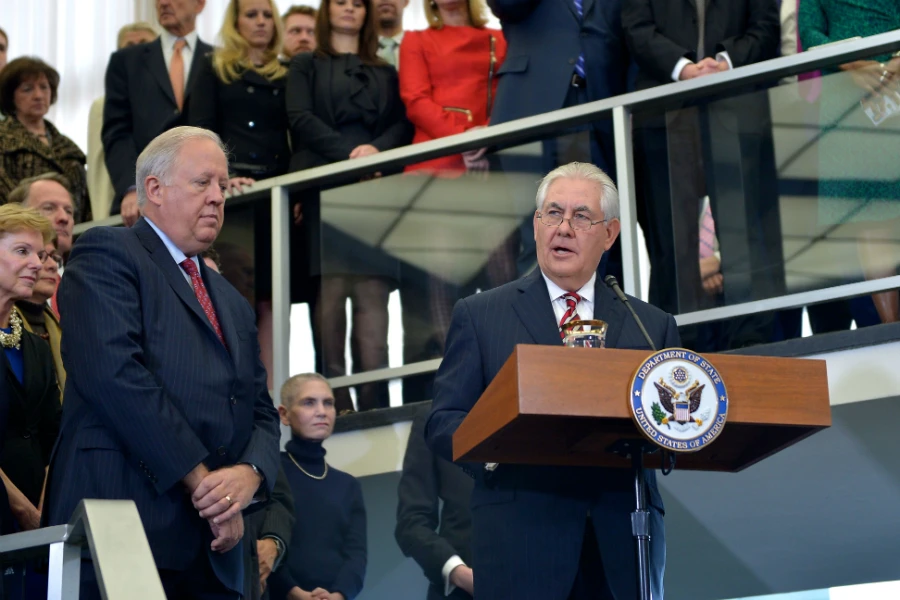
Washington D.C., Jun 19, 2017 / 02:59 pm (CNA/EWTN News).- As a new administration takes form, human rights advocates have showed concern over a possible de-emphasis on human rights and religious freedom in U.S. foreign policy.
“Freedom of religion is the foundational freedom upon which our nation was founded. Because this is a core American value, the U.S. cannot simply ignore the cries of oppressed sufferers abroad,” Dr. Randel Everett, president and founder of the 21st Century Wilberforce Initiative, stated May 23.
“Our foreign policy must reflect this essential component of global security,” he continued.
In a May 3 speech to State Department employees by new Secretary of State Rex Tillerson, he said that U.S. foreign policy cannot always be contingent on “values” like religious freedom and human rights.
“Now, I think it’s important to also remember that guiding all of our foreign policy actions are our fundamental values: our values around freedom, human dignity, the way people are treated,” Tillerson said.
“Those are our values. Those are not our policies; they’re values,” he continued, explaining that “policies can change,” while “our values never change. They’re constant throughout all of this.”
Yet Tillerson went on to say that “in some circumstances, if you condition our national security efforts on someone adopting our values, we probably can’t achieve our national security goals or our national security interests.”
The U.S. took a long time to fundamentally adopt these “values,” he added, and cannot expect other countries to adopt them overnight.
“If we condition too heavily that others must adopt this value that we’ve come to over a long history of our own, it really creates obstacles to our ability to advance our national security interests, our economic interests,” he said.
Sen. John McCain (R-Ariz.) responded with a May 8 op-ed in the New York Times, insisting that “we are a country with a conscience. We have long believed moral concerns must be an essential part of our foreign policy, not a departure from it.”
“To view foreign policy as simply transactional is more dangerous than its proponents realize,” he continued. “Depriving the oppressed of a beacon of hope could lose us the world we have built and thrived in.”
Tillerson’s speech was not the only signal from the State Department that concerned human rights advocates.
Back in March, the agency held a somewhat muted release of its annual reports on human rights in foreign countries. Tillerson was not present at a public release of the report, something that reporters pointed out was a break with long-standing precedent.
Instead, the report was discussed in an on-background conference call with reporters by a “senior administration official.”
Rep. Randy Hultgren (R-Ill.), co-chair of the Tom Lantos Human Rights Commission, noted this in his April statement on the administration’s record in promoting human rights.
“I am concerned at the muted attention the administration has given so far on human rights,” he said, noting “the downplayed release of the State Department’s human rights report.”
“Promoting trade and economic and military cooperation are all essential to America's future – but these mean little if we ignore the people in countries around the world who are suffering at the hands of their own governments and their rights are being abused,” he continued, in a statement made weeks before Tillerson’s May 4 speech.
The concerns come at a time when some are trying to ratchet up international attention on human rights abuses. The bipartisan U.S. Commission on International Religious Freedom, for instance, launched its Prisoners of Conscience Project earlier this spring, drawing attention to the plight of those detained, tortured, or killed by foreign governments because of their religious beliefs.
The commission hopes that the project will attract the attention of the public, but also of lawmakers who can ask to visit these prisoners when they travel abroad. “Public inattention can often lead to more persecution,” the commission’s chair, Fr. Thomas Reese, stated at the launch of the project.
Yet religious freedom advocates are also worried about the direction of the State Department. Everett issued a response to Tillerson’s speech on May 23, explaining how important the promotion of international religious freedom is to U.S. national security interests.
“When we disregard the brutality of religious persecution, the world becomes more dangerous for all,” he said.
As an example of this, he pointed out that “fifteen of the nineteen terrorists on 9/11 were from Saudi Arabia. All were Islamist extremists who believed violence is an acceptable tool to achieve their goals of global adherence to their strict religious laws.”
“Is it a coincidence that these men came from a nation where there is no religious freedom?” he asked.
Not all State Department actions have received criticism from human rights advocates. On April 4, the administration announced it would stop supporting the United Nations Population Fund (UNFPA) because of its support for China’s coercive two-child policy, which was for years a one-child policy until 2015.
China’s forced family-planning policy has resulted in massive human rights abuses like forced abortions and sterilizations of women. The UNFPA “gave China’s brutally enforced population control policies the international stamp of approval,” Rep. Chris Smith (R-N.J.), chair of the House panel on global human rights, stated.
Smith applauded the administration’s decision to stop funding the UNFPA.
“I am heartened by the Trump Administration’s early action to apply Kemp-Kasten and end U.S. support for this most egregious human rights violation,” Smith said of the action. The Kemp-Kasten Amendment allows the President to decide not to fund entities that engage in forced abortions or sterilizations.
Others are trying to inform and push the administration to recognize the importance of religious freedom to U.S. diplomacy. The Religious Freedom Institute released a March report with recommendations for the U.S. government.
“The President should state clearly and often that U.S. IRF policy will be a national security and minority rights priority for his administration,” the report stated.
It also asked the President to nominate an Ambassador-at-Large for International Religious Freedom soon, and for Congress to support the new ambassador by making sure he or she has the proper resources and staff within the State Department.
Previous Post

June 19, 2017
London cardinal 'appalled' by Finsbury Park attack on Muslims
Next Post
June 19, 2017 Immigration in the spotlight with LA Mass, resource website
Browse Our Archives
Select a Category Americas Asia - Pacific Europe Middle East - Africa Uncategorized US Vatican
Select a Month November 2017 October 2017 September 2017 August 2017 July 2017 June 2017 May 2017 April 2017 March 2017 February 2017 January 2017 December 2016 November 2016 October 2016 September 2016 August 2016 July 2016 June 2016 May 2016 April 2016 March 2016 February 2016 January 2016 December 2015 November 2015 October 2015 September 2015 August 2015 July 2015 June 2015 May 2015 April 2015 March 2015 February 2015 January 2015 December 2014 November 2014 October 2014 September 2014 August 2014 July 2014 June 2014 May 2014 April 2014 March 2014 February 2014 January 2014 December 2013 November 2013 October 2013 September 2013 August 2013 July 2013 June 2013 May 2013 April 2013 March 2013 February 2013 January 2013 December 2012 November 2012 October 2012 September 2012 August 2012 July 2012 June 2012 May 2012
TAKE THE
Religious Wisdom Quiz
Four beasts rose from the sea—one like a lion with eagle's wings, one like a bear, one like a leopard, and a fourth terrifying beast. What did these represent?
Select your answer to see how you score.
Four judgments Four kingdoms Four kings Four ages
Related posts from Catholic News

US bishops' new child protection program aims to...

Wealthy foundation aims to redefine religious freedom—and Christianity,...

Victims of Islamic State in focus at UN...

Catholic University of America offers free tuition to...
TRENDING AT PATHEOS Catholic

Rejecting Doom: Christian Hope And Human Action
Christianity is a religion of hope. We are to have hope and...

It’s What Comes From Within Which Matters
One of the most difficult things for us to understand is why...

Why I Choose the Eucharist Over the Sermon
Choose the Eucharist, Not the Sermon What are we supposed to get...

5 Design Elements Found in Spiritually Rooted Homes
Putting Spirituality Into Home Decor Our homes are more than our living...

Credo: A Story of God Told with the...
About 10 years ago, I began to imagine a personal "Credo" that...

The Anatomy of Divine Revelation in Catholic Thought
The claim that God has made Himself known to human beings is...
view all Catholic blogs
Ad-Free & Subscriber Log-In Subscription Support
- About Us
- 2026 Calendar
- Videos
- Podcasts
- Library of World Religions
- Faith In Media Tracker
- Advertise With Us
- Write for Us
- Privacy Policy
- Terms of Service
- Do Not Sell My Data
- Contact Us
- Radiant Digital
- Manage Newsletter Subscriptions
- Unsubscribe From Notifications
- Sitemap
Copyright 2008-2026, Patheos. All rights reserved.
Subscription Support Ad-Free & Subscriber Log-In
Follow Patheos