
BuddhistCatholicContemplativeEvangelicalGeneral ChristianHinduJewishLatter-day SaintMuslimNew VisionsProgressive Christian
Beliefs
- Buddhist
- Catholic
- Contemplative
- Evangelical
- General Christian
- Hindu
- Jewish
- Latter-day Saint
- More Voices
- Muslim
- New Visions
- Pagan
- Progressive Christian
Topics
- Religion News
- Food and Religion
- Sports and Religion
- Religious Art
- Religious Music and Entertainment
- Religious Events
- History and Religion
- Style and Religion
- Politics and Religion
- Women in Religion
- Recreation Outdoors and Religion
- Business Finance and Religion
- Careers Workplace and Religion
- Education and Religion
- Family Parenting and Religion
- Health Fitness and Religion
- Home and Religion
- Relationships and Religion
- Technology and Religion
- Travel and Religion
Columnists
- Buddhist Columnists
- Business Finance and Religion Columnists
- Careers Workplace and Religion Columnists
- Catholic Columnists
- Contemplative Columnists
- Education and Religion Columnists
- Evangelists Columnists
- Family Parenting and Religion Columnists
- General Christian Columnists
- Health Fitness and Religion Columnists
- Hindu Columnists
- History and Religion Columnists
- Home and Religion Columnists
- Jewish Columnists
- More Voices Columnists
- Latter Day Columnists
- Muslim Columnists
- New Visions Columnists
- Nonreligious Columnists
- Pagan Columnists
- Politics and Religion Columnists
- Progressive Columnists
- Recreation Outdoors and Religion Columnists
- Relationships and Religion Columnists
- Religion News Columnists
- Religious Art Columnists
- Religious Events Columnists
- Religious Music and Entertainment Columnists
- Sports and Religion Columnists
- Style and Religion Columnists
- Technology and Religion Columnists
- Travel and Religion Columnists
- Women in Religion Columnists
Resource Library
- 2026 Calendar
- Library of World Religions
- The 100 Most Holy Places on Earth
- Patheos Answers
- Podcasts
- Videos
- Faith Leaders Database
- Anglican Episcopalian
- Bahai
- Baptist
- Buddhism
- Christianity
- Confucianism
- Eastern Orthodoxy
- Hinduism
- Holiness and Pentecostal
- ISKCON
- Islam
- Judaism
- Lutheran
- Methodist
- The Church of Jesus Christ of Latter-day Saints
- New Age
- Paganism
- Presbytarian and Reformed
- Protestantism
- Religion Behind the Scenes
- Roman Catholic
- Scientology
- Shia Islam
- Sikhism
- Sufism
- Sunni Islam
- Taoism
- Zen
- See all religions
Research Tools
 Ad-Free & Subscriber Log-In Subscription Support
Ad-Free & Subscriber Log-In Subscription Support
Follow Patheos 

- Trending:
- Forgiveness
- |
- Marriage
- |
- Consciousness
- |
- Death Penalty
- |
- Election
- |
- Halloween
 Catholic News
- Home
- Catholic
- Religion News
- What the littlest children can teach us about suffering
What the littlest children can teach us about suffering
Last updated on: May 17, 2017 at 9:02 am by CNA Daily News
What the littlest children can teach us about suffering 2017-05-17T09:02:00+00:00 CNA Daily News
Patheos Explore the world's faith through different perspectives on religion and spirituality! Patheos has the views of the prevalent religions and spiritualities of the world.
Denver, Colo., May 17, 2017 / 03:02 am (CNA/EWTN News).- “There will be saints among the children.”
So said Pope Pius X, when he lowered the age that children could receive their First Holy Communion. Previously, children had to be 10 or 12, now they are typically in second grade, or about seven or eight years old, though exceptions are made for some who are even younger.
Last weekend, Pope Francis canonized Sts. Francisco and Jacinta Marto, two of the child visionaries of the Fatima Marian apparitions. Bucking tradition, these shepherd children are the first children who were not martyrs to be canonized by the Church. Both died before age 12.
Austin Ruse, Catholic author and president of C-Fam, a family research institute, believes that Pope Francis may have just “opened the floodgates” to scores of saints from the littlest among us.
Several years ago, Ruse was struck by the stories of three children he knew – either personally or peripherally – that all seemed to have a common theme: “little children who died young, suffered greatly, and brought many people to Christ and his Church through their suffering.”
“They were just profound stories and they needed to be told,” he said in an interview with CNA.
In his recent book, “Littlest Suffering Souls,” Ruse tells of the short but significant lives of six children, three of them contemporary children whose families he has met.
Suffering, with ‘countless graces’
One of those children was Brendan Kelly, whose family went to Ruse’s parish, and whose funeral Ruse attended. While he had never met Brendan, Ruse had been praying for him.
Brendan was born to a devout Catholic family in Virginia. His parents, Frank and Maura, met while working in the George H.W. Bush White House in 1990.
Brendan was born with Down syndrome, and a seemingly innate love for Jesus. By the age of two, he loved to kiss crucifixes and statues of saints.
It was also at that age that a test confirmed Brendan had leukemia. He began a series of intense and painful treatments that would become an off-and-on part of the rest of his life.
“But along with the suffering would come countless graces,” Ruse noted.
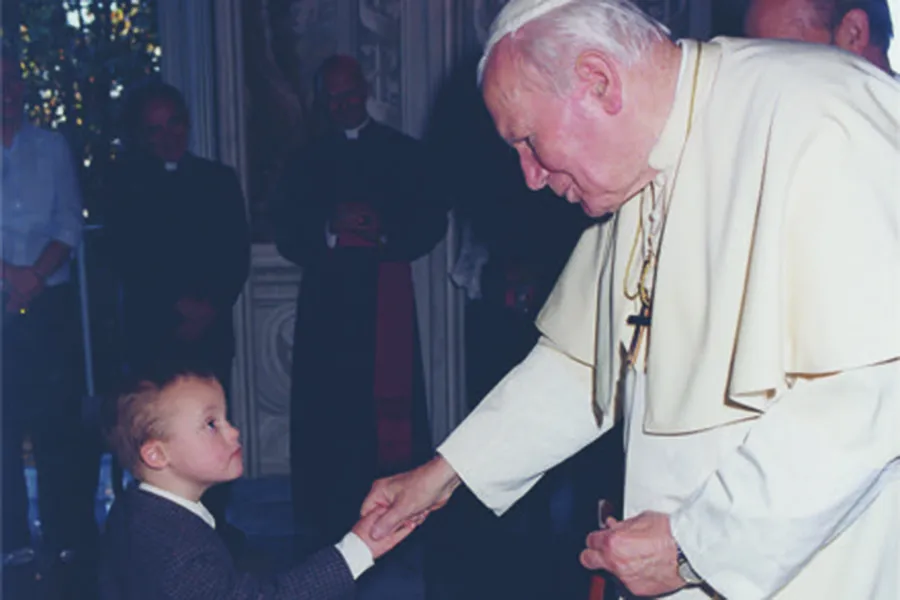
One of the biggest graces was the “mystical” friendship that Brendan would develop with the pope at the time, Pope John Paul II.
Former senator and presidential candidate Rick Santorum, a family friend, personally delivered a photo of Brendan to Pope John Paul II while on a state visit to the Vatican. Once Brendan found out the pope was praying for him personally, he started praying for the pope personally too – every night.
Some time later, Brendan was offered a wish from the Make a Wish Foundation, the group that grants wishes to very sick children – typically a visit to Disneyland, or something along those lines.
But Brendan wanted something different.
“Me meet pope!” the toddler exclaimed. The Make-a-Wish officials were not convinced that this request was coming from the little boy, and so they shooed his parents out of the room. After an hour of questioning, Brendan didn’t waiver.
And so he did meet the pope – at the age of four, Brendan was granted an audience with Pope John Paul II. Not satisfied with the standard brief meeting and shaking of hands, Brendan stood by Pope John Paul II as he greeted everyone in the audience that day. As the pope was leaving, Brendan shouted “Bye, Pope!” and was able to shake hands one last time with the spiritual giant and his personal hero.
Other incredible moments of grace and signs of God’s presence occurred throughout Brendan’s short life. On one occasion, one of Frank’s friends, Peter O’Malley, was in the midst of a terrorist attack at Taj Mahal Palace in 2008.
In his moment of crisis, O’Malley knew who to call for prayers. Brendan prayed, and O’Malley escaped unharmed that night, when 164 people were shot.
His parish priest, Father Drummond, said he was first struck by Brendan’s faith and “absolute joy” as he was preparing him for communion and confession. When Father told him he would get to wear the black and white vestments of an altar boy, “He got a faraway look in his eyes and said quietly, ‘I love those’.”
Throughout his short life, Brendan would suffer bouts of leukemia, and grueling treatments. Before each one, his parents would ask him for whom he would offer his suffering – and he always had an intention.
One of his most frequent intentions was Bella Santorum, Rick Santorum’s daughter, who was born with a rare genetic disorder, Trisomy 18. She was only supposed to live a few months, but Brendan offered his suffering for her throughout his entire life. “Bella, I love you,” he would repeat during moments of pain. She is still alive today, some nine years longer than she was expected to live.
“(Brendan) very early on grabbed onto the idea of offering up his suffering, and he always would do it cheerfully, even though it was unbelievably painful, or it made him incredibly sick, he just knew that throwing up for the tenth time, this time is going to be for somebody, and it was useful,” Frank told CNA.
At the same time, he was a normal boy. He didn’t want to be sick, he loved to play with his siblings and be the life of the party. And he could school anyone in trivia from his favorite T.V. show “The Office.” He could name the season and the episode of any quote from Michael Scott or Dwight Schrute that his family could lob at him.
And so, when sick from leukemia and quarantined for a bone marrow transplant as a teenager, Brendan and his family played office trivia through a small, grainy T.V. – the only way they could communicate during the sterile procedure. Soon a crowd of doctors and nurses joined in the fun.
But it was his profound faith and joyful personality that impacted almost everyone he met, and that drew people to him.
“He wasn’t just this always smiley, (disabled) little child,” Frank said. “He would have very profound conversations with people, and say things that would profoundly impact people.”
When he passed away in 2013, at the age of 16, the line at his wake had to be cut short after three hours of people filing past to pay their final respects to Brendan.
“We had to go outside and thank everybody because it was too long, and there was almost an equal number of people at the funeral Mass the next day,” Frank said.
Since that day, they’ve had hundreds of requests for prayer cards of Brendan.
Frank said it has been a “surreal” experience to have a child whose impact is so great that there are people asking for his prayers.
He said he hopes that people who read Brendan’s story and are experiencing suffering themselves understand that they are never alone.
“Brendan never felt alone, and he knew that people were praying for him, starting with Pope John Paul II to the builders who were working on our house, to people he never knew,” Frank said. Even people in other countries who had never met Brendan had offered their prayers.
A witness amid the ‘culture of death’
Another suffering soul, Margaret Leo, also had a dad who worked in the Washington, D.C. political scene. Leonard Leo is the executive vice president of the Federalist Society – a law organization to which several federal and Supreme Court justices belong. He also worked for President George W. Bush’s administration at one time.
Though Margaret suffered throughout her life from spina bifida and related complications, she bore everything with a cheerful smile and a simple but profound faith. Her photo now sits on the desk of U.S. Supreme Court Justice Clarence Thomas.
Ruse names the people impacted by these suffering souls in his book intentionally.
These were not peasant children, like Sts. Francisco and Jacinta Marto, Ruse noted, and that’s important.
“They were born into influence and affluence, into a modern day (moral) desert, and they have a message for the modern day desert – all lives are worth living, there are no useless lives, even short, painful lives have a great deal of meaning,” Ruse said.
“We live in an age that people call the culture of death, aimed largely at the defenseless: children, the elderly, the disabled, the intellectually disabled, and these children are witnesses to the fact that all lives are worth living, even ones that are judged not to be worth living.”
It’s something that Margaret’s mom, Sally, hopes that people understand as they read her daughter’s story.
“Especially because such a high percentage of children with spina bifida and other disabilities are aborted these days, and we barely even ever see them,” she told CNA.
“If that wasn’t the case, we would see these kids walking around, we would see kids with braces or crutches or Down syndrome all the time, but 80-90 percent of them are killed, they’re not even given the chance.”
But in Sally’s experience, “It was a gift.”
Margaret taught them about faith and love in the simplest of ways. She gently pestered her dad until he became a daily Mass attendee. She would ask people when they were going to baptize their new baby, or if they had been confirmed.
“Her faith would invariably come up in any discussion that was more the perfunctory, and it would have an impact on people,” her father, Leonard, told CNA.
But she wasn’t a mystic, her parents insist. She just had a strong attraction to holy and beautiful things, and an intense but simple joy that was attractive to those around her. She loved coloring, and being involved in her siblings’ antics, and holding babies.
“In other words, you wouldn’t necessarily go away thinking, ‘Oh wow, I just met a saint.’ But she would say to you, ‘Hi, how are you? How was your day? How was your birthday? When’s your confirmation?’ She wanted to know about you, which was really what touched people most about her, because you don’t necessarily find that among strangers,” Sally said.
“Charity and kindness and friendship, but at its most pure and most intense level,” Leonard added.
Margaret’s spina bifida meant that she had to have titanium rods placed in her back to straighten her spine. But instead, Margaret’s back bent the titanium rods – so much so that they ended up protruding from her neck. Despite it all, Margaret did not complain.
“It’s ok,” she would cheerfully say, even when it was clear that it was not.
Today, Leonard keeps the rods on his desk – “to remind me what a real bad day looks like.”
After Margaret passed away and her story spread, the Leos were surprised at the impact their simple but faithful little girl was having on the people around them. When Ruse published an article about Margaret, they received hundreds of requests for a prayer card of her.
What continues to draw people to Margaret is how she suffered with joy and trust in God, Leonard said.
“I think at some level that when we’re faced with adversity and suffering, we wish that we could be filled with joy, and we could be able to confront it in a way that brings us closer to God and closer to other people, and make the very best of it,” he said.
“And so when you saw her, it was impossible not to be reminded of the fact that we should be filled with joy, we should be thankful to God. As her tombstone says, we should be praying and thanking God without ceasing.”
Tears of inspiration
The third contemporary little suffering soul whose story Ruse tells is that of Audrey from France.
Although her parents were lukewarm Catholics when she was born, Audrey was “spiritually precocious” from a young age.
She practiced mortification by carrying home her school pencils in her shoe. She begged to receive Holy Communion at the age of five. Upon examining her, her priest found her ready to do so, because she understood that Holy Communion is Jesus, “And I want to receive Jesus.” She insisted that her family say grace before meals and a prayer for vocations every night.
She was also sure from a young age that she had a Carmelite vocation, “Caramel” as the little girl pronounced it.
This surprising faith scared Lillian, Audrey’s mom, who wasn’t sure where Audrey was getting her ideas.
“Follow her,” a priest told Lillian.
But she was also scared that her daughter’s spiritual maturity meant great trials were ahead – and they were. At a very young age, Audrey was diagnosed with leukemia.
When Lillian broke the news to Audrey, “She got this very wise, very gentle sort of look” and told her mother that they were “going to do what Jesus says. We’re going to be like the birds in the sky, and we’re just going to take one day at a time.”
“I can’t say that without weeping,” Ruse said.
And indeed, “Littlest Suffering Souls” is a book that will make you weep. But not in a sad way.
“We’re not crying out of sadness, we’re crying out of inspiration,” Ruse said.
“They’re neither tears of joy nor sadness, they’re some other kind of tear, that I don’t have the name for, but it’s just being moved by these inspiring stories.”
Audrey battled leukemia for several years, and, like Brendan, made it on the personal prayer list of Pope John Paul II after her dad was able to hand him a photo of her.
Audrey too offered her sufferings for specific intentions, and, like Brendan, people began flooding her with prayer requests. She had a special heart for vocations, and prayed especially for her Uncle Mick – who is now a priest today.
A bone marrow transplant for Audrey eventually proved ineffective. Knowing she was near death, her family took her to Lourdes, and then to Rome, where she was able to meet Pope John Paul II.
They spoke together for several minutes, captured by a photo of Audrey’s swollen head next to the bent-down head of the now-Saint.
While no one knows what was said between the two of them, for the rest of the day, John Paul II could be heard around the Vatican muttering her name: “Audrey, Audrey, Audrey.”
She also asked to be confirmed, and insisted that the party be an “elegant” event – one of her favorite words, but one that she meant in beautiful simplicity, rather than extravagance.
In her final weeks, which she was able to spend at home, Audrey spent hours in the family’s chapel, where the bishop had allowed them to keep the blessed sacrament. She told her grandma that she spent her days praying and waiting.
She passed away at 3 p.m., the hour of mercy, on August 22, 1991, the Feast of the Queenship of Mary. Her father Jerome had prayed she would pass away on a Marian feast day.
Audrey’s cause for canonization has been opened, and her story has spread throughout France and indeed throughout the world. Seminarians pray for her intercession for their vocations. A Carmelite convent in Spain has her First Communion dress on display, with permission of the family.
Lessons learned
The suffering of children is a difficult subject, but one that captures the attention of all, Ruse said.
“It seems to us to be profoundly unfair that children suffer, and that’s a common human reaction,” he reflected.
“Moreover, the reaction of these particular children to their suffering and maladies is confounding to those of us who cannot even handle the simple contradictions of the day very well,” he said.
“The simplest things can vex us, and yet these are kids who had bone marrow transplants and while they had them, Audrey was singing songs to Mary, and Brendan was offering his suffering for others – they’re just astounding.”
At the end of his book, Ruse offers what he believes are several lessons that can be learned from the stories of little suffering souls – forbearance, simplicity, a love for God, particularly in the Eucharist.
Moreover, he said, we learn that each life has dignity.
“Our modern man might see a child suffering from leukemia who has died young and see nothing but a misbegotten tragedy, a life with no meaning,” he wrote.
“In the simplest terms, modern man is wrong. The Littlest Suffering Souls stand as witnesses to the proposition that all human life has meaning and dignity, even and especially those lives we may not fully understand.”
Previous Post

May 17, 2017
Sign of hope in Syria – Aleppo consecrated to Our Lady of Fatima
Next Post
May 17, 2017 Pope points to Mary Magdalene as an apostle of hope
Browse Our Archives
Select a Category Americas Asia - Pacific Europe Middle East - Africa Uncategorized US Vatican
Select a Month November 2017 October 2017 September 2017 August 2017 July 2017 June 2017 May 2017 April 2017 March 2017 February 2017 January 2017 December 2016 November 2016 October 2016 September 2016 August 2016 July 2016 June 2016 May 2016 April 2016 March 2016 February 2016 January 2016 December 2015 November 2015 October 2015 September 2015 August 2015 July 2015 June 2015 May 2015 April 2015 March 2015 February 2015 January 2015 December 2014 November 2014 October 2014 September 2014 August 2014 July 2014 June 2014 May 2014 April 2014 March 2014 February 2014 January 2014 December 2013 November 2013 October 2013 September 2013 August 2013 July 2013 June 2013 May 2013 April 2013 March 2013 February 2013 January 2013 December 2012 November 2012 October 2012 September 2012 August 2012 July 2012 June 2012 May 2012
TAKE THE
Religious Wisdom Quiz
True or False: Hebrews states that it is appointed for men to die once, and after this comes judgment.
Select your answer to see how you score.
FALSE TRUE
Related posts from Catholic News

US bishops' new child protection program aims to...

Wealthy foundation aims to redefine religious freedom—and Christianity,...

Victims of Islamic State in focus at UN...

Catholic University of America offers free tuition to...
TRENDING AT PATHEOS Catholic

Creation, Preservation, and Teleology in Catholic Theology
As I write this, it is very early Monday morning. Like millions...

The Parable Of The Sower And The Word...
One of Christ’s most famous parables is that of the sower who...

Rejecting Doom: Christian Hope And Human Action
Christianity is a religion of hope. We are to have hope and...

Why I Choose the Eucharist Over the Sermon
Choose the Eucharist, Not the Sermon What are we supposed to get...

5 Design Elements Found in Spiritually Rooted Homes
Putting Spirituality Into Home Decor Our homes are more than our living...

Credo: A Story of God Told with the...
About 10 years ago, I began to imagine a personal "Credo" that...
view all Catholic blogs
Ad-Free & Subscriber Log-In Subscription Support
- About Us
- 2026 Calendar
- Videos
- Podcasts
- Library of World Religions
- Faith In Media Tracker
- Advertise With Us
- Write for Us
- Privacy Policy
- Terms of Service
- Do Not Sell My Data
- Contact Us
- Radiant Digital
- Manage Newsletter Subscriptions
- Unsubscribe From Notifications
- Sitemap
Copyright 2008-2026, Patheos. All rights reserved.
Subscription Support Ad-Free & Subscriber Log-In
Follow Patheos