
BuddhistCatholicContemplativeEvangelicalGeneral ChristianHinduJewishLatter-day SaintMuslimNew VisionsProgressive Christian
Beliefs
- Buddhist
- Catholic
- Contemplative
- Evangelical
- General Christian
- Hindu
- Jewish
- Latter-day Saint
- More Voices
- Muslim
- New Visions
- Pagan
- Progressive Christian
Topics
- Religion News
- Food and Religion
- Sports and Religion
- Religious Art
- Religious Music and Entertainment
- Religious Events
- History and Religion
- Style and Religion
- Politics and Religion
- Women in Religion
- Recreation Outdoors and Religion
- Business Finance and Religion
- Careers Workplace and Religion
- Education and Religion
- Family Parenting and Religion
- Health Fitness and Religion
- Home and Religion
- Relationships and Religion
- Technology and Religion
- Travel and Religion
Columnists
- Buddhist Columnists
- Business Finance and Religion Columnists
- Careers Workplace and Religion Columnists
- Catholic Columnists
- Contemplative Columnists
- Education and Religion Columnists
- Evangelists Columnists
- Family Parenting and Religion Columnists
- General Christian Columnists
- Health Fitness and Religion Columnists
- Hindu Columnists
- History and Religion Columnists
- Home and Religion Columnists
- Jewish Columnists
- More Voices Columnists
- Latter Day Columnists
- Muslim Columnists
- New Visions Columnists
- Nonreligious Columnists
- Pagan Columnists
- Politics and Religion Columnists
- Progressive Columnists
- Recreation Outdoors and Religion Columnists
- Relationships and Religion Columnists
- Religion News Columnists
- Religious Art Columnists
- Religious Events Columnists
- Religious Music and Entertainment Columnists
- Sports and Religion Columnists
- Style and Religion Columnists
- Technology and Religion Columnists
- Travel and Religion Columnists
- Women in Religion Columnists
Resource Library
- 2026 Calendar
- Library of World Religions
- The 100 Most Holy Places on Earth
- Patheos Answers
- Podcasts
- Videos
- Faith Leaders Database
- Anglican Episcopalian
- Bahai
- Baptist
- Buddhism
- Christianity
- Confucianism
- Eastern Orthodoxy
- Hinduism
- Holiness and Pentecostal
- ISKCON
- Islam
- Judaism
- Lutheran
- Methodist
- The Church of Jesus Christ of Latter-day Saints
- New Age
- Paganism
- Presbytarian and Reformed
- Protestantism
- Religion Behind the Scenes
- Roman Catholic
- Scientology
- Shia Islam
- Sikhism
- Sufism
- Sunni Islam
- Taoism
- Zen
- See all religions
Research Tools
 Ad-Free & Subscriber Log-In Subscription Support
Ad-Free & Subscriber Log-In Subscription Support
Follow Patheos 

- Trending:
- Forgiveness
- |
- Marriage
- |
- Consciousness
- |
- Death Penalty
- |
- Election
- |
- Halloween
 Catholic News
- Home
- Catholic
- Religion News
- What common ground could Trump and Pope Francis find?
What common ground could Trump and Pope Francis find?
Last updated on: May 22, 2017 at 6:02 pm by CNA Daily News
What common ground could Trump and Pope Francis find? 2017-05-22T18:02:00+00:00 CNA Daily News
Patheos Explore the world's faith through different perspectives on religion and spirituality! Patheos has the views of the prevalent religions and spiritualities of the world.
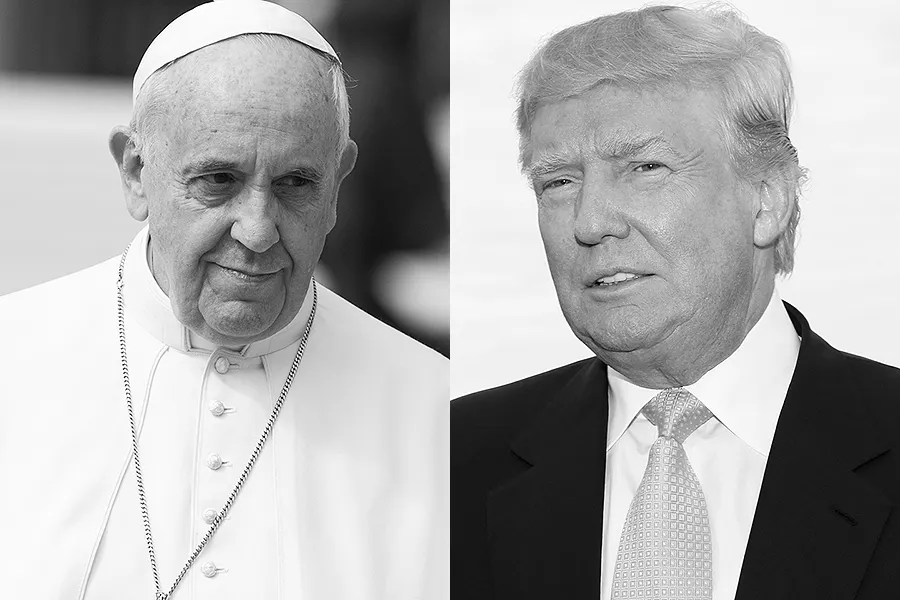
Vatican City, May 22, 2017 / 12:02 pm (CNA/EWTN News).- When Pope Francis was asked last week about his upcoming meeting with U.S. president Donald Trump, he made headlines for answering that he always tries to look for common ground.
Given that they have vocally disagreed on prominent issues in the past, what will the areas of shared agreement be?
The two are set to meet at the Vatican Wednesday, May 24, at 8:30 a.m., before Pope Francis' weekly general audience.
President Trump arrives to Italy May 23 after stopping in both Saudi Arabia and Israel as part of his first international trip, which lasts nine days. He will also attend a NATO meeting in Brussels on May 25 and a G7 summit in Sicily on May 26.
Perhaps the most prominent area of disagreement between Trump and Francis is immigration.
During a Feb. 18, 2016, in-flight press conference, the Pope was asked to respond to Donald Trump’s immigration stand, particularly his threat to build a wall along the U.S.-Mexico border.
Pope Francis responded saying “a person who thinks only about building walls, wherever they may be, and not building bridges, is not Christian. This is not in the Gospel.” However, he also said that he would “give the benefit of the doubt” to the political candidate.
One week prior, Trump had bashed Pope Francis as a “pawn” for the Mexican government and “a very political person” who does not understand the problems of the United States.
After the fact, then-Holy See spokesman Fr. Federico Lombardi told Vatican Radio that the Pope’s comment “was never intended to be, in any way, a personal attack or an indication of how to vote” and had repeated a longstanding theme of his papacy: bridge-building.
During Trump’s time in office so far, U.S. bishops – who have Francis’ full backing on the issue – have been critical of Trump’s moves on immigration, criticizing the “ban” he implemented in his first week in office halting refugee admissions for 120 days – indefinitely for Syrian refugees – and temporarily banning visa permissions for people seeking entry to the United States from Iraq, Syria, Iran, Sudan, Libya, Somalia and Yemen.
Trump and Francis also have very divergent opinions on climate change. Francis insisted on the need to protect creation in his environmental encyclical Laudato Si, saying problems such as global warming are caused by human activity.
The Pope gave his full support of the Paris Climate deal in 2015, sending Vatican Secretary of State, Cardinal Pietro Parolin, to the Nov. 30-Dec. 11 summit as his personal delegate to the gathering.
Trump later threatened to back out of the deal, but delayed the process until after the G7 summit he’ll be participating in this week.
While there will certainly be these and other points the two disagree on, there are several issues – other than their shared disregard for formal protocol – that could actually bring the two together.
These, to name a few, could be: pro-life issues, above all defense of the unborn; religious freedom, particularly for Christians in the Middle East; and the push for a solution to the Israel-Palestine conflict.
Since his campaign days, Trump has identified himself as pro-life, and even gave a shout-out to the Jan. 27 March for Life in Washington D.C. in a clip of an interview with David Muir of ABC.
U.S. Vice President Mike Pence became the first vice president to participate in the event, giving a keynote speech that stressed the “sanctity of life.”
Pro-life issues are likely to be at least one strong point of union for Trump and Francis, who has often spoken out against abortion and other concerns such as euthanasia, calling them in one audience in 2014 “sins against God.”
He has also encouraged the use of conscientious objection based on religious convictions, at one point describing it as “a basic human right.”
When it comes to the Trump administration, the pro-life issue remains a big issue for many U.S. Catholics, who praised the president’s reinstatement of the “Mexico City Policy,” which prohibits U.S. funding of non-government organizations that either promote or perform abortions through family-planning funds.
Trump was also lauded for his appointment of Niel Gorsuch to fill the Supreme Court vacancy left when Justice Antonin Scalia passed away last year. Gorsuch has been praised not only for his pro-life stance, but also for his commitment to religious freedom.
Pope Francis and Trump are also likely to share concern for persecuted Christians and other religious minorities in Iraq and throughout the Middle East.
Both Trump and Francis have called for greater solidarity and protection of persecuted Christians.
Francis has repeatedly spoken out on modern persecution, saying there are more martyrs today than in the early Church, with the “ecumenism of blood” having become a watermark phrase of his pontificate.
Trump himself said during his campaign that protecting persecuted Christians would be a priority. As evidence of this intent, at a May 11 summit on persecuted Christians U.S. Vice President Mike Pence said, “We’re with you, we stand with you,” and assured of both his and Trump’s prayers.
As with any political figure, questions still loom as to how much Trump will actually do, especially if differing political opinions get in the way. But overall, the topic will likely be a point of agreement and collaboration with the Vatican.
And while Trump’s previous rhetoric on Islam is something Francis would likely hastily disagree with, a recent shift in the president’s tone is something the Pope would certainly welcome.
During his election campaign, Trump called for the “total and complete shutdown of Muslims entering the United States,” and voicing his opinion that “Islam hates us.”
However, so far Trump’s rhetoric on Muslims has cooled during his first international trip abroad.
In his May 21 speech at the Arab Islamic American Summit in Ridyadh, Saudi Arabia, Trump avoided the phrase “radical Islamic terrorism,” referring instead to “the crisis of Islamist extremism and the Islamist terror groups it inspires.”
“The nations of the Middle East will have to decide what kind of future they want for themselves, for their country and, frankly, for their families and for their children,” Trump said, speaking to leaders from more than 50 predominantly Muslim countries.
The choice is “between two futures,” and “it is a choice America cannot make for you,” he said, adding that “a better future is only possible if your nations drive out the terrorists and drive out the extremists.”
He said he didn’t come to “lecture,” but to seek an end to terrorism and the beginning of peace in the Middle East region, noting that roughly 95 percent of terrorist victims are themselves Muslim.
The president said he wants a partnership with people who share the same “interests and values” as the U.S., calling Islam one of the “great faiths” with an “ancient heritage” that has served as the “cradle of civilization.”
In addition, Trump said the problem of terrorism is not “a battle between different faiths, different sects, or different civilizations. This is a battle between barbaric criminals who seek to obliterate human life and decent people of all religions who seek to protect it…This is a battle between good and evil.”
The U.S. president’s more moderate tone on Islam, and indeed his unprecedented praise of some aspects of Muslim culture, is something Pope Francis would likely appreciate. The Pope has on multiple occasions warned against “Islamophobia,” insisting that not all Muslims are terrorist.
However, while the two might have new-found common ground in terms of how they refer to the Muslim community, at least in the public sphere, Francis will likely take issue with the weapons deal signed by Trump and Saudi King Salman.
The deal guarantees the Middle Eastern powerhouse some $350 billion in weapons over the next 10 years, with $110 billion going into effect immediately.
Francis has consistently called for an end to the arms trade, criticizing nations that sell weapons to warring countries in order to keep the conflicts going that line their own pockets. The Pope has used almost countless occasions to insist for an end to this “scourge.”
Saudi Arabia has also been criticized by many other Middle Eastern nations for funding ISIS, most directly through weapons sales.
But regardless of the deal, terrorism is sure to be one of the key topics discussed, and if Trump’s speech in Saudi Arabia is an indication of how he intends to address the issue from here on out, the two just might be able agree on this point.
After leaving Saudi Arabia, Trump flew to Israel for an official visit in a bid to cement Israeli ties and help move forward on a peace deal with Palestine. After arriving this morning, he voiced hopes to Israeli President Reuven Rivlin of a broader peace deal in the region.
“You have a great opportunity right now. Great feeling for peace throughout the Middle East. People have had enough of the bloodshed and the killing. I think we're going to start see things starting to happen,” he told Rivlin.
In a speech to Israeli Prime Minister on the tarmac, Trump said: “We have before us a rare opportunity to bring security and stability and peace to this region and its people, defeating terrorism and creating a future of harmony, prosperity and peace, but we can only get there working together. There is no other way.”
In a previous encounter, Trump had asked Netenyahu to “hold off” on building more settlements in order help give space to further peace discussions in the region.
Earlier this month Trump met with Palestinian leader Mahmoud Abbas at the White House, telling him that when it comes to a deal that pleases both parties, “we will get it done.”
The commitment to a two-state solution has been a longstanding priority for the Vatican, which was reinforced during a recent 2015 agreement between Palestine and the Holy See to promote religious freedom in the area.
Trump himself, however, has said his administration is not married to the idea of a two-state solution to the decades-long conflict, deviating from previous administrations on the issue.
While the Vatican and Trump might not agree on what exactly a peace deal looks like, it’s likely to be a shared concern.
Another topic that could be a point of union between the Pope and the president is human trafficking; not necessarily because Trump himself has been a hardliner on the issue, but more likely because the president’s daughter and high-profile adviser Ivanka Trump has made a commitment to it.
It is in this capacity that she is participating in each of the nine days of Trump’s first trip abroad as president, including the public portion of his meeting with Francis.
While in Italy, Ivanka is also set to meet with the Community of Sant’Egidio, a group often praised by Pope Francis for their work with the poor and refugees, to discuss putting an end to human trafficking.
During the meeting, the Ivanka is expected to meet with several women who are victims of trafficking, and discuss various ways in which the Church and the U.S. government can collaborate on the issue.
So while there are clearly many areas in which Pope Francis and Trump diverge, the meeting will likely find both men seeking to find common ground.
Francis himself during his May 13 press conference refrained from making a premature evaluation of Trump, saying “I never make a judgment of a person without listening to them. I believe that I should not do this.”
When the two finally meet, “things will come out, I will say what I think, he will say what he thinks, but I never, ever, wanted to make a judgment without hearing the person.”
Peace and friendship are things that can’t be forced, he said, explaining that they take daily effort and are “handcrafted.”
“Respect the other, say that which one thinks, but with respect, but walk together,” he said. Even if someone thinks differently, “be very sincere,” and respectful.
Previous Post

May 22, 2017
Sanctions on Syria's military a good step, Christian advocate says
Next Post
May 22, 2017 Pence to Notre Dame graduates: Bring values into the workplace
Browse Our Archives
Select a Category Americas Asia - Pacific Europe Middle East - Africa Uncategorized US Vatican
Select a Month November 2017 October 2017 September 2017 August 2017 July 2017 June 2017 May 2017 April 2017 March 2017 February 2017 January 2017 December 2016 November 2016 October 2016 September 2016 August 2016 July 2016 June 2016 May 2016 April 2016 March 2016 February 2016 January 2016 December 2015 November 2015 October 2015 September 2015 August 2015 July 2015 June 2015 May 2015 April 2015 March 2015 February 2015 January 2015 December 2014 November 2014 October 2014 September 2014 August 2014 July 2014 June 2014 May 2014 April 2014 March 2014 February 2014 January 2014 December 2013 November 2013 October 2013 September 2013 August 2013 July 2013 June 2013 May 2013 April 2013 March 2013 February 2013 January 2013 December 2012 November 2012 October 2012 September 2012 August 2012 July 2012 June 2012 May 2012
TAKE THE
Religious Wisdom Quiz
Who prophesied a virgin would bear a son called Immanuel?
Select your answer to see how you score.
Jeremiah Micah Isaiah Ezekiel
Related posts from Catholic News

How do we help trafficking victims re-enter society?...

More than just giving – World Day of...

New book reveals details of John Paul I’s...

Despite reports, Pope Francis isn’t opening the door...
TRENDING AT PATHEOS Catholic

Creation, Preservation, and Teleology in Catholic Theology
As I write this, it is very early Monday morning. Like millions...

The Parable Of The Sower And The Word...
One of Christ’s most famous parables is that of the sower who...

Rejecting Doom: Christian Hope And Human Action
Christianity is a religion of hope. We are to have hope and...

Why I Choose the Eucharist Over the Sermon
Choose the Eucharist, Not the Sermon What are we supposed to get...

5 Design Elements Found in Spiritually Rooted Homes
Putting Spirituality Into Home Decor Our homes are more than our living...

Credo: A Story of God Told with the...
About 10 years ago, I began to imagine a personal "Credo" that...
view all Catholic blogs
Ad-Free & Subscriber Log-In Subscription Support
- About Us
- 2026 Calendar
- Videos
- Podcasts
- Library of World Religions
- Faith In Media Tracker
- Advertise With Us
- Write for Us
- Privacy Policy
- Terms of Service
- Do Not Sell My Data
- Contact Us
- Radiant Digital
- Manage Newsletter Subscriptions
- Unsubscribe From Notifications
- Sitemap
Copyright 2008-2026, Patheos. All rights reserved.
Subscription Support Ad-Free & Subscriber Log-In
Follow Patheos