
BuddhistCatholicContemplativeEvangelicalGeneral ChristianHinduJewishLatter-day SaintMuslimNew VisionsProgressive Christian
Beliefs
- Buddhist
- Catholic
- Contemplative
- Evangelical
- General Christian
- Hindu
- Jewish
- Latter-day Saint
- More Voices
- Muslim
- New Visions
- Pagan
- Progressive Christian
Topics
- Religion News
- Food and Religion
- Sports and Religion
- Religious Art
- Religious Music and Entertainment
- Religious Events
- History and Religion
- Style and Religion
- Politics and Religion
- Women in Religion
- Recreation Outdoors and Religion
- Business Finance and Religion
- Careers Workplace and Religion
- Education and Religion
- Family Parenting and Religion
- Health Fitness and Religion
- Home and Religion
- Relationships and Religion
- Technology and Religion
- Travel and Religion
Columnists
- Buddhist Columnists
- Business Finance and Religion Columnists
- Careers Workplace and Religion Columnists
- Catholic Columnists
- Contemplative Columnists
- Education and Religion Columnists
- Evangelists Columnists
- Family Parenting and Religion Columnists
- General Christian Columnists
- Health Fitness and Religion Columnists
- Hindu Columnists
- History and Religion Columnists
- Home and Religion Columnists
- Jewish Columnists
- More Voices Columnists
- Latter Day Columnists
- Muslim Columnists
- New Visions Columnists
- Nonreligious Columnists
- Pagan Columnists
- Politics and Religion Columnists
- Progressive Columnists
- Recreation Outdoors and Religion Columnists
- Relationships and Religion Columnists
- Religion News Columnists
- Religious Art Columnists
- Religious Events Columnists
- Religious Music and Entertainment Columnists
- Sports and Religion Columnists
- Style and Religion Columnists
- Technology and Religion Columnists
- Travel and Religion Columnists
- Women in Religion Columnists
Resource Library
- 2026 Calendar
- Library of World Religions
- The 100 Most Holy Places on Earth
- Patheos Answers
- Podcasts
- Videos
- Faith Leaders Database
- Anglican Episcopalian
- Bahai
- Baptist
- Buddhism
- Christianity
- Confucianism
- Eastern Orthodoxy
- Hinduism
- Holiness and Pentecostal
- ISKCON
- Islam
- Judaism
- Lutheran
- Methodist
- The Church of Jesus Christ of Latter-day Saints
- New Age
- Paganism
- Presbytarian and Reformed
- Protestantism
- Religion Behind the Scenes
- Roman Catholic
- Scientology
- Shia Islam
- Sikhism
- Sufism
- Sunni Islam
- Taoism
- Zen
- See all religions
Research Tools
 Ad-Free & Subscriber Log-In Subscription Support
Ad-Free & Subscriber Log-In Subscription Support
Follow Patheos 

- Trending:
- Forgiveness
- |
- Marriage
- |
- Consciousness
- |
- Death Penalty
- |
- Election
- |
- Halloween
 Catholic News
- Home
- Catholic
- Religion News
- Papal visit completes anniversary celebrations, Fatima bishop says
Papal visit completes anniversary celebrations, Fatima bishop says
Last updated on: May 3, 2017 at 9:10 am by CNA Daily News
Papal visit completes anniversary celebrations, Fatima bishop says 2017-05-03T09:10:00+00:00 CNA Daily News
Patheos Explore the world's faith through different perspectives on religion and spirituality! Patheos has the views of the prevalent religions and spiritualities of the world.
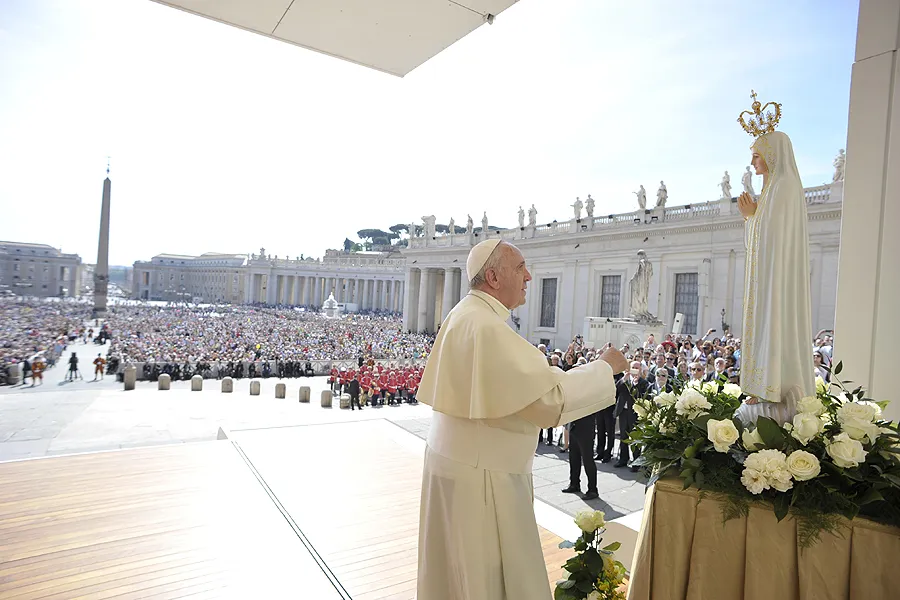
Fatima, Portugal, May 3, 2017 / 03:10 am (CNA/EWTN News).- After a whirlwind trip to Egypt last week, Pope Francis in just 10 days will head to Portugal for the centenary celebration of the Marian apparitions of Fatima, where anticipation is building for the visit of the “bishop in white.”
“The centenary is a memorable, unforgettable date to give thanks to God for all the gifts that the message of Fatima has scattered throughout Portugal, but also in the whole world,” Bishop Antonio dos Santos Marto of Leiria-Fatima told CNA in an interview.
And the centenary celebrations “wouldn’t be complete without the presence of the Pope,” he said, explaining that the Pope “is part of the message of Fatima.”
Pointing to the third “secret” of Our Lady of Fatima, which presents a pilgrim Church that is persecuted and led by a “bishop in white,” Marto said this figure can be understood to be the Pope, who is present in Our Lady’s message.
In her apparitions, Mary also asked for people to pray for the Pope, “so the Pope is part of the message of Fatima,” he said, adding that the fact that several Popes have visited Fatima shows the “catholicity,” or “universality” of Our Lady’s message.
“It’s not only for Portugal, it’s not only for the Church in Portugal, it’s for the entire Church and, I would say, the entire world,” he said. “So people who work here preparing for the Pope’s visit are working with a lot of commitment and a lot of enthusiasm.”
Bishop Marto has overseen the diocese of Leiria-Fatima since 2006, and is in charge of preparing not only for the 100th anniversary of the apparitions of Our Lady of Fatima, but also for the May 12-13 visit of Pope Francis to Fatima for the celebrations.
On May 13, 1917, three shepherd children named Lucia, Jacinta, and Francisco saw a vision of Our Lady of Fatima who was dressed in white and holding a rosary. These apparitions lasted through October of the same year, and brought messages of prayer, repentance, and reparation.
The apparitions were declared of “supernatural character” by the Catholic Church in 1930, and a shrine was erected near the original apparition site in Fatima. Since then, thousands of pilgrims have made their prayerful journeys to Fatima, including three popes: Pope Paul VI, Pope John Paul II, and Pope Benedict XVI.
The bishop said that the diocese has been preparing for the centenary for almost 10 years, since the visit of Pope Benedict XVI in 2010.
Since that visit, the diocese has dedicated each year to one of Our Lady’s apparitions as a lead-in to the centenary, beginning with one year dedicated the message of the angel who appeared to Lucia, Francisco and Jacinta before Mary herself appeared to them.
An angel appeared to the shepherd children three times the year before the Marian apparitions, at one point giving them the Eucharist.
“So it was the theme of the mystery of the trinitarian love of God for the first year,” Bishop Marto said, explaining that each year after that had its own theme based on Mary’s apparitions, complete with a theological points developed through congresses, catechetical studies and a different pilgrim itinerary for each year.
In addition to this, the Fatima shrine has also offered special catechetical themes for parishes focused on the visit of Pope Francis.
The staff of the diocese is currently divided into different working groups that focus on practical preparations such as protocol and logistics, including the details of the papal delegation and the swath of journalists who will travel with the Pope.
Ultimately, the Pope’s visit to Fatima for the centenary of the apparitions will help “to rediscover the richness and beauty of this message for our time,” the bishop said.
The message of Fatima, he said, refers to “the greatest, most tragic events of the 20th century.” Namely, the two World Wars, “with their genocides, millions of innocent victims,” and the persecution at the hands of atheist and totalitarian regimes, which threatened to destroy the Church from view.
“So it was a message of grace, to say that God is with us, he doesn’t abandon us, the mercy of God has a higher limit than the power of evil, and a message of peace,” Marto said. “These three words are the gift Our Lady brings: grace, mercy and peace.”
Our Lady’s appeals for conversion, prayer and reparation are also very timely, he said, noting that even in contemporary society, at times we forget “to make reparation for what was spoiled.”
Using new technologies as an example, he said that today if something we own breaks, we toss it and get a new one, “but you can’t repair the heart like this, throwing it out of the chest.”
“The heart, relationships with others and among people, need reparation, need renewal in the sense of rebuilding, renewing; of re-making even the relationships with God and others,” he said, warning that “sometimes in front of evil, we feel powerless, and there’s a sense of resignation.”
Mary, the bishop said, came “to look for collaborators in the merciful design of God before the power of evil,” which makes her message extremally relevant today, because while there might not be as much persecution from atheist regimes, “there’s the danger of something, in my view, that’s worse: religious indifference.”
“To live as if God didn’t exist. To live with your back to God. The sense of God is lost, and when one loses the sense of God, they also lose the sense of humanity,” he said, explaining that because of this, “the message (of Fatima) is always relevant.”
Bishop Marto also spoke on the coming canonization of Francisco and Jacinta Marto, who will be canonized May 13 during Pope Francis’ Mass at the Fatima shrine, marking the first time in the history of the Church that a child who is not a martyr has been declared a Saint.
“The canonization of the shepherds is a gift,” the bishop said, explaining that the holiness of children is “one of the most beautiful fruits of the apparitions.”
With her initial invitation to the children to “offer yourselves to God in reparation for the sins of the world” and her promise later to Lucia, who became a nun, that “I will never leave you, my Immaculate Heart will be your refuge,” Mary accompanied the children on their entire path to holiness, he said.
“The Madonna guided the children, the shepherds, on this path of holiness. So I think it will be very beautiful for the people to be able to pray to these two saints.”
When asked what Francisco and Jacinta can teach the world today, Bishop Marto said their witness is one of “everyday holiness…they are an example of the holiness of the people, accessible to everyone, to all ages; children, adults, men, women, teenagers, etc.”
They also show us how this holiness is lived with different personalities, he said, noting that while Francisco was more contemplative and united to the suffering experienced by Jesus due to sin, Jacinta was more compassionate and concerned with the salvation of others.
“Francisco was fascinated with the mystery of God, the beauty of the mystery of God, the beauty of the goodness of the love of God that remained inside of him,” the bishop said, explaining that during his time in adoration, Francisco saw the sadness of God due to the sins of the world and chose to accompany him “for hours of praying, meditating, contemplating.”
“He put into action a very urgent dimension of the faith, which is mystic of the faith,” he said, adding that “if we don’t have a loving experience of God, we won’t have a faith that sustains us in the world today.”
“Faith today no longer goes through traditions, it no longer has the support of the traditions of the family, of school, of the culture,” he said, so “it has to be a personal conviction, a personal experience of the presence of God in us.”
Jacinta, on the other hand, was “full of compassion for those who suffered, (and) the poor, whom she prayed for. She had a strong tenderness.”
This tenderness was shown to all who came to her, whether it was by recommending prayers, giving food to those who didn’t have any, or sharing what she had with others, the bishop said.
“Today compassion is very important in the culture of indifference. Each day it’s stronger. What does that one matter to me? Each one makes do (for themselves),” he said. “So this compassion, this ability to suffer with others, to share in the suffering of the other and also to suffer for others,” is crucial.
Previous Post

May 3, 2017
A day in the life of a cardinal
Next Post
May 3, 2017 After visit, Pope Francis says Egypt is a 'sign of hope'
Browse Our Archives
Select a Category Americas Asia - Pacific Europe Middle East - Africa Uncategorized US Vatican
Select a Month November 2017 October 2017 September 2017 August 2017 July 2017 June 2017 May 2017 April 2017 March 2017 February 2017 January 2017 December 2016 November 2016 October 2016 September 2016 August 2016 July 2016 June 2016 May 2016 April 2016 March 2016 February 2016 January 2016 December 2015 November 2015 October 2015 September 2015 August 2015 July 2015 June 2015 May 2015 April 2015 March 2015 February 2015 January 2015 December 2014 November 2014 October 2014 September 2014 August 2014 July 2014 June 2014 May 2014 April 2014 March 2014 February 2014 January 2014 December 2013 November 2013 October 2013 September 2013 August 2013 July 2013 June 2013 May 2013 April 2013 March 2013 February 2013 January 2013 December 2012 November 2012 October 2012 September 2012 August 2012 July 2012 June 2012 May 2012
TAKE THE
Religious Wisdom Quiz
What food did God provide for Israel in the wilderness?
Select your answer to see how you score.
Fish Bread Manna Milk
Related posts from Catholic News

Sixty Vincentians martyred during Spanish Civil War to...

Filipinos gather in Rome to promote bishop's beatification...

UK bishop calls for prayers as MPs urge...

On All Souls' Day, Pope Francis prays for...
TRENDING AT PATHEOS Catholic

The Parable Of The Sower And The Word...
One of Christ’s most famous parables is that of the sower who...

Rejecting Doom: Christian Hope And Human Action
Christianity is a religion of hope. We are to have hope and...

Why I Choose the Eucharist Over the Sermon
Choose the Eucharist, Not the Sermon What are we supposed to get...

5 Design Elements Found in Spiritually Rooted Homes
Putting Spirituality Into Home Decor Our homes are more than our living...

Credo: A Story of God Told with the...
About 10 years ago, I began to imagine a personal "Credo" that...

The Anatomy of Divine Revelation in Catholic Thought
The claim that God has made Himself known to human beings is...
view all Catholic blogs
Ad-Free & Subscriber Log-In Subscription Support
- About Us
- 2026 Calendar
- Videos
- Podcasts
- Library of World Religions
- Faith In Media Tracker
- Advertise With Us
- Write for Us
- Privacy Policy
- Terms of Service
- Do Not Sell My Data
- Contact Us
- Radiant Digital
- Manage Newsletter Subscriptions
- Unsubscribe From Notifications
- Sitemap
Copyright 2008-2026, Patheos. All rights reserved.
Subscription Support Ad-Free & Subscriber Log-In
Follow Patheos