
BuddhistCatholicContemplativeEvangelicalGeneral ChristianHinduJewishLatter-day SaintMuslimNew VisionsProgressive Christian
Beliefs
- Buddhist
- Catholic
- Contemplative
- Evangelical
- General Christian
- Hindu
- Jewish
- Latter-day Saint
- More Voices
- Muslim
- New Visions
- Pagan
- Progressive Christian
Topics
- Religion News
- Food and Religion
- Sports and Religion
- Religious Art
- Religious Music and Entertainment
- Religious Events
- History and Religion
- Style and Religion
- Politics and Religion
- Women in Religion
- Recreation Outdoors and Religion
- Business Finance and Religion
- Careers Workplace and Religion
- Education and Religion
- Family Parenting and Religion
- Health Fitness and Religion
- Home and Religion
- Relationships and Religion
- Technology and Religion
- Travel and Religion
Columnists
- Buddhist Columnists
- Business Finance and Religion Columnists
- Careers Workplace and Religion Columnists
- Catholic Columnists
- Contemplative Columnists
- Education and Religion Columnists
- Evangelists Columnists
- Family Parenting and Religion Columnists
- General Christian Columnists
- Health Fitness and Religion Columnists
- Hindu Columnists
- History and Religion Columnists
- Home and Religion Columnists
- Jewish Columnists
- More Voices Columnists
- Latter Day Columnists
- Muslim Columnists
- New Visions Columnists
- Nonreligious Columnists
- Pagan Columnists
- Politics and Religion Columnists
- Progressive Columnists
- Recreation Outdoors and Religion Columnists
- Relationships and Religion Columnists
- Religion News Columnists
- Religious Art Columnists
- Religious Events Columnists
- Religious Music and Entertainment Columnists
- Sports and Religion Columnists
- Style and Religion Columnists
- Technology and Religion Columnists
- Travel and Religion Columnists
- Women in Religion Columnists
Resource Library
- 2026 Calendar
- Library of World Religions
- The 100 Most Holy Places on Earth
- Patheos Answers
- Podcasts
- Videos
- Faith Leaders Database
- Anglican Episcopalian
- Bahai
- Baptist
- Buddhism
- Christianity
- Confucianism
- Eastern Orthodoxy
- Hinduism
- Holiness and Pentecostal
- ISKCON
- Islam
- Judaism
- Lutheran
- Methodist
- The Church of Jesus Christ of Latter-day Saints
- New Age
- Paganism
- Presbytarian and Reformed
- Protestantism
- Religion Behind the Scenes
- Roman Catholic
- Scientology
- Shia Islam
- Sikhism
- Sufism
- Sunni Islam
- Taoism
- Zen
- See all religions
Research Tools
 Ad-Free & Subscriber Log-In Subscription Support
Ad-Free & Subscriber Log-In Subscription Support
Follow Patheos 

- Trending:
- Forgiveness
- |
- Marriage
- |
- Consciousness
- |
- Death Penalty
- |
- Election
- |
- Halloween
 Catholic News
- Home
- Catholic
- Religion News
- Menorah exhibit in Rome underlines positive Catholic-Jewish relations
Menorah exhibit in Rome underlines positive Catholic-Jewish relations
Last updated on: May 18, 2017 at 9:04 am by CNA Daily News
Menorah exhibit in Rome underlines positive Catholic-Jewish relations 2017-05-18T09:04:00+00:00 CNA Daily News
Patheos Explore the world's faith through different perspectives on religion and spirituality! Patheos has the views of the prevalent religions and spiritualities of the world.
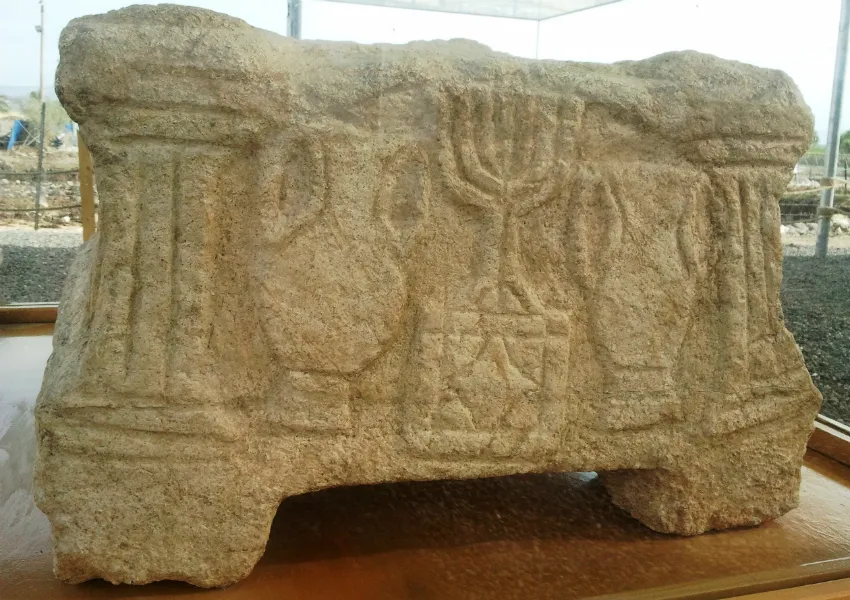
Rome, Italy, May 18, 2017 / 03:04 am (CNA/EWTN News).- At the center of the first joint exhibit between the Vatican Museums and the Jewish museum in Rome is the Magdala Stone, a large decorated stone block from a first century Galilean synagogue which has shed light on synagogue worship before the destruction of the Second Temple.
The Magdala Stone was found during the excavation of an synagogue on the site of what is believed to be Magdala, the hometown of Mary Magdalene. The 4.2 cubic feet limestone block may have been used as a bema, on which the Torah was read.
It is carved on four sides and its top with decorative symbols, most prominently the Menorah which was found in the Jewish Temple – a seven-branch menorah described in Exodus, distinct from the nine-branch menorah associated with Hannukah and the Maccabees.
The stone is the centerpiece of the exhibit “Menorah: Worship, History, and Legend”, shown simultaneously at the Jewish Museum and the Braccio di Carlo Magno Museum in the Vatican, located under the left colonnade in St. Peter’s Square.
The exhibit runs May 15-July 23 and includes roughly 130 pieces, including menorahs from various periods and depictions of them in paintings, sarcophagi, sculptures, and medieval and Renaissance drawings and manuscripts.
This is the first time the Magdala Stone has left Israel or been displayed publicly, and its presence at the Vatican is just “one more sign of the collapsing of the walls between Christianity and Judaism,” in the opinion of Fr. Juan Solana, L.C., General Director of the Magdala Project.
Fr. Solana told CNA that the stone’s presence at the exhibit marks not only an interreligious effort between the Vatican Museums and the Jewish museums in Rome, but also collaboration between Vatican City and the State of Israel.
“I know that it was a lot of work behind the scenes to make it happen,” he explained. “I think it really shows the importance of interreligious dialogue and especially dialogue and friendship between Catholics and Jews.”
Magdala “is very close to Capernaum, in the old area where Jesus preached and taught and performed many miracles,” Fr. Solana said. “So we believe that Jesus went to Magdala and eventually he went to the synagogue and preached there.”
While they can’t know for sure, it is even possible that Christ used the Magdala Stone himself to display scrolls of the Torah.
The town and synagogue were first discovered in 2009 during excavations in preparation for building a Catholic center in Israel. Stalled by the discovery of the site, the Magdala Center, as it is called, is still in the works.
“We found the whole town of Mary Magdalene,” Fr. Solana said; and the cherry on the top, so-to-speak, was the Magdala Stone.
There are seven synagogues known of from the period of Christ's life and more or less 50 years before and after, but in no other synagogue have they found this kind of block, he said.
Archaeologists found a total of three stone blocks in Magdala: one from what was probably a school of the synagogue and one which had been reused as a chair of Moses, the place of authority from which the scribes and Pharisees interpreted the Jewish law. The Magdala Stone was at the center of the synagogue.
The stone is considered important for Judaism because Jewish scholars believe it marks a change within Judaism itself, brought about by the influence of Christianity, Fr. Solana explained.
This is because “Jesus destroyed the idea of the Temple as the center of Judaism,” he said, “and it was confirmed by the destruction of the Temple” in AD 70.
The Magdala Stone and the synagogue both pre-date the destruction of the Temple, which has been confirmed by coins found inside which range from AD 5 to 63 – the time of Christ's life and the first generation of Christians.
Of course, this makes them very important pieces historically, Fr. Solana continued, explaining that the stone itself is a model of the destroyed Temple in Jerusalem. Covered in carvings of Jewish symbols, more even than the Temple itself, it also displays the oldest-known carving of a menorah in Israel.
Previous Post

May 18, 2017
How one cardinal believes euthanasia can be shown as 'toxic'
Next Post
May 18, 2017 Pope to ambassadors: Work for peace amid 'complex' global conflicts
Browse Our Archives
Select a Category Americas Asia - Pacific Europe Middle East - Africa Uncategorized US Vatican
Select a Month November 2017 October 2017 September 2017 August 2017 July 2017 June 2017 May 2017 April 2017 March 2017 February 2017 January 2017 December 2016 November 2016 October 2016 September 2016 August 2016 July 2016 June 2016 May 2016 April 2016 March 2016 February 2016 January 2016 December 2015 November 2015 October 2015 September 2015 August 2015 July 2015 June 2015 May 2015 April 2015 March 2015 February 2015 January 2015 December 2014 November 2014 October 2014 September 2014 August 2014 July 2014 June 2014 May 2014 April 2014 March 2014 February 2014 January 2014 December 2013 November 2013 October 2013 September 2013 August 2013 July 2013 June 2013 May 2013 April 2013 March 2013 February 2013 January 2013 December 2012 November 2012 October 2012 September 2012 August 2012 July 2012 June 2012 May 2012
TAKE THE
Religious Wisdom Quiz
What was an omer's capacity? (Biblical Measurement)
Select your answer to see how you score.
1 quart 3 quarts 2 quarts 4 quarts
Related posts from Catholic News

Sixty Vincentians martyred during Spanish Civil War to...

Filipinos gather in Rome to promote bishop's beatification...

UK bishop calls for prayers as MPs urge...

On All Souls' Day, Pope Francis prays for...
TRENDING AT PATHEOS Catholic

Creation, Preservation, and Teleology in Catholic Theology
As I write this, it is very early Monday morning. Like millions...

The Parable Of The Sower And The Word...
One of Christ’s most famous parables is that of the sower who...

Rejecting Doom: Christian Hope And Human Action
Christianity is a religion of hope. We are to have hope and...

Why I Choose the Eucharist Over the Sermon
Choose the Eucharist, Not the Sermon What are we supposed to get...

5 Design Elements Found in Spiritually Rooted Homes
Putting Spirituality Into Home Decor Our homes are more than our living...

Credo: A Story of God Told with the...
About 10 years ago, I began to imagine a personal "Credo" that...
view all Catholic blogs
Ad-Free & Subscriber Log-In Subscription Support
- About Us
- 2026 Calendar
- Videos
- Podcasts
- Library of World Religions
- Faith In Media Tracker
- Advertise With Us
- Write for Us
- Privacy Policy
- Terms of Service
- Do Not Sell My Data
- Contact Us
- Radiant Digital
- Manage Newsletter Subscriptions
- Unsubscribe From Notifications
- Sitemap
Copyright 2008-2026, Patheos. All rights reserved.
Subscription Support Ad-Free & Subscriber Log-In
Follow Patheos