
BuddhistCatholicContemplativeEvangelicalGeneral ChristianHinduJewishLatter-day SaintMuslimNew VisionsProgressive Christian
Beliefs
- Buddhist
- Catholic
- Contemplative
- Evangelical
- General Christian
- Hindu
- Jewish
- Latter-day Saint
- More Voices
- Muslim
- New Visions
- Pagan
- Progressive Christian
Topics
- Religion News
- Food and Religion
- Sports and Religion
- Religious Art
- Religious Music and Entertainment
- Religious Events
- History and Religion
- Style and Religion
- Politics and Religion
- Women in Religion
- Recreation Outdoors and Religion
- Business Finance and Religion
- Careers Workplace and Religion
- Education and Religion
- Family Parenting and Religion
- Health Fitness and Religion
- Home and Religion
- Relationships and Religion
- Technology and Religion
- Travel and Religion
Columnists
- Buddhist Columnists
- Business Finance and Religion Columnists
- Careers Workplace and Religion Columnists
- Catholic Columnists
- Contemplative Columnists
- Education and Religion Columnists
- Evangelists Columnists
- Family Parenting and Religion Columnists
- General Christian Columnists
- Health Fitness and Religion Columnists
- Hindu Columnists
- History and Religion Columnists
- Home and Religion Columnists
- Jewish Columnists
- More Voices Columnists
- Latter Day Columnists
- Muslim Columnists
- New Visions Columnists
- Nonreligious Columnists
- Pagan Columnists
- Politics and Religion Columnists
- Progressive Columnists
- Recreation Outdoors and Religion Columnists
- Relationships and Religion Columnists
- Religion News Columnists
- Religious Art Columnists
- Religious Events Columnists
- Religious Music and Entertainment Columnists
- Sports and Religion Columnists
- Style and Religion Columnists
- Technology and Religion Columnists
- Travel and Religion Columnists
- Women in Religion Columnists
Resource Library
- 2026 Calendar
- Library of World Religions
- The 100 Most Holy Places on Earth
- Patheos Answers
- Podcasts
- Videos
- Faith Leaders Database
- Anglican Episcopalian
- Bahai
- Baptist
- Buddhism
- Christianity
- Confucianism
- Eastern Orthodoxy
- Hinduism
- Holiness and Pentecostal
- ISKCON
- Islam
- Judaism
- Lutheran
- Methodist
- The Church of Jesus Christ of Latter-day Saints
- New Age
- Paganism
- Presbytarian and Reformed
- Protestantism
- Religion Behind the Scenes
- Roman Catholic
- Scientology
- Shia Islam
- Sikhism
- Sufism
- Sunni Islam
- Taoism
- Zen
- See all religions
Research Tools
 Ad-Free & Subscriber Log-In Subscription Support
Ad-Free & Subscriber Log-In Subscription Support
Follow Patheos 

- Trending:
- Forgiveness
- |
- Marriage
- |
- Consciousness
- |
- Death Penalty
- |
- Election
- |
- Halloween
 Catholic News
- Home
- Catholic
- Religion News
- In Genoa, Pope challenges workers, religious and youth
In Genoa, Pope challenges workers, religious and youth
Last updated on: May 27, 2017 at 12:02 pm by CNA Daily News
In Genoa, Pope challenges workers, religious and youth 2017-05-27T12:02:00+00:00 CNA Daily News
Patheos Explore the world's faith through different perspectives on religion and spirituality! Patheos has the views of the prevalent religions and spiritualities of the world.
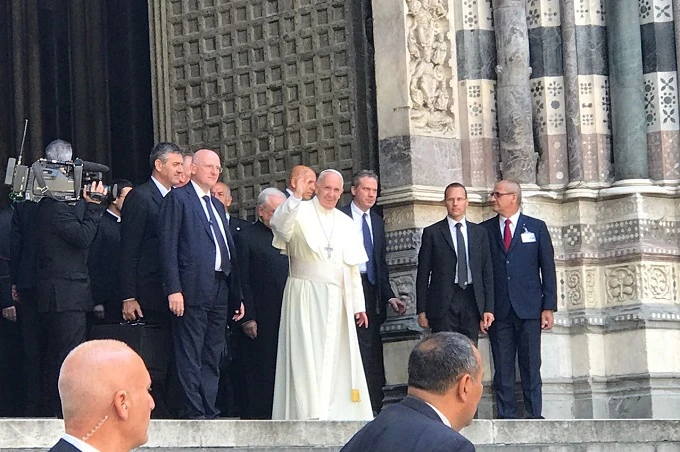
Vatican City, May 27, 2017 / 06:02 am (CNA/EWTN News).- On Saturday Pope Francis paid a visit to the Italian diocese of Genoa, where he had lengthy Q&A sessions with youth, the city’s working class, and their bishops, priests and religious, challenging them and offering antidotes to modern problems.
After landing just around 8a.m. local time May 27, the Pope was greeted by Genoa’s archbishop, Cardinal Angelo Bagnasco, who just finished his term as president of the Italian Bishops Conference. He was replaced by Cardinal Gualtiero Bassetti, archbishop of Perugia.
Once he left the airport, Francis immediately went to a warehouse where he met with the city’s workers. Afterward, he met the diocese’s bishops, priests and religious at the city’s cathedral before heading to a special shrine where he spoke with youth.
In each of the meetings Pope Francis responded to questions, taking his time to respond well to each of their concerns.
After the meetings, he is slated to eat lunch with the poor, refugees and prisoners before greeting sick children at the Pediatric Gianna Gaslini Hospital. The Pope made a phone call to the hospital earlier this week to tell the children that he was coming to see them, and assured them that Jesus is always with us difficult moments.
Established in 1931, the hospital is linked to the University of Genoa and is considered as one of the most prestigious children’s hospitals in Europe. It has formally recognized as a scientific institute for research, hospitalization and healthcare.
After greeting the children, Pope Francis will head to the city’s Kennedy Square to celebrate Mass before returning to Rome.
Workers
In his audience with the workforce, Francis responded to four questions: one from an entrepreneur, the head of a company, who asked for a word of encouragement in his responsibilities; two questions from workers on how to recover from the economic crisis and how to avoid careerism and foster fraternity, and one question from an unemployed woman who asked how to stay strong despite challenges of not having consistent work.
In his responses, Francis said that in the world today, work today is “at risk,” because “it’s a world where work isn’t considered with the dignity it has and gives.” Work, he said, “is a human priority,” and because of this, “it’s a Christian priority, and also a priority of the Pope!”
Speaking inside a warehouse, the Pope said he wanted to meet with them there because the Church is where the people are, “in your places of work, in the places where you are.”
In his response to the first question, the Pope said, “there is no good economy without good businessmen,” adding that they are “the figure of a good economy,” since society functions well when there are honest and caring people in charge.
He cautioned against the temptation to do one’s work well just because they get paid to do it, saying this mentality is an injustice to the working system, “because it negates the dignity of work, which begins with working for dignity, for honor.”
On the other hand, a good boss “knows his workers, because he works beside them, with them,” the Pope said. “Let’s not forget that a businessman above all must be a worker. If he doesn’t have this sense of the dignity of work, he won’t be a good businessman.”
The Pope then warned against the temptation to solve problems in a company by firing people, explaining that a person who does this “is not a businessman, he is a commercialist. Today he sells his employees, tomorrow he sells his own dignity.”
“A sickness of the economy is the progressive transformation of workers into speculators, profiteers,” he said, adding that “workers must absolutely not be confused with profiteers,” because they are different things.
Profiteers, he said, “eat” people, leaving the economy abstract and “without a face.” In addition, laws intended to help the honest then end up penalizing the honest and profiting the corrupt.
He also warned the workers against competition in the workplace, calling it “an anthropological and Christian error,” as well as an “economic error,” since it forces people to work against each other.
Too much competition destroys the “fabric of trust” that binds every organization, he said, noting that when a crisis arrives, “the company implodes” because there is no longer a sense of collegiality uniting it.
Francis then issued a stern warning against the “non-virtue” of meritocracy, referring to the political philosophy that power ought to be invested in individuals solely based on their abilities and talents.
This attitude “denatures” the human being and creates inequality, he said, explaining that under this mentality the poor are faulted for their disadvantage and the rich are “exonerated.”
On the economic crisis, Francis noted that with unemployment, there often come illegal contracts and inhumane working conditions.
He noted that many people are forced into working 11 hours a day for just 800 euro a month, or they are paid illegally under the table with no contract or benefits.
In these cases, work becomes about survival, he said, noting that while this is part of is, work is about “much, much more,” because by working, “we become more human,” since we participate in God’s act of creation.
“Work is man’s friend, and man is work’s friend,” he said, explaining that there are few joys greater than what one experiences in a good and healthy workplace, and there are fewer sorrows than when one work harms, exploits or even “kills” people.
He pointed to the societal paradox that there is an increasing number of people who are unemployed but want to work, and that there are fewer and fewer people who work too much and want time off.
This is based on the logic of consumption, Francis said, calling it “an idol of our time” that eventually leads us to worship “pure pleasure,” rather than appreciating the value of “fatigue and sweat,” which are the backbone of work.
Bishops, Priests and Religious
Pope Francis opened his nearly 2-hour conversation with bishops, priests, religious and seminarians by leading them in a moment of silent prayer for the victims of yesterday’s attack on Coptic Christians in Egypt, that killed 28.
After then reciting a Hail Mary for the deceased, the wounded and their families, the Pope took four questions on how to maintain a good spiritual life daily, how to keep the charism of an order fresh as time passes, how to foster priestly brotherhood and what to do about the current vocational crisis.
When it comes to having a good spiritual life, the Pope said two things are essential: a constant encounter with God through prayer, and being close to the people.
He noted that the world today is constantly “in a hurry,” and that it’s often difficult to take time to be with people and listen to their problems and concerns. But this doesn’t mean being inactive, he said, adding that “I am afraid of static priests.”
Priests who are obsessed with structure and organization are better “businessman” than pastors, he said, noting that they might pray and celebrate Mass, Jesus himself was “always a man on the street,” in the midst of his people and “open to the surprises of God.”
There’s a certain tension between these two extremes, he said, but urged consecrated people to “not be afraid of this tension,” because it’s a sign of “vitality” and movement.
He told priests to be flexible in their prayer, always seeking a true encounter with God, and urged them to allow themselves to “get worn out be the people,” and not to “defend your own tranquility,” since Jesus himself prioritized relationships with the people, yet always set aside time to be with his Father.
When it comes to fostering a stronger sense of brotherhood among priests, the Pope said that first of all this means letting go of “that image of the priest who knows everything,” and who doesn’t need the input of others.
Self-sufficiency does a lot of harm to a consecrated person, he said, and asked the priests and religious how many times during a meeting they stop paying attention to what a fellow brother or sister is saying, and let their minds to “into orbit” with other things.
Even if what the other person says isn’t necessarily of immediate interest, it’s important to pay attention, he said, explaining that each person “is a richness.” He told them to look for moments to pray together, go for lunch or play sports together, which all help to form stronger ties.
He also warned against “murmuring” and “jealousy,” noting that at times when he reviews information collected on possible candidates for bishops, “you find true calumny or opinions that could be serious calumny but which devalue the priest.”
To speak poorly of a brother is to “betray” him, Francis said, and warned, as he often does, about the dangers of gossip and the importance of forgiveness.
When it comes to keep charisms fresh, the Pope emphasized the importance of staying attached to the concrete realities of a diocese or project.
While a congregation might be “universal” in the sense that it has houses throughout the world, the “concreteness” of involvement in the helps give the order “roots,” allowing it to stay remain and also to grow as they see different needs come up.
On the vocational crisis, Francis immediately pointed out the low birthrate in Europe, particularly Italy, saying the lack of vocations is also tied to the “demographic problem” that people don’t want to get married or have children.
“If there are no young men and women, there are no vocations,” he said, explaining that while this is not the only reason for the crisis, it’s something that must be kept in mind.
He also stressed the importance of looking critically at what is happening in the world and posing the question: “what is the Lord asking right now?”
“The vocational crisis is affecting the entire Church,” including the priesthood, religious life and even marriage, he said, noting that many young couples don’t want to commit themselves to the vocation of marriage, but instead prefer to cohabitate.
Give the widespread nature of the crisis, “it’s a time to ask ourselves, to ask the Lord, what must we do? What must we change?” he said, adding that “to face the problems is necessary, (but) to learn from problems is obligatory.”
His words have a special resonance given that the next Synod of Bishops, set to take place in October 2018, will address the topic: “Young People, Faith and the Discernment of Vocation.”
Francis cautioned against the temptation of “conquest” when it comes to filling empty convents and seminaries, stressing that true vocational work “is hard, but we must do it.”
“It’s a challenge, but we must be creative,” he said, and emphasized the importance of bearing personal witness through the living of one’s own vocation, which “is key” to showing youth how rewarding a life offered for Christ and others can be.
Youth
In a meeting with youth at Genoa’s Sanctuary of Our Lady of the Guard, he also took questions from four youth, two boys and two girls, telling them he wouldn’t give them “pre-made answers,” but personal answers.
In their questions, the youth asked how to be a missionary in the face modern challenges; how to go beyond modern distractions and love those in difficulty and crisis around us; how to have a strong prayer and spiritual life, and how to have sincere relationships in a culture of indifference.
Francis said that being a missionary above all “means letting yourself be transformed by the Lord.
“Normally when we live these activities, we are joyful when things go well, and this is good, but there is another transformation that you don’t see, it’s hidden and is born in the lives of all of us,” he said, adding that to be a missionary “allows us to learn how to look, how to see with new eyes.”
He told the youth to stop being “tourists,” many of whom come to the city and take pictures of everything, but “don’t look at anything.”
“To look at life with the eyes of tourists is superficial…it means I don’t touch reality, I don’t see things as they are,” he said, noting that going on mission helps us to go beyond the superficial and “draw near to the heart of another…and it destroys hypocrisy.”
For adults, but especially for youth to have this attitude, “is suicide. Understand? It’s suicide,” he said, stressing that accepting Jesus’ invitation to me a missionary helps us to look at each other in the eye and purifies us from seeing the Church divided into the “good” and the “bad.”
He said that to respond to the needs of people in difficulty – the poor, migrants, homeless and unemployed – we must first of all “love them. We can’t do anything without love.”
No matter how many projects we set up or are involved in, it’s useless without love he said, explaining that whenever he can he likes to ask people, when they give to the poor, if they “touch the hand of the person” they give to, or if they pull back immediately.
Love, he said, is the ability to take hold of the “dirty hand” and to look at people in situations of drugs, poverty and hardship, and to say that “for me, you are Jesus.”
Pope Francis said focusing on the person who has been wounded and excluded, rather than their situation, is part of “the madness of the faith,” and of the announcement of Jesus.
He told the youth to never ignore people or “make the person into an adjective,” calling them a “drunk,” because they are a person with a name. “Never make people into adjectives!” he said, adding that “God is the only one who can judge, and he will do it in the Final Judgement for each one of us.”
Giving advice for how to have a strong spiritual life, the Pope tied the his answer to the city’s link with boaters and sailors, telling them that if they want to be a good disciple, “you need the same heart as a navigator: a horizon and courage.”
“If you don’t have a horizon…you will never be a good missionary,” he said, and warned against the distractions new media technologies bring.
“You have the opportunity to know everything with new technologies, but these information technologies make you fall into a canal many times, because instead of informing us, the saturate us,” he said, adding that when you are saturated, the horizon “gets closer and closer” and soon “you have a wall in front of you.”
When this happens, the horizon is lost as is the ability to contemplate, he said, and told the youth to take time to contemplate and make good decisions, instead of eating whatever is put in front of them.
He also urged the youth to question what has become almost routine in today’s “normal culture,” using smoking as an example. Instead of just accepting that this is normal, he told them to ask themselves: “is this normal, or is this not normal?” and to “have courage to seek the truth.”
At the close of his meeting with youth, Francis offered a special greeting to prisoners of watching the meeting via television before heading to lunch with poor, refugees, homeless and prisoners from Genoa.
Previous Post

May 27, 2017
In Iraq, necessity makes priests become engineers
Next Post
May 27, 2017 Pope Francis: Jesus intercedes for us – every day, every moment
Browse Our Archives
Select a Category Americas Asia - Pacific Europe Middle East - Africa Uncategorized US Vatican
Select a Month November 2017 October 2017 September 2017 August 2017 July 2017 June 2017 May 2017 April 2017 March 2017 February 2017 January 2017 December 2016 November 2016 October 2016 September 2016 August 2016 July 2016 June 2016 May 2016 April 2016 March 2016 February 2016 January 2016 December 2015 November 2015 October 2015 September 2015 August 2015 July 2015 June 2015 May 2015 April 2015 March 2015 February 2015 January 2015 December 2014 November 2014 October 2014 September 2014 August 2014 July 2014 June 2014 May 2014 April 2014 March 2014 February 2014 January 2014 December 2013 November 2013 October 2013 September 2013 August 2013 July 2013 June 2013 May 2013 April 2013 March 2013 February 2013 January 2013 December 2012 November 2012 October 2012 September 2012 August 2012 July 2012 June 2012 May 2012
TAKE THE
Religious Wisdom Quiz
Who played the harp for King Saul?
Select your answer to see how you score.
Asaph Solomon David Samuel
Related posts from Catholic News

How do we help trafficking victims re-enter society?...

More than just giving – World Day of...

New book reveals details of John Paul I’s...

Despite reports, Pope Francis isn’t opening the door...
TRENDING AT PATHEOS Catholic

Creation, Preservation, and Teleology in Catholic Theology
As I write this, it is very early Monday morning. Like millions...

The Parable Of The Sower And The Word...
One of Christ’s most famous parables is that of the sower who...

Rejecting Doom: Christian Hope And Human Action
Christianity is a religion of hope. We are to have hope and...

Why I Choose the Eucharist Over the Sermon
Choose the Eucharist, Not the Sermon What are we supposed to get...

5 Design Elements Found in Spiritually Rooted Homes
Putting Spirituality Into Home Decor Our homes are more than our living...

Credo: A Story of God Told with the...
About 10 years ago, I began to imagine a personal "Credo" that...
view all Catholic blogs
Ad-Free & Subscriber Log-In Subscription Support
- About Us
- 2026 Calendar
- Videos
- Podcasts
- Library of World Religions
- Faith In Media Tracker
- Advertise With Us
- Write for Us
- Privacy Policy
- Terms of Service
- Do Not Sell My Data
- Contact Us
- Radiant Digital
- Manage Newsletter Subscriptions
- Unsubscribe From Notifications
- Sitemap
Copyright 2008-2026, Patheos. All rights reserved.
Subscription Support Ad-Free & Subscriber Log-In
Follow Patheos