
BuddhistCatholicContemplativeEvangelicalGeneral ChristianHinduJewishLatter-day SaintMuslimNew VisionsProgressive Christian
Beliefs
- Buddhist
- Catholic
- Contemplative
- Evangelical
- General Christian
- Hindu
- Jewish
- Latter-day Saint
- More Voices
- Muslim
- New Visions
- Pagan
- Progressive Christian
Topics
- Religion News
- Food and Religion
- Sports and Religion
- Religious Art
- Religious Music and Entertainment
- Religious Events
- History and Religion
- Style and Religion
- Politics and Religion
- Women in Religion
- Recreation Outdoors and Religion
- Business Finance and Religion
- Careers Workplace and Religion
- Education and Religion
- Family Parenting and Religion
- Health Fitness and Religion
- Home and Religion
- Relationships and Religion
- Technology and Religion
- Travel and Religion
Columnists
- Buddhist Columnists
- Business Finance and Religion Columnists
- Careers Workplace and Religion Columnists
- Catholic Columnists
- Contemplative Columnists
- Education and Religion Columnists
- Evangelists Columnists
- Family Parenting and Religion Columnists
- General Christian Columnists
- Health Fitness and Religion Columnists
- Hindu Columnists
- History and Religion Columnists
- Home and Religion Columnists
- Jewish Columnists
- More Voices Columnists
- Latter Day Columnists
- Muslim Columnists
- New Visions Columnists
- Nonreligious Columnists
- Pagan Columnists
- Politics and Religion Columnists
- Progressive Columnists
- Recreation Outdoors and Religion Columnists
- Relationships and Religion Columnists
- Religion News Columnists
- Religious Art Columnists
- Religious Events Columnists
- Religious Music and Entertainment Columnists
- Sports and Religion Columnists
- Style and Religion Columnists
- Technology and Religion Columnists
- Travel and Religion Columnists
- Women in Religion Columnists
Resource Library
- 2026 Calendar
- Library of World Religions
- The 100 Most Holy Places on Earth
- Patheos Answers
- Podcasts
- Videos
- Faith Leaders Database
- Anglican Episcopalian
- Bahai
- Baptist
- Buddhism
- Christianity
- Confucianism
- Eastern Orthodoxy
- Hinduism
- Holiness and Pentecostal
- ISKCON
- Islam
- Judaism
- Lutheran
- Methodist
- The Church of Jesus Christ of Latter-day Saints
- New Age
- Paganism
- Presbytarian and Reformed
- Protestantism
- Religion Behind the Scenes
- Roman Catholic
- Scientology
- Shia Islam
- Sikhism
- Sufism
- Sunni Islam
- Taoism
- Zen
- See all religions
Research Tools
 Ad-Free & Subscriber Log-In Subscription Support
Ad-Free & Subscriber Log-In Subscription Support
Follow Patheos 

- Trending:
- Forgiveness
- |
- Marriage
- |
- Consciousness
- |
- Death Penalty
- |
- Election
- |
- Halloween
 Catholic News
- Home
- Catholic
- Religion News
- Vatican praised, cautioned on dialogue with al-Azhar university
Vatican praised, cautioned on dialogue with al-Azhar university
Last updated on: April 28, 2017 at 3:01 am by CNA Daily News
Vatican praised, cautioned on dialogue with al-Azhar university 2017-04-28T03:01:00+00:00 CNA Daily News
Patheos Explore the world's faith through different perspectives on religion and spirituality! Patheos has the views of the prevalent religions and spiritualities of the world.
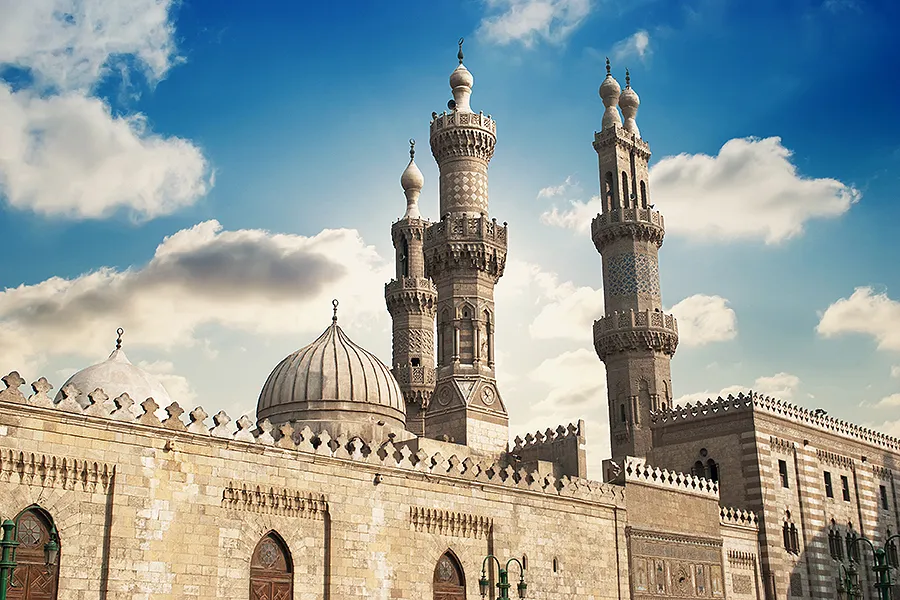
Rome, Italy, Apr 27, 2017 / 09:01 pm (CNA/EWTN News).- A leading scholar in the Arab world has applauded the goodwill of both the Vatican and the prestigious Islamic al-Azhar university Pope Francis will visit for aiming to increase Catholic-Muslim dialogue.
But she also issued a warning that goodwill isn't enough for things to change.
“Dialogue is good, generally any dialogue is good. Any kind of debate and any steps to show goodwill, to show a commitment, to show a recognition of the other in principle is very good,” Mariz Tadros told CNA in an interview.
However, “the extent to which this will translate into a change in eliminating or reducing the appeal of militant Islam, that’s what I’m questioning.”
Tadros, who spoke over Skype from the U.K., is an author and scholar on persecution in the Arab world. She is currently a fellow at the Institute of Development Studies at Sussex University in the U.K.
She spoke ahead of Pope Francis' April 28-29 visit to Cairo, where he is set to meet with Coptic Pope Tawadros II and the Grand Imam of the Mosque of al Azhar, Sheikh Ahmed Mohamed el-Tayyib, as well as Egypt's president Abdel Fattah el-Sisi and the bishops of the local Catholic Church.
His visit comes as the result of a recent thawing in relations between the Vatican and the al-Azhar University, which had been strained since 2011. The imam of al-Azhar is considered by some Muslims to be the highest authority the 1.5-billion strong Sunni Muslim world and oversees Egypt’s al-Azhar Mosque and the prestigious University attached to it.
Dialogue picked up between the two after el-Tayyib visited the Vatican in May 2016 with a message condemning the acts of Islamic fundamentalism, culminating a year later in the Pope’s visit to Egypt this weekend.
However, in addition to the heightened prospect for dialogue, the trip will also have an inevitable undertone of the very real risks Christians still face in Egypt, particularly from extremist factions of militant Islam.
While Catholic-Muslim dialogue has picked up over the past year, so have attacks against Coptic Christians.
According to His Grace Bishop Angaelos, general bishop of the Coptic Orthodox Church in the United Kingdom, there have been at least 40 reported murders of Christians in Egypt in the past four months alone.
In February 2015, Egyptian society was shocked by the grisly beheading 20 Orthodox Coptic faithful in Libya carried out by ISIS, the video of which was circulated online. The extremists have also claimed responsibility for several other high-profile attacks, including a bombing at St. Mark’s Coptic Orthodox Cathedral in Cairo in December that killed 29 people.
Most recently, ISIS claimed responsibility for twin bombings in Tanta and Alexandria April 9 that left some 45-people dead. The blasts took place on Palm Sunday, one of the holiest days in the Christian calendar commemorating Jesus’ entrance into Jerusalem before his Passion and Death.
With these attacks looming closely in the rear-view mirror, many are asking whether the Pope’s attention to dialogue with Islam, particularly his relationship with al-Azhar and his trip to Egypt, will make a difference.
The debate surrounding al-Azhar
According to Tadros, the prospect of any dialogue is good and shouldn’t be discouraged. However, she cautioned that despite the well-intentioned gesture of meeting with the Pope and cementing good relations with the Holy See, there is still cause for concern regarding al-Ahar – particularly the university's duplicitous curriculum.
“When we look at institutions such as al-Azher, there have been many Egyptian non-Islamist Muslims, very progressive Muslims, who have sought to hold al-Azhar accountable for the duality of its discourse,” she said.
On one hand, “al-Azhar will sit with you and say we love you, we care for you, we’re all one citizenship, we’re all one people.” But on the other hand, “if you look at the syllabi, what they are teaching the generations of scholars that graduate from that university about the religious other, it is horrendous.”
What they are teaching is “undoubtedly a message that these are infidels, and at best they should be tolerated and at worst, killing them is not such a travesty.”
If one actually looks at what comes out of al-Azhar, “there’s a massive, massive disconnect between the public discourse and what is being taught to people across the country,” she said, explaining that there have been several moderate Muslim activists who have called on the university to reform their syllabi, including a man who was jailed for his activism, but who has recently been released.
While al-Azhar is seen by many militant Islamic groups as lacking legitimacy for not following the “right path” of Islam, others have criticized the university for failing to speak out strongly enough when condemning extremist groups such as ISIS.
Many have asked al-Azhar to put their money where their mouth is, so to speak, and declare ISIS as “un-Islamic.” In short, it's no longer good enough to simply condemn what they are doing, but the entity itself must be recognized as not being faithful to the Muslim religion.
“As a Christian you can tell me, 'if you lie that is not consistent with Christianity,' but you are not telling me, 'for shooting people in the name of Christianity, you no longer belong to Christianity.' Do you see the difference?” Tadros said.
But when it comes to Al-Azhar, they have “consistently cowed away from declaring ISIS as not part of the Islamic community.”
Although some might say making such a declaration is playing into the game of name-calling and labeling one another as infidels, Tadros stressed that “unless you tell the broader international community that those who kill and maim and commit genocide in the name of Islam no longer are part of the Islamic community, they do not have the right to claim themselves as Muslim,” nothing will change.
That, she said, is “a very different story and they have cowed away from doing that.”
Tadros clarified that she is “in no way” saying that dialogue between Pope Francis and al-Tayeeb isn’t good or that it shouldn’t happen. “All I’m saying is let’s not count on that as a way of making militant Islam less appealing.”
She stressed that there are “a lot of Muslims” that have shown solidarity with Christians in Egypt, including speaking out on their behalf after the most recent bombings earlier this month, proving that not all Muslims espouse the radical views of ISIS or other like-minded branches.
However, while not all Muslims are extremists, she said history has proven that no matter how much dialogue is done, fundamentalism will never entirely disappear from Islam.
When asked if she thought this was a realistic eventual outcome of the dialogue between the Vatican and al-Azhar, she said “absolutely not.”
“I think that is the biggest myth that exists in the West and it’s a myth that history has dispelled and is it a myth, the perpetuation of which, only serves to increase the vulnerability of religious minorities in the Middle East. In fact, I would say it directly contributes to it.”
The growing threat of militant Islam “is one that we should not take lightly,” she said, “because they are networked.”
“Even though organizationally they follow different leaders, there are links between them, they are well-resourced, they are recruiting people globally from around the world, and they represent an existential threat to Christians and religious pluralism and all kinds of pluralism in the region.”
So while the importance of dialogue as an expression of finding common values and forging friendships across religions should be appreciated, it should only be valued to the extent that true goodwill and respect for the religious other result, she said.
“But I do support those who challenge their effectiveness in making militant Islam more appealing or undermining its power and influence and implications for Christian minorities.”
A history of persecution
Christian persecution has happened on and off for centuries in Egypt, but this intolerance recently spiked in the 1970s under President Anwar Sadat, who empowered radical Islamists, but was assassinated by fundamentalist army officers in 1981.
A period of higher tolerance ensued after Sadat's death, but attacks targeting Christians picked back up during the Egyptian Revolution of 2011.
The 2011 revolution, part of the Arab Spring, had overthrown Hosni Mubarak, a military officer who had been Egypt's president since 1981. The following year Morsi, of the Islamist movement the Muslim Brotherhood, became the first democratically elected Egyptian president.
On July 3, 2013, Egypt's military ousted Morsi, and in August began a crackdown on the Muslim Brotherhood. Violence then spread across the country, with Islamists killing hundreds of people from August to October. Churches were vandalized, burned, and looted, as were the homes and businesses of Christians.
In January 2014, the interim government approved a new constitution, leading to the May 2014 election of Abdel Fattah el-Sisi as the country’s new president. The elections were boycotted by the Muslim Brotherhood as well as other political groups.
Tadros explained that part of the chaos after the revolution was due to “a complete breakdown in public safety and law and order” in which police left the streets and organized groups of “thugs” took over, meaning public safety was no longer a guarantee.
With a lack of secure borders given the crisis in Egypt and the collapse of nearby Libya, extremists became emboldened, and began smuggling and trading weapons with greater confidence and ease.
Radical Islam also began to take on different forms in this time, Tadros said, explaining that whereas previously terrorists were homegrown and committed smaller acts of violence, the rise of factions such as ISIS looking to impose maximum damage through suicide bombs is new.
“The fact that ISIS is now a player is a game-changer,” she said, explaining that with an increase in deadly attacks, there is greater need for security. However, she voiced doubt that the current state of emergency declared by el-Sisi in wake of the April 9 bombings will be effective in terms of protecting Copts.
From a scholarly and historic point of view, emergency law has done nothing, she said, noting that it was implemented by both Mubarak and Morsi when they were in power, “and in both cases it was not conducive to the well-being of the Egyptian population in general.”
Since his election el-Sisi has been praised for receiving representatives from both the Orthodox and Catholics, as well as Protestants.
However, even though the situation has “officially” improved under el-Sisi, who has said and done the right things, Tadros said the improvement is due not so much to el-Sisi’s efforts as it is to the fact that Morsi was driven from power.
“The situation under el-Sisi is very complicated, because on the one hand there is an improvement in the Copts’ everyday experience. Not directly as a consequence of any of el-Sisi's policies by any stretch of the imagination, but it is an unintended outcome of ousting Morsi,” she said.
“Never in the modern history of the Copts have they been such a target of militant targeting as they are today,” she said, explaining that if fundamentalists want to target Copts, there is realistically little that can be done to stop them.
How can Christians be helped?
With Christians in Egypt increasingly becoming a target of systematic violence and a bleak prospect of effective help from the government, Tadros suggested several things that can be done now to help the 9 million-strong Coptic community in Egypt.
First, “security is crucial,” she said, explaining that the ability to ensure basic protection of schools, places of worship such as churches and monasteries, and faith-based organizations, “is extremely important.”
Another essential help is “drying out the sources of funding,” Tadros said, noting that currently “we do have a problem with Saudi Arabia, Qatar and other Arab countries funding Islamist movements.”
“They have to be named and shamed, and even if it goes to the point of economic sanctions against any country that funds Islamist movements, that would significantly help the Christians,” she said, adding that this is “one of those unintended outcomes: if you remove their sources of income, they can’t buy arms, and therefore their ability to strike is significantly decreased.”
A third option Tadros mentioned is the growth and promotion of solidarity among the different churches in the region. As an example, the scholar noted how Pope Francis called Coptic Pope Tawadros personally to offer his sympathies after the April 9 attacks.
“We need to see more of that,” she said, stressing the need for Christians of all rites and practices to band together, because “divided we fall, united we’re strong.”
Finally, she pointed to the importance of raising awareness in international Christian communities of the “existential threat” that Christians in the Middle East face.
“We’re no longer talking about what we saw in Egypt four or five years ago where it’s a number of Muslim mobs burning a number of houses,” she said. “We are now talking about a broader, new strategic plan to eliminate Christianity from the region.”
The global community, she said, needs to “raise awareness and sensitize their congregations of the need to support the churches in the Middle East” in various ways, such as through prayer and concrete initiatives that will help those who have lost everything to rebuild their lives.
Another important aspect is “strengthening local Christian civil society,” she said, “because sometimes Church leadership, such as in the case of Egypt, find themselves in a position where they can’t come out and criticize governments, there’s too much at stake.”
“So you need Christian civil society that play the role of monitoring the situation, raising alarm bells when they see signs of genocide and of strengthening local initiatives.”
Holding governments accountable is also part of the equation, she said, sometimes by “criticizing the government, and sometimes mobilizing against government policy if it’s not going to be conducive to citizenship.”
Previous Post

April 27, 2017
Revised health care bill still has 'serious flaws', US bishops maintain
Next Post
April 28, 2017 Utah bishop exhorts faithful to evangelization, renewal
Browse Our Archives
Select a Category Americas Asia - Pacific Europe Middle East - Africa Uncategorized US Vatican
Select a Month November 2017 October 2017 September 2017 August 2017 July 2017 June 2017 May 2017 April 2017 March 2017 February 2017 January 2017 December 2016 November 2016 October 2016 September 2016 August 2016 July 2016 June 2016 May 2016 April 2016 March 2016 February 2016 January 2016 December 2015 November 2015 October 2015 September 2015 August 2015 July 2015 June 2015 May 2015 April 2015 March 2015 February 2015 January 2015 December 2014 November 2014 October 2014 September 2014 August 2014 July 2014 June 2014 May 2014 April 2014 March 2014 February 2014 January 2014 December 2013 November 2013 October 2013 September 2013 August 2013 July 2013 June 2013 May 2013 April 2013 March 2013 February 2013 January 2013 December 2012 November 2012 October 2012 September 2012 August 2012 July 2012 June 2012 May 2012
TAKE THE
Religious Wisdom Quiz
What does "Salem" (as in Melchizedek, king of Salem) mean?
Select your answer to see how you score.
Joy Peace Ark Light
Related posts from Catholic News

Sixty Vincentians martyred during Spanish Civil War to...

Filipinos gather in Rome to promote bishop's beatification...

UK bishop calls for prayers as MPs urge...

On All Souls' Day, Pope Francis prays for...
TRENDING AT PATHEOS Catholic

Creation, Preservation, and Teleology in Catholic Theology
As I write this, it is very early Monday morning. Like millions...

The Parable Of The Sower And The Word...
One of Christ’s most famous parables is that of the sower who...

Rejecting Doom: Christian Hope And Human Action
Christianity is a religion of hope. We are to have hope and...

Why I Choose the Eucharist Over the Sermon
Choose the Eucharist, Not the Sermon What are we supposed to get...

5 Design Elements Found in Spiritually Rooted Homes
Putting Spirituality Into Home Decor Our homes are more than our living...

Credo: A Story of God Told with the...
About 10 years ago, I began to imagine a personal "Credo" that...
view all Catholic blogs
Ad-Free & Subscriber Log-In Subscription Support
- About Us
- 2026 Calendar
- Videos
- Podcasts
- Library of World Religions
- Faith In Media Tracker
- Advertise With Us
- Write for Us
- Privacy Policy
- Terms of Service
- Do Not Sell My Data
- Contact Us
- Radiant Digital
- Manage Newsletter Subscriptions
- Unsubscribe From Notifications
- Sitemap
Copyright 2008-2026, Patheos. All rights reserved.
Subscription Support Ad-Free & Subscriber Log-In
Follow Patheos