
BuddhistCatholicContemplativeEvangelicalGeneral ChristianHinduJewishLatter-day SaintMuslimNew VisionsProgressive Christian
Beliefs
- Buddhist
- Catholic
- Contemplative
- Evangelical
- General Christian
- Hindu
- Jewish
- Latter-day Saint
- More Voices
- Muslim
- New Visions
- Pagan
- Progressive Christian
Topics
- Religion News
- Food and Religion
- Sports and Religion
- Religious Art
- Religious Music and Entertainment
- Religious Events
- History and Religion
- Style and Religion
- Politics and Religion
- Women in Religion
- Recreation Outdoors and Religion
- Business Finance and Religion
- Careers Workplace and Religion
- Education and Religion
- Family Parenting and Religion
- Health Fitness and Religion
- Home and Religion
- Relationships and Religion
- Technology and Religion
- Travel and Religion
Columnists
- Buddhist Columnists
- Business Finance and Religion Columnists
- Careers Workplace and Religion Columnists
- Catholic Columnists
- Contemplative Columnists
- Education and Religion Columnists
- Evangelists Columnists
- Family Parenting and Religion Columnists
- General Christian Columnists
- Health Fitness and Religion Columnists
- Hindu Columnists
- History and Religion Columnists
- Home and Religion Columnists
- Jewish Columnists
- More Voices Columnists
- Latter Day Columnists
- Muslim Columnists
- New Visions Columnists
- Nonreligious Columnists
- Pagan Columnists
- Politics and Religion Columnists
- Progressive Columnists
- Recreation Outdoors and Religion Columnists
- Relationships and Religion Columnists
- Religion News Columnists
- Religious Art Columnists
- Religious Events Columnists
- Religious Music and Entertainment Columnists
- Sports and Religion Columnists
- Style and Religion Columnists
- Technology and Religion Columnists
- Travel and Religion Columnists
- Women in Religion Columnists
Resource Library
- 2026 Calendar
- Library of World Religions
- The 100 Most Holy Places on Earth
- Patheos Answers
- Podcasts
- Videos
- Faith Leaders Database
- Anglican Episcopalian
- Bahai
- Baptist
- Buddhism
- Christianity
- Confucianism
- Eastern Orthodoxy
- Hinduism
- Holiness and Pentecostal
- ISKCON
- Islam
- Judaism
- Lutheran
- Methodist
- The Church of Jesus Christ of Latter-day Saints
- New Age
- Paganism
- Presbytarian and Reformed
- Protestantism
- Religion Behind the Scenes
- Roman Catholic
- Scientology
- Shia Islam
- Sikhism
- Sufism
- Sunni Islam
- Taoism
- Zen
- See all religions
Research Tools
 Ad-Free & Subscriber Log-In Subscription Support
Ad-Free & Subscriber Log-In Subscription Support
Follow Patheos 

- Trending:
- Forgiveness
- |
- Marriage
- |
- Consciousness
- |
- Death Penalty
- |
- Election
- |
- Halloween
 Catholic News
- Home
- Catholic
- Religion News
- Cardinal to Harvard students: You need to be courageous
Cardinal to Harvard students: You need to be courageous
Last updated on: March 16, 2017 at 8:50 am by CNA Daily News
Cardinal to Harvard students: You need to be courageous 2017-03-16T08:50:00+00:00 CNA Daily News
Patheos Explore the world's faith through different perspectives on religion and spirituality! Patheos has the views of the prevalent religions and spiritualities of the world.
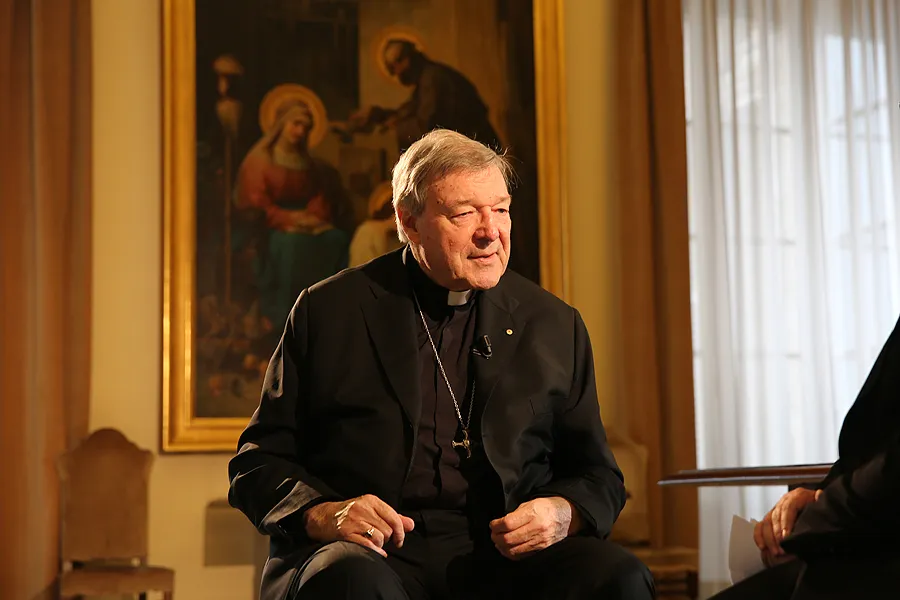
Rome, Italy, Mar 16, 2017 / 02:50 am (CNA/EWTN News).- This week Cardinal George Pell sat down with some 20 students from Harvard visiting Rome, with the goal of challenging them to both set firm ideals and to work hard to achieve them – something the Church can help with by providing a basic framework for moral leadership.
In a March 14 interview with CNA ahead of his speech, Cardinal Pell said the main point he would make to the students is “that they need a cause. They need a set of principles that they accept and follow and that they will be prepared to make sacrifices for.”
He stressed the importance of conveying the message that as future leaders “they need to be courageous and they need to be persevering. And if they can be strategists, take a long-term view, so much the better.”
Cardinal Pell, prefect of the Secretariat for the Economy, spoke just before giving his speech on Principled Leadership to a group of 20 people who are among Harvard University’s graduating class of 2017 and who traveled to Rome for a four-day “Harvard Vatican Leadership Summit.”
A student-led initiative, the event was held at the Pontifical Lateran University and hosted students from various backgrounds at Harvard, including the business, law, divinity, medical, and dental schools.
In addition to Cardinal Pell, other key figures participants have met with during the summit include Vatican Secretary of State Cardinal Pietro Parolin; Vatican Secretary for Relations with the States, Archbishop Paul Gallagher; Cardinal Peter Turkson, president of the Pontifical Council for Integral Human Development; and Cardinal Giuseppe Versaldi, prefect of the Congregation for Catholic Education.
In his comments to CNA, Cardinal Pell outlined the key principles that ought to guide business and economic decisions, saying that no matter what, “you must be aware of the common good.”
“Think of the whole of society, not just the shareholders, not just the workers in the small group,” he said. “Have some real understanding of what justice is. Have a special sensitivity for those who are less fortunate, those who are poor.”
One of the most important things to have a constant awareness of is our responsibility toward future generations, he said, cautioning that one modern danger is that “people know more and more about less and less.”
An advantage of the Catholic Church in this regard, he said, is that it can help provide “a general scheme” into which specific principles, causes, and points of view can fit.
However, he stressed that despite the Church’s role in providing this scheme for various fields, particularly economics and business, it is above all a religious institution, and as such doesn’t embrace any one system in particular.
Reflecting on criticisms Pope Francis has at times voiced in reference to the current global market system, the cardinal stressed that the Pope “is a religious leader, he is not an economist.”
The Church, he said, “does not espouse socialism, much less communism or Nazism or the free market. It announces general principles and says this fits or that doesn't fit.”
“We should listen very seriously to everything the Pope says on economics,” he said, but emphasized that as Christians, we listen to him because “he is the successor of Peter, he teaches us things religious.”
In this sense the Pope is applying Gospel standards to the economic situation, Cardinal Pell said, adding that if he himself were to speak out on the topic, people wouldn’t necessarily need to take notes on the economic aspect, “but if I preach the Gospel, I hope people listen.”
Since not all of the students participating in the summit are Catholic, the cardinal voiced his hope that they would walk away with at least a better idea of the Church’s social doctrine.
He brought a compendium of the social doctrine of the Church for each of the participants, because it is “a coherent exposition on many, many important topics,” including “right and wrong, natural law, subsidiarity, the common good and different types of justice.”
The Catholic Church is “one of the few organizations that has an over-arching system of thought to make people think,” he said, explaining that “it is logical and coherent, it's an impressive piece of work.”
Cardinal Pell praised the idea of summit as unique, and “exactly what a Catholic university needs to be doing.”
“I think the Christian perspective brings flourishing, brings life, makes good societies, brings happiness, development,” he said. So to have a group of students from a university such as Harvard is “a wonderful thing. I think it'll be good for them and it'll be good for us.”
Okendo Lewis, a student at the John F. Kennedy School of Government who spent part of his childhood in Milan, was the one who initially thought of the summit and made it happen with the help of Mary Ann Glendon, who was a US Ambassador to the Holy See during the George W. Bush administration and who now teaches at Harvard Law School.
In comments to CNA, Lewis said part of why he wanted to offer students a Vatican perspective on leadership is because “there seems to be a crisis in leadership” throughout the world, “and Pope Francis very much speaks to many who are trying to figure out how to lead in these difficult times.”
“I definitely wanted this next generation of leaders, whether they’re in business or in medicine or in law, to learn from the wisdom of the Pope, but also the city and the Church, which has had two thousand years of experience,” he said.
Lewis said he initially had doubts about whether or not people would come, since it was already late when they started to advertise the trip. However, they received over 180 applications, and had to narrow it down to 20 spots.
“I think that speaks to the power of the Catholic Church and the interest there is in Pope Francis. So people were actually very enthusiastic to be here,” he said.
Lewis voiced his hope that the summit would become an annual event. This year’s theme of “How to Answer the Call to Serve” fits into what most of the university’s students hope to accomplish, he said, explaining that “they’re trying to figure out how to leverage their education and their studies to help meet the needs of society, how can they be student leaders.”
“So my hope is that this will become an annual tradition so that students across Harvard and hopefully across the United States, can come to Rome and learn from so many of the institutions here where there’s the pontifical universities, there are dicasteries, and certainly the Pope himself.”
Kiernan Schmidt, a student at Harvard Business School, told CNA he wanted to participate not only because of his Irish and Catholic background, but also because the idea of “how morality plays into the decisions we make” as leaders in various fields.
“The idea of examining how morality guides our leadership styles was really the main impetus,” he said, adding that Pope Francis’ challenge for global leaders “to reexamine what we’re doing for each other and how we think of ourselves as leaders” was also a key factor.
What had impacted Schmidt so far in the meetings they had with Vatican officials was “hearing humility from almost every level of leadership that we've met with.”
Another point of particular interest was gaining “a profound understanding that traditions and conditions in local Churches can be very different from what you hear in Rome.”
“I think that that adjusting of leadership and tactics in how we approach problems can be very different in the cultural context,” he said, noting that in their meeting with Archbishop Gallagher, the prelate told them that he not only explains Rome to the local Churches of where he goes, but he also “explains the local Churches to Rome.”
This “two-way dialogue” in the Church, Schmidt said, “was something that felt very new, very refreshing and very modern and also very true to the words we hear from Pope Francis, you know, approaching problems with humility and seeking to talk one to one.”
Previous Post

March 16, 2017
Nigeria's bishops call on government to defend human rights
Next Post
March 16, 2017 What can evangelize the world? A good Catholic school.
Browse Our Archives
Select a Category Americas Asia - Pacific Europe Middle East - Africa Uncategorized US Vatican
Select a Month November 2017 October 2017 September 2017 August 2017 July 2017 June 2017 May 2017 April 2017 March 2017 February 2017 January 2017 December 2016 November 2016 October 2016 September 2016 August 2016 July 2016 June 2016 May 2016 April 2016 March 2016 February 2016 January 2016 December 2015 November 2015 October 2015 September 2015 August 2015 July 2015 June 2015 May 2015 April 2015 March 2015 February 2015 January 2015 December 2014 November 2014 October 2014 September 2014 August 2014 July 2014 June 2014 May 2014 April 2014 March 2014 February 2014 January 2014 December 2013 November 2013 October 2013 September 2013 August 2013 July 2013 June 2013 May 2013 April 2013 March 2013 February 2013 January 2013 December 2012 November 2012 October 2012 September 2012 August 2012 July 2012 June 2012 May 2012
TAKE THE
Religious Wisdom Quiz
True or False: Romans teaches that whoever calls on the name of the Lord will be saved.
Select your answer to see how you score.
FALSE TRUE
Related posts from Catholic News

Sixty Vincentians martyred during Spanish Civil War to...

Filipinos gather in Rome to promote bishop's beatification...

UK bishop calls for prayers as MPs urge...

On All Souls' Day, Pope Francis prays for...
TRENDING AT PATHEOS Catholic

Creation, Preservation, and Teleology in Catholic Theology
As I write this, it is very early Monday morning. Like millions...

The Parable Of The Sower And The Word...
One of Christ’s most famous parables is that of the sower who...

Rejecting Doom: Christian Hope And Human Action
Christianity is a religion of hope. We are to have hope and...

Why I Choose the Eucharist Over the Sermon
Choose the Eucharist, Not the Sermon What are we supposed to get...

5 Design Elements Found in Spiritually Rooted Homes
Putting Spirituality Into Home Decor Our homes are more than our living...

Credo: A Story of God Told with the...
About 10 years ago, I began to imagine a personal "Credo" that...
view all Catholic blogs
Ad-Free & Subscriber Log-In Subscription Support
- About Us
- 2026 Calendar
- Videos
- Podcasts
- Library of World Religions
- Faith In Media Tracker
- Advertise With Us
- Write for Us
- Privacy Policy
- Terms of Service
- Do Not Sell My Data
- Contact Us
- Radiant Digital
- Manage Newsletter Subscriptions
- Unsubscribe From Notifications
- Sitemap
Copyright 2008-2026, Patheos. All rights reserved.
Subscription Support Ad-Free & Subscriber Log-In
Follow Patheos