
BuddhistCatholicContemplativeEvangelicalGeneral ChristianHinduJewishLatter-day SaintMuslimNew VisionsProgressive Christian
Beliefs
- Buddhist
- Catholic
- Contemplative
- Evangelical
- General Christian
- Hindu
- Jewish
- Latter-day Saint
- More Voices
- Muslim
- New Visions
- Pagan
- Progressive Christian
Topics
- Religion News
- Food and Religion
- Sports and Religion
- Religious Art
- Religious Music and Entertainment
- Religious Events
- History and Religion
- Style and Religion
- Politics and Religion
- Women in Religion
- Recreation Outdoors and Religion
- Business Finance and Religion
- Careers Workplace and Religion
- Education and Religion
- Family Parenting and Religion
- Health Fitness and Religion
- Home and Religion
- Relationships and Religion
- Technology and Religion
- Travel and Religion
Columnists
- Buddhist Columnists
- Business Finance and Religion Columnists
- Careers Workplace and Religion Columnists
- Catholic Columnists
- Contemplative Columnists
- Education and Religion Columnists
- Evangelists Columnists
- Family Parenting and Religion Columnists
- General Christian Columnists
- Health Fitness and Religion Columnists
- Hindu Columnists
- History and Religion Columnists
- Home and Religion Columnists
- Jewish Columnists
- More Voices Columnists
- Latter Day Columnists
- Muslim Columnists
- New Visions Columnists
- Nonreligious Columnists
- Pagan Columnists
- Politics and Religion Columnists
- Progressive Columnists
- Recreation Outdoors and Religion Columnists
- Relationships and Religion Columnists
- Religion News Columnists
- Religious Art Columnists
- Religious Events Columnists
- Religious Music and Entertainment Columnists
- Sports and Religion Columnists
- Style and Religion Columnists
- Technology and Religion Columnists
- Travel and Religion Columnists
- Women in Religion Columnists
Resource Library
- 2026 Calendar
- Library of World Religions
- The 100 Most Holy Places on Earth
- Patheos Answers
- Podcasts
- Videos
- Faith Leaders Database
- Anglican Episcopalian
- Bahai
- Baptist
- Buddhism
- Christianity
- Confucianism
- Eastern Orthodoxy
- Hinduism
- Holiness and Pentecostal
- ISKCON
- Islam
- Judaism
- Lutheran
- Methodist
- The Church of Jesus Christ of Latter-day Saints
- New Age
- Paganism
- Presbytarian and Reformed
- Protestantism
- Religion Behind the Scenes
- Roman Catholic
- Scientology
- Shia Islam
- Sikhism
- Sufism
- Sunni Islam
- Taoism
- Zen
- See all religions
Research Tools
 Ad-Free & Subscriber Log-In Subscription Support
Ad-Free & Subscriber Log-In Subscription Support
Follow Patheos 

- Trending:
- Forgiveness
- |
- Marriage
- |
- Consciousness
- |
- Death Penalty
- |
- Election
- |
- Halloween
 Catholic News
- Home
- Catholic
- Religion News
- Archbishop Gomez: English wasn’t America’s first language
Archbishop Gomez: English wasn’t America’s first language
Last updated on: March 30, 2017 at 9:02 am by CNA Daily News
Archbishop Gomez: English wasn’t America’s first language 2017-03-30T09:02:00+00:00 CNA Daily News
Patheos Explore the world's faith through different perspectives on religion and spirituality! Patheos has the views of the prevalent religions and spiritualities of the world.
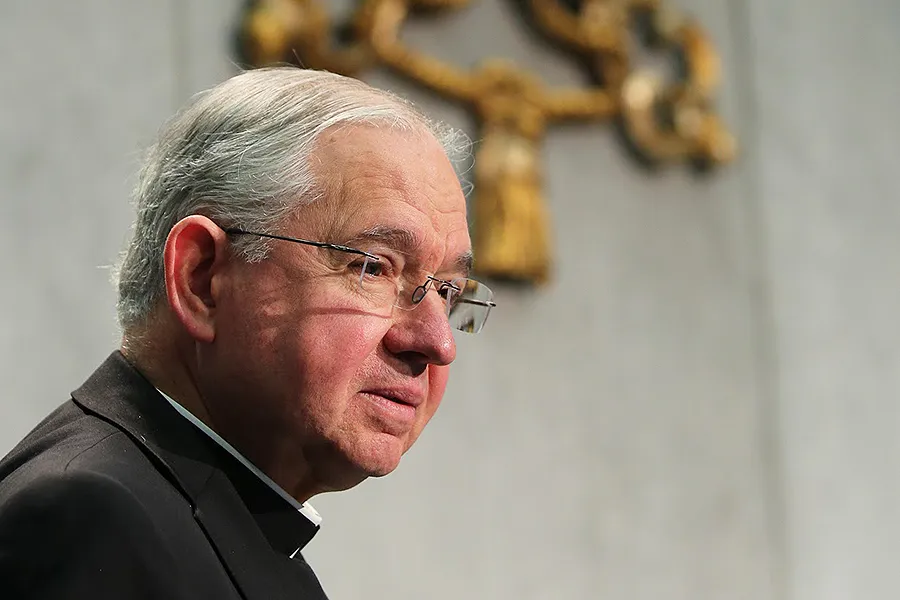
Washington D.C., Mar 30, 2017 / 03:02 am (CNA/EWTN News).- In recent months, national debates over immigration and deportation have reached a fever pitch in the wake of President Trump's election.
But for Archbishop Jose Gomez, both Catholic principles and the history of America as a home to people from a variety of backgrounds means that the immigration debate has higher stakes than just law enforcement or national sovereignty.
“For me, and for the Catholic Church in this country, immigration is about people. It is about families,” the archbishop said in a March 23 talk at the Catholic University of America.
“We are talking about souls, not statistics.”
Born in Monterrey, Mexico, the archbishop explained that he too was an immigrant, even though he has been an American citizen for more than 20 years. He pointed out that his family has been living in what is now Texas since the early 19th Century, and his family's relationship to both America and immigration reaches back generations.
He also explained that his archdiocese – the Archdiocese of Los Angeles – is not only the largest, with around 5 million Catholics, but the most diverse.
Within the archdiocese, Mass is celebrated and parishioners ministered to in more than 40 languages, from nearly every country in Latin America, Asia, Africa and the Middle East.
“The Church is alive here – and active,” he said. “And we are really a Church of immigrants.”
Nearly one million of these immigrants who live within the Archdiocese of Los Angeles are undocumented.
Archbishop Gomez argued that this issue of large numbers of undocumented persons is something his adopted country desperately needs to address. This is incredibly important, he said, not only for immigrants and their families, but for America as a whole.
“Everybody right now knows that our immigration system is totally broken and needs to be fixed,” the archbishop said. However, while the United States has a right to secure its borders and enforce its laws, it also has to take responsibility for creating and benefiting from the situation that lead more than 11 million people to come to the country without documentation, he said.
“For many years our country did not enforce its immigration laws,” Archbishop Gomez said. “Why not? Because American businesses were demanding 'cheap' labor. So government officials looked the other way.”
The archbishop argued that “we need to recognize that we all share some of the blame for this broken immigration system.”
“Business is to blame. Government is to blame,” Archbishop Gomez said. “And you and I – we have responsibility, too. We 'benefit' and depend every day on an economy that is built on the backs of undocumented workers. It is just a fact. Immigrants grow our food, they serve us in our restaurants; they clean our rooms and our offices, they build our homes.”
He noted that while undocumented persons may be living here in violation of the law, “we aren’t putting business owners in jail or punishing government workers who didn’t do their job.”
“The only people we are punishing is the undocumented workers,” he charged. “They are the only ones.” While some punishment, such as community service or other requirements to stay in the United States may be appropriate, Archbishop Gomez commented, it is unfair to the families of nearly 11 million people to deport people with families – some of whom have been here for years.
“That is not fair. It is cruel, actually,” Archbishop Gomez said. “These are just ordinary moms and dads – just like your parents – who want to give their kids a better life.”
To balance love, laws, justice, and mercy, Catholics should consider principles that focus on the human person. The first principle, he said, is to recognize that “every immigrant is a human person, a child of God,” regardless of their legal status or background. The second Catholic principle to consider is that"immigration should keep families together.”
Archbishop Gomez pointed out that over a quarter of deportations break up families, and overwhelming majority of these deportations do not apply to violent criminals.
“I do not believe there is any public policy purpose that is served by taking away some little girl’s dad or some little boy’s mom. We are breaking up families and punishing kids for the mistakes of their parents. And that’s not right.”
While some common place policies could quickly resolve the issues surrounding immigration, Archbishop Gomez argued that the real conflict has more to do with ongoing questions about America – questions like what it means to be an American and what America’s mission is in the world.
The archbishop noted that almost all Americans are of immigrant heritage. “But immigration to this country has never been easy.” He pointed out that immigrant groups like the Irish have faced discrimination and hardship.
Yet, the history of America owes much to its immigrant – particularly Hispanic – roots, which long predate the arrival of English settlers, the archbishop said.
“For me – American history begins with Our Lady of Guadalupe,” Archbishop Gomez reflected. Before the founding fathers were born or before the Revolutionary War was fought, Spanish and Mexican missionaries and Philippine immigrants were settling in what is now the United States, celebrating the nation’s first Thanksgiving and establishing churches.”
“Something we should think about: the first non-indigenous language spoken in this country was not English. It was Spanish. We need to really think about what the means,” he said.
What it means, in his opinion, is that we “can no longer afford to tell a story of America that excludes the rich inheritance of Latinos and Asians.”
Conceptions of American identity that don’t incorporate the rich history of these groups, he said, are not only incomplete and inarticulate, they are not as well-set to adjust to the changing landscape of the United States. America is changing, and if America wants to be great, he argued, it needs to speak to the conscience and realities of the United States.
“That is what’s at stake in our immigration debate – the future of this beautiful American story,” Archbishop Gomez concluded. “Our national debate is really a great struggle for the American spirit and the American soul.”
Next Post

March 30, 2017 Love must be core of family life, Pope says ahead of WMOF
Browse Our Archives
Select a Category Americas Asia - Pacific Europe Middle East - Africa Uncategorized US Vatican
Select a Month November 2017 October 2017 September 2017 August 2017 July 2017 June 2017 May 2017 April 2017 March 2017 February 2017 January 2017 December 2016 November 2016 October 2016 September 2016 August 2016 July 2016 June 2016 May 2016 April 2016 March 2016 February 2016 January 2016 December 2015 November 2015 October 2015 September 2015 August 2015 July 2015 June 2015 May 2015 April 2015 March 2015 February 2015 January 2015 December 2014 November 2014 October 2014 September 2014 August 2014 July 2014 June 2014 May 2014 April 2014 March 2014 February 2014 January 2014 December 2013 November 2013 October 2013 September 2013 August 2013 July 2013 June 2013 May 2013 April 2013 March 2013 February 2013 January 2013 December 2012 November 2012 October 2012 September 2012 August 2012 July 2012 June 2012 May 2012
TAKE THE
Religious Wisdom Quiz
Which prophet's father was a priest named Buzi?
Select your answer to see how you score.
Joel Ezekiel Daniel Hosea
Related posts from Catholic News

US bishops' new child protection program aims to...

Wealthy foundation aims to redefine religious freedom—and Christianity,...

Victims of Islamic State in focus at UN...

Catholic University of America offers free tuition to...
TRENDING AT PATHEOS Catholic

Creation, Preservation, and Teleology in Catholic Theology
As I write this, it is very early Monday morning. Like millions...

The Parable Of The Sower And The Word...
One of Christ’s most famous parables is that of the sower who...

Rejecting Doom: Christian Hope And Human Action
Christianity is a religion of hope. We are to have hope and...

Why I Choose the Eucharist Over the Sermon
Choose the Eucharist, Not the Sermon What are we supposed to get...

5 Design Elements Found in Spiritually Rooted Homes
Putting Spirituality Into Home Decor Our homes are more than our living...

Credo: A Story of God Told with the...
About 10 years ago, I began to imagine a personal "Credo" that...
view all Catholic blogs
Ad-Free & Subscriber Log-In Subscription Support
- About Us
- 2026 Calendar
- Videos
- Podcasts
- Library of World Religions
- Faith In Media Tracker
- Advertise With Us
- Write for Us
- Privacy Policy
- Terms of Service
- Do Not Sell My Data
- Contact Us
- Radiant Digital
- Manage Newsletter Subscriptions
- Unsubscribe From Notifications
- Sitemap
Copyright 2008-2026, Patheos. All rights reserved.
Subscription Support Ad-Free & Subscriber Log-In
Follow Patheos