
BuddhistCatholicContemplativeEvangelicalGeneral ChristianHinduJewishLatter-day SaintMuslimNew VisionsProgressive Christian
Beliefs
- Buddhist
- Catholic
- Contemplative
- Evangelical
- General Christian
- Hindu
- Jewish
- Latter-day Saint
- More Voices
- Muslim
- New Visions
- Pagan
- Progressive Christian
Topics
- Religion News
- Food and Religion
- Sports and Religion
- Religious Art
- Religious Music and Entertainment
- Religious Events
- History and Religion
- Style and Religion
- Politics and Religion
- Women in Religion
- Recreation Outdoors and Religion
- Business Finance and Religion
- Careers Workplace and Religion
- Education and Religion
- Family Parenting and Religion
- Health Fitness and Religion
- Home and Religion
- Relationships and Religion
- Technology and Religion
- Travel and Religion
Columnists
- Buddhist Columnists
- Business Finance and Religion Columnists
- Careers Workplace and Religion Columnists
- Catholic Columnists
- Contemplative Columnists
- Education and Religion Columnists
- Evangelists Columnists
- Family Parenting and Religion Columnists
- General Christian Columnists
- Health Fitness and Religion Columnists
- Hindu Columnists
- History and Religion Columnists
- Home and Religion Columnists
- Jewish Columnists
- More Voices Columnists
- Latter Day Columnists
- Muslim Columnists
- New Visions Columnists
- Nonreligious Columnists
- Pagan Columnists
- Politics and Religion Columnists
- Progressive Columnists
- Recreation Outdoors and Religion Columnists
- Relationships and Religion Columnists
- Religion News Columnists
- Religious Art Columnists
- Religious Events Columnists
- Religious Music and Entertainment Columnists
- Sports and Religion Columnists
- Style and Religion Columnists
- Technology and Religion Columnists
- Travel and Religion Columnists
- Women in Religion Columnists
Resource Library
- 2026 Calendar
- Library of World Religions
- The 100 Most Holy Places on Earth
- Patheos Answers
- Podcasts
- Videos
- Faith Leaders Database
- Anglican Episcopalian
- Bahai
- Baptist
- Buddhism
- Christianity
- Confucianism
- Eastern Orthodoxy
- Hinduism
- Holiness and Pentecostal
- ISKCON
- Islam
- Judaism
- Lutheran
- Methodist
- The Church of Jesus Christ of Latter-day Saints
- New Age
- Paganism
- Presbytarian and Reformed
- Protestantism
- Religion Behind the Scenes
- Roman Catholic
- Scientology
- Shia Islam
- Sikhism
- Sufism
- Sunni Islam
- Taoism
- Zen
- See all religions
Research Tools
 Ad-Free & Subscriber Log-In Subscription Support
Ad-Free & Subscriber Log-In Subscription Support
Follow Patheos 

- Trending:
- Forgiveness
- |
- Marriage
- |
- Consciousness
- |
- Death Penalty
- |
- Election
- |
- Halloween
 Catholic News
- Home
- Catholic
- Religion News
- Cardinal Etchegaray’s retirement means the end of an era
Cardinal Etchegaray’s retirement means the end of an era
Last updated on: January 26, 2017 at 1:10 pm by CNA Daily News
Cardinal Etchegaray’s retirement means the end of an era 2017-01-26T13:10:00+00:00 CNA Daily News
Patheos Explore the world's faith through different perspectives on religion and spirituality! Patheos has the views of the prevalent religions and spiritualities of the world.
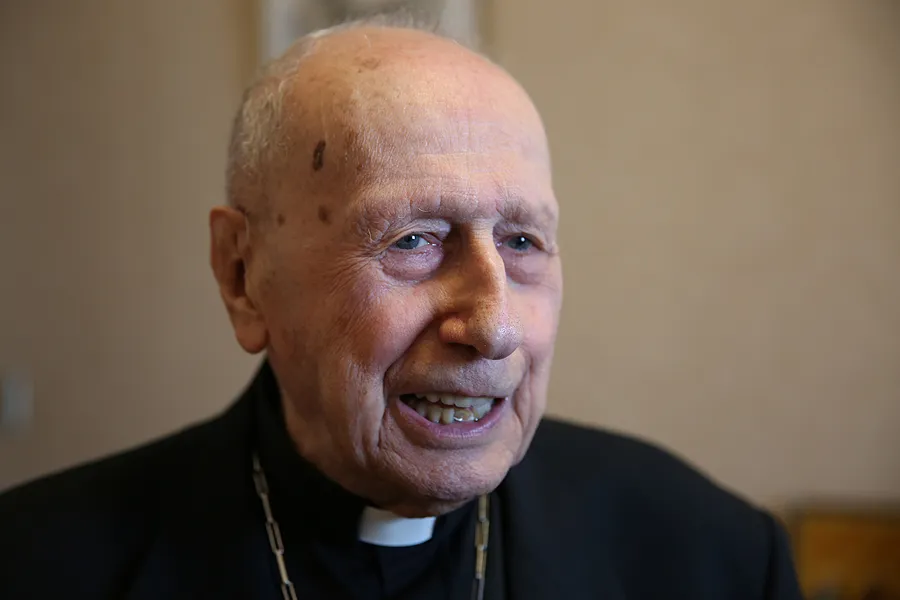
Vatican City, Jan 26, 2017 / 06:10 am (CNA/EWTN News).- As Cardinal Roger Etchegaray leaves Rome to retire to France, his homeland, an era has closed.
He was a bishop without emblem or motto, but he was committed to peace and to the human person. Cardinal Etchegaray epitomizes all the characteristics of the modern Church. If there is something we deem to be new, it is possible he had done it already.
The news of Cardinal Etchegaray’s departure was spread by Angelo Scelzo, former deputy director of the Holy See Press Office and a good friend of the cardinal. Scelzo penned a Jan. 20 article on the Italian Bishops Conference’s newspaper Avvenire and reported that, before leaving, Cardinal Etchegaray was able to say goodbye both to Pope Francis and Pope emeritus Benedict.
Why was Cardinal Etchegaray so important for the life of the Church?
A smart French priest with a profound human touch, Cardinal Etchegaray was born in 1922 in the southwestern French town of Espelette, the first of three children. Ordained a priest in 1947, he was among the Second Vatican Council’s experts, called “periti,” and also Vicar for Catholic Action. He served as deputy and secretary general of the French Bishops’ Conference from 1961 to 1969. He was Archbishop of Marseille from 1970 to 1985 before entering the Roman Curia.
In Rome, he served as president of the Pontifical Councils for Justice and Peace from 1984 to 1998 and headed Cor Unum from 1984 to 1995. To some extent, by assuming both the posts of the Vatican dicasteries for charities and international works, Cardinal Etchegaray anticipated the current Curia reform that places them in the same sphere of responsibility.
But this just a minor observation in a whole life whose deeds marked an era of the Catholic Church.
Cardinal Etchegaray, 94, now leaves his house in Piazza San Calisto to return to Bayonne, in France, where he will live out his life with his sister in a retirement home
There are many reasons this retirement means the end of an era.
This is evident in his home, full of books, memories and history. And among the memories, there was a Nativity artwork displayed in the dining room. That Nativity was donated to him by Fidel Castro. If the Church can now have an impact on Cuba’s life and current developments, it is because Cardinal Etchegaray worked out the first steps there.
Cardinal Etchegaray went to Cuba for the first time in 1989. At the time, he was serving as president of the Pontifical Council for Justice and Peace. The trip was kept secret, as it presented many difficulties. For instance, state atheism was the official religion in Cuba until 1992.
In 1989 John Paul II sent Cardinal Etchegaray to Cuba to build bridges. It was Christmas time, and Cardinal Etchegaray could celebrate a Mass in a crowded Cathedral of Habana.
At the end of the Mass, Cardinal Etchegaray “posed a crowd-pleasing question: ‘What message shall I take to the Pope?’ ‘That he come! That he come! That he come!’ thousands of voices roared in unison. ‘I hear your message,’ replied Etchegaray, ‘I don’t know what he will say, but I am certain he will come’,” according to the Los Angeles Times.
That was the first of many trips to Cuba that eventually found fruition in the first, historic visit of a Pope in to the island in 1998.
Cardinal Etchegaray’s lifestyle shows his impact on the era.
As Pope Francis encourages a sober style of life, asks Christians to commit to the poor, preaches conversion and a flight from worldliness, it must be remembered that Cardinal Etchegaray, once he was ordained bishop in 1969, never wanted an emblem or a motto. When asked about that decision, he said that “having an emblem and a motto seems to me an inheritance of the medieval past.” He was among the very few who made such a symbolic decision.
Back in 1986, Cardinal Etchegaray was among the organizers of the first meeting of the world’s religions in Assisi, and he took part in all the other meetings. Although that first meeting was strongly criticized within the Curia, he was held in great esteem not just by the Pope, but by many Curia members.
In 1997, he was called to preach the Lenten Spiritual Exercises to the Curia. He presented a reflection focused on Jesus “True God and true man,” linked by a guiding line, a sentence of the French philosopher Blaise Pascal: “Outside of Jesus Christ, we do not know who God is, nor who we are.
The spirit of the cardinal’s life has always aimed to build bridges. He was sent as papal envoy to Iraq to attempt to avoid the Second Gulf War in 2002. He traveled through China four times (in 1980, 1993, 2000, and 2003) in order to try to better understand the situation of the Church of China and eventually improved relations with the country.
He was the man two Popes turned to in scenarios of crisis. At the same time, he was a good friend to Pope Paul VI, whom he described as “a very discreet, very reserved Pope, who became a wanderer Pope, the first Pope to take the plane, the first Pope to go to the Holy Land, the first Pope to go to the United Nations,” and who “had taught the truth of humanity to all men, and he went toward the poorest.”
Before leaving Rome, Cardinal Etchegaray was also able to say goodbye to the Pope emeritus Benedict XVI. To Benedict, he has a special link: on Christmas Eve 2009, Cardinal Etchegaray was seriously injured as a person unsuccessfully attacked Benedict XVI during the procession into Mass.
Now Cardinal Etchegaray is not leaving on a mission for the Church, but he returns home, to Bayonne, to live with his beloved sister Maite.
Previous Post

January 26, 2017
This priest says Adoration has made Juarez a safer city
Next Post
January 26, 2017 US bishops dismayed as Trump vows to build border wall
Browse Our Archives
Select a Category Americas Asia - Pacific Europe Middle East - Africa Uncategorized US Vatican
Select a Month November 2017 October 2017 September 2017 August 2017 July 2017 June 2017 May 2017 April 2017 March 2017 February 2017 January 2017 December 2016 November 2016 October 2016 September 2016 August 2016 July 2016 June 2016 May 2016 April 2016 March 2016 February 2016 January 2016 December 2015 November 2015 October 2015 September 2015 August 2015 July 2015 June 2015 May 2015 April 2015 March 2015 February 2015 January 2015 December 2014 November 2014 October 2014 September 2014 August 2014 July 2014 June 2014 May 2014 April 2014 March 2014 February 2014 January 2014 December 2013 November 2013 October 2013 September 2013 August 2013 July 2013 June 2013 May 2013 April 2013 March 2013 February 2013 January 2013 December 2012 November 2012 October 2012 September 2012 August 2012 July 2012 June 2012 May 2012
TAKE THE
Religious Wisdom Quiz
What does the Pale Horse in Revelations symbolize?
Select your answer to see how you score.
Prosperity War Death The Kingdom of God
Related posts from Catholic News

How do we help trafficking victims re-enter society?...

More than just giving – World Day of...

New book reveals details of John Paul I’s...

Despite reports, Pope Francis isn’t opening the door...
TRENDING AT PATHEOS Catholic

Creation, Preservation, and Teleology in Catholic Theology
As I write this, it is very early Monday morning. Like millions...

The Parable Of The Sower And The Word...
One of Christ’s most famous parables is that of the sower who...

Rejecting Doom: Christian Hope And Human Action
Christianity is a religion of hope. We are to have hope and...

Why I Choose the Eucharist Over the Sermon
Choose the Eucharist, Not the Sermon What are we supposed to get...

5 Design Elements Found in Spiritually Rooted Homes
Putting Spirituality Into Home Decor Our homes are more than our living...

Credo: A Story of God Told with the...
About 10 years ago, I began to imagine a personal "Credo" that...
view all Catholic blogs
Ad-Free & Subscriber Log-In Subscription Support
- About Us
- 2026 Calendar
- Videos
- Podcasts
- Library of World Religions
- Faith In Media Tracker
- Advertise With Us
- Write for Us
- Privacy Policy
- Terms of Service
- Do Not Sell My Data
- Contact Us
- Radiant Digital
- Manage Newsletter Subscriptions
- Unsubscribe From Notifications
- Sitemap
Copyright 2008-2026, Patheos. All rights reserved.
Subscription Support Ad-Free & Subscriber Log-In
Follow Patheos