
BuddhistCatholicContemplativeEvangelicalGeneral ChristianHinduJewishLatter-day SaintMuslimNew VisionsProgressive Christian
Beliefs
- Buddhist
- Catholic
- Contemplative
- Evangelical
- General Christian
- Hindu
- Jewish
- Latter-day Saint
- More Voices
- Muslim
- New Visions
- Pagan
- Progressive Christian
Topics
- Religion News
- Food and Religion
- Sports and Religion
- Religious Art
- Religious Music and Entertainment
- Religious Events
- History and Religion
- Style and Religion
- Politics and Religion
- Women in Religion
- Recreation Outdoors and Religion
- Business Finance and Religion
- Careers Workplace and Religion
- Education and Religion
- Family Parenting and Religion
- Health Fitness and Religion
- Home and Religion
- Relationships and Religion
- Technology and Religion
- Travel and Religion
Columnists
- Buddhist Columnists
- Business Finance and Religion Columnists
- Careers Workplace and Religion Columnists
- Catholic Columnists
- Contemplative Columnists
- Education and Religion Columnists
- Evangelists Columnists
- Family Parenting and Religion Columnists
- General Christian Columnists
- Health Fitness and Religion Columnists
- Hindu Columnists
- History and Religion Columnists
- Home and Religion Columnists
- Jewish Columnists
- More Voices Columnists
- Latter Day Columnists
- Muslim Columnists
- New Visions Columnists
- Nonreligious Columnists
- Pagan Columnists
- Politics and Religion Columnists
- Progressive Columnists
- Recreation Outdoors and Religion Columnists
- Relationships and Religion Columnists
- Religion News Columnists
- Religious Art Columnists
- Religious Events Columnists
- Religious Music and Entertainment Columnists
- Sports and Religion Columnists
- Style and Religion Columnists
- Technology and Religion Columnists
- Travel and Religion Columnists
- Women in Religion Columnists
Resource Library
- 2026 Calendar
- Library of World Religions
- The 100 Most Holy Places on Earth
- Patheos Answers
- Podcasts
- Videos
- Faith Leaders Database
- Anglican Episcopalian
- Bahai
- Baptist
- Buddhism
- Christianity
- Confucianism
- Eastern Orthodoxy
- Hinduism
- Holiness and Pentecostal
- ISKCON
- Islam
- Judaism
- Lutheran
- Methodist
- The Church of Jesus Christ of Latter-day Saints
- New Age
- Paganism
- Presbytarian and Reformed
- Protestantism
- Religion Behind the Scenes
- Roman Catholic
- Scientology
- Shia Islam
- Sikhism
- Sufism
- Sunni Islam
- Taoism
- Zen
- See all religions
Research Tools
 Ad-Free & Subscriber Log-In Subscription Support
Ad-Free & Subscriber Log-In Subscription Support
Follow Patheos 

- Trending:
- Forgiveness
- |
- Marriage
- |
- Consciousness
- |
- Death Penalty
- |
- Election
- |
- Halloween
 Catholic News
- Home
- Catholic
- Religion News
- Cardinal Caffarra explains the reasons behind the dubia
Cardinal Caffarra explains the reasons behind the dubia
Last updated on: January 16, 2017 at 11:44 pm by CNA Daily News
Cardinal Caffarra explains the reasons behind the dubia 2017-01-16T23:44:00+00:00 CNA Daily News
Patheos Explore the world's faith through different perspectives on religion and spirituality! Patheos has the views of the prevalent religions and spiritualities of the world.
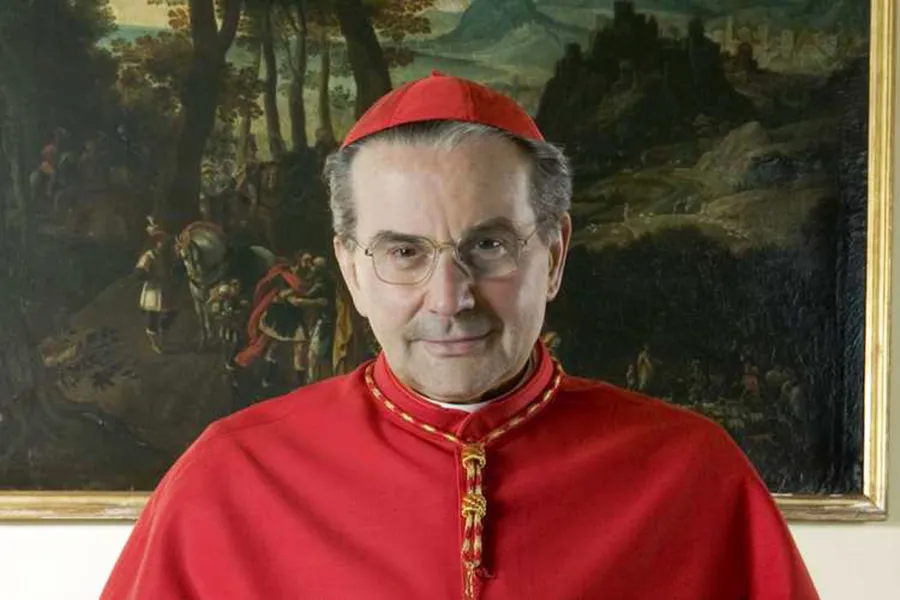
Bologna, Italy, Jan 16, 2017 / 04:44 pm (CNA/EWTN News).- In an interview with an Italian daily published Saturday, Cardinal Carlo Caffarra discussed at length the questions which exist about the interpretation of Amoris laetitia, Pope Francis' apostolic exhortation on love in the family.
Cardinal Caffarra, the emeritus Archbishop of Bologna who was head of the Pontifical John Paul II Institute for Studies on Marriage and Family from 1981 to 1995, spoke to Matteo Matzuzzi of Il Foglio in an interview published Jan. 14.
He is among the four cardinals who authored a letter with five dubia, or doubts, about the interpretation of Amoris laetitia, requesting that Pope Francis “resolve the uncertainties and bring clarity.” Their letter was sent privately to the Pope Sept. 19, but released to the public two months later.
The letter and its dubia “were long reflected on, for months … for my part, they were also the subject of lengthy prayer before the Most Blessed Sacrament,” Cardinal Caffarra explained to Il Foglio.
The four cardinals believed themselves obliged to submit the dubia because of their role in counselling the Pope, and because of “the fact – which only a blind man could deny – that in the Church there exists great confusion, uncertainty, insecurity caused by some paragraphs of Amoris laetitia.”
“In these months, in terms of fundamental questions regarding the sacramental economy (marriage, confession, and the Eucharist) and the Christian life, some bishops have said A, some others have said the contrary of A, with the intention of interpreting well the same text.”
Cardinal Caffarra said that “the way out of this 'conflict of interpretations' was to have recourse to fundamental theological criteria of interpretation, the use of which I think can reasonably demonstrate that Amoris laetitia does not contradict Familiaris consortio.”
And yet, he said, “we saw that this epistemological model would not suffice. The contrast between the two interpretations continued,” and so the only way to address the question was to ask the author of Amoris laetitia to clarify it.
Out of respect for the Pope, the four cardinals chose to submit their dubia privately, deciding to make them public only “when we had certainty that the Holy Father would not respond … we interpreted his silence as authorisation to continue the theological discussion. And, moreover, the problem profoundly involves both the magisterium of the bishops (which, lest we forget, they exercise not by the delegation of the Pope but on the basis of the sacrament which they have received) and the life of the faithful.”
The cardinal noted that scandal on the part of the faithful had been growing, “as though we comported ourselves like the dogs who did not bark,” alluding to Isaiah 56:10, in which the prophet says the Lord's watchmen “are all mute dogs, they cannot bark; dreaming, lying down, loving to slumber.”
He also added that division in the Church “is the cause of the letter, not its effect.”
Cardinal Caffarra pointed to the example of a pastor who had written him saying that “In spiritual direction and in confession I don't know what to say” when confronted by penitents who wish to receive Communion despite their adulterous situation, and cite the Pope in their defence.
“The situation of many pastors of souls, I mean above all parish priests, is this,” the cardinal continued: “there is on their shoulders a burden too hard to bear.”
Cardinal Caffarra charged that speaking of too great a division between doctrine and pastoral practice is a grave problem: “To think pastoral practice is not founded and rooted in doctrine signifies that the foundation and root of pastoral practice is arbitrary. A Church which pays little attention to doctrine is not a more pastoral Church, but a more ignorant Church.”
He continued, “When I hear it said that this is only a pastoral change, and not a doctrinal one, or that the commandment prohibiting adultery is a purely positive law which can be changed (and I think no righteous person can think this), this signifies that yes a triangle has generally three sides, but that it is possible to construct one with four sides. That is, I say, an absurdity.”
Cardinal Caffarra also discussed the notion of “development of doctrine,” which is at times used to invoke the admission of the divorced-and-remarried to Communion.
He said that “if there is one clear point, it is that there is no evolution where there is contradiction. If I say that S is P and then I say that S is not P, the second proposition does not develop the first, but contradicts it. Already Aristotle had justly taught that enunciating a universal affirmative principle (e.g., all adultery is wrong) and at the same time a particular negative proposition having the same subject and predicate (e.g., some adultery is not wrong), this is not making an exception to the first. It is contradicting it.”
The dubia, he noted, were meant to clarify whether or not Amoris laetitia is a development of the preceding Magisterium, or a contradiction of it – as both interpretations have been taken by some bishops.
“Has Amoris laetitia taught that, given certain circumstances and after going through a certain process, the [divorced-and-remarried] faithful could receive the Eucharist without resolving to live in continence? There are bishops who have taught that this is possible,” the cardinal remarked. “By a simple deduction of logic, one must therefore also teach that adultery is not in and of itself evil.”
He affirmed that Amoris laetitia's value is that “it does not call pastors of souls to be content with responding 'no'” to the faithful, but that it calls them to help the faithful discern their situation.
Cardinal Caffarra maintained that the importance of the dubia is ensuring that bishops and pastors remember that there are intrinsically evil acts – which he noted can be known by reason, and was recognized first in the West by Socrates.
The cardinal then turned to misunderstandings of conscience. He clarified that conscience “is an act of reason … a judgement, not a decision,” and contrasted this with the understanding of conscience as “an unappealable tribunal on the goodness or evil of one's actions: one's subjectivity.”
He said the fifth dubium was the most important, for it regarded conscience, asking if the teaching “that conscience can never be authorised to legitimate exceptions to absolute moral norms that prohibit intrinsically evil acts by virtue of their object” still need be regarded as valid.
Cardinal Caffarra noted that a passage of Amoris laetitia seems “to admit the possibility that there can be a true judgement of conscience … in contradiction with what the Church teaches as pertaining to the deposit of divine Revelation. It seems. Therefore have we given the dubia to the Pope.”
The cardinal concluded by referring to Bl. John Henry Newman, who he said understood conscience “in a most lucid way”. The English convert recognised that private judgement cannot be elevated as “the ultimate criterion of moral truth.”
“Never say to a person: 'Always follow your conscience', without adding, always and immediately: 'love and seek the truth about the good'. Otherwise you would put in his hands the weapon most destructive of his humanity.”
Previous Post

January 16, 2017
Philippines blocks websites over child pornography concerns
Next Post
January 17, 2017 Attorney General nominee would consider cracking down on porn
Browse Our Archives
Select a Category Americas Asia - Pacific Europe Middle East - Africa Uncategorized US Vatican
Select a Month November 2017 October 2017 September 2017 August 2017 July 2017 June 2017 May 2017 April 2017 March 2017 February 2017 January 2017 December 2016 November 2016 October 2016 September 2016 August 2016 July 2016 June 2016 May 2016 April 2016 March 2016 February 2016 January 2016 December 2015 November 2015 October 2015 September 2015 August 2015 July 2015 June 2015 May 2015 April 2015 March 2015 February 2015 January 2015 December 2014 November 2014 October 2014 September 2014 August 2014 July 2014 June 2014 May 2014 April 2014 March 2014 February 2014 January 2014 December 2013 November 2013 October 2013 September 2013 August 2013 July 2013 June 2013 May 2013 April 2013 March 2013 February 2013 January 2013 December 2012 November 2012 October 2012 September 2012 August 2012 July 2012 June 2012 May 2012
TAKE THE
Religious Wisdom Quiz
What year was the Bible first translated into English?
Select your answer to see how you score.
1382 1517 1604 1100
Related posts from Catholic News

Sixty Vincentians martyred during Spanish Civil War to...

Filipinos gather in Rome to promote bishop's beatification...

UK bishop calls for prayers as MPs urge...

On All Souls' Day, Pope Francis prays for...
TRENDING AT PATHEOS Catholic

The Parable Of The Sower And The Word...
One of Christ’s most famous parables is that of the sower who...

Rejecting Doom: Christian Hope And Human Action
Christianity is a religion of hope. We are to have hope and...

Why I Choose the Eucharist Over the Sermon
Choose the Eucharist, Not the Sermon What are we supposed to get...

5 Design Elements Found in Spiritually Rooted Homes
Putting Spirituality Into Home Decor Our homes are more than our living...

Credo: A Story of God Told with the...
About 10 years ago, I began to imagine a personal "Credo" that...

The Anatomy of Divine Revelation in Catholic Thought
The claim that God has made Himself known to human beings is...
view all Catholic blogs
Ad-Free & Subscriber Log-In Subscription Support
- About Us
- 2026 Calendar
- Videos
- Podcasts
- Library of World Religions
- Faith In Media Tracker
- Advertise With Us
- Write for Us
- Privacy Policy
- Terms of Service
- Do Not Sell My Data
- Contact Us
- Radiant Digital
- Manage Newsletter Subscriptions
- Unsubscribe From Notifications
- Sitemap
Copyright 2008-2026, Patheos. All rights reserved.
Subscription Support Ad-Free & Subscriber Log-In
Follow Patheos