
BuddhistCatholicContemplativeEvangelicalGeneral ChristianHinduJewishLatter-day SaintMuslimNew VisionsProgressive Christian
Beliefs
- Buddhist
- Catholic
- Contemplative
- Evangelical
- General Christian
- Hindu
- Jewish
- Latter-day Saint
- More Voices
- Muslim
- New Visions
- Pagan
- Progressive Christian
Topics
- Religion News
- Food and Religion
- Sports and Religion
- Religious Art
- Religious Music and Entertainment
- Religious Events
- History and Religion
- Style and Religion
- Politics and Religion
- Women in Religion
- Recreation Outdoors and Religion
- Business Finance and Religion
- Careers Workplace and Religion
- Education and Religion
- Family Parenting and Religion
- Health Fitness and Religion
- Home and Religion
- Relationships and Religion
- Technology and Religion
- Travel and Religion
Columnists
- Buddhist Columnists
- Business Finance and Religion Columnists
- Careers Workplace and Religion Columnists
- Catholic Columnists
- Contemplative Columnists
- Education and Religion Columnists
- Evangelists Columnists
- Family Parenting and Religion Columnists
- General Christian Columnists
- Health Fitness and Religion Columnists
- Hindu Columnists
- History and Religion Columnists
- Home and Religion Columnists
- Jewish Columnists
- More Voices Columnists
- Latter Day Columnists
- Muslim Columnists
- New Visions Columnists
- Nonreligious Columnists
- Pagan Columnists
- Politics and Religion Columnists
- Progressive Columnists
- Recreation Outdoors and Religion Columnists
- Relationships and Religion Columnists
- Religion News Columnists
- Religious Art Columnists
- Religious Events Columnists
- Religious Music and Entertainment Columnists
- Sports and Religion Columnists
- Style and Religion Columnists
- Technology and Religion Columnists
- Travel and Religion Columnists
- Women in Religion Columnists
Resource Library
- 2026 Calendar
- Library of World Religions
- The 100 Most Holy Places on Earth
- Patheos Answers
- Podcasts
- Videos
- Faith Leaders Database
- Anglican Episcopalian
- Bahai
- Baptist
- Buddhism
- Christianity
- Confucianism
- Eastern Orthodoxy
- Hinduism
- Holiness and Pentecostal
- ISKCON
- Islam
- Judaism
- Lutheran
- Methodist
- The Church of Jesus Christ of Latter-day Saints
- New Age
- Paganism
- Presbytarian and Reformed
- Protestantism
- Religion Behind the Scenes
- Roman Catholic
- Scientology
- Shia Islam
- Sikhism
- Sufism
- Sunni Islam
- Taoism
- Zen
- See all religions
Research Tools
 Ad-Free & Subscriber Log-In Subscription Support
Ad-Free & Subscriber Log-In Subscription Support
Follow Patheos 

- Trending:
- Forgiveness
- |
- Marriage
- |
- Consciousness
- |
- Death Penalty
- |
- Election
- |
- Halloween
 Catholic News
- Home
- Catholic
- Religion News
- Traveling display notes struggle, hope of displaced Ukrainians
Traveling display notes struggle, hope of displaced Ukrainians
Last updated on: December 13, 2016 at 7:02 am by CNA Daily News
Traveling display notes struggle, hope of displaced Ukrainians 2016-12-13T07:02:00+00:00 CNA Daily News
Patheos Explore the world's faith through different perspectives on religion and spirituality! Patheos has the views of the prevalent religions and spiritualities of the world.
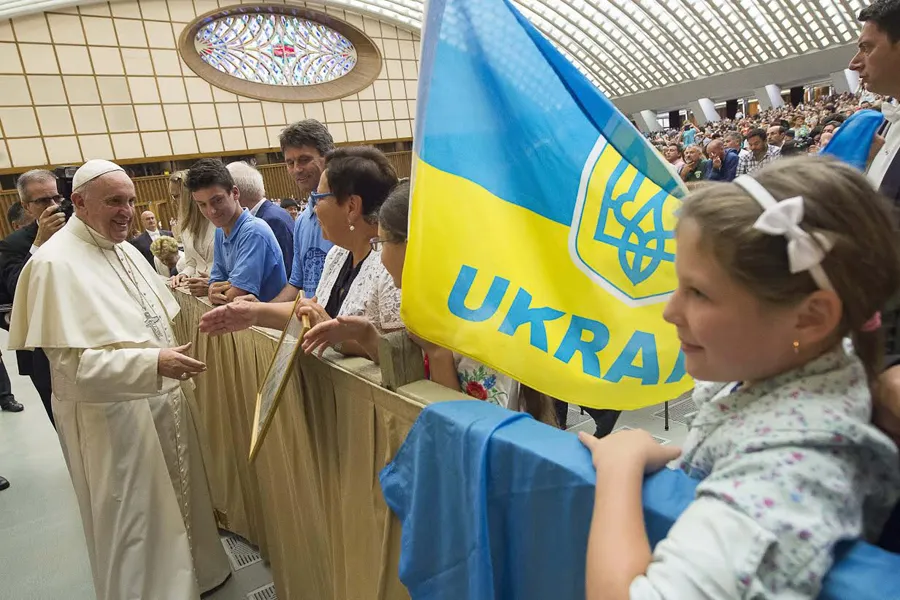
Rome, Italy, Dec 13, 2016 / 12:02 am (CNA/EWTN News).- A traveling exhibit currently set up in Rome’s St. Silvester Square highlights the difficulties – as well as the strength, resilience, and hope – of Ukrainians who have had to flee their homes due to ongoing conflict in the country’s eastern regions.
“Through this exhibition we want to share with you our hopes, energy, and ideas for the future,” the introduction to the display reads. “We, as Ukrainians, have our rights and responsibilities – we want to be part of our nation that lives in peace and security.”
Displaying about 10 stories of individuals and families from different professions and situations, the exhibit shows the common theme of longing for home and the freedom to live a normal life.
“We are internally displaced people who left our homes, but this doesn’t make us different. We were, and are, citizens of Ukraine,” the introduction continues. “We don’t ask the state for anything more than our right to live and be treated the same as others. To have the possibility to work for ourselves and help build our country’s future.”
Launched by the British government through the British Embassy and the British Council in Ukraine, the exhibit was first opened in Kyiv in Nov. 2015 and has stopped in other places in the Ukraine, as well as London and Brussels. It is in Rome Dec. 5-14.
The display consists of large photographs of individuals or families with their own messages superimposed.
Each story and message is unique, expressing the man or woman’s own particular struggles and fears – but through many of them is the same desire – not for charity, but for work, so that they can contribute to and thank their new communities.
Conflict erupted in Ukraine in Nov. 2013, when the former government refused to sign the Association Agreement with the European Union, leading to months of violent protests.
Tensions deepened in Feb. 2014, when the country’s former president was ousted following the protests, and a new government appointed. In March of that year, Ukraine’s eastern peninsula of Crimea was annexed by Russia, and pro-Russian separatists have since taken control of eastern portions of Ukraine.
More than 9,700 people, including civilians, have died in the fighting between Ukraine’s military and the separatists. Roughly 2 million others have been forced to flee due to violence and a lack of basic humanitarian necessities, such as food and medicine.
“They ask me ‘what is it like to lose your home?’” wrote Yana Cherkas, a mother of six. “How should I answer? I don’t know. I don’t have time to think about it. We have lived in five towns in six months. Everything’s destroyed.”
“I want to be home so badly,” she wrote. “I ask myself, does anybody want us. What for? We have no right to vote, no normal life. I just want to settle. With no need to go further, no need to ask anyone for help, no need to survive.”
“I say to myself: tomorrow is a new day, and everything will be fine. Everything will come together, it’s that now it’s difficult. It will get easier. Donetsk remains home for us and one day I dream of returning. But they hate us there fiercely, they hate us here politely.”
Though Cherkas and her family have had trouble settling in the villages, others say they have been welcomed by the people in Kyiv – although the government does nothing to assist them.
One is Olga Todorova, a graphic designer and volunteer from Stakhanov, in the Luhansk Oblast, which is controlled by the separatists. She said that since arriving in Kyiv, she and her family “have met kind people who helped us,” although the government “less so.”
“Our position is this,” she wrote: “if you can’t help, at least don’t hinder.”
“When you see total lawlessness and chaos, you don’t simply leave – you run,” she expressed. “The very beginning is the most difficult, the adaptation. When you think of what you had and what you left behind.”
“Over there, we were ‘Ukry,’ betrayers who left Luhansk to go to Ukraine. But we were luckier than most. I know seven people who were killed because of their pro-Ukrainian position. This is horrifying.”
Anzhelika Ostapenko, a pharmacist also from Luhansk, wrote about the fear of living and working in the middle of conflict, like a bomb that hit a nearby government building while she was working.
“At night I would come to my window, look at all these people with machine guns and realize – this is it, it cannot continue like this any longer.”
“When people shoot near your windows and your child starts trembling with fear, the only thing you can think of is how to save your family,” she wrote. “So we packed our children’s stuff, got on the train and left.”
She noted that people in Kyiv have accepted them very well, but other people have stayed behind in the east, either because of commitments or circumstances.
One is her mother: “she says that relocating at her age is like uprooting an old tree.” But for Ostapenko, “home is where my children are.”
“The only thing I ask now is to have the opportunity to earn money so that we can get a mortgage at normal interest rates,” she wrote. “The rest will follow. Everything else will mend in time.”
In the meantime, one young mother, Elena Lusenko, wrote as if speaking a word of encouragement to her young son: “You will have a wonderful and a very happy life.”
“You will never be an internally displaced person because it is impossible to lose what you have inside your heart. The most important thing is that we are together, where we are truly happy.”
Previous Post

December 13, 2016
New Catholic thriller takes on proof of soul in DNA
Next Post
December 13, 2016 How India's 'unreached' tribal areas are being evangelized
Browse Our Archives
Select a Category Americas Asia - Pacific Europe Middle East - Africa Uncategorized US Vatican
Select a Month November 2017 October 2017 September 2017 August 2017 July 2017 June 2017 May 2017 April 2017 March 2017 February 2017 January 2017 December 2016 November 2016 October 2016 September 2016 August 2016 July 2016 June 2016 May 2016 April 2016 March 2016 February 2016 January 2016 December 2015 November 2015 October 2015 September 2015 August 2015 July 2015 June 2015 May 2015 April 2015 March 2015 February 2015 January 2015 December 2014 November 2014 October 2014 September 2014 August 2014 July 2014 June 2014 May 2014 April 2014 March 2014 February 2014 January 2014 December 2013 November 2013 October 2013 September 2013 August 2013 July 2013 June 2013 May 2013 April 2013 March 2013 February 2013 January 2013 December 2012 November 2012 October 2012 September 2012 August 2012 July 2012 June 2012 May 2012
TAKE THE
Religious Wisdom Quiz
Who prophesied a virgin would bear a son called Immanuel?
Select your answer to see how you score.
Jeremiah Micah Isaiah Ezekiel
Related posts from Catholic News

Sixty Vincentians martyred during Spanish Civil War to...

Filipinos gather in Rome to promote bishop's beatification...

UK bishop calls for prayers as MPs urge...

On All Souls' Day, Pope Francis prays for...
TRENDING AT PATHEOS Catholic

Creation, Preservation, and Teleology in Catholic Theology
As I write this, it is very early Monday morning. Like millions...

The Parable Of The Sower And The Word...
One of Christ’s most famous parables is that of the sower who...

Rejecting Doom: Christian Hope And Human Action
Christianity is a religion of hope. We are to have hope and...

Why I Choose the Eucharist Over the Sermon
Choose the Eucharist, Not the Sermon What are we supposed to get...

5 Design Elements Found in Spiritually Rooted Homes
Putting Spirituality Into Home Decor Our homes are more than our living...

Credo: A Story of God Told with the...
About 10 years ago, I began to imagine a personal "Credo" that...
view all Catholic blogs
Ad-Free & Subscriber Log-In Subscription Support
- About Us
- 2026 Calendar
- Videos
- Podcasts
- Library of World Religions
- Faith In Media Tracker
- Advertise With Us
- Write for Us
- Privacy Policy
- Terms of Service
- Do Not Sell My Data
- Contact Us
- Radiant Digital
- Manage Newsletter Subscriptions
- Unsubscribe From Notifications
- Sitemap
Copyright 2008-2026, Patheos. All rights reserved.
Subscription Support Ad-Free & Subscriber Log-In
Follow Patheos