
BuddhistCatholicContemplativeEvangelicalGeneral ChristianHinduJewishLatter-day SaintMuslimNew VisionsProgressive Christian
Beliefs
- Buddhist
- Catholic
- Contemplative
- Evangelical
- General Christian
- Hindu
- Jewish
- Latter-day Saint
- More Voices
- Muslim
- New Visions
- Pagan
- Progressive Christian
Topics
- Religion News
- Food and Religion
- Sports and Religion
- Religious Art
- Religious Music and Entertainment
- Religious Events
- History and Religion
- Style and Religion
- Politics and Religion
- Women in Religion
- Recreation Outdoors and Religion
- Business Finance and Religion
- Careers Workplace and Religion
- Education and Religion
- Family Parenting and Religion
- Health Fitness and Religion
- Home and Religion
- Relationships and Religion
- Technology and Religion
- Travel and Religion
Columnists
- Buddhist Columnists
- Business Finance and Religion Columnists
- Careers Workplace and Religion Columnists
- Catholic Columnists
- Contemplative Columnists
- Education and Religion Columnists
- Evangelists Columnists
- Family Parenting and Religion Columnists
- General Christian Columnists
- Health Fitness and Religion Columnists
- Hindu Columnists
- History and Religion Columnists
- Home and Religion Columnists
- Jewish Columnists
- More Voices Columnists
- Latter Day Columnists
- Muslim Columnists
- New Visions Columnists
- Nonreligious Columnists
- Pagan Columnists
- Politics and Religion Columnists
- Progressive Columnists
- Recreation Outdoors and Religion Columnists
- Relationships and Religion Columnists
- Religion News Columnists
- Religious Art Columnists
- Religious Events Columnists
- Religious Music and Entertainment Columnists
- Sports and Religion Columnists
- Style and Religion Columnists
- Technology and Religion Columnists
- Travel and Religion Columnists
- Women in Religion Columnists
Resource Library
- 2026 Calendar
- Library of World Religions
- The 100 Most Holy Places on Earth
- Patheos Answers
- Podcasts
- Videos
- Faith Leaders Database
- Anglican Episcopalian
- Bahai
- Baptist
- Buddhism
- Christianity
- Confucianism
- Eastern Orthodoxy
- Hinduism
- Holiness and Pentecostal
- ISKCON
- Islam
- Judaism
- Lutheran
- Methodist
- The Church of Jesus Christ of Latter-day Saints
- New Age
- Paganism
- Presbytarian and Reformed
- Protestantism
- Religion Behind the Scenes
- Roman Catholic
- Scientology
- Shia Islam
- Sikhism
- Sufism
- Sunni Islam
- Taoism
- Zen
- See all religions
Research Tools
 Ad-Free & Subscriber Log-In Subscription Support
Ad-Free & Subscriber Log-In Subscription Support
Follow Patheos 

- Trending:
- Forgiveness
- |
- Marriage
- |
- Consciousness
- |
- Death Penalty
- |
- Election
- |
- Halloween
 Catholic News
- Home
- Catholic
- Religion News
- So what is a consistory, anyway?
So what is a consistory, anyway?
Last updated on: November 18, 2016 at 10:26 pm by CNA Daily News
So what is a consistory, anyway? 2016-11-18T22:26:00+00:00 CNA Daily News
Patheos Explore the world's faith through different perspectives on religion and spirituality! Patheos has the views of the prevalent religions and spiritualities of the world.
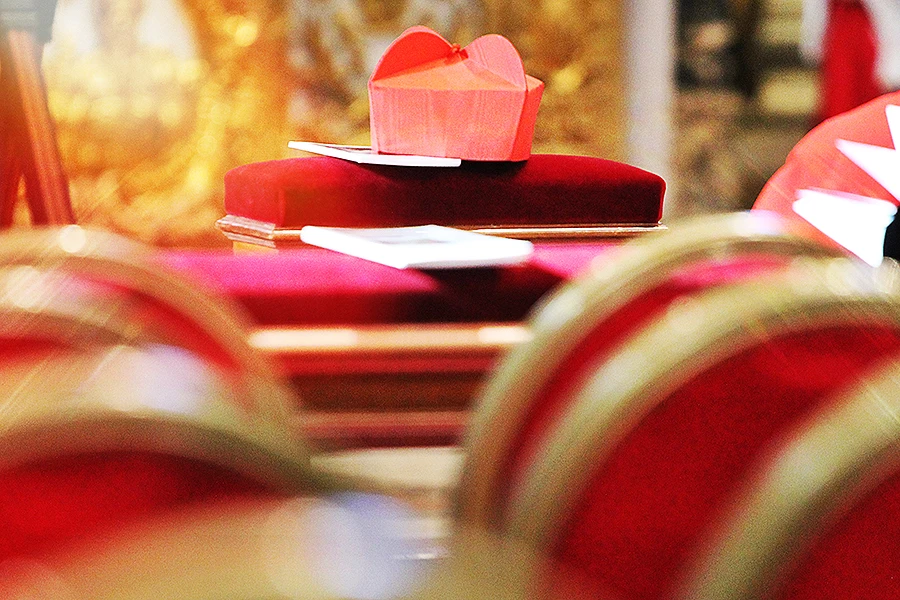
Rome, Italy, Nov 18, 2016 / 03:26 pm (CNA/EWTN News).- In a simple rite this Saturday, 17 prelates will receive a red biretta from Pope Francis and thus join the College of Cardinals.
Dressed in their red robes, the cardinals-to-be will gather in St. Peter Basilica, profess the Creed, and then approach Pope Francis one by one. The Pope will give each of them the red biretta, and their cardinal’s ring
The Pope will place the red hat on each cardinal’s head and say:
“To the glory of almighty God and the honor of the Apostolic See, receive the scarlet biretta as a sign of the dignity of the cardinalate, signifying your readiness to act with courage, even to the shedding of your blood, for the increase of the Christian faith, for the peace and tranquility of the people of God and for the freedom and growth of the Holy Roman Church.”
As he places the ring on a new cardinal’s finger, the Pope will say: “Receive this ring from the hand of Peter and know that, with the love of the Prince of the Apostles, your love for the Church is strengthened.”
Each cardinal will be assigned a titular church. This is an important act, as the cardinals must be a part of the Diocese of Rome, whose bishop and primate is the Pope. This means cardinals are always linked to Rome, though they come from different countries.
The College of Cardinals reflects how the Synod of the Diocese of Rome evolved to become a governmental body. It is an institution that can be simply considered as “the Pope’s Senate.”
Cardinals are now part of Vatican Congregations and dicasteries, and in that capacity they help the Pope to govern the Church. This was not always the case.
During the Middle Ages, consistories were convoked any time the Pope had to make an important decision. The meeting of cardinals also served as a tribunal. In the twelfth century, Pope Alexander III scheduled one consistory per month. Not long after Alexander III’s pontificate, Pope Innocent III scheduled three meetings per week.
In the 16th century, under Pope Sixtus V’s curial reforms, the consistory lost some of its power. Ever since, cardinals mainly assist the Pope in governing the Church and working in Vatican congregations. The consistory is convoked to give a particular solemnity to important moments of the Church.
The rite of the consistory was reformed in 1969 by Blessed Paul VI. The reform gave a liturgical framework to the creation of a new cardinal, though the event had not previously been seen as a liturgical moment.
Pope Paul’s changes elaborated a rite that put the imposition of the red biretta in a context of prayer. He thus gave a spiritual bond to the cardinals’ intimate union with the Pope.
Father Gianfranco Grieco, a former writer for L’Osservatore Romano who covered all the Paul VI’s international trips, recounted in his book “Paul VI” that the Pope used to convoke a consistory any time he came back from an international trip. He would report his impressions from the trip and exchange opinions with the cardinals.
The rite for the consistory was reformed and simplified by Pope Benedict XVI in 2012, while maintaining Paul VI’s vision of a liturgical framework for the creation of new cardinals.
Benedict XVI took from Paul VI’s rite two prayers of the cardinals that refer to the powers God has given to the Church, and especially to the successor of Peter. The successor of Peter, in turn, prays for himself, asking that he will be able to rightly fulfil his office.
Consistories have still had key roles in the life of the Church. Benedict XVI announced his historic resignation of the Petrine ministry on Feb. 11, 2013, during a Consistory for the Canonization of the Martyrs of Otranto.
As for Pope Francis, he has used the consistory as a sort of “advisory board” on core issues.
The Feb. 22, 2014 consistory was preceded by an extraordinary consistory on the issues of the family. It was opened with a speech from Cardinal Walter Kasper that set the tone of the discussion ahead of the two synods on the family.
Pope Francis convoked another extraordinary consistory Feb. 12-13, 2015 to discuss Curia reform, ahead of the Feb. 14-15 consistory for the creation of new Cardinals.
It is noteworthy that the Code of Canon Law, reformed in 1983, lays out two forms of consistory: ordinary and extraordinary. An extraordinary consistory is celebrated in particular cases, and all the cardinals are called to take part in it. An ordinary consistory takes place when the Pope needs the cardinals’ counsel on some important, though normal, issue, or to give solemnity to the Pope’s decision, such as the approval of the canonization of saints.
Kevin J. Jones contributed to this report.
Previous Post

November 18, 2016
Pope tells bishops to have compassion on those with failed marriages
Next Post
November 19, 2016 Pope warns new cardinals against falling into polemics, division
Browse Our Archives
Select a Category Americas Asia - Pacific Europe Middle East - Africa Uncategorized US Vatican
Select a Month November 2017 October 2017 September 2017 August 2017 July 2017 June 2017 May 2017 April 2017 March 2017 February 2017 January 2017 December 2016 November 2016 October 2016 September 2016 August 2016 July 2016 June 2016 May 2016 April 2016 March 2016 February 2016 January 2016 December 2015 November 2015 October 2015 September 2015 August 2015 July 2015 June 2015 May 2015 April 2015 March 2015 February 2015 January 2015 December 2014 November 2014 October 2014 September 2014 August 2014 July 2014 June 2014 May 2014 April 2014 March 2014 February 2014 January 2014 December 2013 November 2013 October 2013 September 2013 August 2013 July 2013 June 2013 May 2013 April 2013 March 2013 February 2013 January 2013 December 2012 November 2012 October 2012 September 2012 August 2012 July 2012 June 2012 May 2012
TAKE THE
Religious Wisdom Quiz
What does Revelation say will wipe away every tear from their eyes?
Select your answer to see how you score.
The tree of life God himself An angel The river of life
Related posts from Catholic News

Sixty Vincentians martyred during Spanish Civil War to...

Filipinos gather in Rome to promote bishop's beatification...

UK bishop calls for prayers as MPs urge...

On All Souls' Day, Pope Francis prays for...
TRENDING AT PATHEOS Catholic

The Parable Of The Sower And The Word...
One of Christ’s most famous parables is that of the sower who...

Rejecting Doom: Christian Hope And Human Action
Christianity is a religion of hope. We are to have hope and...

Why I Choose the Eucharist Over the Sermon
Choose the Eucharist, Not the Sermon What are we supposed to get...

5 Design Elements Found in Spiritually Rooted Homes
Putting Spirituality Into Home Decor Our homes are more than our living...

Credo: A Story of God Told with the...
About 10 years ago, I began to imagine a personal "Credo" that...

The Anatomy of Divine Revelation in Catholic Thought
The claim that God has made Himself known to human beings is...
view all Catholic blogs
Ad-Free & Subscriber Log-In Subscription Support
- About Us
- 2026 Calendar
- Videos
- Podcasts
- Library of World Religions
- Faith In Media Tracker
- Advertise With Us
- Write for Us
- Privacy Policy
- Terms of Service
- Do Not Sell My Data
- Contact Us
- Radiant Digital
- Manage Newsletter Subscriptions
- Unsubscribe From Notifications
- Sitemap
Copyright 2008-2026, Patheos. All rights reserved.
Subscription Support Ad-Free & Subscriber Log-In
Follow Patheos