
BuddhistCatholicContemplativeEvangelicalGeneral ChristianHinduJewishLatter-day SaintMuslimNew VisionsProgressive Christian
Beliefs
- Buddhist
- Catholic
- Contemplative
- Evangelical
- General Christian
- Hindu
- Jewish
- Latter-day Saint
- More Voices
- Muslim
- New Visions
- Pagan
- Progressive Christian
Topics
- Religion News
- Food and Religion
- Sports and Religion
- Religious Art
- Religious Music and Entertainment
- Religious Events
- History and Religion
- Style and Religion
- Politics and Religion
- Women in Religion
- Recreation Outdoors and Religion
- Business Finance and Religion
- Careers Workplace and Religion
- Education and Religion
- Family Parenting and Religion
- Health Fitness and Religion
- Home and Religion
- Relationships and Religion
- Technology and Religion
- Travel and Religion
Columnists
- Buddhist Columnists
- Business Finance and Religion Columnists
- Careers Workplace and Religion Columnists
- Catholic Columnists
- Contemplative Columnists
- Education and Religion Columnists
- Evangelists Columnists
- Family Parenting and Religion Columnists
- General Christian Columnists
- Health Fitness and Religion Columnists
- Hindu Columnists
- History and Religion Columnists
- Home and Religion Columnists
- Jewish Columnists
- More Voices Columnists
- Latter Day Columnists
- Muslim Columnists
- New Visions Columnists
- Nonreligious Columnists
- Pagan Columnists
- Politics and Religion Columnists
- Progressive Columnists
- Recreation Outdoors and Religion Columnists
- Relationships and Religion Columnists
- Religion News Columnists
- Religious Art Columnists
- Religious Events Columnists
- Religious Music and Entertainment Columnists
- Sports and Religion Columnists
- Style and Religion Columnists
- Technology and Religion Columnists
- Travel and Religion Columnists
- Women in Religion Columnists
Resource Library
- 2026 Calendar
- Library of World Religions
- The 100 Most Holy Places on Earth
- Patheos Answers
- Podcasts
- Videos
- Faith Leaders Database
- Anglican Episcopalian
- Bahai
- Baptist
- Buddhism
- Christianity
- Confucianism
- Eastern Orthodoxy
- Hinduism
- Holiness and Pentecostal
- ISKCON
- Islam
- Judaism
- Lutheran
- Methodist
- The Church of Jesus Christ of Latter-day Saints
- New Age
- Paganism
- Presbytarian and Reformed
- Protestantism
- Religion Behind the Scenes
- Roman Catholic
- Scientology
- Shia Islam
- Sikhism
- Sufism
- Sunni Islam
- Taoism
- Zen
- See all religions
Research Tools
 Ad-Free & Subscriber Log-In Subscription Support
Ad-Free & Subscriber Log-In Subscription Support
Follow Patheos 

- Trending:
- Forgiveness
- |
- Marriage
- |
- Consciousness
- |
- Death Penalty
- |
- Election
- |
- Halloween
 Catholic News
- Home
- Catholic
- Religion News
- For Cardinal Kasper, ‘Amoris laetitia’ allows new pastoral practices
For Cardinal Kasper, ‘Amoris laetitia’ allows new pastoral practices
Last updated on: October 28, 2016 at 11:07 pm by CNA Daily News
For Cardinal Kasper, ‘Amoris laetitia’ allows new pastoral practices 2016-10-28T23:07:00+00:00 CNA Daily News
Patheos Explore the world's faith through different perspectives on religion and spirituality! Patheos has the views of the prevalent religions and spiritualities of the world.
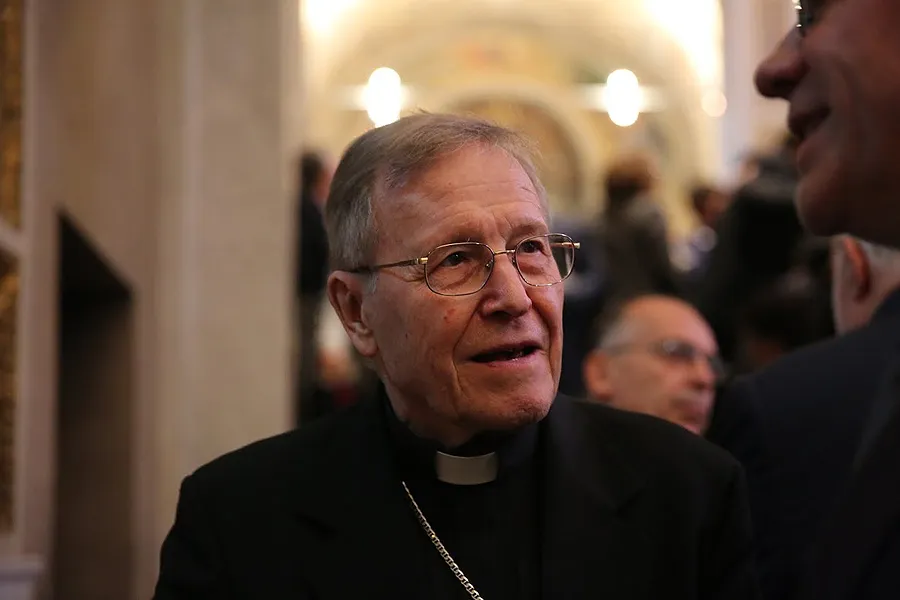
Munich, Germany, Oct 28, 2016 / 05:07 pm (CNA/EWTN News).- In a recent article for a German journal, Cardinal Walter Kasper – a protagonist for the admission of the divorced-and-remarried to Holy Communion – has written that Amoris laetitia marks a “paradigm shift” that allows for a “changed pastoral practice.”
“There is leeway in the concrete elaboration of the dogmatic principles’ practical pastoral consequences,” the president emeritus of the Pontifical Council for Promoting Christian Unity wrote in his article for the November 2016 edition of Stimmen der Zeit, a monthly journal on Christian culture.
Cardinal Kasper began by examining the range of interpretations of the apostolic exhortation issued by Pope Francis in March. He dismissed Cardinal Raymond Burke's denial that it is magisterially binding, saying this “formally contradicts the character of an apostolic exhortation as well as its content.”
The cardinal complained that most commentaries focus on the document's controversial eighth chapter, saying this “does not do justice in any way to the rich biblical and pastoral content of the exhortation.”
On the conservative side, he cited Robert Spaemann's view that Amoris laetitia is a breach with the Church's teaching tradition; Cardinal Gerhard Müller's that it has not changed the Church's “teaching position”; and Rocco Buttiglione's that it is a “progression” which “lies on the line sketched out” by St. John Paul II.
Turning to the progressive side, Cardinal Kasper pointed to those who see “a cautious progression” and those who, like Norbert Lüdecke, “see the door open for a new pastoral praxis, which allows civilly remarried divorces to decide themselves in their own conscience, whether they can partake in Communion.”
For his own part, Cardinal Kasper said he “fundamentally associates” with the “centrist conservatives (or also centrist progressives)”, such as Cardinal Christoph Schönborn and Fr. Antonio Spadaro, whose interpretation he said “essentially concurs” with Buttiglione's position.
He charged that “alleged anxiety” about the document comes from a group “which has alienated itself from a sense of faith and the life of the people of God.”
Amoris laetitia has “a new, fresh and honestly liberating tone,” Cardinal Kasper maintained. “It speaks not from an abstract image of the family thought out at a desk, but a realistic one of the joys as well as the difficulties in family life today. It does not want to criticize or moralize or indoctrinate, but it addresses sexuality and eroticism openly and in a relaxed manner expressing understanding and appreciation for the good that can also be found in situations that are not or not fully conforming to church teaching and ordinance.”
He emphasized the encouragement and joy of the exhortation, pointing out that the fourth chapter, an exegesis on St. Paul's hymn to charity, is what Pope Francis has called its “heart”. From this exegesis comes a pastoral conception “not characterized by the raised finger but the outstretched helping hand. Listening, appreciating, accompanying and integrating are decisive for this pastoral care.”
According to Cardinal Kasper, behind this pastoral tone is a “thoroughly thought-out theological position,” demonstrated by the “many references” to St. Thomas Aquinas on the passions: “One could say cum grano salis that Amoris laetitia refrains from a predominantly negative, Augustinian view of sexuality and turns toward the creation-affirming Thomistic view.”
He also emphasizes the central place of the concept of the journey of life in Francis' thought, in which he said “the law always applies” as the final cause which “orients every single step towards the goal” and “is not a distant ideal.”
“Usually people – and we are all such people – cannot do the optimum, but only the best possible in one’s situation; often we must choose the lesser evil. In a lived life, there are not only black and white, but also very different nuances and shades,” Cardinal Kasper wrote.
He added that Amoris laetitia can be understood only “if the paradigm shift that this exhortation undertakes is comprehended.”
“A paradigm shift does not change the previous teaching; it moves the teaching nonetheless into a larger context. So Amoris laetitia does not change an iota in the Church’s teaching, and yet it still changes everything. The paradigm shift entails Amoris laetitia taking the step from a legal morality towards the virtue ethics of Thomas Aquinas. Hence the exhortation stands in the best tradition. The new is, in reality, the proven old.”
The cardinal cited Aquinas as a support for his understanding of the exhortation, and hearkened back to his February 2014 address to the consistory of cardinals in which he suggested that a “smaller segment” of the divorced-and-remarried might be admitted to Communion. He emphasized the virtue of prudence and concluded that “the norm is not applied in the same mechanical manner to every situation. For its appropriate application, it needs the visual judgement of prudence and the eye of love and mercy.”
Prudence, Cardinal Kasper wrote, “does not rescind the words of the Gospel on adultery but applies them. So the statement of John Paul II is also irrevocably valid, according to which a civil marriage during the continuity of the first valid sacramental marriage stands in objective contradiction to the indissoluble sacramental bond of the first marriage. That is immovable Catholic tradition, which is not contradicted in Amoris laetitia, but affirmed.”
As a consequence, he acknowledged that “a civil marriage during the continuity of the first sacramental marriage cannot be a sacramental marriage.”
He also traced different ways that the tradition has regarded the divorced-and-remarried, saying that Benedict XVI “adhered to the decision of John Paul II to not allow divorced-and-remarried persons to Communion; he did this while he spoke of an encouragement of civilly divorced-and-remarried persons to an abstinent life. With this, he focused on a process of maturity and spiritual growth.”
“In this dynamic way of thinking, Pope Francis now goes a step further, in which he places the problem in the process of a comprehensive pastoral care of gradual integration.”
According to Cardinal Kasper, St. John Paul II “had already opened the door a little bit” by allowing the divorced-and-remarried to receive absolution if they take on the duty to live in complete continence.
“This clause is basically an admission,” the cardinal wrote. “For the abstinence belongs to the realm of intimacy and it does not rescind the objective contradiction between the continuous marital bond of the first sacramental marriage and the legal public marriage … It shows that there is leeway in the concrete elaboration of the dogmatic principles’ practical pastoral consequences.”
For Cardinal Kasper, Amoris laetitia gets to the root of this leeway by its use of Aquinas' “distinction between the objective deadly sins and their subjective culpable apportionment,” with Pope Francis choosing to emphasize the subjective aspect of sin and the role of conscience.
He noted that the exhortation does not draw “any clear practical consequences,” but it does adopt premises by which “a changed pastoral practice is allowed in justified individual cases.”
“It leaves open the concrete question of admittance to absolution and Communion,” Cardinal Kasper wrote.
“On this question, the Pope has followed the way of the preserved tradition of the teaching to not force contentious questions but to leave it open for the unity of the Church. That does not mean, as some think, that the teaching office is abolished; leaving a question open is itself a momentous decision of the teaching office.”
He said that “The direction in which Pope Francis wants to go seems clear,” while adding that it is much more important that step-by-step integration of the divorced-and-remarried be “oriented according to its essence towards admittance to the Eucharist as a full form of participation in the life of the Church.”
This interpretation “agrees with valid canon law without any difficulties,” according to Cardinal Kasper.
“With what right may the Church deny Christians the help of a means of grace that they, moved by grace, strive with their best powers towards a Christian life through prayer, the Christian raising of children, service to the parish, and charitable and social dedication?” he asked.
“Can it be that the Spirit of God proves to be presently effective, but the Church – like Pilate – washes her hands in innocence and is sorry to not be able to do anything? Does it not also pertain to the Church in certain situations to be merciful like our Father?”
Concluding, Cardinal Kasper maintained that Amoris laetitia “does not give up one iota of the traditional teaching of the Church. Indeed, this exhortation changes everything insofar as it places the traditional teaching in a new perspective. This apostolic exhortation is no breach of tradition, rather the renewal of a great tradition. It is about continuity in the reform as Benedict XVI – following John Henry Newman – described.”
He said local Churches now “face the question of how they can concretely pursue the pastoral way that Amoris laetitia basically established,” and that this should be not focused solely on the divorced-and-remarried, but includes marriage prep and accompaniment.
Regarding the divorced-and-remarried, he said the exhortation “does not lead us on the comfortable way of patent formulas, which cannot exist in reality … that presents bishops, priests, and pastoral ministers, but most especially confessors, with great challenges.”
“Spiritual discernment demands spiritual competence,” he maintained. “It is a gift of the Holy Spirit as well as a fruit of spiritual experience and of learning from the great masters of the spiritual life. This matter must be strongly accounted for in the formation and continuing education of clerics and pastoral ministers going forward.”
Cardinal Kasper finished, saying, “Everything will need time: time to rethink and time to implement. We can absolutely not forget the synod. There remains much to be done. The synod has passed. The fierce debates will also hopefully pass soon. The concrete work begins now. We must make Amoris laetitia an awakening of family pastoral ministry. Marriage and family must be the central theme in pastoral care because the family is the way of the Church.”
Previous Post

October 28, 2016
Supreme Court to hear school's transgender bathroom case
Next Post
October 29, 2016 Want to end child soldiers? Stop fighting, Sudanese archbishop says
Browse Our Archives
Select a Category Americas Asia - Pacific Europe Middle East - Africa Uncategorized US Vatican
Select a Month November 2017 October 2017 September 2017 August 2017 July 2017 June 2017 May 2017 April 2017 March 2017 February 2017 January 2017 December 2016 November 2016 October 2016 September 2016 August 2016 July 2016 June 2016 May 2016 April 2016 March 2016 February 2016 January 2016 December 2015 November 2015 October 2015 September 2015 August 2015 July 2015 June 2015 May 2015 April 2015 March 2015 February 2015 January 2015 December 2014 November 2014 October 2014 September 2014 August 2014 July 2014 June 2014 May 2014 April 2014 March 2014 February 2014 January 2014 December 2013 November 2013 October 2013 September 2013 August 2013 July 2013 June 2013 May 2013 April 2013 March 2013 February 2013 January 2013 December 2012 November 2012 October 2012 September 2012 August 2012 July 2012 June 2012 May 2012
TAKE THE
Religious Wisdom Quiz
What Christian group requires its members to serve as missionaries?
Select your answer to see how you score.
Latter-day Saints Jehovah’s Witnesses Anglicans Baptists
Related posts from Catholic News

Sixty Vincentians martyred during Spanish Civil War to...

Filipinos gather in Rome to promote bishop's beatification...

UK bishop calls for prayers as MPs urge...

On All Souls' Day, Pope Francis prays for...
TRENDING AT PATHEOS Catholic

Creation, Preservation, and Teleology in Catholic Theology
As I write this, it is very early Monday morning. Like millions...

The Parable Of The Sower And The Word...
One of Christ’s most famous parables is that of the sower who...

Rejecting Doom: Christian Hope And Human Action
Christianity is a religion of hope. We are to have hope and...

Why I Choose the Eucharist Over the Sermon
Choose the Eucharist, Not the Sermon What are we supposed to get...

5 Design Elements Found in Spiritually Rooted Homes
Putting Spirituality Into Home Decor Our homes are more than our living...

Credo: A Story of God Told with the...
About 10 years ago, I began to imagine a personal "Credo" that...
view all Catholic blogs
Ad-Free & Subscriber Log-In Subscription Support
- About Us
- 2026 Calendar
- Videos
- Podcasts
- Library of World Religions
- Faith In Media Tracker
- Advertise With Us
- Write for Us
- Privacy Policy
- Terms of Service
- Do Not Sell My Data
- Contact Us
- Radiant Digital
- Manage Newsletter Subscriptions
- Unsubscribe From Notifications
- Sitemap
Copyright 2008-2026, Patheos. All rights reserved.
Subscription Support Ad-Free & Subscriber Log-In
Follow Patheos