
BuddhistCatholicContemplativeEvangelicalGeneral ChristianHinduJewishLatter-day SaintMuslimNew VisionsProgressive Christian
Beliefs
- Buddhist
- Catholic
- Contemplative
- Evangelical
- General Christian
- Hindu
- Jewish
- Latter-day Saint
- More Voices
- Muslim
- New Visions
- Pagan
- Progressive Christian
Topics
- Religion News
- Food and Religion
- Sports and Religion
- Religious Art
- Religious Music and Entertainment
- Religious Events
- History and Religion
- Style and Religion
- Politics and Religion
- Women in Religion
- Recreation Outdoors and Religion
- Business Finance and Religion
- Careers Workplace and Religion
- Education and Religion
- Family Parenting and Religion
- Health Fitness and Religion
- Home and Religion
- Relationships and Religion
- Technology and Religion
- Travel and Religion
Columnists
- Buddhist Columnists
- Business Finance and Religion Columnists
- Careers Workplace and Religion Columnists
- Catholic Columnists
- Contemplative Columnists
- Education and Religion Columnists
- Evangelists Columnists
- Family Parenting and Religion Columnists
- General Christian Columnists
- Health Fitness and Religion Columnists
- Hindu Columnists
- History and Religion Columnists
- Home and Religion Columnists
- Jewish Columnists
- More Voices Columnists
- Latter Day Columnists
- Muslim Columnists
- New Visions Columnists
- Nonreligious Columnists
- Pagan Columnists
- Politics and Religion Columnists
- Progressive Columnists
- Recreation Outdoors and Religion Columnists
- Relationships and Religion Columnists
- Religion News Columnists
- Religious Art Columnists
- Religious Events Columnists
- Religious Music and Entertainment Columnists
- Sports and Religion Columnists
- Style and Religion Columnists
- Technology and Religion Columnists
- Travel and Religion Columnists
- Women in Religion Columnists
Resource Library
- 2026 Calendar
- Library of World Religions
- The 100 Most Holy Places on Earth
- Patheos Answers
- Podcasts
- Videos
- Faith Leaders Database
- Anglican Episcopalian
- Bahai
- Baptist
- Buddhism
- Christianity
- Confucianism
- Eastern Orthodoxy
- Hinduism
- Holiness and Pentecostal
- ISKCON
- Islam
- Judaism
- Lutheran
- Methodist
- The Church of Jesus Christ of Latter-day Saints
- New Age
- Paganism
- Presbytarian and Reformed
- Protestantism
- Religion Behind the Scenes
- Roman Catholic
- Scientology
- Shia Islam
- Sikhism
- Sufism
- Sunni Islam
- Taoism
- Zen
- See all religions
Research Tools
 Ad-Free & Subscriber Log-In Subscription Support
Ad-Free & Subscriber Log-In Subscription Support
Follow Patheos 

- Trending:
- Forgiveness
- |
- Marriage
- |
- Consciousness
- |
- Death Penalty
- |
- Election
- |
- Halloween
 Catholic News
- Home
- Catholic
- Religion News
- Church on front line against Ebola outbreak, official says
Church on front line against Ebola outbreak, official says
Last updated on: August 8, 2014 at 6:02 am by CNA Daily News
Church on front line against Ebola outbreak, official says 2014-08-08T06:02:00+00:00 CNA Daily News
Patheos Explore the world's faith through different perspectives on religion and spirituality! Patheos has the views of the prevalent religions and spiritualities of the world.
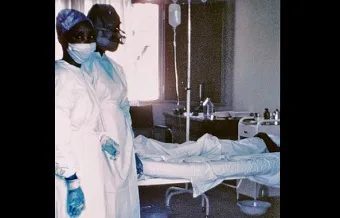
Vatican City, Aug 8, 2014 / 12:02 am (CNA/EWTN News).- The Catholic Church plays a fundamental role in responding to the worst outbreak of Ebola infections in history, a Holy See collaborator has explained.
“The Catholic Church manages health facilities, and so it will be able to care for Ebola-affected people whenever the structures have the capacity to keep the infected people in isolation,” Monsignor Robert J. Vitillo told CNA.
Msgr. Vitillo is special advisor to the Rome-based Catholic relief organization confederation Caritas Internationalis on HIV/AIDS. He also heads Caritas' delegation to the United Nations in Geneva and collaborates with the Holy See.
He said that the Catholic Church is working on three levels to help respond to the epidemic: the cure of infected people, preventive education to avoid a pandemic, and pastoral education.
According to World Health Organization data, 932 people have died from Ebola, out of 1,711 people infected in the latest outbreak. In Liberia, 516 people have been infected and 282 have died; in Nigeria, nine have been infected and one has died; in Sierra Leone 691 have been infected, with 286 deaths; in Guinea there have been 495 cases and 363 deaths.
Already before the outbreak, the Catholic Church had been working to prevent an epidemic and to educate people in common hygienic procedures.
“Working on the ground, we were aware of this extremely dangerous disease for months, and worked really hard to educate communities,” Laura Sheahen, communications officer for Caritas Internationalis, told CNA Aug. 7.
Sheahen said that the organization is working to expand its activity “now that the epidemic is spreading very quickly.”
“There is a need for international funding to help Caritas in developing their work with communities,” she said. “We have a lot of courageous priests, volunteers and parish workers who are working incredibly hard on the ground.”
A World Health Organization survey reported that between 40 percent and 70 percent of African health facilities are the property of or managed by Catholic churches. In many countries the Catholic Church has almost half of the local health facilities.
However, Msgr. Vitillo said, “in situation of crisis like that of the Ebola outbreak, it is difficult to meet all the needs of the population, and it is especially difficult to have access to resources, to supplies.”
“At the moment, we are organizing an emergency appeal, trying to buying supplies,” he explained, adding that this work requires “collaboration with local governments, with international structures and with pharmaceutical companies, which are the producers of supplies.”
The Caritas advisor said that there are presently no medicines able to attack the Ebola virus.
He suggested that many pharmaceutical companies are reluctant to spend so much money on Ebola research. Although the virus has caused “great damage” it is “not spread all over the world.”
Holy See representatives took part in a two-day emergency meeting in Geneva to determine whether the outbreak constitutes a public health emergency and how to address it.
Msgr. Vitillo explained that “that was not a session at a government level, it was mostly a technical session,” but the “Holy See is also in touch with the officials at the World Health Organization and with the officials of the government interested.”
“Church is very much involved in combating the epidemic, it is part of its history. We have always worked a lot during the various pandemics,” he noted.
The Caritas adviser recounted that the Church has also an historical role in the discovery of the Ebola virus. The virus' co-discoverer, Dr. Peter Piot, was working as a missionary doctor in the Zaire when he helped discovered Ebola. According to the monsignor, Piot “always spoke very well of his experience with nuns of the hospital” for which he worked.
Beyond seeking to cure infected people, the Catholic Church is always committed to education, the monsignor added.
“We educate people, we explain in villages the importance of basic hygienic rules, like washing hands, in order to prevent the dissemination of the virus.”
On pastoral education, Msgr. Vitillo said that the Catholic Church “supports people in their suffering, showing that there is a God accompanying us in our sufferings, and that the Church has a special way of commemorating the dead people, that Jesus has given his life for us, he went beyond death for us, and so there is hope.”
This kind of pastoral education is important because it helps to avoid local customs involving the burial of the dead. These traditions include a vigil and touching the corpse of the deceased, a very dangerous practice when seeking to curtail infectious disease.
Sheahen also noted that burial rites are one difficulty regarding Ebola prevention.
She said that “for many months, people did not believe that Ebola is real, some believed it was something the government had created for some strange purpose for political reasons.”
Now, “people do believe it’s real, but they find it difficult to change some cultural traditions that help to spread the infection.”
“West African culture is very social, they shake hands, they like to socialize, to get together, and whether they are Christians, Muslims or of traditional religions, they also want to be in contact with the body of a dead member of their families before the burial,” Sheahen explained.
“They want to wash the body, touch the body. All of this is very dangerous.”
Previous Post

August 7, 2014
Disbelief, horror follow desertion of baby with Down syndrome
Next Post
August 8, 2014 Catholics in Melanesia celebrate gift, power of Bible
Browse Our Archives
Select a Category Americas Asia - Pacific Europe Middle East - Africa Uncategorized US Vatican
Select a Month November 2017 October 2017 September 2017 August 2017 July 2017 June 2017 May 2017 April 2017 March 2017 February 2017 January 2017 December 2016 November 2016 October 2016 September 2016 August 2016 July 2016 June 2016 May 2016 April 2016 March 2016 February 2016 January 2016 December 2015 November 2015 October 2015 September 2015 August 2015 July 2015 June 2015 May 2015 April 2015 March 2015 February 2015 January 2015 December 2014 November 2014 October 2014 September 2014 August 2014 July 2014 June 2014 May 2014 April 2014 March 2014 February 2014 January 2014 December 2013 November 2013 October 2013 September 2013 August 2013 July 2013 June 2013 May 2013 April 2013 March 2013 February 2013 January 2013 December 2012 November 2012 October 2012 September 2012 August 2012 July 2012 June 2012 May 2012
TAKE THE
Religious Wisdom Quiz
In 1 Peter, what does Peter say Christ was chosen before but revealed in when?
Select your answer to see how you score.
Before the creation of the world, revealed in these last times Before time began, revealed at the resurrection Before the prophets spoke, revealed at Pentecost Before Abraham was born, revealed at his baptism
Related posts from Catholic News

How do we help trafficking victims re-enter society?...

More than just giving – World Day of...

New book reveals details of John Paul I’s...

Despite reports, Pope Francis isn’t opening the door...
TRENDING AT PATHEOS Catholic

Rejecting Doom: Christian Hope And Human Action
Christianity is a religion of hope. We are to have hope and...

It’s What Comes From Within Which Matters
One of the most difficult things for us to understand is why...

Why I Choose the Eucharist Over the Sermon
Choose the Eucharist, Not the Sermon What are we supposed to get...

5 Design Elements Found in Spiritually Rooted Homes
Putting Spirituality Into Home Decor Our homes are more than our living...

Credo: A Story of God Told with the...
About 10 years ago, I began to imagine a personal "Credo" that...

The Anatomy of Divine Revelation in Catholic Thought
The claim that God has made Himself known to human beings is...
view all Catholic blogs
Ad-Free & Subscriber Log-In Subscription Support
- About Us
- 2026 Calendar
- Videos
- Podcasts
- Library of World Religions
- Faith In Media Tracker
- Advertise With Us
- Write for Us
- Privacy Policy
- Terms of Service
- Do Not Sell My Data
- Contact Us
- Radiant Digital
- Manage Newsletter Subscriptions
- Unsubscribe From Notifications
- Sitemap
Copyright 2008-2026, Patheos. All rights reserved.
Subscription Support Ad-Free & Subscriber Log-In
Follow Patheos