
BuddhistCatholicContemplativeEvangelicalGeneral ChristianHinduJewishLatter-day SaintMuslimNew VisionsProgressive Christian
Beliefs
- Buddhist
- Catholic
- Contemplative
- Evangelical
- General Christian
- Hindu
- Jewish
- Latter-day Saint
- More Voices
- Muslim
- New Visions
- Pagan
- Progressive Christian
Topics
- Religion News
- Food and Religion
- Sports and Religion
- Religious Art
- Religious Music and Entertainment
- Religious Events
- History and Religion
- Style and Religion
- Politics and Religion
- Women in Religion
- Recreation Outdoors and Religion
- Business Finance and Religion
- Careers Workplace and Religion
- Education and Religion
- Family Parenting and Religion
- Health Fitness and Religion
- Home and Religion
- Relationships and Religion
- Technology and Religion
- Travel and Religion
Columnists
- Buddhist Columnists
- Business Finance and Religion Columnists
- Careers Workplace and Religion Columnists
- Catholic Columnists
- Contemplative Columnists
- Education and Religion Columnists
- Evangelists Columnists
- Family Parenting and Religion Columnists
- General Christian Columnists
- Health Fitness and Religion Columnists
- Hindu Columnists
- History and Religion Columnists
- Home and Religion Columnists
- Jewish Columnists
- More Voices Columnists
- Latter Day Columnists
- Muslim Columnists
- New Visions Columnists
- Nonreligious Columnists
- Pagan Columnists
- Politics and Religion Columnists
- Progressive Columnists
- Recreation Outdoors and Religion Columnists
- Relationships and Religion Columnists
- Religion News Columnists
- Religious Art Columnists
- Religious Events Columnists
- Religious Music and Entertainment Columnists
- Sports and Religion Columnists
- Style and Religion Columnists
- Technology and Religion Columnists
- Travel and Religion Columnists
- Women in Religion Columnists
Resource Library
- 2026 Calendar
- Library of World Religions
- The 100 Most Holy Places on Earth
- Patheos Answers
- Podcasts
- Videos
- Faith Leaders Database
- Anglican Episcopalian
- Bahai
- Baptist
- Buddhism
- Christianity
- Confucianism
- Eastern Orthodoxy
- Hinduism
- Holiness and Pentecostal
- ISKCON
- Islam
- Judaism
- Lutheran
- Methodist
- The Church of Jesus Christ of Latter-day Saints
- New Age
- Paganism
- Presbytarian and Reformed
- Protestantism
- Religion Behind the Scenes
- Roman Catholic
- Scientology
- Shia Islam
- Sikhism
- Sufism
- Sunni Islam
- Taoism
- Zen
- See all religions
Research Tools
 Ad-Free & Subscriber Log-In Subscription Support
Ad-Free & Subscriber Log-In Subscription Support
Follow Patheos 

- Trending:
- Forgiveness
- |
- Marriage
- |
- Consciousness
- |
- Death Penalty
- |
- Election
- |
- Halloween
 The Catholic Book Blogger
-
More
-
2015 Book Reviews
-
- Home
- Catholic
- Faith, nature and natural living
Faith, nature and natural living
Last updated on: May 2, 2017 at 1:00 am by Pete Socks
Faith, nature and natural living 2017-04-30T10:48:53-05:00 Pete Socks
Patheos Explore the world's faith through different perspectives on religion and spirituality! Patheos has the views of the prevalent religions and spiritualities of the world.
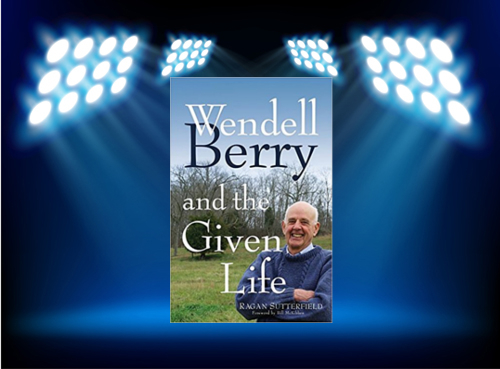
Review by Maura Zagrans
If I could, I would thrust a copy of Wendell Berry and the Given Life
Sutterfield’s book is a terrific introduction to an esteemed man of letters. Wendell Berry is a poet, novelist, essayist, conservation activist, and pioneering agrarian who advocates for sustainable agriculture. Thus Berry is a man whose legacy is equally remarkable for his literary writings as well as for his pioneering work and continuing leadership in the field of responsible agrarianism. If you patronize local farmer’s markets, or if your default setting inside grocery stores is to choose local organic produce, then you have Wendell Berry to thank.
Sutterfield maintains that Berry’s work is important because it speaks to our moral integrity at the same time as it addresses our mortal future. You might say that Berry is Rachel Carson 2.0. Berry brings science, generations of farming history, startling literary brilliance, and a deeply Christian point of view all to bear on discussions of the conservation crisis. On one level, it is crucial for more people to hear Berry’s clarion call to rewind our culture, to back away from industrialism, purely in the interests of survival. On another level, Berry speaks to our moral culpability in the ruination of families, communities, and the planet as a result of our failure to obey the most basic of God’s directives to love thy neighbor.
Sutterfield argues that Berry is a sage, a lamenting prophet who connects the dots between how we live and the state of our souls. Was this what God intended when he handed over his creation to us? Is this the role we were meant to play as caretakers? Sutterfield distills a diverse body of work published over the course of nearly sixty years; in so doing, he performs the invaluable service of making the ideas of a great Christian thinker more accessible to a wider audience.
Would anyone dispute that our souls are mirrors of our lives? That the choices we make as we journey through this one life we have been given become a kind of compilation of who we are? That whom we love or choose not to love imprints a chronology of how closely we followed God’s basic instructions? Sutterfield takes the top notes of Berry’s writings and uses them to compose an undeniable wake-up call. If you think of yourself as a Christian, you will read this book and think again, this time from within Berry’s point of view. Berry digs deep into the Bible as well as into the humus of the land to argue that every creature is connected, that both the known and the unknown play indecipherable roles in the successful turning of the earth. Using the looking glass of Berry’s life and life’s work, Sutterfield helps us see how the whole of our lives represents choices to love or not love. Suddenly we understand that we have no right to feelings of smug satisfaction as we sit in our church pews.
Sutterfield uses Berry’s poetry, prose, and fiction to build a platform from which we can see the panorama of life through Berry’s “deeply Christian” vision. He points out the ways in which Berry is quietly yet convincingly Christian, how Berry lives from the Gospels and by the precepts set forth in the Sermon on the Mount, and how he maneuvers modern culture with the ancient mindset of a peacemaker. He adds, “Berry’s work is, in a way, evangelistic, not only in the ideas it puts forward, but in its spiritual call.”
Sutterfield goes further, arguing that Berry is a modern day prophet, one to whom the banner seems to have been passed by none other than St. Benedict himself. Sutterfield writes of Berry, “Like St. Benedict, he provides a vision that many people respond to not only with their minds, but with their lives.” In seeing Berry as a contemporary St. Benedict, Sutterfield proceeds with the kind of respectful deliberation that Berry himself likely employs during his Sunday hikes stepping through the wild and sacred soil of his old Kentucky farm. Sutterfield strikes a nice balance between objectivity and reverence. There is no doubt that this author is an admirer of his subject but he never crosses the line into hagiography.
Sutterfield is a skilled stylist, his writing often lovely, as when he introduces the topic of earth as God’s kingdom: “Up the hill, there is a stand of timber, uncut in the last century, its older members too large for an embrace.”
His writing is also well crafted, as in the extraordinary chapter on Language. Here, Sutterfield begins by exposing the lying ways of the monstrous agribusiness company Monsanto, whose public-relations campaigns are designed to deceive potential customers about the actual impact of the pesticides and genetically modified crops Monsanto sells. Sutterfield then considers truth and lies from the Christian tradition as reflected by theologians such as Stanley Hauerwas, St. Augustine, and Dietrich Bonhoeffer. In arguing that Berry properly stands in their company, Sutterfield identifies Berry as “a writer worried about his words—he is careful with and of them, but this isn’t simply because he wants to clearly communicate or elicit a particular emotion or response. His care is rooted in his desire to be truthful in his language and thus in himself.” Sutterfield writes, “For language to function, it must dance between the inner and outer, it must bring the self home.” It is to his credit that Sutterfield is able to reveal how Berry’s work does just that.
For all of that, what I love most about this book is the way Sutterfield brings us to the Berry banquet table where he has laid out the quintessence of a modern day hero for us to sample and savor. Some morsels to whet your appetite:
- “We must learn to live a given life in a given world.”
- “The more coherent one becomes within oneself as a creature, the more fully one enters into the communion of all creatures.”
- “Love is never abstract. It does not adhere to the universe or the planet or the nation or the institution or the profession, but to the singular sparrows of the street, the lilies of the field, ‘the least of these my brethren.’”
- “Pleasure is, so to speak, affection in action.”
- “The ‘environmental crisis’ has happened because the human household or economy is in conflict at almost every point with the household of nature.”
- “The Bible’s aim, as I read it, is not the freeing of the spirit from the world. It is the handbook of their interaction. It says that they cannot be divided; that their mutuality, their unity, is inescapable; that they are not reconciled in division, but in harmony.”
- “The idea of the exclusive holiness of church buildings is, of course, wildly incompatible with the idea, which the churches also teach, that God is present in all places to hear prayers.”
- “There are no unsacred places; / there are only sacred places / and desecrated places.”
I’m no theologian, but the thought that Berry is indeed a most likeable prophet occurred to me years ago. Chalk it up to an overactive social conscience. In 2006, for example, after having read Michael Pollan’s The Omnivore’s Dilemma, I was inspired to launch an in-depth study of America’s shockingly toxic, unforgivably cruel food chain, and I’ve never regretted the new eating mantra I was inspired to adopt: Nothing with a beating heart. It was shortly thereafter that I discovered Berry’s poetry and became a fan. His prophetic vision is one that resonates with me. One of the precepts by which I live is the simple awareness that we’re all in this together. Berry’s work trumpets this philosophy. Not surprisingly, then, Berry had me at the title page. These days, I read his poems as if they were prayers because, well, for me, they are.
To read Wendell Berry and the Given Life is to allow a beehive of disquieting awareness to be stirred. What we come to see is just how unholy we have allowed our lives to become. Which brings us to the elephant in the room. What can one person do given the profundity of the mess we have made? Wisely, Sutterfield acknowledges this issue. “The question for many of us is how to translate this vision to our places, places already covered over in concrete, obscured by the anonymity of strip malls . . . The answer, as Berry has on occasion said, is that we must begin. We must make a start.”
I met Berry once, on 10 September 2013, when he and his longtime friend and collaborator Wes Jackson came to Oberlin College. I recall that a student asked the question about what he could do to live a more conscionable life within the context of attending college in a small town in Ohio. Exactly as Sutterfield reports, Berry simply encouraged the student to figure it out and begin.
Following the lecture, Mr. Berry and I spoke for a couple of minutes. I told him that my dad had grown up on a tobacco farm not far from Port Royal, and that we had visited those rolling, verdant hills many times throughout my childhood. His face lit with pleasure. He smiled a smile so warm and unguarded it felt to me as if in that moment we had suddenly become tree house buddies, and my heart suffered a stab of recognition. He reminded me so much of my late father. Was it something about Kentucky that put that familiar twinkle in the eyes of her native sons?
Those who know me know that I’m not very good at keeping my enthusiasm in check. I’m a passionate person who wraps her heart around the whole of life fiercely, joyously, completely. Given my keen admiration for this book, the challenge for me in writing this review was to talk about Wendell Berry and the Given Life with some modicum of objectivism and restraint.
And so, if you and I meet one day and I thrust a copy of this book into your hands, please expect that I will also beg you to call me up after you have read it so that we can dive deeply into a meaningful dialogue about how we can sculpt our personal worlds to create Wendell Berry-esque lives.
What does it mean to live in a Wendell Berry sort of way? It means that we should live as if we understand that we are here for a profound purpose. This purpose is to accept the given gift of life by conducting ourselves responsibly and appreciatively. In the end, the lives we create will be like virtual bouquets presented back to God as an expression of gratitude.
It seems to me that this is pretty much the only decent thing to do when gifted with so extravagant a gift as life.
For further information about Wendell Berry and his important work, visit http://berrycenter.org/
And, for the record, I think that Ragan Sutterfield’s Wendell Berry and the Given Life belongs on this Website’s Wendell Berry Booklist.
Previous Post
May 1, 2017
Live like an angel now to live like an angel; Angels: Day 282
Next Post
May 2, 2017 The service of angels; Angels: Day 283
Browse Our Archives
Select a Category A Year with Mary A Year with the Angels A Year with the Church Fathers Book News Children's Review Featured CD Giveaway Guest Post Interview Linked Review Media review Movie Review New Releases Off the Shelf Review speakers Teen Review The Clergy Speaks The Laity Speaks The Open Book Podcast Uncategorized
Select a Month October 2018 September 2018 August 2018 July 2018 June 2018 May 2018 April 2018 March 2018 February 2018 January 2018 December 2017 November 2017 October 2017 September 2017 August 2017 July 2017 June 2017 May 2017 April 2017 March 2017 February 2017 January 2017 December 2016 November 2016 October 2016 September 2016 August 2016 July 2016 June 2016 May 2016 April 2016 March 2016 February 2016 January 2016 December 2015 November 2015 October 2015 September 2015 August 2015 July 2015 June 2015 May 2015 April 2015 March 2015 February 2015 January 2015 December 2014 November 2014 October 2014 September 2014 August 2014 July 2014 June 2014 May 2014 April 2014 March 2014 February 2014 January 2014 December 2013 November 2013 October 2013 September 2013 August 2013 July 2013 June 2013 May 2013 April 2013 March 2013 February 2013 January 2013 December 2012 November 2012
Follow Us!
TAKE THE
Religious Wisdom Quiz
Who betrayed Jesus for thirty pieces of silver?
Select your answer to see how you score.
Peter Judas Saul James
Related posts from The Catholic Book Blogger

Book Review: We could all use a little...
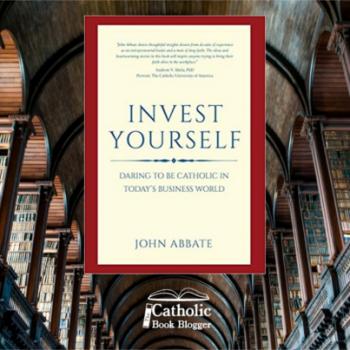
Invest yourself and invest in the greater good

TRENDING AT PATHEOS Catholic

The Parable Of The Sower And The Word...
One of Christ’s most famous parables is that of the sower who...

Rejecting Doom: Christian Hope And Human Action
Christianity is a religion of hope. We are to have hope and...

Why I Choose the Eucharist Over the Sermon
Choose the Eucharist, Not the Sermon What are we supposed to get...

5 Design Elements Found in Spiritually Rooted Homes
Putting Spirituality Into Home Decor Our homes are more than our living...

Credo: A Story of God Told with the...
About 10 years ago, I began to imagine a personal "Credo" that...

The Anatomy of Divine Revelation in Catholic Thought
The claim that God has made Himself known to human beings is...
view all Catholic blogs
Ad-Free & Subscriber Log-In Subscription Support
- About Us
- 2026 Calendar
- Videos
- Podcasts
- Library of World Religions
- Faith In Media Tracker
- Advertise With Us
- Write for Us
- Privacy Policy
- Terms of Service
- Do Not Sell My Data
- Contact Us
- Radiant Digital
- Manage Newsletter Subscriptions
- Unsubscribe From Notifications
- Sitemap
Copyright 2008-2026, Patheos. All rights reserved.
Subscription Support Ad-Free & Subscriber Log-In
Follow Patheos