
BuddhistCatholicContemplativeEvangelicalGeneral ChristianHinduJewishLatter-day SaintMuslimNew VisionsProgressive Christian
Beliefs
- Buddhist
- Catholic
- Contemplative
- Evangelical
- General Christian
- Hindu
- Jewish
- Latter-day Saint
- More Voices
- Muslim
- New Visions
- Pagan
- Progressive Christian
Topics
- Religion News
- Food and Religion
- Sports and Religion
- Religious Art
- Religious Music and Entertainment
- Religious Events
- History and Religion
- Style and Religion
- Politics and Religion
- Women in Religion
- Recreation Outdoors and Religion
- Business Finance and Religion
- Careers Workplace and Religion
- Education and Religion
- Family Parenting and Religion
- Health Fitness and Religion
- Home and Religion
- Relationships and Religion
- Technology and Religion
- Travel and Religion
Columnists
- Buddhist Columnists
- Business Finance and Religion Columnists
- Careers Workplace and Religion Columnists
- Catholic Columnists
- Contemplative Columnists
- Education and Religion Columnists
- Evangelists Columnists
- Family Parenting and Religion Columnists
- General Christian Columnists
- Health Fitness and Religion Columnists
- Hindu Columnists
- History and Religion Columnists
- Home and Religion Columnists
- Jewish Columnists
- More Voices Columnists
- Latter Day Columnists
- Muslim Columnists
- New Visions Columnists
- Nonreligious Columnists
- Pagan Columnists
- Politics and Religion Columnists
- Progressive Columnists
- Recreation Outdoors and Religion Columnists
- Relationships and Religion Columnists
- Religion News Columnists
- Religious Art Columnists
- Religious Events Columnists
- Religious Music and Entertainment Columnists
- Sports and Religion Columnists
- Style and Religion Columnists
- Technology and Religion Columnists
- Travel and Religion Columnists
- Women in Religion Columnists
Resource Library
- 2026 Calendar
- Library of World Religions
- The 100 Most Holy Places on Earth
- Patheos Answers
- Podcasts
- Videos
- Faith Leaders Database
- Anglican Episcopalian
- Bahai
- Baptist
- Buddhism
- Christianity
- Confucianism
- Eastern Orthodoxy
- Hinduism
- Holiness and Pentecostal
- ISKCON
- Islam
- Judaism
- Lutheran
- Methodist
- The Church of Jesus Christ of Latter-day Saints
- New Age
- Paganism
- Presbytarian and Reformed
- Protestantism
- Religion Behind the Scenes
- Roman Catholic
- Scientology
- Shia Islam
- Sikhism
- Sufism
- Sunni Islam
- Taoism
- Zen
- See all religions
Research Tools
 Ad-Free & Subscriber Log-In Subscription Support
Ad-Free & Subscriber Log-In Subscription Support
Follow Patheos 

- Trending:
- Forgiveness
- |
- Marriage
- |
- Consciousness
- |
- Death Penalty
- |
- Election
- |
- Halloween
 The Catholic Book Blogger
-
More
-
2015 Book Reviews
-
- Home
- Catholic
- CBB Interview with Amy Welborn
CBB Interview with Amy Welborn
Last updated on: February 15, 2016 at 12:15 pm by Pete Socks
CBB Interview with Amy Welborn 2016-02-15T12:15:18-05:00 Pete Socks
Patheos Explore the world's faith through different perspectives on religion and spirituality! Patheos has the views of the prevalent religions and spiritualities of the world.

Amy Welborn has worked as a teacher in Catholic high schools, and a Parish Director of Religious Education. She started writing for the diocesan press – the Florida Catholic – in 1988. Amy has written columns for Our Sunday Visitor and Catholic News Service as well at times over the past twenty years. I’ve been writing full time since 1999. Her articles have been published in venues ranging from Our Sunday Visitor to the New York Times to Commonweal. Amy has written nineteen books and many pamphlets and study guides. She is a regular contributor to the Living Faith and Living Faith for Kids devotionals.
Amy has blogged since 2001 – currently and occasionally at Charlotte Was Both. You may also visit her at her website http://www.amywelborn.com/index.html
This time around Amy I discuss the Way of the Cross devotional and her book on Saint John Paull II’s version.
PETE: What drew you to John Paul II’s version of the Way of the Cross?
AMY WELBORN: I really love the traditional Stations of the Cross, of course. Like all Catholics, I have such powerful memories of praying them in different settings – in parishes, outdoors, alone, with family, with classmates or fellow parishioners.
But what drew me to John Paul II’s version was the fact that it is Scripturally based and includes moments of Christ’s passion that are not included in the traditional Stations – Jesus in the Garden of Gethsemane, his encounter with Pilate and the exchange with the thieves on the cross, for example. Those are all such powerful moments for meditation and connection.
PETE: How did you formulate the meditations for this book? It would that would be a daunting task for such an ancient practice.
AMY WELBORN: I have written this type of material for a very long time – that is, reflecting on the intersection of spirituality and life. The columns I wrote for the Catholic press, the devotions I currently write for Living Faith, and even my books on the saints for children and prayer and apologetics for youth and adults all turn on this point: Jesus reaches out to us through Scripture and Tradition into our lives right now. The meaning of the great and small events of our daily lives are illuminated by the light of Christ’s presence as we meet him through the sacramental and spiritual life of his Church.
So with that in mind, I write this kind of material by reflecting on life, first, then, quite honestly, praying to the Holy Spirit for wisdom and trying to relax and let the connections happen.
PETE: What can people gain from partaking in the Stations of the Cross?
AMY WELBORN: The Stations of the Cross are such an important and powerful devotion. The goal of any disciple’s life, as so beautifully articulated by St. Paul, is to let Christ live in me, and we do this when that old self is crucified: “I have been crucified with Christ; it is no longer I who live, but Christ lives in me” (Galatians 2:20)”
The way of Jesus *is* the way of the Cross. This is easy to forget, especially since we would very much like to forget it and live as though it were not. Praying the Stations is a way of keeping that front and center in our lives: that to be like Christ means to die to self, and that in being buried with him – also as Paul reminds us – we rise with him.
Praying the Stations reminds us that there is meaning in suffering, that Jesus walks with us in our suffering, and that walking with him, we journey through suffering to eternal life.
PETE: Are people limited to performing the meditations only during Lent?
AMY WELBORN: No! While we associate the Way of the Cross with Lent, there is no reason to limit our praying of them to this season. We pray the Sorrowful Mysteries of the Rosary year round, the Stations remain in our churches all the time, we reflect on the crucifixes hanging in our home daily, at all times of the year.
I read an interesting story related to this recently.
Readers may remember the very sad story of Natalee Holloway, the young woman who disappeared while on a senior class trip to Aruba back in 2005 . Well, Natalee was from Mountain Brook, a section of Birmingham, Alabama, where I now live. A local magazine recently profiled her mother, Beth, telling the story of her journey since her daughter’s disappearance. In Aruba searching for her daughter, she asked her driver to take her somewhere to pray. The driver took her to a small Catholic church, where she – a Methodist – saw an array of small crosses and began walking from one to the other, praying:
“After days of searching for her missing daughter, Holloway says she was in unbearable pain. Though she was unfamiliar with the Catholic tradition of the stations of the cross, she instinctively went from cross to cross, each time seeking an answer. Finally, on the fifth or sixth station, she found one. “Complete peace blanketed me, and in that instant somehow I then knew that Natalee was with God, and I knew that he had cared for her through whatever ordeal she had encountered that night, and that’s when I became at peace,” she says. “When my grandmother was always saying, ‘Lay your burdens at the cross,’ I got, at that point, what she was saying. I laid the burden of caring for Natalee at the cross. The work to find out what happened to her had to be done, but the burden was taken from me.”
So yes, we can pray the Stations anytime with great benefit…and our churches should be open, welcoming everyone inside to pray at the Cross as well!
(http://b-metro.com/findingpeace/19751/)
PETE: What other suggestions do you have for people to take advantage of during Lent to aid in their spiritual growth?
AMY WELBORN: I have been doing a lot of reading of great spiritual writers and what they say about this season in preparation for this Lent: St. Francis de Sales, Leo the Great, St. Augustine and others. What comes through very strongly in all of them is a sense of letting the Church shape your Lenten practice. Prayer, Fasting and almsgiving in a humble and penitential spirit is where it starts. I do think that some of our contemporary takes on Lent have veered away from this sensibility. Lent isn’t just about me getting a “fresh start” to regain purpose in my life. To me, the place to begin and end is so beautifully captured in the readings for Ash Wednesday – Joel calls us as a people to fast and pray in repentance for our sins and in doing so draw closer to God. St. Paul encourages us to be reconciled to God and to not receive God’s grace in vain – and Jesus reminds us to do all of this with great humility.
I would say that we don’t help ourselves when we treat Lent as a self-help session for which we should set goals and have expectations. Pray, fast and give alms, and do so quietly, in a sacrificial manner, yet cheerfully and humbly – with our eyes on the Cross, on that journey with Christ. It’s simple and profound.
PETE: Time for my signature ending question. It has been a while since we had an opportunity to chat so, what books are currently on your bookshelf to read?
AMY WELBORN: I just finished one project which required me to do a variety of spiritual reading from Catherine of Siena to Chesterton to Newman, so while in “recovery,” my reading tends to be random and usually not spiritual. I just finished a new collection of previously unpublished Shirley Jackson essays and stories called Let Me Tell You. I also just finished The Memoirs of Louis Bouyer, the French convert-theologian who was involved in the Second Vatican Council. I have just started The Good Companions by J. B. Priestley, which I am enjoying so far, and am dipping into F. Scott Fitzgerald’s Pat Hobby Stories. As is always the case with me – absolutely no rhyme or reason to any of it – simply what looks interesting on the “new books” section of the library or the free e-books I can find online!
__________________________________________________________________________________________
John Paul II's Way of the Cross
Previous Post

February 14, 2016
Visit the poor house of my soul, Mary: Day 208
Next Post
February 15, 2016 The first fruits of redemption passed through Mary, Mary: Day 209
Browse Our Archives
Select a Category A Year with Mary A Year with the Angels A Year with the Church Fathers Book News Children's Review Featured CD Giveaway Guest Post Interview Linked Review Media review Movie Review New Releases Off the Shelf Review speakers Teen Review The Clergy Speaks The Laity Speaks The Open Book Podcast Uncategorized
Select a Month October 2018 September 2018 August 2018 July 2018 June 2018 May 2018 April 2018 March 2018 February 2018 January 2018 December 2017 November 2017 October 2017 September 2017 August 2017 July 2017 June 2017 May 2017 April 2017 March 2017 February 2017 January 2017 December 2016 November 2016 October 2016 September 2016 August 2016 July 2016 June 2016 May 2016 April 2016 March 2016 February 2016 January 2016 December 2015 November 2015 October 2015 September 2015 August 2015 July 2015 June 2015 May 2015 April 2015 March 2015 February 2015 January 2015 December 2014 November 2014 October 2014 September 2014 August 2014 July 2014 June 2014 May 2014 April 2014 March 2014 February 2014 January 2014 December 2013 November 2013 October 2013 September 2013 August 2013 July 2013 June 2013 May 2013 April 2013 March 2013 February 2013 January 2013 December 2012 November 2012
Follow Us!
TAKE THE
Religious Wisdom Quiz
In Revelation, what color is the horse ridden by Death?
Select your answer to see how you score.
Red Pale (or green) Black White
Related posts from The Catholic Book Blogger

It's time to rethink happiness
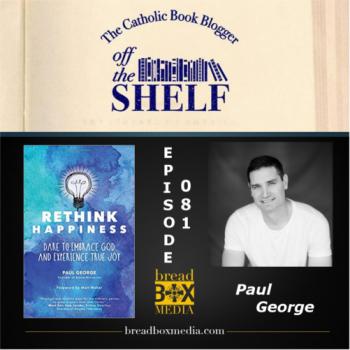
Rethink Happiness on Off the Shelf Episode 081
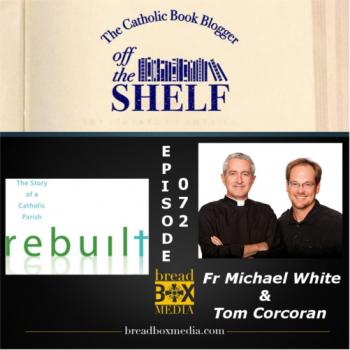
Rebuilt - Off the Shelf 072 with Fr....
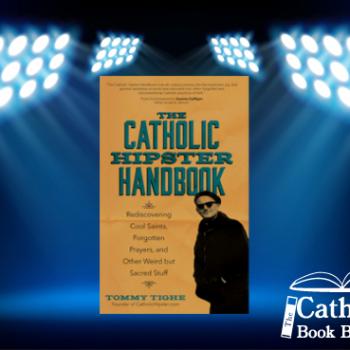
From Millennials to the Young at Heart -...
TRENDING AT PATHEOS Catholic

Rejecting Doom: Christian Hope And Human Action
Christianity is a religion of hope. We are to have hope and...

It’s What Comes From Within Which Matters
One of the most difficult things for us to understand is why...

Why I Choose the Eucharist Over the Sermon
Choose the Eucharist, Not the Sermon What are we supposed to get...

5 Design Elements Found in Spiritually Rooted Homes
Putting Spirituality Into Home Decor Our homes are more than our living...

Credo: A Story of God Told with the...
About 10 years ago, I began to imagine a personal "Credo" that...

The Anatomy of Divine Revelation in Catholic Thought
The claim that God has made Himself known to human beings is...
view all Catholic blogs
Ad-Free & Subscriber Log-In Subscription Support
- About Us
- 2026 Calendar
- Videos
- Podcasts
- Library of World Religions
- Faith In Media Tracker
- Advertise With Us
- Write for Us
- Privacy Policy
- Terms of Service
- Do Not Sell My Data
- Contact Us
- Radiant Digital
- Manage Newsletter Subscriptions
- Unsubscribe From Notifications
- Sitemap
Copyright 2008-2026, Patheos. All rights reserved.
Subscription Support Ad-Free & Subscriber Log-In
Follow Patheos