
BuddhistCatholicContemplativeEvangelicalGeneral ChristianHinduJewishLatter-day SaintMuslimNew VisionsProgressive Christian
Beliefs
- Buddhist
- Catholic
- Contemplative
- Evangelical
- General Christian
- Hindu
- Jewish
- Latter-day Saint
- More Voices
- Muslim
- New Visions
- Pagan
- Progressive Christian
Topics
- Religion News
- Food and Religion
- Sports and Religion
- Religious Art
- Religious Music and Entertainment
- Religious Events
- History and Religion
- Style and Religion
- Politics and Religion
- Women in Religion
- Recreation Outdoors and Religion
- Business Finance and Religion
- Careers Workplace and Religion
- Education and Religion
- Family Parenting and Religion
- Health Fitness and Religion
- Home and Religion
- Relationships and Religion
- Technology and Religion
- Travel and Religion
Columnists
- Buddhist Columnists
- Business Finance and Religion Columnists
- Careers Workplace and Religion Columnists
- Catholic Columnists
- Contemplative Columnists
- Education and Religion Columnists
- Evangelists Columnists
- Family Parenting and Religion Columnists
- General Christian Columnists
- Health Fitness and Religion Columnists
- Hindu Columnists
- History and Religion Columnists
- Home and Religion Columnists
- Jewish Columnists
- More Voices Columnists
- Latter Day Columnists
- Muslim Columnists
- New Visions Columnists
- Nonreligious Columnists
- Pagan Columnists
- Politics and Religion Columnists
- Progressive Columnists
- Recreation Outdoors and Religion Columnists
- Relationships and Religion Columnists
- Religion News Columnists
- Religious Art Columnists
- Religious Events Columnists
- Religious Music and Entertainment Columnists
- Sports and Religion Columnists
- Style and Religion Columnists
- Technology and Religion Columnists
- Travel and Religion Columnists
- Women in Religion Columnists
Resource Library
- 2026 Calendar
- Library of World Religions
- The 100 Most Holy Places on Earth
- Patheos Answers
- Podcasts
- Videos
- Faith Leaders Database
- Anglican Episcopalian
- Bahai
- Baptist
- Buddhism
- Christianity
- Confucianism
- Eastern Orthodoxy
- Hinduism
- Holiness and Pentecostal
- ISKCON
- Islam
- Judaism
- Lutheran
- Methodist
- The Church of Jesus Christ of Latter-day Saints
- New Age
- Paganism
- Presbytarian and Reformed
- Protestantism
- Religion Behind the Scenes
- Roman Catholic
- Scientology
- Shia Islam
- Sikhism
- Sufism
- Sunni Islam
- Taoism
- Zen
- See all religions
Research Tools
 Ad-Free & Subscriber Log-In Subscription Support
Ad-Free & Subscriber Log-In Subscription Support
Follow Patheos 

- Trending:
- Forgiveness
- |
- Marriage
- |
- Consciousness
- |
- Death Penalty
- |
- Election
- |
- Halloween
 The Catholic Book Blogger
-
More
-
2015 Book Reviews
-
- Home
- Catholic
- CBB Review: New Testament Basics for Catholics
CBB Review: New Testament Basics for Catholics
Last updated on: January 6, 2016 at 5:30 pm by Pete Socks
CBB Review: New Testament Basics for Catholics 2015-12-28T16:03:41-05:00 Pete Socks
Patheos Explore the world's faith through different perspectives on religion and spirituality! Patheos has the views of the prevalent religions and spiritualities of the world.
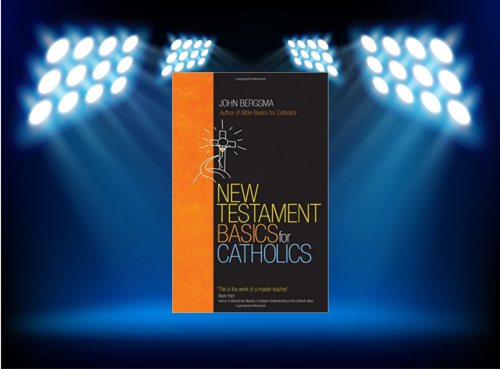 John Bergsma is back with a follow up to his very popular book Bible Basics for Catholics: A New Picture of Salvation History

If you have read his first offering, you will be pleased to hear that the stick figure drawings are back. Sprinkled throughout the book these serve as visual aids in piecing together the timeline of the Bible. They are just as valuable in the volume dedicated to the New Testament.
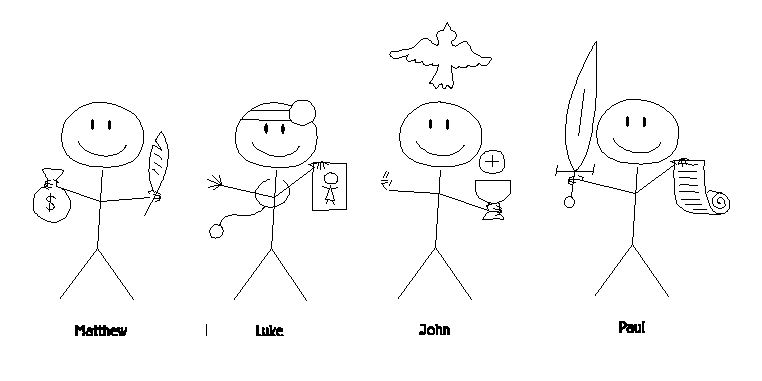
Of interest is the fact that John does not focus on every book in the New Testament. He recognizes that much of the story told within the first four books repeats itself to some extent. To simplify the study of the New Testament and break it into memorable chunks he chooses to focus on four authors. Matthew, Luke, Paul and John account for 85% of the content in the New Testament. If we understand their writings, we will have a pretty clear understanding of the entire second half of the Bible.
The author states (and I agree): “These four men give us the majority of the New Testament. Of course, modern scholars have cast doubt on whether they wrote the books that bear their names. But I think there are good reasons to trust the traditions of the Christian people about who wrote their most precious texts. So, if we concentrate on getting to know these four, we’ll get the “big picture” of this holy book.”
If you have not read Bible Basics for Catholics don’t worry. Chapter one takes the reader through a thirteen-page crash course of the six covenants “episodes” that lead up to the New Testament. They are the Adamic Covenant, the Noahic Covenant, the Abrahamic Covenant, the Mosaic Covenant, the Davidic Covenant and finally the New Covenant. From here we have the foundation upon which the New Testament is built.
The rest of the book is divided into four parts. Part I: The Kingdom of God Has Come! focuses on the Gospel of Matthew. Part II: The Kingdom of God Grows! looks at the Gospel of Luke and the Acts of the Apostles. Part III: Living in the Kingdom! gives insight into St. Paul and the Letter to the Romans. Part IV: The Kingdom Perfected! wraps up the book with a study of the Gospel of John and The Book of Revelation.
John focuses on two of the four Gospels to begin the book. In Matthew he looks at the five major sermons of Jesus: The Sermon in the Mount, The Mission Sermon, The Parables of the Kingdom Sermon, The Mercy Sermon and The End Times Sermon. Completing the study of Matthew, we review the Christmas story, Jesus announcing the kingdom, Jesus sending out his royal officers, Jesus’ teaching on the hidden kingdom, Jesus’ teaching on the forgiving kingdom, Jesus’ teaching on the end of the kingdom and finally the Easter story. Moving forward John breaks Luke down into four main sections. Jesus’ childhood, Jesus’ early ministry, Jesus’ final journey to Jerusalem, and Holy Week. By taking this approach the main themes of the Gospels are all covered.
The sequel to the Gospel of Luke: The Book of the Acts of the Apostles is covered next. As John states: “While we have four biographies of Jesus, we have only one of the infant Church. We should be grateful to St. Luke for recording for us the beautiful accounts of the Ascension, Pentecost, the Martyrdom of Stephen, the Calling of St. Paul, and so many other earthshaking events that shaped the Church and the history of the world.” The topics mentioned in this quote are covered as well as a rather lengthy look at St. Peter and the Gentiles.
In opening part three and his focus on St. Paul’s Letter to the Romans, John gives a quick overview of the fourteen epistles of Paul. Romans was chosen as the focus for more in depth study as it was Paul’s longest and perhaps most influential epistle. “He lays out his theology in greatest depth, emphasizing that the Good News of Jesus Christ is the way of salvation for all human beings, whether they are Jews, Greeks, or barbarians.” The Letter to the Romans is broken down into four sections: Opening greeting (1:1-7), Doctrinal section (chapters 1-11), Practical section (chapters 12-15) and Closing instructions, greetings, and blessings (15:14 to end).
In the beginning of his study of the Gospel of John the author states: “What we’re about to study is the greatest piece of world literature, period. This is the most influential, the most widely distributed, and the most historically significant book in human history.” With the Bible being the most widely sold book in the world John holds a special place within the Bible as being perhaps the most quoted book of all. Why is that? “And what we’re going to find out in the next few pages is that the Gospel of John is actually a book about the Catholic sacraments. I invite you to ponder that: the world’s most popular book, the world’s most widely read book, is actually a book about the sacraments of the Catholic Church.” I’ll sum that up with one word…..wow.
To wrap up our deep dive journey through the New Testament John Bergsma takes us through the Book of Revelation. Perhaps one of the most famous books in the Bible it is also one of the most wrongly interpreted. John gives clarity to this book in a relatively short 28 pages. He ably points out that Revelation is a book about the past, the present and the future. I personally found this chapter fascinating.
I invite you to take a journey through the New Testament with the help of author John Bergsma. Presented with clarity and a simplicity that makes the themes of the second part of the Bible approachable to all, this book is a must for anyone wishing to have a deeper understanding of Scripture.
_____________________________________________________________________________________________________
I received a copy of this book from the publisher in exchange for an honest review.
New Testament Basics for Catholics
Previous Post

January 6, 2016
Mary, Model of Virtue, Mary: Day 169
Next Post
January 7, 2016 Mary, Mother of Oil, Mary: Day: 170
Browse Our Archives
Select a Category A Year with Mary A Year with the Angels A Year with the Church Fathers Book News Children's Review Featured CD Giveaway Guest Post Interview Linked Review Media review Movie Review New Releases Off the Shelf Review speakers Teen Review The Clergy Speaks The Laity Speaks The Open Book Podcast Uncategorized
Select a Month October 2018 September 2018 August 2018 July 2018 June 2018 May 2018 April 2018 March 2018 February 2018 January 2018 December 2017 November 2017 October 2017 September 2017 August 2017 July 2017 June 2017 May 2017 April 2017 March 2017 February 2017 January 2017 December 2016 November 2016 October 2016 September 2016 August 2016 July 2016 June 2016 May 2016 April 2016 March 2016 February 2016 January 2016 December 2015 November 2015 October 2015 September 2015 August 2015 July 2015 June 2015 May 2015 April 2015 March 2015 February 2015 January 2015 December 2014 November 2014 October 2014 September 2014 August 2014 July 2014 June 2014 May 2014 April 2014 March 2014 February 2014 January 2014 December 2013 November 2013 October 2013 September 2013 August 2013 July 2013 June 2013 May 2013 April 2013 March 2013 February 2013 January 2013 December 2012 November 2012
Follow Us!
TAKE THE
Religious Wisdom Quiz
What food did God provide for Israel in the wilderness every morning?
Select your answer to see how you score.
Barley Olives Manna Quail
Related posts from The Catholic Book Blogger
Book Review: We could all use a little...
Invest yourself and invest in the greater good
TRENDING AT PATHEOS Catholic

The Parable Of The Sower And The Word...
One of Christ’s most famous parables is that of the sower who...

Rejecting Doom: Christian Hope And Human Action
Christianity is a religion of hope. We are to have hope and...

Why I Choose the Eucharist Over the Sermon
Choose the Eucharist, Not the Sermon What are we supposed to get...

5 Design Elements Found in Spiritually Rooted Homes
Putting Spirituality Into Home Decor Our homes are more than our living...

Credo: A Story of God Told with the...
About 10 years ago, I began to imagine a personal "Credo" that...

The Anatomy of Divine Revelation in Catholic Thought
The claim that God has made Himself known to human beings is...
view all Catholic blogs
Ad-Free & Subscriber Log-In Subscription Support
- About Us
- 2026 Calendar
- Videos
- Podcasts
- Library of World Religions
- Faith In Media Tracker
- Advertise With Us
- Write for Us
- Privacy Policy
- Terms of Service
- Do Not Sell My Data
- Contact Us
- Radiant Digital
- Manage Newsletter Subscriptions
- Unsubscribe From Notifications
- Sitemap
Copyright 2008-2026, Patheos. All rights reserved.
Subscription Support Ad-Free & Subscriber Log-In
Follow Patheos