
BuddhistCatholicContemplativeEvangelicalGeneral ChristianHinduJewishLatter-day SaintMuslimNew VisionsProgressive Christian
Beliefs
- Buddhist
- Catholic
- Contemplative
- Evangelical
- General Christian
- Hindu
- Jewish
- Latter-day Saint
- More Voices
- Muslim
- New Visions
- Pagan
- Progressive Christian
Topics
- Religion News
- Food and Religion
- Sports and Religion
- Religious Art
- Religious Music and Entertainment
- Religious Events
- History and Religion
- Style and Religion
- Politics and Religion
- Women in Religion
- Recreation Outdoors and Religion
- Business Finance and Religion
- Careers Workplace and Religion
- Education and Religion
- Family Parenting and Religion
- Health Fitness and Religion
- Home and Religion
- Relationships and Religion
- Technology and Religion
- Travel and Religion
Columnists
- Buddhist Columnists
- Business Finance and Religion Columnists
- Careers Workplace and Religion Columnists
- Catholic Columnists
- Contemplative Columnists
- Education and Religion Columnists
- Evangelists Columnists
- Family Parenting and Religion Columnists
- General Christian Columnists
- Health Fitness and Religion Columnists
- Hindu Columnists
- History and Religion Columnists
- Home and Religion Columnists
- Jewish Columnists
- More Voices Columnists
- Latter Day Columnists
- Muslim Columnists
- New Visions Columnists
- Nonreligious Columnists
- Pagan Columnists
- Politics and Religion Columnists
- Progressive Columnists
- Recreation Outdoors and Religion Columnists
- Relationships and Religion Columnists
- Religion News Columnists
- Religious Art Columnists
- Religious Events Columnists
- Religious Music and Entertainment Columnists
- Sports and Religion Columnists
- Style and Religion Columnists
- Technology and Religion Columnists
- Travel and Religion Columnists
- Women in Religion Columnists
Resource Library
- 2026 Calendar
- Library of World Religions
- The 100 Most Holy Places on Earth
- Patheos Answers
- Podcasts
- Videos
- Faith Leaders Database
- Anglican Episcopalian
- Bahai
- Baptist
- Buddhism
- Christianity
- Confucianism
- Eastern Orthodoxy
- Hinduism
- Holiness and Pentecostal
- ISKCON
- Islam
- Judaism
- Lutheran
- Methodist
- The Church of Jesus Christ of Latter-day Saints
- New Age
- Paganism
- Presbytarian and Reformed
- Protestantism
- Religion Behind the Scenes
- Roman Catholic
- Scientology
- Shia Islam
- Sikhism
- Sufism
- Sunni Islam
- Taoism
- Zen
- See all religions
Research Tools
 Ad-Free & Subscriber Log-In Subscription Support
Ad-Free & Subscriber Log-In Subscription Support
Follow Patheos 

- Trending:
- Forgiveness
- |
- Marriage
- |
- Consciousness
- |
- Death Penalty
- |
- Election
- |
- Halloween
 The Catholic Book Blogger
-
More
-
2015 Book Reviews
-
- Home
- Catholic
- CBB Interview with Father James Martin, SJ
CBB Interview with Father James Martin, SJ
Last updated on: May 11, 2014 at 5:30 pm by Pete Socks
CBB Interview with Father James Martin, SJ 2014-05-03T22:11:30-05:00 Pete Socks
Patheos Explore the world's faith through different perspectives on religion and spirituality! Patheos has the views of the prevalent religions and spiritualities of the world.
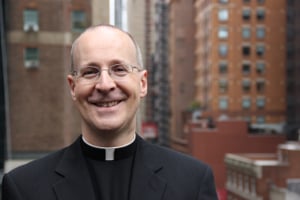 PETE: Your new book Jesus: A Pilgrimage for lack of better words is massive. How much time went into writing this book?
FATHER JAMES MARTIN: In a sense, I’ve been working on it for 25 years—ever since I entered the Jesuit novitiate in 1988. It was then that I started to study and pray about Jesus in earnest. But the book itself took me about five years from start to finish. But every day I worked on it was a joy—truly!
PETE: What research is required for a work of this magnitude?
FATHER JAMES MARTIN: There were different types of research. The most challenging was the work of reviewing all the contemporary New Testament scholarship so that I would be able to present the current thinking on a variety of Scripture passages. But that was one of the most enjoyable parts of the book. There are so many wonderful Bible commentaries, with absolutely fascinating insights, that never get read by the general public because they’re written in a very “academic” style. So I wanted to make the best Bible scholarship accessible to a general audience with this book.
Second, there was the research that I undertook on my pilgrimage to the Holy Land in 2011. At first, I didn’t really want to go to Israel, since I worried that seeing “touristy” sites might ruin my pristine mental images of places like Nazareth, Bethlehem and the Sea of Galilee. But as anyone who has journeyed there knows, simply being there was immensely helpful in understanding the Gospels. Knowing the topography made the Gospels come alive in ways that I couldn’t have imagined. I share a lot of those insights in this book. This is why the Holy Land is often called “The Fifth Gospel.”
Finally, there were years of prayer that were brought to bear on this book. I combed through my retreat journals to locate insights related to various Bible passages, which I share liberally in the book.
And then of course there was the construction of the book, the writing, the editing, the footnotes–and then the editing and editing and more editing. On top of that was the work of other people. I sent the book out, for example, to dozens of New Testament scholars for their feedback, which was astoundingly helpful. And of course there were editors at my publisher, fact checkers and even an independent copy editor who I found, who was a huge help. It was a big project.
PETE: I think your book is approachable on many levels. Who was your intended target audience?
FATHER JAMES MARTIN: Don’t laugh: Everybody. I wanted Jesus: A Pilgrimage to be accessible to everyone from the person who knows very little about New Testament scholarship to the person who has devoted their whole life to Jesus. Consequently, I start with the basics—explaining how the Gospels were constructed, what we mean about Jesus being human and divine, and even talking about how a little Greek helps us better understand the texts. But I also assume that people can come up to speed quickly and, as Jesus said, “follow me.”
PETE: If there is one thing you want readers to take away from this what would that be?
FATHER JAMES MARTIN: That it is important to understand both the “Jesus of history” and the “Christ of faith.”
Most books focus on one or the other—to the exclusion of the other. In other words, books on the historical Jesus, that is, on what history and archeology can tell us about the life and times of Jesus of Nazareth often say, “Well, we won’t talk about the miracles or the Resurrection because those are faith-based questions.” And religious books on Jesus, which focus on his divine identity and highlight his miracles, often say, “Well, we won’t treat ‘mere historical questions.’”
But you need to know about both approaches. You simply cannot understand one without the other. How can you fathom his parables, for example, if you’ve no clue what first-century Palestine was like? His real-life example will make no sense. So you have to know the history. And how can you ignore the miracles when they are a huge part of the Gospels? In fact, if you omit the miracles some of Jesus’s sayings that people take for granted are left with no context. So this book brings both the Jesus of history and the Christ of faith together—they are one.
PETE: Honest answer required on this one. This book has received a lot of pre-release buzz. Does that make you nervous that the anticipation level is set so high?
FATHER JAMES MARTIN: Honestly, not really. I’m delighted that the advance reviews and endorsements have been so positive and that the pre-orders are high, but I try to focus on what the book might mean for the individual reader—rather than how many copies we sell. Of course my Wharton background helps me to remember that in order to have people read the book, I have to promote it—and I’ve been working hard on that. But the more “nervous” part was working on the book, that is, making sure I got everything right in the writing.
PETE: Do you have any other projects in the works you can share with us or after this project are you taking a well-deserved break?
FATHER JAMES MARTIN: Well, I won’t have that break, well deserved or otherwise, for some time, since I’m promoting my book for a few months. But I will take a break from book writing (not from writing for venues like America of course, since that’s my job). Then I’ll turn my attention to a book on prayer.
PETE: Time for my signature ending question. This is a blog about books. What is currently on your bookshelf to read?
FATHER JAMES MARTIN: I always have a few books on my nightstand: To End all Wars, by Adam Hochschild, a book about resistance movements in the First World War, No Irrelevant Jesus, a book of essays by the New Testament scholar Gerhard Lohfink, and Mercy, by Cardinal Walter Kasper on, of course, mercy. Plus, I’m rereading one of my favorite Bill Bryson books, I’m a Stranger Here Myself.
Previous Post

May 8, 2014
Weekly Giveaway - Jesus: A Pilgrimage
Next Post
May 14, 2014 CBB Review - Through, With, and In Him
Browse Our Archives
Select a Category A Year with Mary A Year with the Angels A Year with the Church Fathers Book News Children's Review Featured CD Giveaway Guest Post Interview Linked Review Media review Movie Review New Releases Off the Shelf Review speakers Teen Review The Clergy Speaks The Laity Speaks The Open Book Podcast Uncategorized
Select a Month October 2018 September 2018 August 2018 July 2018 June 2018 May 2018 April 2018 March 2018 February 2018 January 2018 December 2017 November 2017 October 2017 September 2017 August 2017 July 2017 June 2017 May 2017 April 2017 March 2017 February 2017 January 2017 December 2016 November 2016 October 2016 September 2016 August 2016 July 2016 June 2016 May 2016 April 2016 March 2016 February 2016 January 2016 December 2015 November 2015 October 2015 September 2015 August 2015 July 2015 June 2015 May 2015 April 2015 March 2015 February 2015 January 2015 December 2014 November 2014 October 2014 September 2014 August 2014 July 2014 June 2014 May 2014 April 2014 March 2014 February 2014 January 2014 December 2013 November 2013 October 2013 September 2013 August 2013 July 2013 June 2013 May 2013 April 2013 March 2013 February 2013 January 2013 December 2012 November 2012
Follow Us!
TAKE THE
Religious Wisdom Quiz
A plant grew overnight to shade me, then withered, making me angry enough to die. What lesson did God teach through this?
Select your answer to see how you score.
God's Patience with us Our need for Humility Trust in God God's compassion for people
Related posts from The Catholic Book Blogger


CBB Interview with Sonja Corbitt

CBB Interview with Robert Wicks
TRENDING AT PATHEOS Catholic

Rejecting Doom: Christian Hope And Human Action
Christianity is a religion of hope. We are to have hope and...

It’s What Comes From Within Which Matters
One of the most difficult things for us to understand is why...

Why I Choose the Eucharist Over the Sermon
Choose the Eucharist, Not the Sermon What are we supposed to get...

5 Design Elements Found in Spiritually Rooted Homes
Putting Spirituality Into Home Decor Our homes are more than our living...

Credo: A Story of God Told with the...
About 10 years ago, I began to imagine a personal "Credo" that...

The Anatomy of Divine Revelation in Catholic Thought
The claim that God has made Himself known to human beings is...
view all Catholic blogs
Ad-Free & Subscriber Log-In Subscription Support
- About Us
- 2026 Calendar
- Videos
- Podcasts
- Library of World Religions
- Faith In Media Tracker
- Advertise With Us
- Write for Us
- Privacy Policy
- Terms of Service
- Do Not Sell My Data
- Contact Us
- Radiant Digital
- Manage Newsletter Subscriptions
- Unsubscribe From Notifications
- Sitemap
Copyright 2008-2026, Patheos. All rights reserved.
Subscription Support Ad-Free & Subscriber Log-In
Follow Patheos