
BuddhistCatholicContemplativeEvangelicalGeneral ChristianHinduJewishLatter-day SaintMuslimNew VisionsProgressive Christian
Beliefs
- Buddhist
- Catholic
- Contemplative
- Evangelical
- General Christian
- Hindu
- Jewish
- Latter-day Saint
- More Voices
- Muslim
- New Visions
- Pagan
- Progressive Christian
Topics
- Religion News
- Food and Religion
- Sports and Religion
- Religious Art
- Religious Music and Entertainment
- Religious Events
- History and Religion
- Style and Religion
- Politics and Religion
- Women in Religion
- Recreation Outdoors and Religion
- Business Finance and Religion
- Careers Workplace and Religion
- Education and Religion
- Family Parenting and Religion
- Health Fitness and Religion
- Home and Religion
- Relationships and Religion
- Technology and Religion
- Travel and Religion
Columnists
- Buddhist Columnists
- Business Finance and Religion Columnists
- Careers Workplace and Religion Columnists
- Catholic Columnists
- Contemplative Columnists
- Education and Religion Columnists
- Evangelists Columnists
- Family Parenting and Religion Columnists
- General Christian Columnists
- Health Fitness and Religion Columnists
- Hindu Columnists
- History and Religion Columnists
- Home and Religion Columnists
- Jewish Columnists
- More Voices Columnists
- Latter Day Columnists
- Muslim Columnists
- New Visions Columnists
- Nonreligious Columnists
- Pagan Columnists
- Politics and Religion Columnists
- Progressive Columnists
- Recreation Outdoors and Religion Columnists
- Relationships and Religion Columnists
- Religion News Columnists
- Religious Art Columnists
- Religious Events Columnists
- Religious Music and Entertainment Columnists
- Sports and Religion Columnists
- Style and Religion Columnists
- Technology and Religion Columnists
- Travel and Religion Columnists
- Women in Religion Columnists
Resource Library
- 2026 Calendar
- Library of World Religions
- The 100 Most Holy Places on Earth
- Patheos Answers
- Podcasts
- Videos
- Faith Leaders Database
- Anglican Episcopalian
- Bahai
- Baptist
- Buddhism
- Christianity
- Confucianism
- Eastern Orthodoxy
- Hinduism
- Holiness and Pentecostal
- ISKCON
- Islam
- Judaism
- Lutheran
- Methodist
- The Church of Jesus Christ of Latter-day Saints
- New Age
- Paganism
- Presbytarian and Reformed
- Protestantism
- Religion Behind the Scenes
- Roman Catholic
- Scientology
- Shia Islam
- Sikhism
- Sufism
- Sunni Islam
- Taoism
- Zen
- See all religions
Research Tools
 Ad-Free & Subscriber Log-In Subscription Support
Ad-Free & Subscriber Log-In Subscription Support
Follow Patheos 

- Trending:
- Forgiveness
- |
- Marriage
- |
- Consciousness
- |
- Death Penalty
- |
- Election
- |
- Halloween
 The Catholic Book Blogger
-
More
-
2015 Book Reviews
-
- Home
- Catholic
- CBB Interview with Daniel Horan, OFM
CBB Interview with Daniel Horan, OFM
Last updated on: March 31, 2014 at 4:58 am by Pete Socks
CBB Interview with Daniel Horan, OFM 2014-03-31T04:58:58-05:00 Pete Socks
Patheos Explore the world's faith through different perspectives on religion and spirituality! Patheos has the views of the prevalent religions and spiritualities of the world.
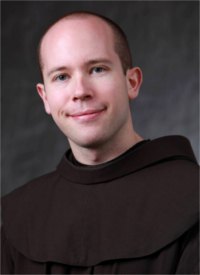
PETE: The preface of your book The Last Words of Jesus: A Meditation on Love and Suffering outlines how this book came to be. For those who have yet to get it can you describe the process.
DANIEL HORAN: Well, back in 2011 the Franciscan friar in charge of organizing the Holy Week services at St. Francis of Assisi Parish on West 31st Street in Manhattan approached me with an invitation to be the annual preacher for the “7 Seven Last Words.” It is a tradition I was familiar with, but I had never actually participated in what amounts to a multi-hour prayer service. Churches all over the world have adopted this tradition of inviting someone or a team of people to offer reflections on those seven phrases Jesus utters from the Cross according to the Gospels – these include “My God, My God, Why have you Forsaken me?” “I Thirst,” “Today You Will Be With Me in Paradise,” among others.
I reluctantly agreed to be the preacher, an honor for which I didn’t feel deserving, but I nevertheless made it my Lenten intention to meditate, pray, research, and reflect on these last words during the season of Lent so that I would be ready come Good Friday. When one of my editors heard about this, she suggested that it might make a good book and that I should also keep that in the back of my mind. In the end, it turned out that the format and style did lend itself well to a book, something very close to a short Lenten retreat or series of reflections that others might appreciate.
PETE: This book is certainly presented with the Franciscan viewpoint on Love and Suffering. What makes Franciscan though on these two topics different than others?
DANIEL HORAN: That is an important observation. I wanted to make sure that the Franciscan spiritual and theological tradition that has so formed me also informed my reflections and, honestly, I’m not sure it could have been any other way. I really believe that Francis of Assisi, who remains the most famous saint in Christian history (after Mary the mother of God, of course), offers all women and men a model of Christian living. He knew intuitively what it was to love fully and suffer, as well as the centrality of these themes in the Christian tradition. What I suggest in the book’s introduction is that love and suffering aren’t contradictory in the way many might at first think. Rather, these are two sides of the same coin, which we might call passion. When one loves, truly loves in the way God calls us to love and the way Jesus modeled, she or he must let go of the control that we so desperately wish to hold onto at times and risk the vulnerability that comes with it. The Franciscan tradition, especially through the theological work of St. Bonaventure, helps to highlight the connection between the Incarnation and the Cross, the twofold place of love and suffering in the life of faith.
PETE: Meditation books for the Lenten and Advent seasons occupy a pretty crowded market. What do you think makes yours unique?
DANIEL HORAN: I explain in the preface to the book that, after being invited to give those seven initial reflections on the last words from the cross, I set out to write this book with three primary goals in mind. First, I wanted the reflections to be grounded in good Scriptural scholarship. Second, I wanted to bring in the wisdom of the Franciscan spiritual and theological tradition in an explicit way, both through the example of St. Francis of Assisi as well as in the theological insights of those who followed him. Finally, I wanted there to be an explicit social-justice dimension, a way for the reader to connect with what Jesus was saying from the Cross in real and pragmatic ways. As you mention, there are lots of books on this and other Lenten themes out there, but very few of them take these three threads and weave them together. Oftentimes it can be easy to “over spiritualize” these passages and miss the timely and personal challenge that these last words present to us — I think that one of the things that makes this book unique is the practical way each chapter calls us to pause and look at the Gospel in a new way and then reflect on what it might mean for our lives as we strive to follow in the footsteps of Christ.
PETE: You are a Franciscan friar and thus share a brotherhood with our current Pope, Francis through his namesake. Can you give us an idea of what that is like for you and your fellow Franciscans?
DANIEL HORAN: It has been exhilarating, refreshing, and challenging! Pope Francis is really living up to his namesake’s legacy in many ways, particularly as he calls us to return time and again to the centrality of evangelical poverty for all Christians and the need we have to address the concrete and material poverty that exists in our world. His pastoral sense and seemingly complete openness to relationship, especially in how accessible he appears, is right in the tradition of St. Francis. As he grew in his faith and understanding of Gospel Life, St. Francis did everything he could to tear down the walls and barriers we place between ourselves and others so that he could be a brother to all women, men, and the whole of creation. I see Pope Francis emulating that spirit and challenging all of us, but especially those of us who are formally “Franciscan,” to live that aspect of our lives with more integrity. His emphasis on mercy and justice, as well as his outspoken disdain for clericalism, fit well with the Franciscan tradition of fraternity, peacemaking, and reconciliation. He has also gestured to an increase in interreligious dialogue, something the Saint from Assisi was also known for doing. There’s a lot to be excited about and a lot to reflect upon, which is exactly what we need in our time. I know my Franciscan brothers and sisters are likewise enthusiastic and inspired.
PETE: Time for my signature ending question. This is a blog about books. What is currently on your bookshelf to read?
DANIEL HORAN: I always have a huge stack of books that I need to read, whether for school (I’m currently working on a PhD in systematic theology at Boston College), for my own research, for reviews, or for fun – there’s not enough space to list them all. I can say that I just finished an advance copy of Fr. Jim Martin, SJ’s latest, Jesus: A Pilgrimage, which is excellent. Currently, though, I’m reading two books. The first is Sr. Elizabeth Johnson, CSJ’s latest, Ask The Beasts: Darwin and the God of Love. It is wonderful so far! Professor Johnson is by far one of the best writers among academic theologians. I’ve loved reading all of her books, each of which cause me to slow down to absorb her well-crafted and insightful prose. This book is especially exciting for me to read given my own interest in the subject of theology of creation. The second book is My Age of Anxiety: Fear, Hope, Dread, and the Search for Peace of Mind by Scott Stossel, the editor of The Atlantic Magazine. A friend of mine, who has struggled personally with anxiety, and I are reading this and talking about it. It’s a fascinating book that is both well written and filled with a lot great information about the science and chemistry of anxiety and the art of psychotherapy. I also highly recommend this book.
____________________________________________________________________________________________________
You can read my review of the book The Last Words of Jesus: A Meditation on Love and Suffering here.
You can learn more about Daniel and his work at his website http://danhoran.com/
Other books by this author
Dating God: Live and Love in the Way of St. Francis
Spirit and Life: A Franciscan Guide for Spiritual Reflection
Franciscan Spirituality for the 21st Century: Selected Reflections from the Dating God Blog and Other Essays: Volume One


Next Post

April 1, 2014 CBB Review - The Truth Is Out There: Vol.1 Brendan and Erc in Exile
Browse Our Archives
Select a Category A Year with Mary A Year with the Angels A Year with the Church Fathers Book News Children's Review Featured CD Giveaway Guest Post Interview Linked Review Media review Movie Review New Releases Off the Shelf Review speakers Teen Review The Clergy Speaks The Laity Speaks The Open Book Podcast Uncategorized
Select a Month October 2018 September 2018 August 2018 July 2018 June 2018 May 2018 April 2018 March 2018 February 2018 January 2018 December 2017 November 2017 October 2017 September 2017 August 2017 July 2017 June 2017 May 2017 April 2017 March 2017 February 2017 January 2017 December 2016 November 2016 October 2016 September 2016 August 2016 July 2016 June 2016 May 2016 April 2016 March 2016 February 2016 January 2016 December 2015 November 2015 October 2015 September 2015 August 2015 July 2015 June 2015 May 2015 April 2015 March 2015 February 2015 January 2015 December 2014 November 2014 October 2014 September 2014 August 2014 July 2014 June 2014 May 2014 April 2014 March 2014 February 2014 January 2014 December 2013 November 2013 October 2013 September 2013 August 2013 July 2013 June 2013 May 2013 April 2013 March 2013 February 2013 January 2013 December 2012 November 2012
Follow Us!
TAKE THE
Religious Wisdom Quiz
What woman followed Naomi to Bethlehem and later married Boaz?
Select your answer to see how you score.
Sarah Hannah Esther Ruth
Related posts from The Catholic Book Blogger

CBB Interview with Sonja Corbitt

CBB Interview with Robert Wicks
TRENDING AT PATHEOS Catholic

Rejecting Doom: Christian Hope And Human Action
Christianity is a religion of hope. We are to have hope and...

It’s What Comes From Within Which Matters
One of the most difficult things for us to understand is why...

Why I Choose the Eucharist Over the Sermon
Choose the Eucharist, Not the Sermon What are we supposed to get...

5 Design Elements Found in Spiritually Rooted Homes
Putting Spirituality Into Home Decor Our homes are more than our living...

Credo: A Story of God Told with the...
About 10 years ago, I began to imagine a personal "Credo" that...

The Anatomy of Divine Revelation in Catholic Thought
The claim that God has made Himself known to human beings is...
view all Catholic blogs
Ad-Free & Subscriber Log-In Subscription Support
- About Us
- 2026 Calendar
- Videos
- Podcasts
- Library of World Religions
- Faith In Media Tracker
- Advertise With Us
- Write for Us
- Privacy Policy
- Terms of Service
- Do Not Sell My Data
- Contact Us
- Radiant Digital
- Manage Newsletter Subscriptions
- Unsubscribe From Notifications
- Sitemap
Copyright 2008-2026, Patheos. All rights reserved.
Subscription Support Ad-Free & Subscriber Log-In
Follow Patheos