
BuddhistCatholicContemplativeEvangelicalGeneral ChristianHinduJewishLatter-day SaintMuslimNew VisionsProgressive Christian
Beliefs
- Buddhist
- Catholic
- Contemplative
- Evangelical
- General Christian
- Hindu
- Jewish
- Latter-day Saint
- More Voices
- Muslim
- New Visions
- Pagan
- Progressive Christian
Topics
- Religion News
- Food and Religion
- Sports and Religion
- Religious Art
- Religious Music and Entertainment
- Religious Events
- History and Religion
- Style and Religion
- Politics and Religion
- Women in Religion
- Recreation Outdoors and Religion
- Business Finance and Religion
- Careers Workplace and Religion
- Education and Religion
- Family Parenting and Religion
- Health Fitness and Religion
- Home and Religion
- Relationships and Religion
- Technology and Religion
- Travel and Religion
Columnists
- Buddhist Columnists
- Business Finance and Religion Columnists
- Careers Workplace and Religion Columnists
- Catholic Columnists
- Contemplative Columnists
- Education and Religion Columnists
- Evangelists Columnists
- Family Parenting and Religion Columnists
- General Christian Columnists
- Health Fitness and Religion Columnists
- Hindu Columnists
- History and Religion Columnists
- Home and Religion Columnists
- Jewish Columnists
- More Voices Columnists
- Latter Day Columnists
- Muslim Columnists
- New Visions Columnists
- Nonreligious Columnists
- Pagan Columnists
- Politics and Religion Columnists
- Progressive Columnists
- Recreation Outdoors and Religion Columnists
- Relationships and Religion Columnists
- Religion News Columnists
- Religious Art Columnists
- Religious Events Columnists
- Religious Music and Entertainment Columnists
- Sports and Religion Columnists
- Style and Religion Columnists
- Technology and Religion Columnists
- Travel and Religion Columnists
- Women in Religion Columnists
Resource Library
- 2026 Calendar
- Library of World Religions
- The 100 Most Holy Places on Earth
- Patheos Answers
- Podcasts
- Videos
- Faith Leaders Database
- Anglican Episcopalian
- Bahai
- Baptist
- Buddhism
- Christianity
- Confucianism
- Eastern Orthodoxy
- Hinduism
- Holiness and Pentecostal
- ISKCON
- Islam
- Judaism
- Lutheran
- Methodist
- The Church of Jesus Christ of Latter-day Saints
- New Age
- Paganism
- Presbytarian and Reformed
- Protestantism
- Religion Behind the Scenes
- Roman Catholic
- Scientology
- Shia Islam
- Sikhism
- Sufism
- Sunni Islam
- Taoism
- Zen
- See all religions
Research Tools
 Ad-Free & Subscriber Log-In Subscription Support
Ad-Free & Subscriber Log-In Subscription Support
Follow Patheos 

- Trending:
- Forgiveness
- |
- Marriage
- |
- Consciousness
- |
- Death Penalty
- |
- Election
- |
- Halloween
 The Catholic Book Blogger
-
More
-
2015 Book Reviews
-
- Home
- Catholic
- CBB Interview with Elizabeth Scalia
CBB Interview with Elizabeth Scalia
Last updated on: March 12, 2014 at 7:25 pm by Pete Socks
CBB Interview with Elizabeth Scalia 2014-03-12T19:25:50-05:00 Pete Socks
Patheos Explore the world's faith through different perspectives on religion and spirituality! Patheos has the views of the prevalent religions and spiritualities of the world.
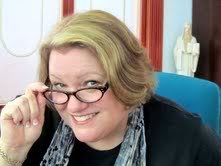 Yesterday I posted my review of Strange Gods : Unmasking the Idols in Everyday Life. You can find that review here. I was really excited when Elizabeth Scalia, The Anchoress, agreed to take some time out of her busy schedule to answer a few questions. So without further ado….here is my latest author interview.
Q: With a rather large and steady following on the internet, best known there as the Anchoress, how did you find time to write a book?
A: I have the best husband in the world, basically. At Patheos I run my own blog, manage and promote about 25 other writers and edit submissions, and I have regular column deadlines for First Things and The Catholic Answer, so most of the book writing happened when the workday was done. My husband had to deal with me complaining that by 10 PM my head was empty of brains, or whining about writer’s block. He was magnificent, through the whole ordeal. He still is.
Q: Your most recent book for those who may not know is titled Strange Gods : Unmasking the Idols in Everday Life. The subject matter of idols in daily life is a huge issue in our non-stop, gotta have my info now, world. What in particular drove you to tackle the topic?
A: I hate to say “Saint Gregory of Nyssa and the Holy Spirit” because it makes it sound like I’m presenting myself as someone a lot holier than I am, or as someone “chosen” to write this (which, honestly, I’d roll my eyes at myself!) but I have long-believed that while none of us are worthy of a thing from God, our willingness is always put to use toward his purposes. Bono said once that when writing music, it sometimes seem to him as though the thing — the melody, the notion, the musical phrasing — is already “out there” and waiting for someone to be willing to grab it and develop it. The book was a little like that, for me. I kept pondering Nyssa’s quote, “ideas lead to idols, only wonder leads to knowing” and at the same time I kept bumping into my own questions as to whether idolatry was churning beneath America’s relentless ideological division (which I wrote about a few times in First Things), and then one night, I was trying to sleep and suddenly the outline popped into my head, fully formed. So, I got out of bed, typed it out, said “okay, Lord, if you want this, I’m willing!” and sent it to someone I’d been in touch with at Ave Maria Press, basically saying, “yeah, I think this is a book I’d be able to write…”
The funny thing about it — both funny-haha and funny-strange — is that the book was released right around the time Pope Francis began talking about idolatry with some frequency. That’s why I think the book has nothing at all to do with me, but that the Holy Spirit means for us to think about, and talk about, what we’re putting between ourselves and God, and what that habit is doing to our souls and to our relationship with a Creator who is always reaching out to us. If that’s the case, then if I hadn’t been willing to write Strange Gods, someone else would have. Sometimes, in the pope’s words, I get a sense of urgency about it — that we really need to understand this.
Q: You mention a number of idols throughout the book. What do you feel is the most damaging idol a person can allow to consume them?
A: Wow, that’s a really good and really difficult question. I imagine it is different for everyone, but perhaps the idol of hipness — of being cool and riding every trend — is the most damaging because it encourages a suspension of reason for the ease of parroting whatever the current slogan/philosophy is occupying our minds. We’re not meant to give up our reason, but the zeitgeist, if it is embraced, demands that we do so: think the correctly-current thoughts or be seen as out-of-touch, or even as some sort of narrow-minded “hate-ist”, and be despised.
It’s an insidious idol, and one many parents train their kids to bow to, every single day, because they — the parents — are also unwittingly caught in its snares. It’s an idol that foments cynicism and destroys the idea that anyone is ever dealing in good faith.
Q: As I work my way through the book I am finding a number of “that’s me” moments. Did you experience the same thing as you wrote the book?
A: Constantly. The reason I was the right person to write the book is because I’ve been an idolator all my life. Hey, hey, we’re the Monkees! I was right there plastering these pictures all over my walls; I’d read a book and allow myself to be so caught up in it, it would enter my dreams. In the last chapter of the book, I make confession about all of that and more.
Q: What is the main take away you hope every reader gets from Strange Gods?
A: God is reaching out to us, to every one of us. The commandment to honor him is not put there because he is an insecure God who needs us to be telling him how great he is, but to remind us to look at him — the Creator who loved us into being and is Eternal — and not at the world of illusion, division and temporary things; to look at him and let him love us. Pope Benedict XVI wrote often, and beautifully, about God’s indulgent love for us, and Pope Francis is building on that in his forthright homilies. God is an abundance of love and it comes forth to us on his intention full of “yes.” But we have to be able to receive it, willing to receive it, and then clear out some of the stuff cluttering the pathway.
Q: Are there any other books on the horizon or any ideas for potential books?
A: Oh, boy. Remember I told you my husband was “magnificent”? Yes. But I don’t know if I can ask him to do that again. I have a million titles/notions in my head but so far none of them are waking me up and forcing me to type up an outline. Whatever God wants. I just kiss it all up to him and don’t think about it.
Q: Time for my signature ending question. This is a blog about books. What is currently on your bookshelf to read?
A: I just finished reading Men on Strike by Helen Smith, PhD (a fast read on an important topic) and The Everyday Catholic’s Guide to the Liturgy of the Hours by Daria Sockey (ditto), but I haven’t had a chance to write about them, yet. Also just finished How the West Really Lost God by Mary Eberstadt — which ties in, in a way, with Smith’s book. Perhaps we’re meant to be pondering how the loss of the family foments loss of faith, and the importance of men in that whole equation.
Right now I’m cueing up On Heaven and Earth which is by the Holy Father (when he was still Cardinal Bergoglio) and Abraham Skorka, and I have The Miracle of Father Kapaun ready to go on my nightstand, and Mother Dolores Hart’s The Ear of the Heart. But I’m also trying to re-read Catch-22, because I’m specifically looking for one paragraph that I want to write about in relation to something happening in the news. And because of the recent death of E.L. Konigsberg, I just re-read From the Mixed-Up Files of Mrs. Basil E. Frankweiler. Because I just love it.
Thanks again to Elizabeth Scalia to sharing some thoughts and taking the time out for some questions! Be sure to visit her Patheos blog here.
Strange Gods : Unmasking the Idols in Everyday Life
Previous Post

May 30, 2013
Strange Gods : Unmasking the Idols in Everyday Life
Next Post
June 3, 2013 Journeys with Mary : Apparitions of Our Lady
Browse Our Archives
Select a Category A Year with Mary A Year with the Angels A Year with the Church Fathers Book News Children's Review Featured CD Giveaway Guest Post Interview Linked Review Media review Movie Review New Releases Off the Shelf Review speakers Teen Review The Clergy Speaks The Laity Speaks The Open Book Podcast Uncategorized
Select a Month October 2018 September 2018 August 2018 July 2018 June 2018 May 2018 April 2018 March 2018 February 2018 January 2018 December 2017 November 2017 October 2017 September 2017 August 2017 July 2017 June 2017 May 2017 April 2017 March 2017 February 2017 January 2017 December 2016 November 2016 October 2016 September 2016 August 2016 July 2016 June 2016 May 2016 April 2016 March 2016 February 2016 January 2016 December 2015 November 2015 October 2015 September 2015 August 2015 July 2015 June 2015 May 2015 April 2015 March 2015 February 2015 January 2015 December 2014 November 2014 October 2014 September 2014 August 2014 July 2014 June 2014 May 2014 April 2014 March 2014 February 2014 January 2014 December 2013 November 2013 October 2013 September 2013 August 2013 July 2013 June 2013 May 2013 April 2013 March 2013 February 2013 January 2013 December 2012 November 2012
Follow Us!
TAKE THE
Religious Wisdom Quiz
What physical affliction did Job suffer?
Select your answer to see how you score.
Painful boils Leprosy Blindness Broken bones
Related posts from The Catholic Book Blogger
CBB Interview with Sonja Corbitt
CBB Interview with Robert Wicks
TRENDING AT PATHEOS Catholic

Rejecting Doom: Christian Hope And Human Action
Christianity is a religion of hope. We are to have hope and...

It’s What Comes From Within Which Matters
One of the most difficult things for us to understand is why...

Why I Choose the Eucharist Over the Sermon
Choose the Eucharist, Not the Sermon What are we supposed to get...

5 Design Elements Found in Spiritually Rooted Homes
Putting Spirituality Into Home Decor Our homes are more than our living...

Credo: A Story of God Told with the...
About 10 years ago, I began to imagine a personal "Credo" that...

The Anatomy of Divine Revelation in Catholic Thought
The claim that God has made Himself known to human beings is...
view all Catholic blogs
Ad-Free & Subscriber Log-In Subscription Support
- About Us
- 2026 Calendar
- Videos
- Podcasts
- Library of World Religions
- Faith In Media Tracker
- Advertise With Us
- Write for Us
- Privacy Policy
- Terms of Service
- Do Not Sell My Data
- Contact Us
- Radiant Digital
- Manage Newsletter Subscriptions
- Unsubscribe From Notifications
- Sitemap
Copyright 2008-2026, Patheos. All rights reserved.
Subscription Support Ad-Free & Subscriber Log-In
Follow Patheos