
BuddhistCatholicContemplativeEvangelicalGeneral ChristianHinduJewishLatter-day SaintMuslimNew VisionsProgressive Christian
Beliefs
- Buddhist
- Catholic
- Contemplative
- Evangelical
- General Christian
- Hindu
- Jewish
- Latter-day Saint
- More Voices
- Muslim
- New Visions
- Pagan
- Progressive Christian
Topics
- Religion News
- Food and Religion
- Sports and Religion
- Religious Art
- Religious Music and Entertainment
- Religious Events
- History and Religion
- Style and Religion
- Politics and Religion
- Women in Religion
- Recreation Outdoors and Religion
- Business Finance and Religion
- Careers Workplace and Religion
- Education and Religion
- Family Parenting and Religion
- Health Fitness and Religion
- Home and Religion
- Relationships and Religion
- Technology and Religion
- Travel and Religion
Columnists
- Buddhist Columnists
- Business Finance and Religion Columnists
- Careers Workplace and Religion Columnists
- Catholic Columnists
- Contemplative Columnists
- Education and Religion Columnists
- Evangelists Columnists
- Family Parenting and Religion Columnists
- General Christian Columnists
- Health Fitness and Religion Columnists
- Hindu Columnists
- History and Religion Columnists
- Home and Religion Columnists
- Jewish Columnists
- More Voices Columnists
- Latter Day Columnists
- Muslim Columnists
- New Visions Columnists
- Nonreligious Columnists
- Pagan Columnists
- Politics and Religion Columnists
- Progressive Columnists
- Recreation Outdoors and Religion Columnists
- Relationships and Religion Columnists
- Religion News Columnists
- Religious Art Columnists
- Religious Events Columnists
- Religious Music and Entertainment Columnists
- Sports and Religion Columnists
- Style and Religion Columnists
- Technology and Religion Columnists
- Travel and Religion Columnists
- Women in Religion Columnists
Resource Library
- 2026 Calendar
- Library of World Religions
- The 100 Most Holy Places on Earth
- Patheos Answers
- Podcasts
- Videos
- Faith Leaders Database
- Anglican Episcopalian
- Bahai
- Baptist
- Buddhism
- Christianity
- Confucianism
- Eastern Orthodoxy
- Hinduism
- Holiness and Pentecostal
- ISKCON
- Islam
- Judaism
- Lutheran
- Methodist
- The Church of Jesus Christ of Latter-day Saints
- New Age
- Paganism
- Presbytarian and Reformed
- Protestantism
- Religion Behind the Scenes
- Roman Catholic
- Scientology
- Shia Islam
- Sikhism
- Sufism
- Sunni Islam
- Taoism
- Zen
- See all religions
Research Tools
 Ad-Free & Subscriber Log-In Subscription Support
Ad-Free & Subscriber Log-In Subscription Support
Follow Patheos 

- Trending:
- Forgiveness
- |
- Marriage
- |
- Consciousness
- |
- Death Penalty
- |
- Election
- |
- Halloween

- Home
- Catholic
- The Homeless at Home by Blessed Fulton Sheen
The Homeless at Home by Blessed Fulton Sheen
Last updated on: September 24, 2026 at 8:52 am by Mark Wilson
The Homeless at Home by Blessed Fulton Sheen 2026-09-24T08:52:33-05:00 Mark Wilson
Patheos Explore the world's faith through different perspectives on religion and spirituality! Patheos has the views of the prevalent religions and spiritualities of the world.
In Honor of the Beatification of Fulton Sheen, here is an excerpt from Chapter 1 of
The Moral Universe A Preface To Christian Living (1936)
from the Internet Archive
That according to Read Sheen is a Public Domain Text
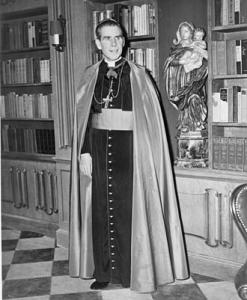
Plus some videos related to the Beatification.
I THE HOMELESS AT HOME
Knowledge of the moral life is conditioned
upon the removal of all prejudice.
Not everything that is novel is true,,
and what is called modern,,
may be only a new label for an old error.
Divinity which is the basis of true morality,
is often where one least expects to find it.
Every artist has the feel ing of being at home in his studio, every patriot at home in his own country, and every man at home in his house. One should therefore expect that the Creator would be at home in His own creation, and that God should be at home in the world He had made. And yet the most startling fact of human history is that when God came to earth He was homeless at home.
“He came unto His own and His own received Him not.”
Ere yet the great portals of the flesh swung open, Mary and Joseph sought in vain for a place where might be born the One to whom the heavens and earth belonged. And so when human history shall have written its last word in the scrolls of time, the saddest line of all will be:
“There was no room in the inn’.
There was room in the inn for those who bore on their breasts the screaming eagles of Rome; there was room for the daughters of the rich merchants of the
East; there was room for all clothed in fine purple and soft garments; there was room for everyone except the foster father and the mother of the One
who was to bring redemption to the world.
And so away from the inn, and out to the stable they had to go, to a crude cave into which shepherds drove their flocks in storms. In that little haven, with manger beasts as companions, and at a central point between the three great civilizations of Memphis, Athens, and Rome, something happened the only thing in the world that ever happened and mattered. That which happened was nothing less than Heaven being found on the earth as the Cry of a God cried out in the cry of a Child.
A startling paradox indeed: When God came to earth there was no room in the inn, but there was room in the stable. What lesson is hidden behind the inn and the stable? What is an inn, but the gathering place of public opinion, the focal point of the world’s moods, the residence of the worldly, the rallying place of the fashionable, and those who count in the man agreement of the world’s affairs? What is a stable, but the place of outcasts, the refuge of beasts, and the shelter of the valueless, and therefore the symbol of those who in the eyes of public opinion do not count, and hence may be ignored as of no great value or moment? Anyone in the world would have expected to have found Divinity in an inn, but no one would have expected to have found It in a stable. Divinity,
therefore, is always where you least expect to find It.
If in those days the stars of the heavens by some magic touch had folded themselves together as silver words, and announced the birth of the Expected of
the Nations, where would the world have gone in search of Him? The world would have searched for the Babe in some palace by the Tiber, or in some
gilded house of Athens, or in some inn of a great city where gathered the rich, the mighty and the powerful ones of earth. They would not have been the least
surprised to have found the new-born King of Kings stretched out on a cradle of gold and surrounded by kings and philosophers paying to Him their tribute
and obeisance.
But they would have been surprised to have discovered Him in a manger laid on coarse straw and warmed by the breath of oxen, as if in atonement for the coldness of the hearts of men. No one would have expected that the One whose fingers could stop the turning of Arcturus would be smaller
than the head of an ox; that He who could hurl the ball of fire into the heavens would one day be warmed by the breath of beasts; or that He who could make a canopy of stars would be shielded from a stormy sky by the roof of a stable; or that He who made the earth as His future home would be home
less at home. No one would have expected to find Divinity in such a condition; but that is because
Divinity is always where you least expect to find It.
I wonder if that is not the reason why the modern world misses the discovery of Divinity. There is no doubt that it is seeking Divinity if for no other reason
than because it feels its own insufficiency and craves a God who will bring pardon for its sins and healing oil for its wounds. It seeks a Divinity who will
deliver it from the terrible restlessness and emptiness of life. But where does it seek that Divinity? It seeks it in the inns where gather the publicized, the propagandized, the popular, and the modern.
The modern world looks for Divinity and the solution of its ills in the Superman of H. G. Wells, in the Humanism of Irving Babbitt, in the Sexualism of
Sigmund Freud, in the Cynicism of Bertrand Russell, in the naturalism of modern religion, in the book of the month, in the reinterpreted Christ, in the new
morals, in the new psychology, in the new science; but in none of these inns is Divinity to be found. As it was not in the inn in the first century, so it shall
not be found in the inn of the twentieth century, for what is true of the first day is true of our own:
Divinity is always where you least expect to find It.
Suppose now that it was suggested to the modern world that the Divinity it seeks is to be found in the Church; suppose that it was hinted to all who are
seeking for Divinity that the truth it craves is to be found only in the Vicar of Christ, who, as another Peter, articulates the mind of Christ; that the Divine
Life for which it yearns is to be found only in the seven-branched fountain of the sacraments; that the pardon it begs, drops from an uplifted hand in the
confessional; that only in the Church’s attitude toward marriage can our national fabric be preserved; and only in the Church’s morality can personal virtue be regained; suppose that the modern world today was told that Bethlehem continued to our own day; that by some great miracle of God’s love the stable is now the tabernacle; the manger is startling now the ciborium; the straw is now the altar flowers; the swaddling bands are now the white species of bread, and that the Body and Blood, Soul and Divinity of Christ is living among us in that tabernacle just as really and truly as in the crib suppose, I say, that such a startling declaration was made to our day and age and such a statement is just as true as it is what would be the answer of the modern world?
It would say: “That is absurd. The Church is antiquated, unmodern, behind the times; it is ignored by all the great Universities of our land; its dogmas are myths; its moral, passe; its belief in the Real Presence of Christ on the altar, impossible. Why should our Lord ever live under the species of bread? Why should truth be sought in that which the world ignores? No one today ever thinks of going to the Church in search of Divinity.” But that is just exactly what the world thought in the first century. No one ever thought of going to a stable in search of the Truth and Life of the Son of God. But that is most likely where it is to be found, for
Divinity is always where you least expect to find It.
The world has always missed Divinity either because it has sought it in the wrong places, or because it has ignored the wrong things. It has sought Divinity in Power, in Popularity, in Progress, in Science; it has ignored the possibility of ever finding it in simplicity, in the unexpected, in defeat, and in frailty. And yet the sign of Divinity will always be the sign of seeming weakness
“This shall be to you a sign: A Babe wrapped in swaddling clothes, lying in a manger/’
The world has always sought Divinity in the power of a Babel, but never in the weakness of a Bethlehem; it has searched for it in the inns ofpopular opinion, but never in the stable of the ignored; it has looked for it in the cradles of gold but never in the cribs o straw. Always in Power, but never in weakness. But Divinity came to earthly life in the form of a helpless Babe, and left it in the form of a helpless Man. If God, therefore, is to be found by us, He must be sought in weakness and defeat, but a weakness under which there is Power, and a defeat after which there is Victory.
God will be found only by those who sing the Hymn of the Conquered and search the forgotten stables and scan the ignoble crosses. This great lesson of the Incarnation is to be remembered as the great Drama of Christian morality is unfolded. In the following chapters will be treated such old themes as God as the ground of morality, the necessity of mortification, the beauty of a retired life, the sanctity of marriage, the fact of sin, the need of Redemption,
future judgment, the existence of hell, the joy of defeat all the pillars of the Christian moral edifice but now so long forgotten as to be new; all homeless truths, for the inns of the modern world ignore them; all homeless truths because there are few who take them to heart; all homeless maxims because welcomed only by those whom the world ignores; all homeless gifts like the Babe of Bethlehem. The world certainly does not expect to find Divinity insuch a homeless moral but
Divinity is always where you least expect to find It,
and only where He was homeless, are you and I at home.
This world is wild as an old wive’s tale,
And strange the plain things are,
The earth is enough and the air is enough
For our wonder and our war.
But our rest is as far as the fire drake swings
And our peace is put in impossible things
Where clash and thunder unthinkable wings
Round an incredible star.
To an open house in the evening,
Home shall all men come,
To an older place than Eden
And a taller town than Rome.
To the end of the way of the wandering star,To the things that cannot be and that are,
To the place where God was homeless
And all men are at home.
A Child in a Foul Stable
Where wild beasts feed and foam
Only where He was homeless
Are you and I at home.*
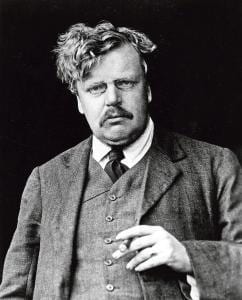
- From Collected Poems, by G. K.. Chesterton. Permission Dodd, Mead
and Co., publishers
Previous Post
September 23, 2026
Meet Likoudis Legacy Foundation Founder Andrew Likoudis
Next Post

October 2, 2026 Meet Fellowship & Fairydust Founder Avellina Balestri
Browse Our Archives
Select a Category 1889 abortion adoption Advent After Life Angles apologetics Art Awards BCCT bible book review books business Carmelite Catechetics Catholic Actors catholic authors Catholic Bard Catholic Faith Catholic List Catholic Rigorous Vortex Christian Authors Christmas church teaching civil conversation coronavirus Current Events death Different Religions Divine Mercy Easter Education encouragment Entertainment Eucharist Evangelization Event faith Family Life famous people feast day food Fun Stuff Global Church God guest post Harry Potter healing Heck of a Ride Around the Sun history holiday Holy Family Holy Orders Holy Spirit Holy Week hope Humor Interview Ireland Jesus kindle unlimited reflections Last Things Lecto Divina with Kristin Lent Lent/Easter liturgy love marriage Mary Meet the Author Mission Month in Advance Movie Review Movies Movies of the Month Music Narrative Older Writings patheos authors personal Philosophy podcasts poetry political Politics pope prayer Private Revelation pro-life public domain Quotes racial relations racism reflection Religious Life Saints science Scriptural Meditation social justice Social Media spirituality suffering supernatural theology Topics Travel Trivia Tweeting to the Choir Uncategorized universal church Vatican virtue war Week in Review women world religions writing Writing Write Now
Select a Month October 2026 September 2026 August 2026 July 2026 June 2026 May 2026 April 2026 March 2026 February 2026 January 2026 December 2025 November 2025 October 2025 September 2025 August 2025 July 2025 June 2025 May 2025 April 2025 March 2025 February 2025 January 2025 December 2024 November 2024 October 2024 September 2024 August 2024 July 2024 June 2024 May 2024 April 2024 March 2024 February 2024 January 2024 December 2023 November 2023 October 2023 September 2023 August 2023 July 2023 June 2023 May 2023 April 2023 March 2023 February 2023 January 2023 December 2022 November 2022 October 2022 September 2022 August 2022 July 2022 June 2022 May 2022 April 2022 March 2022 February 2022 January 2022 December 2021 November 2021 October 2021 September 2021 August 2021 July 2021 June 2021 May 2021 April 2021 March 2021 February 2021 January 2021 December 2020 November 2020 October 2020 September 2020 August 2020 July 2020 June 2020 May 2020
Follow Us!
TAKE THE
Religious Wisdom Quiz
Which Christian season is marked by purple, penance, and preparation before Easter?
Select your answer to see how you score.
Advent Epiphany Feast of All Saints Lent
Books by This Author Books by Catholic Bard
Related posts from Catholic Bard

Looking For Good Catholic Writing - October 2026

Meet Grimm Catholic Writer J.C. Hopes

Meet Taco Loving Catholic Historical Writer Leah Fisher

Meet Fellowship & Fairydust Founder Avellina Balestri
TRENDING AT PATHEOS Catholic

Emotion in Early Christianity by Andrew Crislip
Andrew Crislip’s Emotion in Early Christianity examines an often overlooked dimension of...

16 Spiritual Touchstones for a More Grounded Life
After decades of spiritual study, here are 16 principles I try...

Catholic Evangelization: Sharing Your Faith Every Day
Welcome back to the Graceful Awakening mini-series called, “From Faith to Mission.” ...

The Pillar of the Boatmen: the Ancient Monument...
The Pillar of the Boatmen is a Romano-Gaulish sculpture that dates from...

In one sense walking into Westminster Abbey is like walking down the...

'Super Scam Me' Exposes AI Jon Bon Jovi...
Leslie Pickett believed she was in a relationship with Jon Bon Jovi....
view all Catholic blogs
Ad-Free & Subscriber Log-In Subscription Support
- About Us
- 2026 Calendar
- Videos
- Podcasts
- Library of World Religions
- Faith In Media Tracker
- Advertise With Us
- Write for Us
- Privacy Policy
- Terms of Service
- Do Not Sell My Data
- Contact Us
- Radiant Digital
- Manage Newsletter Subscriptions
- Unsubscribe From Notifications
- Sitemap
Copyright 2008-2026, Patheos. All rights reserved.
Subscription Support Ad-Free & Subscriber Log-In
Follow Patheos