
BuddhistCatholicContemplativeEvangelicalGeneral ChristianHinduJewishLatter-day SaintMuslimNew VisionsProgressive Christian
Beliefs
- Buddhist
- Catholic
- Contemplative
- Evangelical
- General Christian
- Hindu
- Jewish
- Latter-day Saint
- More Voices
- Muslim
- New Visions
- Pagan
- Progressive Christian
Topics
- Religion News
- Food and Religion
- Sports and Religion
- Religious Art
- Religious Music and Entertainment
- Religious Events
- History and Religion
- Style and Religion
- Politics and Religion
- Women in Religion
- Recreation Outdoors and Religion
- Business Finance and Religion
- Careers Workplace and Religion
- Education and Religion
- Family Parenting and Religion
- Health Fitness and Religion
- Home and Religion
- Relationships and Religion
- Technology and Religion
- Travel and Religion
Columnists
- Buddhist Columnists
- Business Finance and Religion Columnists
- Careers Workplace and Religion Columnists
- Catholic Columnists
- Contemplative Columnists
- Education and Religion Columnists
- Evangelists Columnists
- Family Parenting and Religion Columnists
- General Christian Columnists
- Health Fitness and Religion Columnists
- Hindu Columnists
- History and Religion Columnists
- Home and Religion Columnists
- Jewish Columnists
- More Voices Columnists
- Latter Day Columnists
- Muslim Columnists
- New Visions Columnists
- Nonreligious Columnists
- Pagan Columnists
- Politics and Religion Columnists
- Progressive Columnists
- Recreation Outdoors and Religion Columnists
- Relationships and Religion Columnists
- Religion News Columnists
- Religious Art Columnists
- Religious Events Columnists
- Religious Music and Entertainment Columnists
- Sports and Religion Columnists
- Style and Religion Columnists
- Technology and Religion Columnists
- Travel and Religion Columnists
- Women in Religion Columnists
Resource Library
- 2026 Calendar
- Library of World Religions
- The 100 Most Holy Places on Earth
- Patheos Answers
- Podcasts
- Videos
- Faith Leaders Database
- Anglican Episcopalian
- Bahai
- Baptist
- Buddhism
- Christianity
- Confucianism
- Eastern Orthodoxy
- Hinduism
- Holiness and Pentecostal
- ISKCON
- Islam
- Judaism
- Lutheran
- Methodist
- The Church of Jesus Christ of Latter-day Saints
- New Age
- Paganism
- Presbytarian and Reformed
- Protestantism
- Religion Behind the Scenes
- Roman Catholic
- Scientology
- Shia Islam
- Sikhism
- Sufism
- Sunni Islam
- Taoism
- Zen
- See all religions
Research Tools
 Ad-Free & Subscriber Log-In Subscription Support
Ad-Free & Subscriber Log-In Subscription Support
Follow Patheos 

- Trending:
- Forgiveness
- |
- Marriage
- |
- Consciousness
- |
- Death Penalty
- |
- Election
- |
- Halloween

- Home
- Catholic
- After Washing of the Feet Take and Eat
After Washing of the Feet Take and Eat
Last updated on: April 2, 2026 at 8:21 am by Mark Wilson
After Washing of the Feet Take and Eat 2026-04-02T08:21:55-05:00 Mark Wilson
Patheos Explore the world's faith through different perspectives on religion and spirituality! Patheos has the views of the prevalent religions and spiritualities of the world.
For Holy Thursday
A selection from
LIFE OF CHRIST (1923) by Giovanni Papini
That book is in the public domain.
The Washing of the Feet
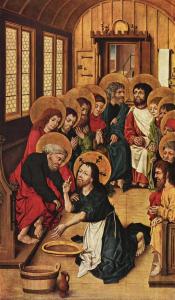
Now that He was on the point of being snatched from those whom He loved, He wished to give them a supreme proof of this love. From the time they had begun to share His life, He had always loved them, all of them, even Judas: He always loved them with a love surpassing all other affections, a love so bountiful that their narrow hearts could not always contain it; but now about to leave them, knowing that He was to be with them again only when transfigured after death, all His hitherto unexpressed affection overflowed in a great wave of tender sadness.
Before beginning the supper where He was the head of the family, He wished to be kinder than a Father, humbler than a servant. He was their King, and He would humble Himself to the service performed by slaves: He was their Master and He would put Himself below the level of His disciples; He was the Son of God and He would accept a position despised of men: He was the first and He would kneel before His inferiors as if He had been the last. So many times, to rebuke their pride and jealousy, He had told them that the Master must serve His servants, that the Son of Man was come to serve, that the first must be last. But His words had not yet been assimilated by those souls, since even up to the last, they continued to quarrel for priority and precedence.
For raw, untrained minds, action has more meaning than words. Jesus prepared Himself to repeat, with the symbolic aspect of a humiliating service, one of His most important instructions. John tells us,
“He riseth from supper, and laid aside his garments; and took a towel, and girded himself. After that he poureth water into a basin and began to wash the disciples’ feet, and to wipe them with the towel wherewith he was girded.”
Only a mother or a slave would have done what Jesus did that evening. The mother would have done it for her little children, but for no one else: the slave for his masters, but for no others. The mother would have served joyfully because of her love, the slave would have been resigned through obedience. But the Twelve were neither Christ’s children nor His masters. Son of Man and of God, His love was above that of all earthly mothers,—King of a kingdom existing in the future, but more legitimate than all existing monarchies, He was the unrecognized Master of all masters.
And yet He was willing to wash and wipe those twenty-four callous and sweaty feet, in order to engrave on those unwilling hearts, still swollen with vanity, the truth which His lips had so long vainly pronounced;
“And whosoever shall exalt himself shall be abased; and he that shall humble himself shall be exalted.”
So after He had washed their feet and taken His garments and was set down again He said unto them,
“Know ye what I have done to you? Ye call me Master and Lord: and ye say well; for so I am. If I then, your Lord and Master, have washed your feet; ye also ought to wash one another’s feet. For I have given you an example, that ye should do as I have done to you. Verily, verily I say unto you, The servant is not greater than his lord; neither is he that is sent greater than he that sent him. If ye know these things, happy are ye if ye do them.”
Jesus had not only given them a memory of complete humility, but an example of perfect love.
“A new commandment I give unto you, That ye love one another; as I have loved you, that ye also love one another. Greater love hath no man than this, that a man lay down his life for his friends. Ye are my friends if ye do whatsoever I command you.”
But this action, with its deep meaning hidden under the appearance of menial service, signifies purification as well as love.
“He that is washed needeth not save to wash his feet, but is clean every whit: and ye are clean, but not all”.
The eleven, although not of lofty character, had some right to this cleansing service from Jesus. For many months those feet had trodden the dusty, muddy, filthy roads of Judea to follow Him who brought life; and after His death, year by year, they were to tread longer and harder roads in countries the very names of which they then did not know; and foreign clay would soil the sandaled feet of those who were to go as pilgrims and strangers to repeat the call of the Crucified One.
Take—Eat

These thirteen men had apparently come together to perform the old social rite in memory of the liberation of their people from Egyptian slavery. They seemed to be thirteen devout men of the people, waiting about a white table redolent of roasted lamb and wine, for the signal to begin an intimate and festal supper.
But this was only in appearance. In reality it was a vigil of leave-taking and separation. Two of these thirteen, He into whom God had entered and he into whom Satan had entered, were to die terrible deaths before the next nightfall. The very next day the others were to be dispersed, like reapers at the first downfall of hail.
But this supper which was the viaticum of an ending, was also a wonderful beginning. In the midst of these thirteen Jews the observance of the Jewish Passover was about to be transfigured into something incomparably higher and more universal, into something unequaled and ineffable; into the great Christian mystery. The simple eating of bread was to become actual communion with God.
For the Jews, Easter is only the feast in memory of their flight from Egypt. They never forgot their victorious escape from their slavery, accompanied by so many prodigies, so manifestly under God’s protection, although they were to bear on their necks the yokes of other captivities, and to undergo the shame of other deportations. Exodus prescribed an annual festivity which took the name of the Passover; Pasch, the paschal feast. It was a sort of banquet intended to bring to mind the hastily prepared food of the fugitives. A lamb or a goat should be roasted over the fire, that is, cooked in the simplest and quickest way;
bread without leaven, because there was no time to let yeast rise. And they were to eat of it with their loins girded, their staves in their hands, eating in haste, like people about to set out upon a journey.
The bitter herbs were the poor wild grasses snatched up as they went along by the fugitives, to dull the hunger of their interminable wanderings. The red sauce, where the bread was dipped, was in memory of the bricks which the Jewish slaves were obliged to bake for the Pharaohs. The wine was something added: the joy of escape, the hope of the land of promise, the exaltation of thanksgiving to the Eternal.
Jesus changed nothing in the order of this ancient feast. After the prayer He had them pass from hand to hand the cup of wine, calling on God’s name. Then He gave the bitter herbs to each one and filled a second time the cup which was to be passed around the table for each to sip. What taste did that wine have in the mouth of the traitor, when Jesus in that deep silence pronounced those words of longing and hope which were not for Judas, but only for those who could ascend to the eternal banquet of the Father: Take this and divide it among yourselves,
“but I say unto you I will not drink henceforth of this fruit of the vine, until that day when I drink it new with you in my Father’s kingdom.”
A sad farewell; but nevertheless the confirming of a solemn promise. Perhaps they felt only the promise, and perhaps there flashed before their poor men’s eyes a vision of the great Heavenly feast. They did not believe that they would have a long time to mourn: after that other vintage-time, after the fruit of the vine had fermented, and the sweet wine had been poured into the flasks, the Master would return, as He had promised, to summon them to the great wedding of Heaven and Earth, to the everlasting banquet. They must have thought,
“We are men growing old, elderly men, more than mature, within sight of old age; if the Bridegroom tarries too long He will not find us among the living, and those who have believed Him will be mocked at.”
Comforted by the certainty of an early and glorious reunion, they chanted together, as the custom was, the Psalm of the first Thanksgiving, a chant of praise to the Father from Him who served Him.
“Tremble, thou earth, at the presence of the Lord, at the presence of the God of Jacob; which turned the rock into a standing water, the flint into a fountain of waters.—He raiseth up the poor out of the dust, and lifteth the needy out of the dung-hill; that he may set him with princes, even with the princes of
his people.”
These old words, colored at that moment with a new meaning, were sung with a joyful conviction of their truth. They, too, the Disciples, were poor men and they would be raised out of the dust of poverty by the intercession of the Son of God: they too were poor men and He would soon raise them out of the misery of their beggary, to make them masters of inconsumable wealth. Then Jesus, who saw how insufficiently they understood, took the loaves, blessed them, broke them and, as He gave them each a piece, set the dreadful truth before their eyes.
“Take, eat; This is my body which is given for you: this do in rememberance of me.”
So He was not to return as quickly as they thought! After His brief stay during the Resurrection, His second coming was to be delayed, so long that it might be possible to forget Him and His death.
“This do in remembrance of me.”
The breaking of bread at the common table among those who await Him shall be the signal of a new brotherhood. Every time that you break bread, I will not only be present among you, but by that means you will be intimately united with me. Because, as this bread is broken in my hands, my body will be broken by my enemies. As this bread eaten tonight will be your food until to-morrow, my body which I will offer in death to all men shall satisfy the hunger of those who believe in me, until the day when the great granaries of the Kingdom shall be open to all, when you shall be angels in the presence of your Father whom you shall have found again. I will leave you therefore not merely a memory; I will be present with a mystic but real presence in every particle of bread consecrated to me and this bread shall be a living necessary food for souls, and my promise to be with you shall be fulfilled till time shall be no more.
In the meantime, this evening, eat this unleavened bread, this bread made by the hand of man, made of water and grain, these loaves which have felt the heat of the oven and which my hands, not yet cold in death, have divided amongst you—and which my love has changed into my flesh so that it may be your everlasting food. It is sweet to the heart of a friend to see his friends eating bread at his table, bread born of the earth, bread which was green blades with flowering lilies among them, and then the ripe ear bending down the tall stalk with its golden weight.
You know how many efforts, how much anxiety, how much trouble, are contained in a piece of bread; how the great oxen cultivated the earth, how the countrymen threw great handfuls of the grain into the fallow land in winter, how the first blade softly penetrated the damp darkness of the earth, how the reapers all day long cut down the ripened stalks, and then the sheaves were bound, and carried to the threshing floor and beaten so that the ears let fall the grain.
The workers must wait for a little wind, neither too gentle nor too violent, to winnow out the good grain from the chaff. Then they grind it, sift out the bran from it, make a dough with warm water, heat the oven with dry grass or twigs. All this must be done with love and patience before the father may break a piece with his children, the friend with his friends, the host with strangers. Plowers, sowers, reapers, winnowers, millers and bakers sweat in the heat of the
sun, in the heat of the oven, before the golden wheat can be transformed into well-baked golden bread for our table.
Truly it is sweet to eat good wholesome bread with friends: the soft white crumb, covered with the crisp crust. So many times with me you have begged bread in poor men’s houses; and all your lives you are to beg it in my name: you will have the moldy hard crusts which dogs refuse, the dry bits left at the bottom of the dish, the crusts gnawed by children and old people which they have let fall upon the hearth. But you know want, and nights of fasting and the pale face of poverty. But you are strong; you have the powerful jaws of those who eat hard bread. You will not lose courage, if no place is made for you at the tables of the well-to-do.
But verily it is infinitely sweeter for Him who loves you to transform the bread which comes from the hard earth and from hard labor into the Body which will be eternally offered for you, into the Body which every day will come down from Heaven as the visible means of grace. Remember the prayer which I taught you:
“Give us this day our daily bread—”
For to-day and for always your bread is this bread, my Body. He shall never know hunger who shall eat my Body, which every morning throughout endless centuries shall be changed into endless morsels of transubstantiated bread. But whosoever shall refuse it, shall be hungered to all eternity.
The passage continues in
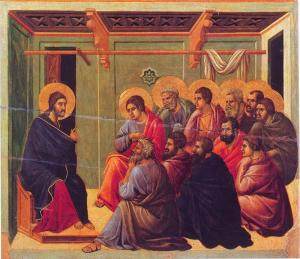
Jesus giving the Farewell Discourse (John 14–17) to his disciples, after the Last Supper, from the Maestà by Duccio, 1308–1311
The Wine And Blood Of Christ |
A Meditation From LIFE OF CHRIST On The Last Supper.
Previous Post
March 29, 2026
A Picture of Palm Sunday
Next Post
April 3, 2026 The Death that Gives Life to All
Browse Our Archives
Select a Category 1889 abortion adoption Advent After Life Angles apologetics Art Awards BCCT bible book review books business Carmelite Catechetics Catholic Actors catholic authors Catholic Bard Catholic Faith Catholic List Catholic Rigorous Vortex Christian Authors Christmas church teaching civil conversation coronavirus Current Events death Different Religions Divine Mercy Easter Education encouragment Entertainment Eucharist Evangelization Event faith Family Life famous people feast day food Fun Stuff Global Church God guest post Harry Potter healing Heck of a Ride Around the Sun history holiday Holy Family Holy Orders Holy Spirit Holy Week hope Humor Interview Ireland Jesus kindle unlimited reflections Last Things Lecto Divina with Kristin Lent Lent/Easter liturgy love marriage Mary Meet the Author Mission Month in Advance Movie Review Movies Movies of the Month Music Narrative Older Writings patheos authors personal Philosophy podcasts poetry political Politics pope prayer Private Revelation pro-life public domain Quotes racial relations racism reflection Religious Life Saints science Scriptural Meditation social justice Social Media spirituality suffering supernatural theology Topics Travel Trivia Tweeting to the Choir Uncategorized universal church Vatican virtue war Week in Review women world religions writing Writing Write Now
Select a Month October 2026 September 2026 August 2026 July 2026 June 2026 May 2026 April 2026 March 2026 February 2026 January 2026 December 2025 November 2025 October 2025 September 2025 August 2025 July 2025 June 2025 May 2025 April 2025 March 2025 February 2025 January 2025 December 2024 November 2024 October 2024 September 2024 August 2024 July 2024 June 2024 May 2024 April 2024 March 2024 February 2024 January 2024 December 2023 November 2023 October 2023 September 2023 August 2023 July 2023 June 2023 May 2023 April 2023 March 2023 February 2023 January 2023 December 2022 November 2022 October 2022 September 2022 August 2022 July 2022 June 2022 May 2022 April 2022 March 2022 February 2022 January 2022 December 2021 November 2021 October 2021 September 2021 August 2021 July 2021 June 2021 May 2021 April 2021 March 2021 February 2021 January 2021 December 2020 November 2020 October 2020 September 2020 August 2020 July 2020 June 2020 May 2020
Follow Us!
TAKE THE
Religious Wisdom Quiz
In which city did David reign seven years before becoming king over all Israel?
Select your answer to see how you score.
Hebron Shechem Jerusalem Bethlehem
Books by This Author Books by Catholic Bard
Related posts from Catholic Bard

Looking For Good Catholic Writing - October 2026

Meet Grimm Catholic Writer J.C. Hopes
The Homeless at Home by Blessed Fulton Sheen

Meet Taco Loving Catholic Historical Writer Leah Fisher
TRENDING AT PATHEOS Catholic

How to Make a Decision When You Can't...
Main point: It’s much more valuable to stay close to God so...

Archdiocese Hosts Military Marriage Retreat in Germany
RASTATT, Germany — The transient military lifestyle, with its frequent deployments and...

Nearly every morning, I make the drive to Detroit with my high-school-age...

The Real AI Story Is Adoption Without Trust
Artificial intelligence has crossed a political threshold. It is no longer a...

A new article, written by Jeff Lindsay and Gale L. Pooley,...

Swimfan: Forgotten Aughts Pleasures
This is a recovery effort. In 2002, My Big Fat Greek Wedding...
view all Catholic blogs
Ad-Free & Subscriber Log-In Subscription Support
- About Us
- 2026 Calendar
- Videos
- Podcasts
- Library of World Religions
- Faith In Media Tracker
- Advertise With Us
- Write for Us
- Privacy Policy
- Terms of Service
- Do Not Sell My Data
- Contact Us
- Radiant Digital
- Manage Newsletter Subscriptions
- Unsubscribe From Notifications
- Sitemap
Copyright 2008-2026, Patheos. All rights reserved.
Subscription Support Ad-Free & Subscriber Log-In
Follow Patheos