
BuddhistCatholicContemplativeEvangelicalGeneral ChristianHinduJewishLatter-day SaintMuslimNew VisionsProgressive Christian
Beliefs
- Buddhist
- Catholic
- Contemplative
- Evangelical
- General Christian
- Hindu
- Jewish
- Latter-day Saint
- More Voices
- Muslim
- New Visions
- Pagan
- Progressive Christian
Topics
- Religion News
- Food and Religion
- Sports and Religion
- Religious Art
- Religious Music and Entertainment
- Religious Events
- History and Religion
- Style and Religion
- Politics and Religion
- Women in Religion
- Recreation Outdoors and Religion
- Business Finance and Religion
- Careers Workplace and Religion
- Education and Religion
- Family Parenting and Religion
- Health Fitness and Religion
- Home and Religion
- Relationships and Religion
- Technology and Religion
- Travel and Religion
Columnists
- Buddhist Columnists
- Business Finance and Religion Columnists
- Careers Workplace and Religion Columnists
- Catholic Columnists
- Contemplative Columnists
- Education and Religion Columnists
- Evangelists Columnists
- Family Parenting and Religion Columnists
- General Christian Columnists
- Health Fitness and Religion Columnists
- Hindu Columnists
- History and Religion Columnists
- Home and Religion Columnists
- Jewish Columnists
- More Voices Columnists
- Latter Day Columnists
- Muslim Columnists
- New Visions Columnists
- Nonreligious Columnists
- Pagan Columnists
- Politics and Religion Columnists
- Progressive Columnists
- Recreation Outdoors and Religion Columnists
- Relationships and Religion Columnists
- Religion News Columnists
- Religious Art Columnists
- Religious Events Columnists
- Religious Music and Entertainment Columnists
- Sports and Religion Columnists
- Style and Religion Columnists
- Technology and Religion Columnists
- Travel and Religion Columnists
- Women in Religion Columnists
Resource Library
- 2026 Calendar
- Library of World Religions
- The 100 Most Holy Places on Earth
- Patheos Answers
- Podcasts
- Videos
- Faith Leaders Database
- Anglican Episcopalian
- Bahai
- Baptist
- Buddhism
- Christianity
- Confucianism
- Eastern Orthodoxy
- Hinduism
- Holiness and Pentecostal
- ISKCON
- Islam
- Judaism
- Lutheran
- Methodist
- The Church of Jesus Christ of Latter-day Saints
- New Age
- Paganism
- Presbytarian and Reformed
- Protestantism
- Religion Behind the Scenes
- Roman Catholic
- Scientology
- Shia Islam
- Sikhism
- Sufism
- Sunni Islam
- Taoism
- Zen
- See all religions
Research Tools
 Ad-Free & Subscriber Log-In Subscription Support
Ad-Free & Subscriber Log-In Subscription Support
Follow Patheos 

- Trending:
- Forgiveness
- |
- Marriage
- |
- Consciousness
- |
- Death Penalty
- |
- Election
- |
- Halloween

- Home
- Catholic
- What Faith Really Means
What Faith Really Means
Last updated on: October 28, 2024 at 7:14 am by Mark Wilson
What Faith Really Means 2024-10-28T07:14:14-05:00 Mark Wilson
Patheos Explore the world's faith through different perspectives on religion and spirituality! Patheos has the views of the prevalent religions and spiritualities of the world.
Here for your reading pleasure and the strengthening of your faith
is a selection from the public domain work
Author of Where We Got The Bible
The science of Religion is not human,
therefore it does not belong to the empirical sciences, to be discovered by experimental research; but as it unfolds a knowledge of God – a pure Spirit – His attributes, and His relations with man, it is entirely beyond the powers of a finite human intellect to penetrate into His mysteries; hence man depends altogether for his knowledge of heavenly things on the revelations that God has deigned to give of Himself. Under the Old Covenant, He revealed much of Himself, through His chosen prophets; under the New Covenant, the second Person of the Blessed Trinity, God the Son, became man, lived amongst men, taught men with human words through human lips still more of the mysteries of Heaven. He then chose men to be the appointed Teachers of His revealed Truths; He breathed on them the power He possessed; He commissioned them and their successors to be His only representatives, in preaching the Gospel and administering His Sacraments until the end of time.
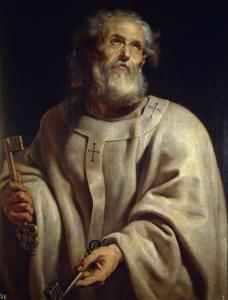
Peter Paul Rubens (1577–1640)
Christianity is a supernatural religion; it is full of mysteries and miracles.
The Christianity which Rationalists and Modernists in our day attempt to recommend – a religion stripped of mysteries and emptied of all supernatural elements – is not the Christianity of Jesus Christ, nor of the Bible, nor even of what is called “Orthodox Protestantism.” We must either take Christianity with its mysteries of leave it alone, for the two stand or fall together. And this applies to Protestant as well as to Catholic. The religion of Jesus Christ asks him to believe not only what he never saw and what no one ever saw, but what no one ever can see, and what from the very nature of the case cannot be proved or accounted for on natural grounds in any way whatsoever. We have only to refer to the Apostles’ Creed, which many Protestants profess as well as we. Take the doctrine that Our Lord was “conceived by the Holy Ghost,” or the “forgiveness of sins,” or the second coming of Christ, or “the life everlasting”; or, again, the existence and guardianship of angels, or the reality of Heaven and Hell. These are realities, but spiritual realities; you cannot see or touch or handle them; they are not proper subjects of natural science or reason; you must take them on faith, as revealed by God. And it is precisely these things which Rationalists, who walk by sight and not by faith, reject. “The sensual [natural, Authorized Version] man perceiveth not these things that are of the Spirit of God, for it is foolishness to him; and he cannot understand, because it is spiritually examined [discerned, Authorized Version] (1 Cor. ii. 14).

Saint Peter Attempting to Walk on Water (1766), painting by François Boucher
Take, for example, the Doctrine of the Blessed Trinity
– that in God there are three Persons, God the Father, God the Son, and God the Holy Ghost, and yet there are not three Gods, but one God; the three Divine Persons are all one and the same God. The natural intelligence instinctively rebels against this; there is nothing like it in the sphere of Nature as known to us – it is, in short, a mystery, that is, a truth which is above reason but revealed by God. If this doctrine came to us on merely human authority, we should certainly refuse to accept it.
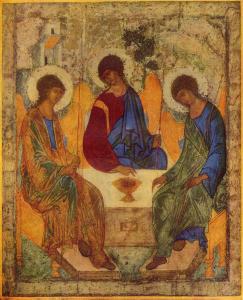
The Trinity by Russian icon painter Andrei Rublev, early 15th century.
Or, again, take the Incarnation
– the doctrine that the Infinite and Eternal God was for a period carried within the womb of a woman, and that the little Infant lying on the manger of the stable at Bethlehem, poor and helpless, was none other than the Omnipotent Creator of Heaven and earth! Or think of the Passion and Death of Jesus Christ. Could the mind of man, unaided by God, take it in that that Sufferer, scourged, kicked, mocked, spat upon, reviled, sold for a price, was really the Second Person of the Blessed Trinity? – that the Man nailed to the Cross, and hanging between Heaven and earth, bleeding and agonizing, the butt and sport of a vile rabble, and executed as a rebel, an outcast, and a blasphemer, was yet the Good God Who loved us with an everlasting love?
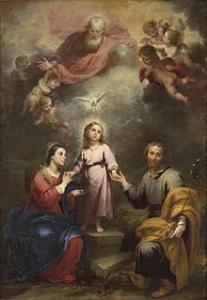
The “Heavenly Trinity” joined to the “Earthly Trinity” through the Incarnation of the Son–The Heavenly and Earthly Trinities by Murillo (c. 1677)
Or, again, take the Blessed Sacrament:
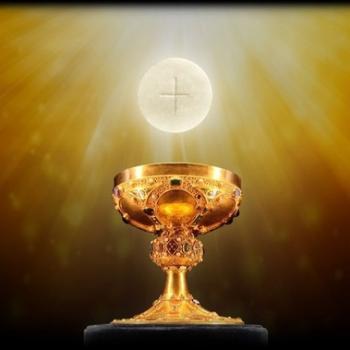
how could we ever believe that the small, round, White Thing which we call the Sacred Host, which has the appearance of bread, and which our senses – touch and taste and sight – tell us is bread, yet is not bread at all, but is the true Body and Blood of God the Son made Man, together with His Soul and Divinity? – that It is as really and truly Jesus Christ, God and Man, as was the Child in Blessed Mary’s arms, or as the Savior upon the Cross, or as the Redeemer at God’s right hand in heaven? How could we believe that the Eternal God, “whom the Heaven of Heavens cannot contain,” is yet confined within the tabernacle on the altar, enclosed within a small ciborium, or carried by a priest in a pocket-pyx?
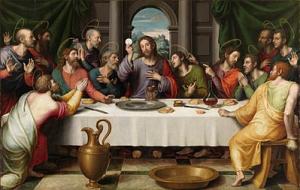
The first Eucharist, depicted by Juan de Juanes in The Last Supper, c. 1562
Once more: take the eternity of Heaven and the eternity of Hell;
our minds, naturally, cannot conceive it.

The Last Judgment by John Martin (1854)
Or, lastly, take the Resurrection of the Body
– the dogma that at the general judgment we shall rise again with the bodies as we have now; that, no matter whether you have been burned to ashes, or become food for the fishes, or been devoured by wild beasts, or been reduced to dust in the grave, yet your body will be raised again and joined to your soul, and in body and soul reunited you will be found either in Heaven or in Hell. I repeat, that these and other doctrines of the Christian religion are simply incredible to a man without faith; he would not and could not accept them; and, what is more, to many they have appeared not only incredible, but unreasonable, unnecessary, and absurd.
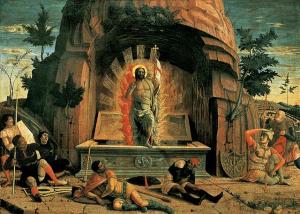
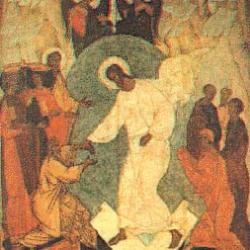
The Resurrection, painting by Andrea Mantegna, 1457–1459
But so soon as you have faith you believe them,
and have no difficulty in believing them. Faith is like a telescope. Astronomers tell us that on a clear night one can see with the naked eye about three thousand stars. But look through a powerful telescope, and you will see many millions. They were in the heavens all the time, but you could not discern them. So it is with the truths of the Christian religion. Many of them seem hard, difficult, impossible; faith comes, and at once you find it easy to believe then. As an example of what I mean, imagine two friends visiting a Catholic Church – the one a Catholic, the other a Protestant. So soon as they enter, the Catholic drops on his knee and remains for a moment or two in prayer; the other stands unmoved, gazes round him, and wonders what the Catholic is doing. What makes the difference in their mode of acting? The difference is that one has faith, the other has not. By faith the Catholic knows and believes that Our Blessed Lord is present on the altar, and consequently he genuflects and adores Him; the Protestant, without faith, neither knows or believes in our Lord’s Presence. The first has the spiritual telescope, and discerns Our Divine Lord in the tabernacle, though under the apperance of bread
“Faith for all defects supplying,
Where the feeble senses fail.” – Benediction Hymn
– the second, destitute of such an instrument, neither knows, believes, nor recognizes Him.
“There hath stood One in the midst of you Whom you know not.”
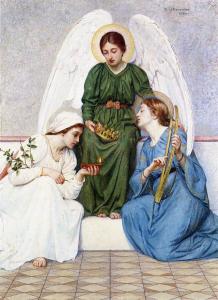
Faith, Hope and Love, 1894, by Mary Lizzie Macomber
Or, again, take the Immaculate Conception
– the doctrine that the Blessed Virgin Mary, by a singular privilege of grace bestowed on her through the merits of her Divine Son, was preserved free from the least guilt or stain of original sin. The Catholic, or course, says: “I believe this, I hold this, with all my heart and soul.” The Protestant says: “No, I do not believe it, and cannot see it.” What makes the difference here? Again, faith. Faith has given the one light, so that he sees the truth revealed by God; the other, without the light of faith, an only look into the darkness.

Giovanni Battista Tiepolo (1696–1770).
You might say the same in regard to many other Catholic doctrines
– e.g., Purgatory, Confession, Indulgences, Masses for the living and the dead, and the like. The Protestant rejects and denies them; the Catholic spontaneously accepts and rejoices in them. It all depends upon the presence or the absence of the great gift of faith. I was right, then, in saying that after grace it is the greatest of all gifts. When a man has it, he is able to accept without hesitation all the mysteries of Christianity, whether he understands them or not. The man who has it not cannot and will not believe them, any more than a bird can fly without wings, or a blind man see, or an astronomer without his telescope perceive the stars that are invisible to the naked eye.
To believe, for example, with your whole heart and soul, in spite of all appearances to the contrary, that the Sacred Host is your Creator and your God under the species of bread, and that in Communion you receive God’s Precious Body and Soul into your own body and soul; to believe that the Blessed Virgin was conceived without that guilt and stain of sin which has rested on every other human being that ever lived; to believe in the existence of souls in Purgatory, and that indulgences can be applied by the living and to assist them – I say to believe all this, and much else in the Catholic Faith, needs faith – intense, profound, stupendous faith, in shot,
Divine faith – and nothing less.
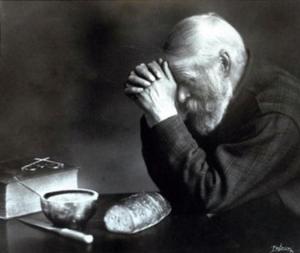
The Minnesota state photograph Grace by Eric Enstrom, depicting travelling salesman Charles Wilden in Bovey. Photograph was published in the United States in 1918 (and therefore public domain).
Previous Post

October 25, 2024
Notable People Alive in 1889
Next Post

October 29, 2024 Meet Luce The Destroyer of the Catholic Church: A Satire
Browse Our Archives
Select a Category 1889 abortion adoption Advent After Life Angles apologetics Art Awards BCCT bible book review books business Carmelite Catechetics Catholic Actors catholic authors Catholic Bard Catholic Faith Catholic List Catholic Rigorous Vortex Christian Authors Christmas church teaching civil conversation coronavirus Current Events death Different Religions Divine Mercy Easter Education encouragment Entertainment Eucharist Evangelization Event faith Family Life famous people feast day food Fun Stuff Global Church God guest post Harry Potter healing Heck of a Ride Around the Sun history holiday Holy Family Holy Orders Holy Spirit Holy Week hope Humor Interview Ireland Jesus kindle unlimited reflections Last Things Lecto Divina with Kristin Lent Lent/Easter liturgy love marriage Mary Meet the Author Mission Month in Advance Movie Review Movies Movies of the Month Music Narrative Older Writings patheos authors personal Philosophy podcasts poetry political Politics pope prayer Private Revelation pro-life public domain Quotes racial relations racism reflection Religious Life Saints science Scriptural Meditation social justice Social Media spirituality suffering supernatural theology Topics Travel Trivia Tweeting to the Choir Uncategorized universal church Vatican virtue war Week in Review women world religions writing Writing Write Now
Select a Month October 2026 September 2026 August 2026 July 2026 June 2026 May 2026 April 2026 March 2026 February 2026 January 2026 December 2025 November 2025 October 2025 September 2025 August 2025 July 2025 June 2025 May 2025 April 2025 March 2025 February 2025 January 2025 December 2024 November 2024 October 2024 September 2024 August 2024 July 2024 June 2024 May 2024 April 2024 March 2024 February 2024 January 2024 December 2023 November 2023 October 2023 September 2023 August 2023 July 2023 June 2023 May 2023 April 2023 March 2023 February 2023 January 2023 December 2022 November 2022 October 2022 September 2022 August 2022 July 2022 June 2022 May 2022 April 2022 March 2022 February 2022 January 2022 December 2021 November 2021 October 2021 September 2021 August 2021 July 2021 June 2021 May 2021 April 2021 March 2021 February 2021 January 2021 December 2020 November 2020 October 2020 September 2020 August 2020 July 2020 June 2020 May 2020
Follow Us!
TAKE THE
Religious Wisdom Quiz
Which Christian holiday starts the new liturgical year in Western churches?
Select your answer to see how you score.
Lent Advent Epiphany Easter
Books by This Author Books by Catholic Bard
Related posts from Catholic Bard

Looking For Good Catholic Writing - October 2026
Catholic Teaching On Tough Issues
I want to Live and Die as a...
TRENDING AT PATHEOS Catholic

When Halloween Unmasks Married Hearts
Written by Dr. David K. Ewen from Eternal Truth Bible College Behind...

Aristotle. He’s been called the father of logic, the father of the...

Methodist Central Hall and Westminster Abbey
Situated on the same square is Methodist Central Hall and Westminster Abbey. ...

57th Dove Awards Honor Dolly Parton, Crown New...
On gospel music’s biggest night, the 57th annual GMA Dove Awards honored...

The First Eucharistic Controversy: Christ’s Real Presence
For Catholics, the Eucharist is the source and summit of the Christian...

What a Stop Sign Can Teach Us About...
How to Make a Decision When You Can't Hear God Main point:...
view all Catholic blogs
Ad-Free & Subscriber Log-In Subscription Support
- About Us
- 2026 Calendar
- Videos
- Podcasts
- Library of World Religions
- Faith In Media Tracker
- Advertise With Us
- Write for Us
- Privacy Policy
- Terms of Service
- Do Not Sell My Data
- Contact Us
- Radiant Digital
- Manage Newsletter Subscriptions
- Unsubscribe From Notifications
- Sitemap
Copyright 2008-2026, Patheos. All rights reserved.
Subscription Support Ad-Free & Subscriber Log-In
Follow Patheos