
BuddhistCatholicContemplativeEvangelicalGeneral ChristianHinduJewishLatter-day SaintMuslimNew VisionsProgressive Christian
Beliefs
- Buddhist
- Catholic
- Contemplative
- Evangelical
- General Christian
- Hindu
- Jewish
- Latter-day Saint
- More Voices
- Muslim
- New Visions
- Pagan
- Progressive Christian
Topics
- Religion News
- Food and Religion
- Sports and Religion
- Religious Art
- Religious Music and Entertainment
- Religious Events
- History and Religion
- Style and Religion
- Politics and Religion
- Women in Religion
- Recreation Outdoors and Religion
- Business Finance and Religion
- Careers Workplace and Religion
- Education and Religion
- Family Parenting and Religion
- Health Fitness and Religion
- Home and Religion
- Relationships and Religion
- Technology and Religion
- Travel and Religion
Columnists
- Buddhist Columnists
- Business Finance and Religion Columnists
- Careers Workplace and Religion Columnists
- Catholic Columnists
- Contemplative Columnists
- Education and Religion Columnists
- Evangelists Columnists
- Family Parenting and Religion Columnists
- General Christian Columnists
- Health Fitness and Religion Columnists
- Hindu Columnists
- History and Religion Columnists
- Home and Religion Columnists
- Jewish Columnists
- More Voices Columnists
- Latter Day Columnists
- Muslim Columnists
- New Visions Columnists
- Nonreligious Columnists
- Pagan Columnists
- Politics and Religion Columnists
- Progressive Columnists
- Recreation Outdoors and Religion Columnists
- Relationships and Religion Columnists
- Religion News Columnists
- Religious Art Columnists
- Religious Events Columnists
- Religious Music and Entertainment Columnists
- Sports and Religion Columnists
- Style and Religion Columnists
- Technology and Religion Columnists
- Travel and Religion Columnists
- Women in Religion Columnists
Resource Library
- 2026 Calendar
- Library of World Religions
- The 100 Most Holy Places on Earth
- Patheos Answers
- Podcasts
- Videos
- Faith Leaders Database
- Anglican Episcopalian
- Bahai
- Baptist
- Buddhism
- Christianity
- Confucianism
- Eastern Orthodoxy
- Hinduism
- Holiness and Pentecostal
- ISKCON
- Islam
- Judaism
- Lutheran
- Methodist
- The Church of Jesus Christ of Latter-day Saints
- New Age
- Paganism
- Presbytarian and Reformed
- Protestantism
- Religion Behind the Scenes
- Roman Catholic
- Scientology
- Shia Islam
- Sikhism
- Sufism
- Sunni Islam
- Taoism
- Zen
- See all religions
Research Tools
 Ad-Free & Subscriber Log-In Subscription Support
Follow Patheos 

- Trending:
- Advent
- |
- Forgiveness
- |
- Thanksgiving
- |
- Election
- |
- Seasonal Holidays
- |
- Marriage

- Home
- Catholic
- History and Religion
- Gregorian Exploration & Reformation Expand The 16th Century
Gregorian Exploration & Reformation Expand The 16th Century
Last updated on: April 24, 2024 at 7:11 am by Mark Wilson
Gregorian Exploration & Reformation Expand The 16th Century 2024-04-24T07:11:11-05:00 Mark Wilson
Patheos Explore the world's faith through different perspectives on religion and spirituality! Patheos has the views of the prevalent religions and spiritualities of the world.
Last Time On HOARATS
Renascence, Reformation, Trent & Guadalupe Change 16th Cent | A Timeline Of Events In The 16th Century 1500 – 1549. (patheos.com)
And Now We Continue On Into the
16th Century
1550 – 1599
16th century: c. 1500 – 1600 – Oxford Reference
Popes 221 – 231 reigned on the throne of St. Peter.
1 Saint Popes
0 Blessed Pope
10 Non – Sainted Popes
0 Anti – Popes
1550’s
1550: Our Lady of Good Health Our Lady of Velankanni
July 7 1550:
Chocolate is introduced in Europe, and the Mexican drink creates a passion that endures after nearly half a millennium.
Europe came late to the joys of chocolate. Native to Mexico, Central and South America, cacao cultivation dates to at least 1250 B.C., according to archaeologists. July 7, 1550: Europeans Discover Chocolate | WIRED
1551: Leonard Digges invents the theodolite.
1551: The Life and Doctrine of Saint Catherine of Genoa is published.
The Treatise on Purgatory: When God sees the Soul pure as it was in its origins, He tugs at it with a glance, draws it, and binds it to Himself with a fiery love that by itself could annihilate the immortal soul. In so acting, God so transforms the soul in Him that it knows nothing other than God; and He continues to draw it up into His fiery love until He restores it to that pure state from which it first issued. These rays purify and then annihilate. The soul becomes like gold that becomes purer as it is fired, all dross being cast out. Having come to the point of twenty-four carats, gold cannot be purified any further; and this is what happens to the soul in the fire of God’s love
1553–1558: Catholic Queen Mary of England reigns, executing many English Protestants
1555: Peace of Augsburg permits Christian rulers to choose either Catholicism or Lutheranism as their state religion
1555- Les Prophéties (The Prophecies) a Nostradamus a collection of prophecies by French physician Nostradamus, (December 1503 – July 1566) is published.
Nostradamus! (His Secret Technique Revealed! Astrologer? Prophet? Psychic?) (sqpn.com)
1558: Elizabeth Tudor becomes Queen Elizabeth I at age 25.
1558–1603: The Elizabethan era is considered the height of the English Renaissance.
1559: Elizabeth I’s Act of Uniformity prohibits the celebration of the Catholic mass in England; she executes many Catholics; Protestant books are banned in Rome;
1559: St. Lawrence of Brindisi (July 22, 1559 – July 22, 1619) is born in Italy. He becomes a Doctor of the Church in 1959.
1559: John Knox (c. 1514 – 24 November 24, 1572) helped to establish a Protestant Church of Scotland.
1560’s
1560: The Geneva Bible was published. It was the first mechanically printed, mass produced bible. Printed in English it was compiled by a number of English scholars that had fled England under Mary I and sought refuge in Geneva, Switzerland.
1561: Sir Francis Bacon (January 22, 1561 – April 9, 1626), is born in London.
1563–**Pope # 225 Non-Saint Pius IV, (**December 26, 1559 –December 9, 1565 – 5 years, 348 days) convinced that reading the fables of Aesop was of great use in forming the morals of young children, commissioned Gabriel Faerno, whom he knew as an excellent poet as well as a man with a taste for elegant and beautiful Latinity, to versify these fables so that children might learn, at the same time and from the same book, both moral and linguistic purity.. Charles Perrault
1564: Galileo Galilei (February 15, 1564 – January 8, 1642) is born.
1564: William Shakespeare (April 26, 1564 – April 23, 1616) is born.
1565: The Hospitallers, a Crusading Order, defeat the Ottoman Empire at the siege of Malta .
1565: Spanish navigator Andres de Urdaneta (1508 – June 3, 1568) discovers the maritime route from Asia to the Americas across the Pacific Ocean, also known as the tornaviaje.
1565: The first permanent European settlement is founded by Spanish admiral and explorer Pedro Menendez de Aviles (1519–1574) at St. Augustine, Florida.
Thus, the first American Thanksgiving was neither at Plymouth Rock in 1621 nor in Texas on April 20, 1568 when Don Juan de Oñate crossed the Rio Grande and took formal possession of present day El Paso. This honor belongs to the city of St. Augustine, Florida, the first and oldest city of our present day United States. The landing of Captain General Pedro Menendez de Aviles and his fleet of soldiers and colonists – accompanied by priests – on the coast of Florida on September 8, 1565 has all the qualification to count it as the first official Thanksgiving Day in our country.
St. Augustine’s FL and the First Thanksgiving – Catholicism.org
1566–1572: Reign of St. **Pope # 226 Pius V (**May 13, 1572 – April 10, 1585 – 12 years, 332 days), Reformed the calendar (1582); built the Gregorian Chapel in the Vatican. The first pope to bestow the Immaculate Conception as patroness to the Philippine Islands through the bull Ilius Fulti Præsido (1579). Strengthened diplomatic ties with Asian nations.
1567: **St. Francis de Sales (**August 21, 1567 – December 28, 1622) bishop of Geneva, is born in France.
1567: St. Dr. Thomas Aquinas is promoted to Doctor of the Church.
1567: Mary, Queen of Scots (December 8, 1542 – 8 February 8, 1587) is imprisoned by Elizabeth I (September 7, 1533 – March 24, 1603)
1568: The Four Greek Fathers are promoted to Doctors of the Church.
- St. Dr. John Chrysostom*
- St. Dr. Basil the Great*
- St. Dr. Gregory of Nazianzus*
- St. Dr. Athanasius*
1569: The papal bull Consueverunt Romani Pontifices by the Dominican Pope Pius V officially established the devotion to the rosary in the Catholic Church. St. Peter Canisius, a Doctor of the Church, who is credited with adding to the Hail Mary the sentence “Holy Mary, Mother of God, pray for us sinners”, was an ardent advocate of the rosary and promoted it (and its Marian devotion in general) as the best way to repair the damage done to the church by the Reformation
May 10, 1569 -John of Ávila ( January 5, 1499 – May 10, 1569) dies. He was a Spanish priest, preacher, scholastic author, and religious mystic, who has been declared a saint and Doctor of the Church in 2012. He is called the “Apostle of Andalusia“, for his extensive ministry in that region.
1570’s
1570: Ivan the Terrible, (August 25, 1530 – March 28, March 1584) tsar of Russia, orders the massacre of inhabitants of Novgorod.
1570: Pope Pius V issues Regnans in Excelsis, a papal bull excommunicating all who obeyed Elizabeth I and calling on all Catholics to rebel against her.
1571: The Thirty-Nine Articles finalize the teachings of the Church of England is finished.
1571: Pope Pius V completes the Holy League as a united front against the Ottoman Turks.
1571: American Indians kill Spanish missionaries in what would later be Jamestown, Virginia.
1571: Turks defeated at The Battle of Lepanto.
The feast of Our Lady of the Rosary, a celebration that has its origin not, as it would seem, in simply a prayer, but in a battle.
On October 7th, 1571 a fleet of ships assembled by the combined forces of Naples, Sardinia, Venice, the Papacy, Genoa, Savoy and the Knights Hospitallers fought an intense battle with the fleet of the Ottoman Empire. The battle took place in the Gulf of Patras located in western Greece. Though outnumbered by the Ottoman forces, the so-called “Holy League” possessed of superior firepower would win the day. This victory would severely curtail attempts by the Ottoman Empire to control the Mediterranean, causing a seismic shift in international relations from East to West. In some respects, and I do not want this claim to be overstated, the world that we know came into being with this victory. This event is known to history as the “Battle of Lepanto.” Our Lady of the Rosary and the Battle of Lepanto – Word on Fire

1571: Italian painter **Caravaggio (**September 29, 1571 – 18 July 18, 1610) is born in Milan.
December 27, 1571 – Johannes Kepler (December 27, 1571 – November 15, 1630) is born. He is best known for his laws of planetary motion, and his books Astronomia nova, Harmonice Mundi, and Epitome Astronomiae Copernicanae. These works also provided one of the foundations for Newton‘s theory of universal gravitation.
1572: Spanish conquistadores apprehend the last Inca leader Tupak Amaru at Vilcabamba, Peru, and execute him in Cuzco.
1572: Catherine de’ Medici instigates the St. Bartholomew’s Day massacre which takes the lives of Protestant leader Gaspard de Coligny and thousands of Huguenots. The violence spreads from Paris to other cities and the countryside.
1572: Saint Jane Frances de Chantal (January 28, 1572 – 13 December 13,1641) is born.

1573: Paolo Veronese The Feast in the House of Levi
1575: Thomas Helwys (c. 1575 – c. 1616) cofounder of the Baptists, is born in England.
1576: The Autobiography of Thomas Platter is published.
1577: December 13, 1577: Francis Drake set out from Plymouth, England on his ship, The Golden Hind, on a voyage that would take the ship and crew around the world, the first circumnavigation of the globe by an English vessel.
1580’s
1580: Vincenzo Campi – The Fruit Seller


1580: Sir Francis Drake (c. 1540 – 28 January 1596) was an English explorer and privateer best known for his circumnavigation of the world in a single expedition between 1577 and 1580.
1581: In England, Jesuit priest St. Edmund Campion (January 25, 1540 – December 1, 1581) is executed for treason along with two fellow priests, Ralph Sherwin and Alexander Briant.

1581: St. Louis Bertrand (1526–1581), Dominican priest (Colombia) dies.
- Declared Venerable: N/A
- Beatified: 19 July 1608 by Pope Paul V
- Canonized: 12 April 1671 by Pope Clement X
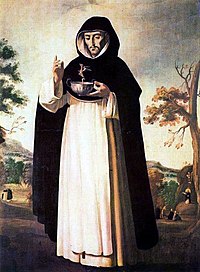
Saint Louis Bertrand, a Spanish Dominican friar, lived out his saintly life in Spain. He is a man of contradicting and conflicting personality traits. His demeanor was grave and he lacked a sense of humor but despite that he had a gentle sweet disposition that made him likable to other people. He was no Thomas Aquinas when it came to intellectual gifts but he studied hard nonetheless. Although it is said that “his voice was raucous, his memory treacherous, his carriage without grace”, he became a fervent and quite popular preacher. He became a spiritual counselor to many, including St. Teresa of Ávila.
He ministered to others when a plague broke out in Valencia Spain and was a missionary to the new world, which is why this Spanish man is known as the “Apostle to the Americas”.
1582: The Gregorian calendar is the calendar used in most parts of the world. It was introduced on February 24 with a papal bull, and went into effect in October 1582 by Pope Gregory XIII as a modification of, and replacement for, the Julian calendar.
1583: Denmark builds the world’s first theme park, Bakken.
1584: English writer, poet, soldier, politician, courtier, spy, and explorer Walter Raleigh (1552–1618) lands on Roanoke Island and calls the land Virginia in honor of Queen Elizabeth.
1584: St. Dr. John of the Cross’s Dark Knight of the Soul is written. He becomes a Doctor of the Church in 1926.
1. On a dark night, Kindled in love with yearnings—oh, happy chance!—
I went forth without being observed, My house being now at rest.2. In darkness and secure, By the secret ladder, disguised—oh, happy chance!—
In darkness and in concealment, My house being now at rest.3. In the happy night, In secret, when none saw me,
Nor I beheld aught, Without light or guide, save that which burned in my heart.4. This light guided me More surely than the light of noonday
To the place where he (well I knew who!) was awaiting me— A place where none appeared.5. Oh, night that guided me, Oh, night more lovely than the dawn,
Oh, night that joined Beloved with lover, Lover transformed in the Beloved!6. Upon my flowery breast, Kept wholly for himself alone,
There he stayed sleeping, and I caressed him, And the fanning of the cedars made a breeze.7. The breeze blew from the turret As I parted his locks;
With his gentle hand he wounded my neck And caused all my senses to be suspended.8. I remained, lost in oblivion; My face I reclined on the Beloved.
All ceased and I abandoned myself, Leaving my cares forgotten among the lilies.
January 25, 1585, Naming a region of North America “Virginia” in honor of the queen resulted in Walter being knighted by the Queen.
August 17, 1585: The Colony at Roanoke founded in Virginia is settled.
November 25, 1585: St. Aloysius Gonzaga (March 9, 1568 – June 21, 1591) is accepted into the Society of Jesus in Rome. During this period, he was asked to moderate his asceticism somewhat and to be more social with the other novices.
1586: Church of the Gesù, first Baroque church, is built in Rome;
1586: St. Margaret Clitherow is martyred for hiding Catholic priests in her English home.
February 1, 1587: Queen Elizabeth I of England signs the death warrant of her cousin Mary, Queen of Scots, after Mary has been implicated in a plot to murder Elizabeth. Seven days later, on the orders of Elizabeth’s privy council, Mary is beheaded at Fotheringhay Castle.
July 22, 1587: Colonist and governor John White (1540–1593) returns to Roanoke after two years. Somehow the colony has disappeared. An additional group of settlers is left once again at Roanoke.
August 18, 1587: Virginia Dare was the first English child born in a New World English colony. The place of her birth was the Roanoke Colony. Each year the current residents of Roanoke Island celebrate her birthday with an Elizabethan Renaissance Festival.
1587: Our Lady of La Leche – American Catholic History Spanish settlers in St. Augustine, Florida established a shrine to Our Lady of La Leche. This was the first shrine to Our Lady, the Blessed Mother Mary, established in what is now the United States. This devotion to the Blessed Mother has roots that go back to the Roman catacombs. It was a favored image of King Philip II of Spain. “La Leche,” Spanish for “The Milk,” depicts the Blessed Mother nursing the infant Jesus. The first chapel dedicated to Our Lady of La Leche was erected in 1609. The chapel currently standing in the Mission of the Name of God in St. Augustine was built in 1914. Many miracles have been attributed to this image and shrine over the centuries. In the 21st century the shrine was named a National Shrine, and the Pope granted the image a canonical coronation.
July 19, 1588: -During the Anglo-Spanish War’s Battle of Gravelines, the ultimately doomed Spanish Armada was sighted in the English Channel.
1588 – St. Dr. Bonaventure is promoted to Doctor of the Church.
1588: St. Dr. Teresa of Ávila’s Interior Castle is published. St. Teresa becomes a Doctor of the church in 1970.
Let us imagine, as I said, that there are many rooms in this castle, of which some are above, some below, others at the side; in the centre, in the very midst of them all, is the principal chamber in which God and the soul hold their most secret intercourse.37 Think over this comparison very carefully; God grant it may enlighten you about the different kinds of graces He is pleased to bestow upon the soul. No one can know all about them, much less a person so ignorant as I am. The knowledge that such things are possible will console you greatly should our Lord ever grant you 41any of these favours; people themselves deprived of them can then at least praise Him for His great goodness in bestowing them on others. The thought of heaven and the happiness of the saints does us no harm, but cheers and urges us to win this joy for ourselves, nor will it injure us to know that during this exile God can communicate Himself to us loathsome worms; it will rather make us love Him for such immense goodness and infinite mercy. Chapter 1:4
Cue for Treason (1940) is a children’s historical novel written by Geoffrey Trease, and is his best-known work. The novel is set in Elizabethan England at the end of the 16th century. Two young runaways become boy actors, at first on the road and later in London, where they are befriended by William Shakespeare. They become aware of a plot against Queen Elizabeth’s life and attempt to prevent it.
It has been claimed that the action can be dated to 1599 from the reference to Henry V and Essex being sent to Ireland, but it is not clear that the author intended to be that specific. However it is clearly set some time between the Spanish Armada in 1588 and the death of Elizabeth in 1603.

1590’s
1590: John White returns again and one again the settlement has disappeared. To this day, mystery surrounds their disappearance.
In Search Of: The Lost Colony of Roanoke (S2, E3) | Full Episode – YouTube
August 1590: Pope # 227 Non-Saint Sixtus V (April 24, 1585 – August 27, 1590 – 5 years, 125 days)(the tough pope) decided to place the first volume of the theological work called *Disputationes (*1581–1593) written by Dr. St. Robert Bellarmine (October 4, 1542 – September 17, 1621) on the dreaded Index of Forbidden Books BECAUSE Bellarmine argued in it, that the Pope is not the temporal ruler of the whole world and that temporal rulers do not derive their authority to rule from God. They get that power from the consent of the governed. HOWEVER Sixtus died before the revised Index was published, and the next Pope # 228 Urban VII, (September 15, 1590 – September 27, 1590 – 12 days) removed the book from the Index during his brief twelve-day reign showcasing what a pope can accomplish in so short a time. St. Rob would become a Doctor of the Church in 1931.
1593–C. 1656: Renaissance artist Artemisia Gentileschi is born.
1594–1634: Our Lady of the Good Event Apparitions– A Conceptionist sister named Mariana Francisca de Jesús Torres claimed to have received Marian apparitions under this title from February 2,1594 to 2 February 2, 1634 in Quito. In the next century in the year 1611, the local bishop, Salvador Ribera Avalos, gave his approval to the apparitions that had occurred up to that point. This apparition is very popular in anti-Vatican II circles.
“As a testament to her sanctity, the body of Ven. Mariana is, to this day, considered incorrupt, and upon the opening of her casket in 1906, was found to exude the fragrance of lilies.“-Steve Skojec 400 Years Ago, Our Lady Sent Us A Message From Ecuador – OnePeterFive
c. 1595: Saint Francis of Assisi in Ecstasy is a painting by the Italian Baroque master Michelangelo Merisi da Caravaggio. It is now in the Wadsworth Atheneum, Hartford, Connecticut 90 minutes from where I currently live in Cranston, RI.

1594: St. Paul’s College, Macau, founded by Alessandro Valignano S.J. was a university founded at the service of the Portuguese under the Padroado treaty. It claims the honered title of the first Western university in East Asia
1595: Clandestine Missionary St. Fr. Robert Southwell S.J. (c. 1561 – February 21, 1595), was spreading the Gospel according to the Catholic Church in Elizabethan England. He was arrested and imprisoned for this in 1592, and intermittently tortured and questioned by priest hunter Richard Topcliffe, St. Southwell was eventually tried and convicted of high treason for his links to the Holy See. On February 21, 21, 1595, Father Southwell was hanged at Tyburn.
Though all the East did quake to hear
Of Alexander’s dreadful name,
And all the West did likewise fear
To hear of Julius Caesar’s fame,
Yet both by death in dust now lie;
Who then can ‘scape but he must die?
If none can ‘scape death’s dreadful dart,
If rich and poor his beck obey,
If strong, if wise, if all do smart,
Then I to ‘scape shall have no way.
Oh, grant me grace, O God, that I
My life may mend, sith I must die.
Upon The Image Of Death by Robert Southwell (poetry.com)
1596: Sir John Harington (1561–1612) published his revolutionary book called A New Discourse of a Stale Subject, Called the Metamorphosis of Ajax towards the end of the 16th century*.* It it he describes a forerunner to the modern flush toilet installed at his house at Kelston in Somerset. The design had a flush valve to let water out of the tank, and a wash-down design to empty the bowl. He installed one for his godmother Queen Elizabeth I at Richmond Palace.
1597: St. Philip of Jesus (Felipe of Jesus) (1571–1597) dies. He was a Professed Priest of the Franciscan Friars Minor (Alcantarines); Martyr (Mexico City, Mexico – Nagasaki, Japan) ) was a Novohispanic Catholic missionary
- Declared Venerable: N/A
- Beatified: 14 September 1627 by Pope Urban VIII
- Canonized: 8 June 1862 by Pope Pius IX

St. Philip was a Novohispanic Catholic missionary who became one of the Twenty-six Martyrs of Japan, the first Mexican saint and patron saint of Mexico City.
1598: The Edict of Nantes: King Henry IV (December 13, 1553 – May 14, 1610) graciously granted the Calvinist Protestants of France, also known as Huguenots, substantial rights in the nation, which was predominantly Catholic. Civil unity was the overall goal of this edict.
1599: The famous Globe Theatre, home to many of Shakespeare’s classic plays, opens on London’s Southbank.
King of Shadows (1999) by Susan Cooper
Only in the world of the theater can Nat Field find an escape from the tragedies that have shadowed his young life. So he is thrilled when he is chosen to join an American drama troupe traveling to London to perform A Midsummer Night’s Dream in a new replica of the famous Globe theater.
Shortly after arriving in England, Nat goes to bed ill and awakens transported back in time four hundred years — to another London, and another production of A Midsummer Night’s Dream. Amid the bustle and excitement of an Elizabethan theatrical production, Nat finds the warm, nurturing father figure missing from his life — in none other than William Shakespeare himself. Does Nat have to remain trapped in the past forever, or give up the friendship he’s so longed for in his own time?- Amazon Description

Next Time on
HOARATS
To Understand
What I love and How I Write About History
Hit the Link Above.
To understand about this particular series I’m writing about, please read
The Catholic Bard’s Guide To History Introduction
And to view a historical article click on
History and Religion
Previous Post
April 4, 2024
Renascence, Reformation, Trent & Guadalupe Change 16th Cent
Next Post
April 15, 2024 Thanksgiving and Hersey in the 17th Century
Browse Our Archives
Select a Category 1889 abortion adoption Advent After Life Angles Anxiety apologetics Art Awards BCCT bible book review books business Carmelite Catechetics Catholic Actors catholic authors Catholic Bard Catholic Faith Catholic List Catholic Rigorous Vortex Christian Authors Christmas church teaching civil conversation coronavirus Current Events death Different Religions Divine Mercy Easter Education encouragment Entertainment Eucharist Evangelization Event faith Family Life famous people feast day food Fun Stuff Global Church God guest post Harry Potter healing Heck of a Ride Around the Sun history holiday Holy Family Holy Orders Holy Spirit Holy Week hope Humor Interview Ireland Jesus kindle unlimited reflections Last Things Lecto Divina with Kristin Lent Lent/Easter liturgy love marriage Mary Meet the Author Mission Month in Advance Movie Review Movies Movies of the Month Music Narrative Older Writings patheos authors personal Philosophy podcasts poetry political Politics pope prayer Private Revelation pro-life public domain Quotes racial relations racism reflection Religious Life Saints science Scriptural Meditation social justice Social Media spirituality suffering supernatural theology Topics Travel Trivia Tweeting to the Choir Uncategorized universal church Vatican virtue war Week in Review women world religions writing Writing Write Now
Select a Month November 2026 October 2026 September 2026 August 2026 July 2026 June 2026 May 2026 April 2026 March 2026 February 2026 January 2026 December 2025 November 2025 October 2025 September 2025 August 2025 July 2025 June 2025 May 2025 April 2025 March 2025 February 2025 January 2025 December 2024 November 2024 October 2024 September 2024 August 2024 July 2024 June 2024 May 2024 April 2024 March 2024 February 2024 January 2024 December 2023 November 2023 October 2023 September 2023 August 2023 July 2023 June 2023 May 2023 April 2023 March 2023 February 2023 January 2023 December 2022 November 2022 October 2022 September 2022 August 2022 July 2022 June 2022 May 2022 April 2022 March 2022 February 2022 January 2022 December 2021 November 2021 October 2021 September 2021 August 2021 July 2021 June 2021 May 2021 April 2021 March 2021 February 2021 January 2021 December 2020 November 2020 October 2020 September 2020 August 2020 July 2020 June 2020 May 2020
Follow Us!
TAKE THE
Religious Wisdom Quiz
Who wrote the book of Genesis?
Select your answer to see how you score.
Eve Paul Adam Moses
Books by This Author Books by Catholic Bard
Related posts from Catholic Bard

Looking For Good Catholic Writing - October 2026
Catholic Teaching On Tough Issues
The Homeless at Home by Blessed Fulton Sheen
TRENDING AT PATHEOS Catholic

Smart people saying smart things (11.24.26)
Please take time to listen to Perry Bacon, Sarah Posner, Adam Serwer,...

The Contingency of Our Technology
Last week we were hit with a raft of massive technology outages....

In 1939, President Franklin D. Roosevelt moved Thanksgiving from November 30 to...

Reasons for Restraint: Ricardo Gonzalez, Florida and Dec...
The Morning of January 3 I begin with the dead. On the...

I published this column for Thanksgiving 2012 in the Deseret News....

For many years, Catholicism has been caught up in division over the...
view all Catholic blogs
Ad-Free & Subscriber Log-In Subscription Support
- About Us
- 2026 Calendar
- Videos
- Podcasts
- Library of World Religions
- Faith In Media Tracker
- Advertise With Us
- Write for Us
- Privacy Policy
- Terms of Service
- Do Not Sell My Data
- Contact Us
- Radiant Digital
- Manage Newsletter Subscriptions
- Unsubscribe From Notifications
- Sitemap
Copyright 2008-2026, Patheos, part of the Radiant Digital network of media brands. All rights reserved.
Subscription Support Ad-Free & Subscriber Log-In
Follow Patheos