
BuddhistCatholicContemplativeEvangelicalGeneral ChristianHinduJewishLatter-day SaintMuslimNew VisionsProgressive Christian
Beliefs
- Buddhist
- Catholic
- Contemplative
- Evangelical
- General Christian
- Hindu
- Jewish
- Latter-day Saint
- More Voices
- Muslim
- New Visions
- Pagan
- Progressive Christian
Topics
- Religion News
- Food and Religion
- Sports and Religion
- Religious Art
- Religious Music and Entertainment
- Religious Events
- History and Religion
- Style and Religion
- Politics and Religion
- Women in Religion
- Recreation Outdoors and Religion
- Business Finance and Religion
- Careers Workplace and Religion
- Education and Religion
- Family Parenting and Religion
- Health Fitness and Religion
- Home and Religion
- Relationships and Religion
- Technology and Religion
- Travel and Religion
Columnists
- Buddhist Columnists
- Business Finance and Religion Columnists
- Careers Workplace and Religion Columnists
- Catholic Columnists
- Contemplative Columnists
- Education and Religion Columnists
- Evangelists Columnists
- Family Parenting and Religion Columnists
- General Christian Columnists
- Health Fitness and Religion Columnists
- Hindu Columnists
- History and Religion Columnists
- Home and Religion Columnists
- Jewish Columnists
- More Voices Columnists
- Latter Day Columnists
- Muslim Columnists
- New Visions Columnists
- Nonreligious Columnists
- Pagan Columnists
- Politics and Religion Columnists
- Progressive Columnists
- Recreation Outdoors and Religion Columnists
- Relationships and Religion Columnists
- Religion News Columnists
- Religious Art Columnists
- Religious Events Columnists
- Religious Music and Entertainment Columnists
- Sports and Religion Columnists
- Style and Religion Columnists
- Technology and Religion Columnists
- Travel and Religion Columnists
- Women in Religion Columnists
Resource Library
- 2026 Calendar
- Library of World Religions
- The 100 Most Holy Places on Earth
- Patheos Answers
- Podcasts
- Videos
- Faith Leaders Database
- Anglican Episcopalian
- Bahai
- Baptist
- Buddhism
- Christianity
- Confucianism
- Eastern Orthodoxy
- Hinduism
- Holiness and Pentecostal
- ISKCON
- Islam
- Judaism
- Lutheran
- Methodist
- The Church of Jesus Christ of Latter-day Saints
- New Age
- Paganism
- Presbytarian and Reformed
- Protestantism
- Religion Behind the Scenes
- Roman Catholic
- Scientology
- Shia Islam
- Sikhism
- Sufism
- Sunni Islam
- Taoism
- Zen
- See all religions
Research Tools
 Ad-Free & Subscriber Log-In Subscription Support
Ad-Free & Subscriber Log-In Subscription Support
Follow Patheos 

- Trending:
- Forgiveness
- |
- Marriage
- |
- Consciousness
- |
- Death Penalty
- |
- Election
- |
- Halloween

- Home
- Catholic
- More Reactions To Traditionis Custodes
More Reactions To Traditionis Custodes
Last updated on: November 30, 2022 at 1:10 am by Mark Wilson
More Reactions To Traditionis Custodes 2022-11-30T01:10:38-05:00 Mark Wilson
Patheos Explore the world's faith through different perspectives on religion and spirituality! Patheos has the views of the prevalent religions and spiritualities of the world.
Some Reactions to Motu Proprio | Mark Wilson (patheos.com)
How not to respond to the Pope

How to respond to the Pope
Young pro-TLM Catholics to Pope Francis: “Can we count on you?” – Catholic World Report
Some Honest Criticism
For the record, I think this decision by the Pope is wrong and I think the reasons he gives, though partially true, do not sufficiently justify this action. I do not attend a TLM Mass and attend instead an Ordinariate parish, but I greatly respect the spiritual fruits that have come from those parishes that celebrate the TLM. I find the motu proprio rather cold and harsh, and find it puzzling that a Pope who speaks so much of mercy and accompaniment when it comes to people in immoral sexual relationships – – going so far as to send a personal letter to Father James Martin thanking him and comparing his ministry to that of Jesus – – should suddenly now turn so harshly against a small number of Catholics of a traditionalist bent. Where is the accompaniment? Where is the dialogue? Where is the reaching out? Where is the frank analysis of why so many Catholics of this type find the mainstream Church so dull and uninspiring that they feel compelled to worship in older forms? These too are his sheep but Pope Francis clearly wants no part in “smelling like them” and prefers instead the odiferous stench of ageing German refugees from the sixties. Apparently, some sheep are more equal than others…
What all of this points to is that the debates and controversies that we see now all around us are not going to go away until we start taking seriously the deep spiritual crisis that is at the core of every single one of them. And we are not going to get anywhere so long as we persist in seeking bureaucratic or “structural” solutions to what are at root deeply spiritual problems. You can legislate away the widespread use of the Tridentine liturgy, but you cannot legislate away the conditions of possibility that led to its rise in the first place. You cannot legislate away the boring and banal mediocrity of so many suburban Catholic parishes. I am a cradle Catholic, a former seminarian and a trained theologian. And I attend an Ordinariate parish rather than my territorial parish. And no motu proprio can legislate away the reasons why I do. The Church can remove the Ordinariates tomorrow and ban every Latin Mass and every altar rail and every veil and every extruded tongue at communion time, and mandate that all Catholics must worship with the “Gather” hymnal in heart shaped churches, with bare concrete walls, holding sweaty hands, while watching maladroit octogenarians do liturgical dance in the sanctuary with streamers, sparklers, and sock puppets, and it will do nothing to ameliorate the spiritual dread that gnaws at us all. All that such legislating will ever do is to deepen the abyss below us as it hollows out the heavens above us.
Larry Chapp, The Hermeneutics of the Abyss: Some Thoughts on Traditionis Custodes. – Gaudium et Spes 22

I am a Novus Ordo man.
I don’t agree that the Roman Missal promulgated by Pope Pius V in 1570 entombed the Roman Rite in ecclesiastical amber, such that it forever remains (as one traditionalist friend recently put it) “the most authentic expression of the Roman Church’s lex orandi [rule of worship].”
That being said, I also think that the recent apostolic letter Traditionis Custodes [Custodians of the Tradition], which attempts to repeal Pope Benedict XVI’s generous permission for easier use of the Traditional Latin Mass in the 2007 apostolic letter Summorum Pontificum, was theologically incoherent, pastorally divisive, unnecessary, cruel—and a sorry example of the liberal bullying that has become all too familiar in Rome recently.
In many American parishes where the Extraordinary Form has been offered as well as the more common Ordinary Form, the unity of the Church has not been impaired. That some proponents of the Extraordinary Form think themselves the sole faithful remnant of a decaying Church is certainly true, and their presence online is depressingly familiar. But it is an empirically unsustainable slander to suggest, as Traditionis Custodes does, that that divisive superiority complex (coupled with an ideologically-driven rejection of Vatican II) is the new normal for those who wish to worship at Masses celebrated with the Missal of 1962. Roman judgments should not be based on the hysteria and antics of the Catholic blogosphere. George Weigel, Liberal Authoritarianism and the Traditional Latin Mass | George Weigel | First Things
Support of the Pope’s Decision.
I also feel more comfortable with Mass in the vernacular, which is what I celebrate every day. And I’ve enjoyed Mass in the vernacular in many languages—in English of course, but also in Spanish on the Lower East Side of Manhattan, in Swahili in Kenya, in French in Lourdes, in Italian in Rome, and in Arabic in the Holy Land.
So I most enjoy Mass when it is celebrated in the vernacular. But, as I’ve written before, if something brings someone closer to God (and I’m speaking of those who appreciate the Mass in Latin) it is to be reverenced. So I reverence the devotion that many have for the Latin Mass.
At the same time, we must take seriously Pope Francis’s consultation with bishops from around the world, in which he inquired about the on-the-ground results of “Summorum Pontificum.”
Some have rejoiced in the greater freedom for the celebration of the Latin Mass since Benedict XVI’s document, but it has also been, sadly, a source of growing and sometimes heated division among some Catholics. At least in the United States, some Catholics now speak of “Traditional Latin Mass parishes,” as if in opposition to “Vatican II parishes.” That does not bode well for unity.
Overall, I agree with Francis’s “motu proprio,” not simply based on my own experience of the growing divisiveness over the Mass, but even more his consultation from bishops around the world, who have weighed in on the experiences of the People of God. It was a kind of discernment in which the Pope consulted widely, listened to the Spirit and decided.
I hope even those who enjoy the Latin Mass can receive the Holy Father’s motu proprio in that way. Fr. James Martin, SJ July 17 at 1:00 PM ·

In 2019, one effort by fans of the Tridentine Mass to provide research bolstering the claim that the rite was “quickly growing” and its followers more devout and orthodox than other American Catholics only served to show how hollow such claims are. In an article for First Things, a conservative magazine, sociologist Audra Dugandzic revealed how flawed the so-called study was, the chief problem being that it was a survey of self-selected Tridentine Mass attenders.
The tendency of the Latin Mass fans to self-select, to gather intentionally and often with greater effort than many parishioners, is a natural function of their passion and that’s a chief reason why they can project an image of a growing cohort. They are visible and they are often outspoken about their beliefs.
If they are small, that does not mean they are without influence. To call them liturgical One Percenters would be vastly overstating their size. But not their reach. The popularity of the Latin Mass almost perfectly tracks the opposition to Pope Francis, an opposition fueled by a conservative political agenda, lots of money, and a platform in industrialized Western countries. “The Anglo-traditionalists have targeted the Francis pontificate from day one, conducting a guerrilla warfare against this papacy,” tweeted Christopher Lamb, Vatican correspondent for The Tablet of London and author of The Outsider, a book about the conservative opposition to Francis. “The Pope is saying you can’t use the liturgy in this war anymore.”
David Gibson Latin Mass Hysteria | SAPIENTIA (fordham.edu)
Bishops Respond
History & Changes
Does this idea of finding unity through the “Latin Mass” hold up to scrutiny? Fundamentally, it is based on a mistaken view of the history of the liturgy. The liturgy of the 1962 missal is not “the Mass of the ages.” It was only codified for the Western Church by Pope St. Pius V in 1570; as the liturgy of the Western Church, it only lasted for about 400 years, from 1570 to 1970. Even during that time, there were numerous changes and revisions, and of course, the various Eastern churches continued to use their own rites. Before 1570, there was a lot more diversity in the European liturgy. In some ways, liturgy in the middle ages was more like the current form of the Roman Rite than like the 1962 missal. In many places, the Mass included public intercessions (in the vernacular), a sign of peace given to the laity, and an offertory procession. There were more “options.” as they are now dismissively called. In some places, blessed bread was distributed after Mass, as it is today in some Eastern Rites. Liturgical gestures such as genuflection and kneeling only came into vogue in the 1100s. The custom of reading the beginning of St. John’s Gospel at the end of every Mass only became universal in the 1500s. In medieval Spain, there were three liturgical readings: one from St. Paul, one from the Old Testament, and one from the Gospels; this should sound familiar to those who attend the current form of the Roman Rite.
As well as all the diversity in the Western Rites, the Church has always included the many Eastern Churches with their fascinating array of liturgies. They use languages ranging from Syriac to Aramaic to Slavonic and contain many different “anaphora” (the equivalent of the “canon” or “Eucharistic prayer” of the West.) The Maronite Rite alone contains over seventy different anaphora! Language such as “the Mass of all the Ages” tends to perpetuate the unfortunate marginalization of the Christian East.
Going further back in time, the western liturgy was initially in Greek. St. Peter and St. Paul would have celebrated the liturgy in Greek, as would have most of the saints and Fathers of the Church in the first three centuries of Christianity.
If the supposed unity with the past created by attending the Mass of St. Pius V extends to those worshiping in such a diverse range of languages and liturgies, then it is hard to see why the current form wouldn’t do the job just as well! There’s more difference between the liturgy of St. Peter or the modern-day Alexandrian Ge’ez Rite and the 1962 Roman Missal than there is between the 1962 Roman Missal and the Mass of Vatican II. Malcolm Schluenderfritz,United to the Past through the “Latin Mass”? | Where Peter Is

The pope has not prohibited priests from saying Mass in Latin. In fact, the standard official version of the current missal is in … Latin. Various parts of the world use translations into the vernacular from this basic text, which can also be used to say Mass in Latin. What Pope Francis has restricted is the rite that was codified after the Council of Trent (1545-1563) and promulgated by Pope Pius V in 1570. The Second Vatican Council (1962-1965) called for the liturgy to be updated and renewed, and in 1970 – four hundred years after the Tridentine missal – Pope Paul VI promulgated a new missal, the one nearly all Catholics around the world follow at Mass in their own language. Priests can still celebrate “the Latin Mass,” just with the new format and formulas which express a different ecclesiology and theology than the older version. “If you like the Latin Mass, you can keep the Latin Mass, because the Missal of Paul VI is the Latin Mass,” Adam Rasmussen, an adjunct professor of theology, wrote at the blog Where Peter Is.
David Gibson Latin Mass Hysteria | SAPIENTIA (fordham.edu)

No, Benedict hasn’t been betrayed. A successor making a different decision on a pastoral matter is in no possible way a betrayal.
A pope isn’t bound to his predecessor’s decisions in such things. Benedict was not bound to the limits his predecessor set. St John Paul II wasn’t betraying Paul VI when he reversed that pope’s restrictions on the old Mass.
That’s just life in a Church with popes. It’s the reality of a Body moving through history and adjusting its course as it goes.
As Newman said in his own way, it is one of the things in the Church’s favor. The ship sails on, steered by its captain, responding to storms, currents, reefs, mines, the wrecks of lesser ships, pirates, other enemies, remaining herself and carrying her people yet always moving on. That means the captain may steer hard to port when his predecessor would have steered hard to starboard. The captain actually at the wheel has to decide.
That’s not “betrayal.” That’s the nature of the Catholic Church. David Mills July 20 at 2:12 PM ·
The US holds the monopoly on the TLM
While “The Latin Mass Directory”—www.latinmassdir.org—an online listing of churches and chapels where the pre-Vatican II Mass is celebrated regularly and with a local bishop’s permission, may not be comprehensive, Archbishop Di Noia said that from his experience, it is accurate in indicating that the older liturgy is offered far more in the United States than any other country. It appears to be no coincidence that the only official translation of Pope Francis’ documents provided by the Vatican were in English.

The United States, which is home to just six percent of the world’s Catholics, is home to nearly forty percent of all Tridentines Masses, with 658 sites. France, Great Britain, and Italy are the next most popular, with 199, 157, and 91 sites (which can be a parish or other chapel or designated spot) respectively. Indeed, Europe and the Anglosphere account for more than eighty-six percent of all Tridentine sites, and if you removed the fifty-seven sites in Brazil – the world’s most populous Catholic country – there would be hardly any in Latin America, Africa, or Asia, the continents where the Catholic population is largest and fastest-growing.
David Gibson Latin Mass Hysteria | SAPIENTIA (fordham.edu)
What Next?
Pope Francis’s motu proprioTraditionis Custodes has been the cause of no small amount of alarm and sorrow in the hearts of many of the faithful. Not only alarm and sorrow but confusion and questions as well. As more than a few bishops have made clear with public statements, thinking and praying over what the Holy Father desires and how practically to bring it about has led to more points of confusion that they will look to the Holy See to clarify. This state is exacerbated by the swiftness—“entering immediately in force”—with which the document’s changes are to be implemented.
No small number of bishops have responded by saying “Status quo ante” until they have time to interpret a document they saw for the first time last Friday. Others have said nothing, doubtless discerning their best course. In effect, they are creating, in the absence of one, an ad hoc vacatio legis—a time for laws to be examined, questioned, clarified, and edited through a cooperative participation of many good minds. Pope Francis points to Pope St. Pius V, who established for the Church a single Roman missal, but the first Dominican pope gave three months (six for dioceses beyond the Alps) for his famous bull to come to complete effect.
Christopher Check,Asking Pope Francis the Rite Questions | Catholic Answers

I have no doubt that some traditionalists will tootle off to an Eastern Rite Catholic congregation of some sort.Others will be disobedient and continue to celebrate the Traditional Latin Mass or we may see a resurgence of the Society of St Pius X or the emergence of a new schism. Not good.
I hope the priests and people who are devoted to the Traditional Latin Mass might decide to follow the way of “subversive obedience.”
Celebrating the Novus Ordo Mass does not mean everyone holding hands and singing Kumbayah.
Remember the flexibility of the Novus Ordo is a two way street. Sure, Sister Sandals and Father Fabulous might celebrate with sock puppets giving the homily and singing happy clappy folk music, but Father Biretta can also use the flexibility to his advantage.
He may celebrate the Novus Ordo in Latin. Ad Orientem. He can use all the Gregorian chant he likes. Wear fine vestments. Have well trained altar boys. Include some of the “extras” like the prayers at the altar, the Prayer to St Michael etc. Administer communion to the faithful kneeling and on the tongue. Encourage traditional devotions in Latin.
In other words let’s celebrate the Novus Ordo Mass joyfully, reverently and obediently fully informed and guided by the Traditional Latin Mass.
Fr. Dwight Longenecker, The Pope’s Motu Proprio: What Next? |
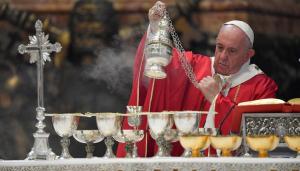
I urge the faithful, to pray fervently for Pope Francis, the Bishops and priests. At the same time, in accord with can. 212, §3, “[a]ccording to the knowledge, competence, and prestige which they possess, they have the right and even at times the duty to manifest to the sacred pastors their opinion on matters which pertain to the good of the Church and to make their opinion known to the rest of the Christian faithful, without prejudice to the integrity of faith and morals, with reverence toward their pastors, and attentive to common advantage and the dignity of persons.” Finally, in gratitude to Our Lord for the Sacred Liturgy, the greatest gift of Himself to us in the Church, may they continue to safeguard and cultivate the ancient and ever new More Ancient Usage or Extraordinary Form of the Roman Rite.
-Raymond Leo Cardinal Burke Statement on the Motu Proprio «Traditionis Custodes» – Cardinal Raymond Burke (cardinalburke.com)

Traditionis Custodes is a reminder that as a whole the Eucharist must be celebrated in a manner that draws the faithful into the Mystery of God. It must be celebrated reverently and beautifully regardless of language or Missal.
Pope Francis has not banned the Latin Mass.
Those who are weeping and disgracefully disparaging Pope Francis must have not read the document. The same goes for those who see this as a victory over those who prefer the Extraordinary Form. The document is brief and direct, it’s worth a read. Father Pablo Migone, Pope Francis, Traditionis Custodes, and the Latin Mass (patheos.com)

Browse Our Archives
Select a Category 1889 abortion adoption Advent After Life Angles apologetics Art Awards BCCT bible book review books business Carmelite Catechetics Catholic Actors catholic authors Catholic Bard Catholic Faith Catholic List Catholic Rigorous Vortex Christian Authors Christmas church teaching civil conversation coronavirus Current Events death Different Religions Divine Mercy Easter Education encouragment Entertainment Eucharist Evangelization Event faith Family Life famous people feast day food Fun Stuff Global Church God guest post Harry Potter healing Heck of a Ride Around the Sun history holiday Holy Family Holy Orders Holy Spirit Holy Week hope Humor Interview Ireland Jesus kindle unlimited reflections Last Things Lecto Divina with Kristin Lent Lent/Easter liturgy love marriage Mary Meet the Author Mission Month in Advance Movie Review Movies Movies of the Month Music Narrative Older Writings patheos authors personal Philosophy podcasts poetry political Politics pope prayer Private Revelation pro-life public domain Quotes racial relations racism reflection Religious Life Saints science Scriptural Meditation social justice Social Media spirituality suffering supernatural theology Topics Travel Trivia Tweeting to the Choir Uncategorized universal church Vatican virtue war Week in Review women world religions writing Writing Write Now
Select a Month October 2026 September 2026 August 2026 July 2026 June 2026 May 2026 April 2026 March 2026 February 2026 January 2026 December 2025 November 2025 October 2025 September 2025 August 2025 July 2025 June 2025 May 2025 April 2025 March 2025 February 2025 January 2025 December 2024 November 2024 October 2024 September 2024 August 2024 July 2024 June 2024 May 2024 April 2024 March 2024 February 2024 January 2024 December 2023 November 2023 October 2023 September 2023 August 2023 July 2023 June 2023 May 2023 April 2023 March 2023 February 2023 January 2023 December 2022 November 2022 October 2022 September 2022 August 2022 July 2022 June 2022 May 2022 April 2022 March 2022 February 2022 January 2022 December 2021 November 2021 October 2021 September 2021 August 2021 July 2021 June 2021 May 2021 April 2021 March 2021 February 2021 January 2021 December 2020 November 2020 October 2020 September 2020 August 2020 July 2020 June 2020 May 2020
Follow Us!
TAKE THE
Religious Wisdom Quiz
This chapter in Psalms declares the blessed man who meditates on God's law day and night is like a tree planted by streams. What is its number?
Select your answer to see how you score.
Psalm 100 Psalm 1 Psalm 119 Psalm 23
Books by This Author Books by Catholic Bard
Related posts from Catholic Bard
Catholic Teaching On Tough Issues
Was 'Rededicate 250' Really One Nation Under God?

Latest News That Doesn't Involve Trump
Can You Disagree With Someone And Still Like...
TRENDING AT PATHEOS Catholic

'The Chosen' S6 Trailer: The Passion Gets Very...
Not many watching 'The Chosen' worry about spoilers, but just because they...

The purpose-driven labor priest
A labor activist reads Rick Warren and it gets me wondering about...

The Golden Rule Demands More than We Think
Everyone is related, and everything is connected. That sets a high standard...

What Will We Be Able to do on...
The term perfect is often misused when it describes our state in...

‘Conceivable’ Opens Friday: Faith, Family & a Surprise...
A new faith-based drama inspired by a true story opens in theaters...
Pope Leo has Lung Cancer. We Need Him...
I’ve been caught up with a conundrum in my own life and...
view all Catholic blogs
Ad-Free & Subscriber Log-In Subscription Support
- About Us
- 2026 Calendar
- Videos
- Podcasts
- Library of World Religions
- Faith In Media Tracker
- Advertise With Us
- Write for Us
- Privacy Policy
- Terms of Service
- Do Not Sell My Data
- Contact Us
- Radiant Digital
- Manage Newsletter Subscriptions
- Unsubscribe From Notifications
- Sitemap
Copyright 2008-2026, Patheos. All rights reserved.
Subscription Support Ad-Free & Subscriber Log-In
Follow Patheos