
BuddhistCatholicContemplativeEvangelicalGeneral ChristianHinduJewishLatter-day SaintMuslimNew VisionsProgressive Christian
Beliefs
- Buddhist
- Catholic
- Contemplative
- Evangelical
- General Christian
- Hindu
- Jewish
- Latter-day Saint
- More Voices
- Muslim
- New Visions
- Pagan
- Progressive Christian
Topics
- Religion News
- Food and Religion
- Sports and Religion
- Religious Art
- Religious Music and Entertainment
- Religious Events
- History and Religion
- Style and Religion
- Politics and Religion
- Women in Religion
- Recreation Outdoors and Religion
- Business Finance and Religion
- Careers Workplace and Religion
- Education and Religion
- Family Parenting and Religion
- Health Fitness and Religion
- Home and Religion
- Relationships and Religion
- Technology and Religion
- Travel and Religion
Columnists
- Buddhist Columnists
- Business Finance and Religion Columnists
- Careers Workplace and Religion Columnists
- Catholic Columnists
- Contemplative Columnists
- Education and Religion Columnists
- Evangelists Columnists
- Family Parenting and Religion Columnists
- General Christian Columnists
- Health Fitness and Religion Columnists
- Hindu Columnists
- History and Religion Columnists
- Home and Religion Columnists
- Jewish Columnists
- More Voices Columnists
- Latter Day Columnists
- Muslim Columnists
- New Visions Columnists
- Nonreligious Columnists
- Pagan Columnists
- Politics and Religion Columnists
- Progressive Columnists
- Recreation Outdoors and Religion Columnists
- Relationships and Religion Columnists
- Religion News Columnists
- Religious Art Columnists
- Religious Events Columnists
- Religious Music and Entertainment Columnists
- Sports and Religion Columnists
- Style and Religion Columnists
- Technology and Religion Columnists
- Travel and Religion Columnists
- Women in Religion Columnists
Resource Library
- 2026 Calendar
- Library of World Religions
- The 100 Most Holy Places on Earth
- Patheos Answers
- Podcasts
- Videos
- Faith Leaders Database
- Anglican Episcopalian
- Bahai
- Baptist
- Buddhism
- Christianity
- Confucianism
- Eastern Orthodoxy
- Hinduism
- Holiness and Pentecostal
- ISKCON
- Islam
- Judaism
- Lutheran
- Methodist
- The Church of Jesus Christ of Latter-day Saints
- New Age
- Paganism
- Presbytarian and Reformed
- Protestantism
- Religion Behind the Scenes
- Roman Catholic
- Scientology
- Shia Islam
- Sikhism
- Sufism
- Sunni Islam
- Taoism
- Zen
- See all religions
Research Tools
 Ad-Free & Subscriber Log-In Subscription Support
Ad-Free & Subscriber Log-In Subscription Support
Follow Patheos 

- Trending:
- Forgiveness
- |
- Marriage
- |
- Consciousness
- |
- Death Penalty
- |
- Election
- |
- Halloween
 Catholic Authenticity
-
Categories
- Home
- Catholic
- A Monstrous Monstrance, or Why Does Religion Suck?
A Monstrous Monstrance, or Why Does Religion Suck?
Last updated on: August 12, 2018 at 2:42 pm by Melinda Selmys
A Monstrous Monstrance, or Why Does Religion Suck? 2018-08-12T14:42:29-04:00 Melinda Selmys
Patheos Explore the world's faith through different perspectives on religion and spirituality! Patheos has the views of the prevalent religions and spiritualities of the world.
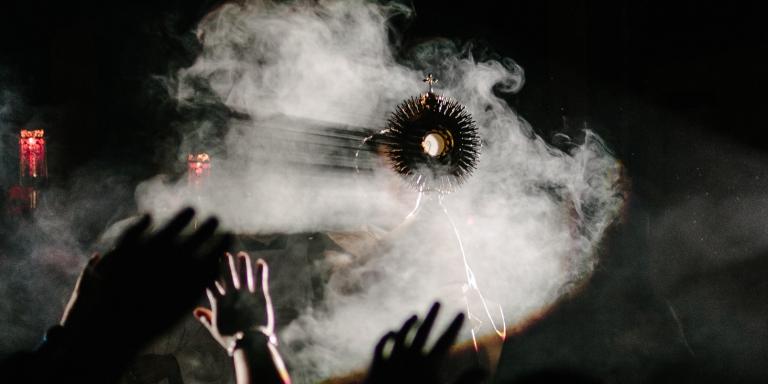
Writing about God is difficult. It’s almost as hard as writing a good sex scene. You can write about the idea of God, of course. You can defend God. Argue in favour of God’s existence. Argue endlessly about what God would probably want if He showed up and weighed in on the state of the modern world. It’s easy to write around God. But to write about God is a different thing.
Because God isn’t a concept, an idea, a champion or a moralizer. God is God. He is simultaneously so completely Other that anything we say about Him is kind of laughable and cartoonish. Even something like the use of male pronouns is misleading – though the use of female pronouns or impersonal pronouns would just be misleading in a different way. Any statement that we make about God, any analogy that we draw, is going to be more unlike than like God.
And yet, at the same time, all of the analogies do contain some truth.
I was thinking about this a while ago when I was in Eucharistic adoration. It was hard to go. I was angry at the Church about a lot of things and of course some of that anger had transferred over to God. But I figured if nothing else, it would be a silent moment in a place that had been dedicated for a long time to silence. Even if the Church was corrupt and God didn’t exist, the fact that spaces which are made to be peaceful do, in fact, have a tendency to provoke feelings of peace is a readily observable, empirical fact.
So I went in and knelt down and there was that immediate sensation of a weight being taken off my shoulders. Muscles that I didn’t even know had been tensed up starting to relax. God asked if I was happy if I had come, and I thought about that for a while before I answered. It was odd because the sense of peace, being in the presence of the Eucharist, came freighted with a whole bunch of irritations – things that were triggering me. Finally I got it down to a coherent thought, “I love you,” I said, addressing the blank, pale, impenetrable host, “but the monstrance is really bothering me.”
It wasn’t that the monstrance in this particular chapel was an especially egregious specimen. It was very normal really: lots of gold, little ceramic portraits of the apostles, rays shaped like a sun. But it seemed like a distraction, like if you put a sublimely beautiful abstract into a clunky, overwrought gold frame. The beauty of the Eucharist lay in that elegant simplicity, its resemblance to a screen where all of the projections that we put on God go to die. The monstrance just seemed like it was trying to tell a story, to build up a series of associations and meanings that clustered around the central mystery, obscuring and in a sense even overawing truth. It suggested that the Eucharist would not attract or hold anybody’s attention if you didn’t artificially wreath it in glitz.
The thing is, if you spend time with God (and this is one of the reasons why I think God is real), there’s a way in which your view of things slowly transforms. In my experience, it slowly transforms into a view that is softer, more forgiving, more tolerant. I believe that God very deeply loves His creation, and that His love is not narcissistic or controlling. I think He’s the kind of father who walks in on the kids happily making a mess in the dining room, and who doesn’t say “What are you doing? Clean that up! You’ve ruined the furniture!” but “Let me see what you’ve painted. Tell me about your game.”
So, slowly, being there just sort of resting in His presence, I started to see the monstrance differently. At first, He gently directed my thoughts towards the artist who had made it. Somebody had put time and thought and effort, and love, into creating this golden monstrosity. And they had done it because they wanted in their hackneyed way to give to glory to God. I could relate to that. I wanted that too, for my art. And I wanted God to be happy to be shown forth in the bizarre monstrances that I create for Him out of words.
That softened me a lot. But the meditation went further. There were people too who worked and had given their money to buy the gold and to pay the artist. Maybe some of them had been wealthy and wanted to show off their wealth. But maybe they had been poor too. And perhaps that didn’t matter all that much: either way, they wanted to make something beautiful for God and they gave the work of their hands to do it. Another thing I could respect.
And so it went, God slowly revealing the monstrance as humanity striving after God, surrounding him with overwrought arguments and gilded promises. Putting ourselves constantly into the picture, trying to gain credibility by proximity to Him. But at the same time, trying to hold up this weightless weight that we do not at all understand, that we simultaneously love and fear, that we cannot control – not even as an object of intellectual appropriation. This Other.
This Other who is as intimate as our inmost selves. Who we must explain, and cannot.
The monstrance is, in a sense, my hands trying to hold up God and make Him visible.
And in doing so, of course there are these places where my fingers get in the way, just like the golden rays of the monstrance obscure parts of the host. Of course there is a reflective pane of glass in front of the mystery, holding it in, trying to keep it safe. But the purpose for all of that, when it comes down to it, is not a craving to clutch and hold the Eucharist as my very own, a need to distract from it with vainglorious flourishes, or a desire to see my own reflection when I try to look at Christ. Those things happen because I am human, because my own subjectivity is the glass through which I see darkly. But they are not the true and secret desire of my heart.
What I desire is that God that I cannot hold, control and tame. What I want is that intimate communion with not-me. The fact that I am always getting in the way is a frustration, not a feature.
But knowing that of myself makes it easier, then, to have compassion for all of the other humans whose striving to know God and, God help us, to portray the God we are trying to know. The monstrance is wealth seeking to draw attention to a mystery that looks like a poor-man’s bread. It is art trying to illustrate the inner radiance of something that appears to be a cracker. It is religion attempting to illuminate the fantastic truth of a God who is here, really present, in the most intimate way, in the simplest realities that sustain our lives. It is theology and philosophy building up clunky towers of inadequate words in an attempt to describe the indescribable.
To hold the monstrance in contempt is, in effect, to condemn humanity. But that is not, I think, how God sees it. I don’t think He sees our condition as essentially pitiable, broken, inadequate. I don’t think God is ashamed to be held up for veneration by our childish attempts to represent glory. I think that while He certainly corrects our efforts, helps us grow so that we can better express this painful and wondrous beauty that we find without us and within, none the less He is not a critic. He is a parent. And He loves the way that we reach up with our dirty little hands to touch His face.
Image credit: pixabay
Stay in touch! Like Catholic Authenticity on Facebook:
Previous Post

July 31, 2018
Humanae Vitae and the Scandal of Abuse
Next Post
August 23, 2018 Is There A Gay Problem in the Priesthood?
Browse Our Archives
Select a Category Abuse Beauty Charity Chastity Current Events Faith Family Feminism Fiction Humility Humour Identity Justice Perseverence Philosophy Poverty Sexuality trauma Uncategorized Virtues Wombats
Select a Month February 2020 November 2019 October 2019 August 2019 July 2019 June 2019 May 2019 April 2019 March 2019 February 2019 October 2018 September 2018 August 2018 July 2018 June 2018 May 2018 April 2018 March 2018 February 2018 January 2018 December 2017 November 2017 October 2017 September 2017 August 2017 July 2017 June 2017 May 2017 April 2017 March 2017 February 2017 January 2017 December 2016 November 2016 October 2016 September 2016 August 2016 July 2016 June 2016 May 2016 April 2016 March 2016 February 2016 January 2016 December 2015 November 2015 October 2015 September 2015 August 2015 July 2015 June 2015
Follow Us!
TAKE THE
Religious Wisdom Quiz
I asked for wisdom above all else, and God granted me riches and honor as well. Who am I?
Select your answer to see how you score.
Solomon Hezekiah Josiah David
Books by This Author Books by Melinda Selmys
Support this
Column


Related posts from Catholic Authenticity

The Lord Has Worked Marvels For Me: Open...

The Central Spiritual Struggle of Women: Open Letter,...

An Open Letter to the Young Rad-Trad Women

Maybe It's Okay That Man Should Be Alone
TRENDING AT PATHEOS Catholic

Rejecting Doom: Christian Hope And Human Action
Christianity is a religion of hope. We are to have hope and...

It’s What Comes From Within Which Matters
One of the most difficult things for us to understand is why...

Why I Choose the Eucharist Over the Sermon
Choose the Eucharist, Not the Sermon What are we supposed to get...

5 Design Elements Found in Spiritually Rooted Homes
Putting Spirituality Into Home Decor Our homes are more than our living...

Credo: A Story of God Told with the...
About 10 years ago, I began to imagine a personal "Credo" that...

The Anatomy of Divine Revelation in Catholic Thought
The claim that God has made Himself known to human beings is...
view all Catholic blogs
Ad-Free & Subscriber Log-In Subscription Support
- About Us
- 2026 Calendar
- Videos
- Podcasts
- Library of World Religions
- Faith In Media Tracker
- Advertise With Us
- Write for Us
- Privacy Policy
- Terms of Service
- Do Not Sell My Data
- Contact Us
- Radiant Digital
- Manage Newsletter Subscriptions
- Unsubscribe From Notifications
- Sitemap
Copyright 2008-2026, Patheos. All rights reserved.
Subscription Support Ad-Free & Subscriber Log-In
Follow Patheos