
BuddhistCatholicContemplativeEvangelicalGeneral ChristianHinduJewishLatter-day SaintMuslimNew VisionsProgressive Christian
Beliefs
- Buddhist
- Catholic
- Contemplative
- Evangelical
- General Christian
- Hindu
- Jewish
- Latter-day Saint
- More Voices
- Muslim
- New Visions
- Pagan
- Progressive Christian
Topics
- Religion News
- Food and Religion
- Sports and Religion
- Religious Art
- Religious Music and Entertainment
- Religious Events
- History and Religion
- Style and Religion
- Politics and Religion
- Women in Religion
- Recreation Outdoors and Religion
- Business Finance and Religion
- Careers Workplace and Religion
- Education and Religion
- Family Parenting and Religion
- Health Fitness and Religion
- Home and Religion
- Relationships and Religion
- Technology and Religion
- Travel and Religion
Columnists
- Buddhist Columnists
- Business Finance and Religion Columnists
- Careers Workplace and Religion Columnists
- Catholic Columnists
- Contemplative Columnists
- Education and Religion Columnists
- Evangelists Columnists
- Family Parenting and Religion Columnists
- General Christian Columnists
- Health Fitness and Religion Columnists
- Hindu Columnists
- History and Religion Columnists
- Home and Religion Columnists
- Jewish Columnists
- More Voices Columnists
- Latter Day Columnists
- Muslim Columnists
- New Visions Columnists
- Nonreligious Columnists
- Pagan Columnists
- Politics and Religion Columnists
- Progressive Columnists
- Recreation Outdoors and Religion Columnists
- Relationships and Religion Columnists
- Religion News Columnists
- Religious Art Columnists
- Religious Events Columnists
- Religious Music and Entertainment Columnists
- Sports and Religion Columnists
- Style and Religion Columnists
- Technology and Religion Columnists
- Travel and Religion Columnists
- Women in Religion Columnists
Resource Library
- 2026 Calendar
- Library of World Religions
- The 100 Most Holy Places on Earth
- Patheos Answers
- Podcasts
- Videos
- Faith Leaders Database
- Anglican Episcopalian
- Bahai
- Baptist
- Buddhism
- Christianity
- Confucianism
- Eastern Orthodoxy
- Hinduism
- Holiness and Pentecostal
- ISKCON
- Islam
- Judaism
- Lutheran
- Methodist
- The Church of Jesus Christ of Latter-day Saints
- New Age
- Paganism
- Presbytarian and Reformed
- Protestantism
- Religion Behind the Scenes
- Roman Catholic
- Scientology
- Shia Islam
- Sikhism
- Sufism
- Sunni Islam
- Taoism
- Zen
- See all religions
Research Tools
 Ad-Free & Subscriber Log-In Subscription Support
Ad-Free & Subscriber Log-In Subscription Support
Follow Patheos 

- Trending:
- Forgiveness
- |
- Marriage
- |
- Consciousness
- |
- Death Penalty
- |
- Election
- |
- Halloween
 Catholic Authenticity
-
Categories
- Home
- Catholic
- Addicted to Patriarchy: Infallibility IV
Addicted to Patriarchy: Infallibility IV
Last updated on: August 17, 2017 at 12:35 pm by Melinda Selmys
Addicted to Patriarchy: Infallibility IV 2017-08-17T12:35:55-04:00 Melinda Selmys
Patheos Explore the world's faith through different perspectives on religion and spirituality! Patheos has the views of the prevalent religions and spiritualities of the world.
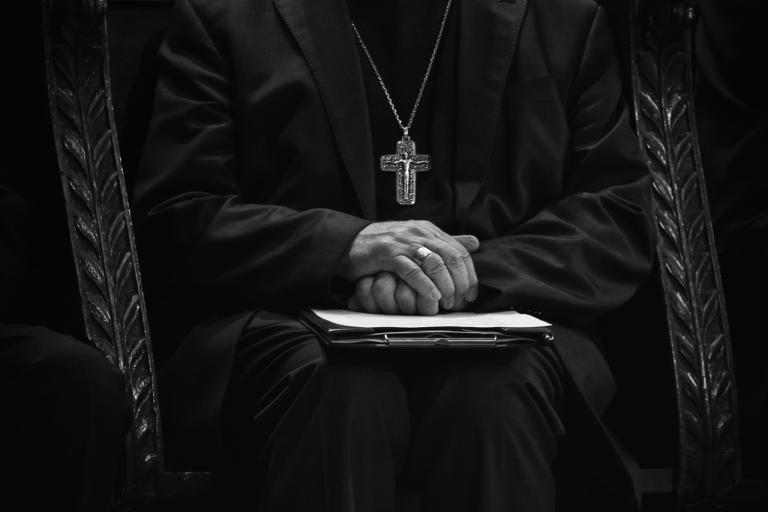
I mentioned yesterday that I see the relationship between the Catholic laity and the hierarchy as being like a marriage…and that it is this relationship between myself and the Church that is the most conflicted.
I’m hardly alone in this. Over the past hundred years or so we’ve seen a massive drop-off in Church attendance in Western countries. Last Sunday, an elderly Priest who used to serve our parish thirty or forty years ago visited and performed the Mass. In his sermon he mentioned that probably there was something going on that weekend to explain the scarcity of bodies in the pews. I don’t think anybody had the heart to tell him that it was a pretty normal turn-out.
Here in Canada, it’s pretty conspicuous that the parishes which are thriving and growing are located in urban centres with large immigrant populations, and that the people filling the pews are not primarily of European descent. In rural areas where the population is mostly white, parishes are at risk of closure, and it’s quite common to have one priest serving several different small congregations.
Back when I was on the conservative Catholic bandwagon, I didn’t see this as cause for alarm: Western society was decadent, and the hope for the Church lay in places like Africa, Asia and South America. What I didn’t notice at the time is that this vision is actually severely problematic: Western culture is the culture that has been most informed by Christianity for the longest period of time. Ideas which had their origins in Christian thought (compassion for the marginalized, and the universal dignity of humankind, for instance) have put down deeper roots in the West than anywhere else in the world.
And the reasons for the Western rejection of the Church derive pretty directly from these fundamental Christian principles.
This leaves us with the unsettling probability that the reason the Church is growing in cultures that are more patriarchal and more authoritarian, and dying in cultures that are democratic and egalitarian, is that values like democracy and equality are not especially compatible with a religious system where power is exercised by a hierarchical elite that is open only to men. Meaning that if Christian development efforts in poorer countries continue to promote values like participatory government and women’s education, we should expect to see a trajectory similar to what we’ve seen in Europe.
The standard conservative line is to point the finger at feminism, but this ignores the historical fact that the present crisis in the Church derives just as much (if not more) from democracy as from the emancipation of women. It ignores the fact that in spite of the Church’s patriarchal structure, women continue to attend at a higher rate than men. And it fails to acknowledge that if you drove all of the feminists out of the Church, an awful lot of parishes, several religious orders, and probably at least a couple of dioceses, would simply crumble – because feminists do an awful lot of essential, on-the-ground, parish-level work that conservative men are actually not willing to do.
Besides which, in any case, the Church actually acknowledges that participatory government is a good thing, and that the inclusion of women as equals in society is both necessary and just. It is simply neither true, nor responsible, to behave as though the nasty secular West is completely wrong about everything and is destroying the Church. This kind of finger-pointing did not impress God in Eden, and I very much doubt that it impresses Him now.
Which brings me back to the analogy to marriage.
Within the Church, we have two groups of adults who exist in relationship with one another. It’s a mutual relationship which requires the participation of both groups: just as a man without a spouse is not a husband, a group of celibate guys without a community to minister to is not a priesthood. Conversely, a group of lay people who operate without a priestly class is not the same thing as a church. The laity and the hierarchy exist in a complementary, reciprocal relationship much like a husband and wife.
But here’s the thing. We no longer believe in the obedient submission of woman to man in marriage. For the better part of two-thousand years, Christian commentators (almost all of them male) interpreted the words of Genesis 3 as a normative command: “From now on, your husband will have the right to lord it over you.” But that’s not what it says. John Paul II points out that Gen 3:16 is a curse, a description of how human relations are broken by sin, not an expression of God’s will. Instead, JPII proposes a model of mutual subjugation in which both parties submit to one another as equals.
If male domination of women is a curse, then it is reasonable to treat its expressions in the same way that we treat the weeds and thistles that grow in our fields. Id est, pull them out by the root.
This, however, presents some serious issues in terms of the Church’s hierarchical patriarchy. St. Paul, significantly, tells the Corinthians that he does not wish to “lord it over” their faith (cf. 2 Cor 1:24). He seems to see that there is a possibility for clerics to engage in the same kind of dynamic of domination that Genesis 3 predicts, and he makes it clear that he rejects this kind of domineering authority.
And to be honest, I think the Church’s hierarchy has started to realize that they do, in fact, have a problem with clericalism and male-domination. Since Vatican II there has been a lot of ink spilled over the question of how to include lay people, and particularly women, within the power structures of the Church. It’s been thought about and talked about a lot. Implementation on the other hand…well, it’s been slow.
Now, this is very similar to the situation that we see in marriages. Even men who claim to be in favour of women’s equality often seem to find it very difficult to let go of masculine privilege. We know that women continue to be primarily responsible for childcare, and primarily responsible for house-keeping, even when they are making just as much as, or more than, their male spouses. We also know that in settings where efforts are made to ensure that women get as much time to speak as their male counterparts, males will perceive the women as having dominated the conversation – even though, objectively, both sexes spoke for exactly the same amount of time. And I often find myself in conversations with men who just don’t seem to be able to comprehend that equality between women and men in marriage is not matriarchy, nor is it “the woman wearing the pants.” To a lot of men, the idea of having to actually be on equal terms with their wives seems threatening, and they construe a woman’s desire to be treated as an adult human being as a form of arrogant defiance.
It’s worth noting that in such cases if the males in question are religious they are likely to make arguments that their right to domestic superiority derives from God.
This isn’t a problem with males specifically: in any transition from a position of superiority to one of equality, the person or group who is accustomed to holding power will perceive themselves as being forced to make constant sacrifices and accommodations which seem onerous. A common response to this is to seek reciprocation (“I’m being asked to do all of these things for you, so what sacrifices are you going to make?”) as though restorative justice were an act of charity, rather than a balancing of the scales. In most cases, this behaviour is the natural result of those who hold privilege agreeing to equality without realizing just how many invisible benefits they’ve been deriving from an unjust distribution of power.
In the case of the Catholic hierarchy, this is evident to an almost embarrassing degree. Talk of women’s inclusion has not been completely fruitless, but you can feel the institutional inertia grinding away in the background. Even the most low-level forms of inclusion like women having their feet washed are met with staunch opposition from conservative elements within the Church.
More problematically, people at the top of the organizational structure have benefited from the fact that the structure, in its present form, privileges them. They are no more likely to voluntarily reform institutions that give them an advantage than the Liberal Party of Canada is to do away with the First Past the Post electoral system that has consistently delivered them majority governments throughout most of Canada’s history. They might pay lip-service to the need for change in order to secure the continued loyalty of their followers, but they’re very unlikely to ever follow through.
Power is like that. People will generally not give it up unless they have no choice. And we know, from the way that the hierarchy has always behaved in the past when it has lost power, influence or wealth, that the leaders of the Catholic Church are not in any way exempt from this general rule.
For these reasons, and others, I strongly believe that the hierarchy today suffers from a disordered attachment to patriarchal power which is no different from its previous disordered attachments to secular power, land, wealth, vanity and ecclesiastic pomp.
So what’s a Catholic feminist to do?
Image credit: pixabay
Stay in touch! Like Catholic Authenticity on Facebook:
Previous Post

August 16, 2017
The Fractal Church: Infallibility Part III
Next Post

August 24, 2017 Poverty Is Not What Austin Ruse Wants You to Think It Is
Browse Our Archives
Select a Category Abuse Beauty Charity Chastity Current Events Faith Family Feminism Fiction Humility Humour Identity Justice Perseverence Philosophy Poverty Sexuality trauma Uncategorized Virtues Wombats
Select a Month February 2020 November 2019 October 2019 August 2019 July 2019 June 2019 May 2019 April 2019 March 2019 February 2019 October 2018 September 2018 August 2018 July 2018 June 2018 May 2018 April 2018 March 2018 February 2018 January 2018 December 2017 November 2017 October 2017 September 2017 August 2017 July 2017 June 2017 May 2017 April 2017 March 2017 February 2017 January 2017 December 2016 November 2016 October 2016 September 2016 August 2016 July 2016 June 2016 May 2016 April 2016 March 2016 February 2016 January 2016 December 2015 November 2015 October 2015 September 2015 August 2015 July 2015 June 2015
Follow Us!
TAKE THE
Religious Wisdom Quiz
I asked for wisdom above all else, and God granted me riches and honor as well. Who am I?
Select your answer to see how you score.
Solomon Hezekiah Josiah David
Books by This Author Books by Melinda Selmys
Support this
Column


Related posts from Catholic Authenticity

Sex Positive: How I Learned To Stop Worrying...


The Lord Has Worked Marvels For Me: Open...

The Central Spiritual Struggle of Women: Open Letter,...
TRENDING AT PATHEOS Catholic

Rejecting Doom: Christian Hope And Human Action
Christianity is a religion of hope. We are to have hope and...

It’s What Comes From Within Which Matters
One of the most difficult things for us to understand is why...

Why I Choose the Eucharist Over the Sermon
Choose the Eucharist, Not the Sermon What are we supposed to get...

5 Design Elements Found in Spiritually Rooted Homes
Putting Spirituality Into Home Decor Our homes are more than our living...

Credo: A Story of God Told with the...
About 10 years ago, I began to imagine a personal "Credo" that...

The Anatomy of Divine Revelation in Catholic Thought
The claim that God has made Himself known to human beings is...
view all Catholic blogs
Ad-Free & Subscriber Log-In Subscription Support
- About Us
- 2026 Calendar
- Videos
- Podcasts
- Library of World Religions
- Faith In Media Tracker
- Advertise With Us
- Write for Us
- Privacy Policy
- Terms of Service
- Do Not Sell My Data
- Contact Us
- Radiant Digital
- Manage Newsletter Subscriptions
- Unsubscribe From Notifications
- Sitemap
Copyright 2008-2026, Patheos. All rights reserved.
Subscription Support Ad-Free & Subscriber Log-In
Follow Patheos