
BuddhistCatholicContemplativeEvangelicalGeneral ChristianHinduJewishLatter-day SaintMuslimNew VisionsProgressive Christian
Beliefs
- Buddhist
- Catholic
- Contemplative
- Evangelical
- General Christian
- Hindu
- Jewish
- Latter-day Saint
- More Voices
- Muslim
- New Visions
- Pagan
- Progressive Christian
Topics
- Religion News
- Food and Religion
- Sports and Religion
- Religious Art
- Religious Music and Entertainment
- Religious Events
- History and Religion
- Style and Religion
- Politics and Religion
- Women in Religion
- Recreation Outdoors and Religion
- Business Finance and Religion
- Careers Workplace and Religion
- Education and Religion
- Family Parenting and Religion
- Health Fitness and Religion
- Home and Religion
- Relationships and Religion
- Technology and Religion
- Travel and Religion
Columnists
- Buddhist Columnists
- Business Finance and Religion Columnists
- Careers Workplace and Religion Columnists
- Catholic Columnists
- Contemplative Columnists
- Education and Religion Columnists
- Evangelists Columnists
- Family Parenting and Religion Columnists
- General Christian Columnists
- Health Fitness and Religion Columnists
- Hindu Columnists
- History and Religion Columnists
- Home and Religion Columnists
- Jewish Columnists
- More Voices Columnists
- Latter Day Columnists
- Muslim Columnists
- New Visions Columnists
- Nonreligious Columnists
- Pagan Columnists
- Politics and Religion Columnists
- Progressive Columnists
- Recreation Outdoors and Religion Columnists
- Relationships and Religion Columnists
- Religion News Columnists
- Religious Art Columnists
- Religious Events Columnists
- Religious Music and Entertainment Columnists
- Sports and Religion Columnists
- Style and Religion Columnists
- Technology and Religion Columnists
- Travel and Religion Columnists
- Women in Religion Columnists
Resource Library
- 2026 Calendar
- Library of World Religions
- The 100 Most Holy Places on Earth
- Patheos Answers
- Podcasts
- Videos
- Faith Leaders Database
- Anglican Episcopalian
- Bahai
- Baptist
- Buddhism
- Christianity
- Confucianism
- Eastern Orthodoxy
- Hinduism
- Holiness and Pentecostal
- ISKCON
- Islam
- Judaism
- Lutheran
- Methodist
- The Church of Jesus Christ of Latter-day Saints
- New Age
- Paganism
- Presbytarian and Reformed
- Protestantism
- Religion Behind the Scenes
- Roman Catholic
- Scientology
- Shia Islam
- Sikhism
- Sufism
- Sunni Islam
- Taoism
- Zen
- See all religions
Research Tools
 Ad-Free & Subscriber Log-In Subscription Support
Ad-Free & Subscriber Log-In Subscription Support
Follow Patheos 

- Trending:
- Forgiveness
- |
- Marriage
- |
- Consciousness
- |
- Death Penalty
- |
- Election
- |
- Halloween
 Catholic Authenticity
-
Categories
- Home
- Catholic
- Review: My Life with the Saints (by Fr. James Martin)
Review: My Life with the Saints (by Fr. James Martin)
Last updated on: March 27, 2017 at 11:56 am by Melinda Selmys
Review: My Life with the Saints (by Fr. James Martin) 2017-03-27T11:56:42-04:00 Melinda Selmys
Patheos Explore the world's faith through different perspectives on religion and spirituality! Patheos has the views of the prevalent religions and spiritualities of the world.
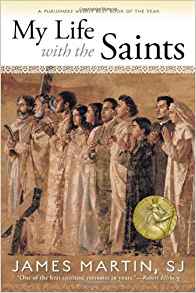
I’m usually not a big fan of contemporary writing about the Saints. I like the Golden Legend, not because I believe the stories but because it’s a great read and it offers a fascinating glimpse into Medieval Christianity. I enjoy St. Jerome’s outlandish tales of garish martyrdoms. I tolerate Butler’s because it’s the book about the Saints. But I’ll be honest, for the most part when I want to know who the patron Saint of gardening is so that I’ll have a middle name for a baby whose birth was induced by hilling potatoes, I mostly just rely on Wikipedia.
So I picked up Fr. James Martin’s My Life with the Saints more because of the author than because of the subject matter. I’d seen enough of Fr. Martin’s work elsewhere to feel reasonably confident that I would be interested in what he had to say. The promise of a book that dealt as much with the author’s relationship with the Saints as with the holy men and women themselves also appealed to me.
The main difficulty that I usually have with books about the Saints is that they tend to appeal to a fairly sentimentally pious demographic. There’s nothing wrong with that, per se. The preference for sentimentality in art, including religious art, is not inherently inferior (or inherently superior) to a preference for ethereal creepiness or hard-nosed realism. Some people like Precious Moments and love to hear “On Eagle’s Wings.” Others prefer ossuaries and “Let All Mortal Flesh Keep Silence”. These are aesthetic, not moral, differences.
I just don’t happen to have much of a spiritual sweet-tooth, and I find that most writing about the Saints is not to my taste.
Fr. Martin’s book is therefore refreshing. It’s not overly pious. It’s not gimmicky. There’s no cute premise. It’s just a book about the holy people who have inspired him. The stories of their lives are interwoven with memoir, so you get a balance that makes the Saints easier to relate to.
For example, in the chapter on St. Bernadette he draws attention to the fact that the Saint refused all of the gifts that were offered to her as a result of her visions. Later, in the same chapter, Martin mentions being invited out to lunch by a reader who wanted him to be chaplain on a pilgrimage to Lourdes. He accepts the invite because he’s “always happy for a free meal.” This counterpoint makes it easier to love Bernadette because it draws attention to the fact that we can admire her virtues, even if they are not identical to our own.
The Saints as Martin portrays them are not perfect airbrushed people immortalized in plaster and placed upon a pedestal. But nor are they gritty, flawed, semi-neurotic people with dark secrets. They are just very, very good human beings. By avoiding the excesses of pious legend Martin is able to show how heroic virtue can manifest in people who are not superhuman.
To me, this is the most important achievement of this book. Too often, the Saints come across as being a different order of being. They are too idealized, and so they can only ever be lionized or crucified. We can’t relate to them as friends, only as ideals.
Instead of idolizing the Saints, Martin sympathizes with them. He imagines what some of their trials must have been like, and instead of focusing only on the grand theatrical struggles he enters into their little day-to-day frustrations. This makes it easier to imagine how we might imitate someone like Joan of Arc, or Therese of Lisieux, or Francis of Assisi. After all, most of us are not called to the convent at 14. We don’t hear voices commanding us to lead armies. We aren’t the founders of great religious movements.
We can, on the other hand, imagine the frustration of being snubbed and disposed of by those who we once helped. We all know what it’s like to suffer ingratitude for our labors, or to have people pester us over and over and over again for the same answers to the same questions that we’ve gone over a hundred times. Showing how the Saints bore their little crosses with a combination of patience, good humor, and occasional sharp wit, offers us something that we can actually imitate in our ordinary lives.
Finally, Martin brings all of this together by showing how the Saints have helped him in his own spiritual growth. This means that alongside the fantastic exploits we have the evidence of a much more quotidian type of holiness. Father Martin is someone that we relate to directly. He drives a car, he has ordinary doubts and questions, he gets caught up in silly quibbles about who is going to piously renounce the good room at the retreat house. He has the humility and good humor to recognize his foibles as foibles, without ever droning on self-importantly about what a terrible sinner he is. His memoir illuminates his own personality without being self-indulgent or attention seeking.
By giving us the gift of his own relationship with the Saints, Martin provides us with an invitation. It’s kind of like someone introducing you to a new friend. I found myself softening towards Saints that have always intimidated me, like Ignatius of Loyola, and growing in love towards old friends who have gone before me on the way.
If you’re looking for a pleasant, readable, and relatable introduction to the diversity with which sanctity manifests itself in human lives, this is a book that I would highly recommend.
Stay in touch! Like Catholic Authenticity on Facebook:
Previous Post

March 26, 2017
Do You Have All Six Yet?
Next Post

March 29, 2017 To All You Whiny Snowflakes Who *Need* an Epidural
Browse Our Archives
Select a Category Abuse Beauty Charity Chastity Current Events Faith Family Feminism Fiction Humility Humour Identity Justice Perseverence Philosophy Poverty Sexuality trauma Uncategorized Virtues Wombats
Select a Month February 2020 November 2019 October 2019 August 2019 July 2019 June 2019 May 2019 April 2019 March 2019 February 2019 October 2018 September 2018 August 2018 July 2018 June 2018 May 2018 April 2018 March 2018 February 2018 January 2018 December 2017 November 2017 October 2017 September 2017 August 2017 July 2017 June 2017 May 2017 April 2017 March 2017 February 2017 January 2017 December 2016 November 2016 October 2016 September 2016 August 2016 July 2016 June 2016 May 2016 April 2016 March 2016 February 2016 January 2016 December 2015 November 2015 October 2015 September 2015 August 2015 July 2015 June 2015
Follow Us!
TAKE THE
Religious Wisdom Quiz
What does "Nain" mean in Hebrew?
Select your answer to see how you score.
Land of God Holy place City of refuge Pleasant
Books by This Author Books by Melinda Selmys
Support this
Column


Related posts from Catholic Authenticity

The Lord Has Worked Marvels For Me: Open...

The Central Spiritual Struggle of Women: Open Letter,...

An Open Letter to the Young Rad-Trad Women

Maybe It's Okay That Man Should Be Alone
TRENDING AT PATHEOS Catholic

Rejecting Doom: Christian Hope And Human Action
Christianity is a religion of hope. We are to have hope and...

It’s What Comes From Within Which Matters
One of the most difficult things for us to understand is why...

Why I Choose the Eucharist Over the Sermon
Choose the Eucharist, Not the Sermon What are we supposed to get...

5 Design Elements Found in Spiritually Rooted Homes
Putting Spirituality Into Home Decor Our homes are more than our living...

Credo: A Story of God Told with the...
About 10 years ago, I began to imagine a personal "Credo" that...

The Anatomy of Divine Revelation in Catholic Thought
The claim that God has made Himself known to human beings is...
view all Catholic blogs
Ad-Free & Subscriber Log-In Subscription Support
- About Us
- 2026 Calendar
- Videos
- Podcasts
- Library of World Religions
- Faith In Media Tracker
- Advertise With Us
- Write for Us
- Privacy Policy
- Terms of Service
- Do Not Sell My Data
- Contact Us
- Radiant Digital
- Manage Newsletter Subscriptions
- Unsubscribe From Notifications
- Sitemap
Copyright 2008-2026, Patheos. All rights reserved.
Subscription Support Ad-Free & Subscriber Log-In
Follow Patheos