
BuddhistCatholicContemplativeEvangelicalGeneral ChristianHinduJewishLatter-day SaintMuslimNew VisionsProgressive Christian
Beliefs
- Buddhist
- Catholic
- Contemplative
- Evangelical
- General Christian
- Hindu
- Jewish
- Latter-day Saint
- More Voices
- Muslim
- New Visions
- Pagan
- Progressive Christian
Topics
- Religion News
- Food and Religion
- Sports and Religion
- Religious Art
- Religious Music and Entertainment
- Religious Events
- History and Religion
- Style and Religion
- Politics and Religion
- Women in Religion
- Recreation Outdoors and Religion
- Business Finance and Religion
- Careers Workplace and Religion
- Education and Religion
- Family Parenting and Religion
- Health Fitness and Religion
- Home and Religion
- Relationships and Religion
- Technology and Religion
- Travel and Religion
Columnists
- Buddhist Columnists
- Business Finance and Religion Columnists
- Careers Workplace and Religion Columnists
- Catholic Columnists
- Contemplative Columnists
- Education and Religion Columnists
- Evangelists Columnists
- Family Parenting and Religion Columnists
- General Christian Columnists
- Health Fitness and Religion Columnists
- Hindu Columnists
- History and Religion Columnists
- Home and Religion Columnists
- Jewish Columnists
- More Voices Columnists
- Latter Day Columnists
- Muslim Columnists
- New Visions Columnists
- Nonreligious Columnists
- Pagan Columnists
- Politics and Religion Columnists
- Progressive Columnists
- Recreation Outdoors and Religion Columnists
- Relationships and Religion Columnists
- Religion News Columnists
- Religious Art Columnists
- Religious Events Columnists
- Religious Music and Entertainment Columnists
- Sports and Religion Columnists
- Style and Religion Columnists
- Technology and Religion Columnists
- Travel and Religion Columnists
- Women in Religion Columnists
Resource Library
- 2026 Calendar
- Library of World Religions
- The 100 Most Holy Places on Earth
- Patheos Answers
- Podcasts
- Videos
- Faith Leaders Database
- Anglican Episcopalian
- Bahai
- Baptist
- Buddhism
- Christianity
- Confucianism
- Eastern Orthodoxy
- Hinduism
- Holiness and Pentecostal
- ISKCON
- Islam
- Judaism
- Lutheran
- Methodist
- The Church of Jesus Christ of Latter-day Saints
- New Age
- Paganism
- Presbytarian and Reformed
- Protestantism
- Religion Behind the Scenes
- Roman Catholic
- Scientology
- Shia Islam
- Sikhism
- Sufism
- Sunni Islam
- Taoism
- Zen
- See all religions
Research Tools
 Ad-Free & Subscriber Log-In Subscription Support
Ad-Free & Subscriber Log-In Subscription Support
Follow Patheos 

- Trending:
- Forgiveness
- |
- Marriage
- |
- Consciousness
- |
- Death Penalty
- |
- Election
- |
- Halloween
 Catholic Authenticity
-
Categories
- Home
- Catholic
- Not The Time Or Place: An Open Letter to Elliot Milco
Not The Time Or Place: An Open Letter to Elliot Milco
Last updated on: June 17, 2016 at 8:36 pm by Melinda Selmys
Not The Time Or Place: An Open Letter to Elliot Milco 2016-06-17T20:36:00-04:00 Melinda Selmys
Patheos Explore the world's faith through different perspectives on religion and spirituality! Patheos has the views of the prevalent religions and spiritualities of the world.
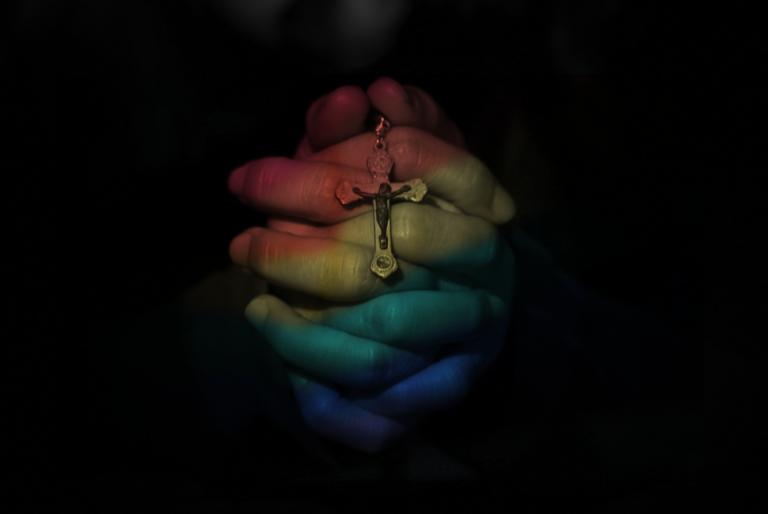
It was less than 24 hours after the Orlando shooting that I saw the first Catholic in a combox complaining about LGBTQ identities. In that case, it was someone scolding my friend Joe Prever for replacing his profile picture with the US flag/rainbow graphic that is currently being used on FaceBook to show solidarity for the victims. The rainbow, it was argued, represented a symbol of an oppressive LGBTQ regime that is undermining the true identity of God’s people.
Today, First Things decided to take up the anthem in a more formal way. Responding to Father James Martin, SJ’s, video criticizing the Catholic bishops for failing to express solidarity specifically for the sufferings of the LGBTQ community at this time, First Things’ deputy editor, Elliot Milco, wrote, “He’s asking, whether or not he realizes it, for the bishops to recognize and tacitly endorse the sexual identities promoted by the LGBT Community—identities bound up fundamentally with the gender ideology promoted by the Community.”
The arguments are painfully familiar: the Church “refuses to mistake the mirage of sin and ideology for the reality of the people it encounters. What it sees is only each child of God: suffering, waiting, longing for absolution, created for the possibility of eternal union with God.”
If a person identifies as LGBTQ, they are identifying with sin, with a false anthropology, with a political enemy with “beliefs, practices, politics, and morals…[that] are fundamentally inimical to the primary end of man.”
I’ve dealt at length, in multiple places, with the question of why a Christian who holds to a traditional sexual ethic, and a traditional Christian anthropology, might identify as LGBTQ. (Here, for example.) I don’t intend to re-present those arguments again now. Rather, I want to point out that there is a profound failure of charity in the fact that this particular line of argumentation is being trotted out at this particular time, in this particular context.
Imagine, to draw an analogy, that a Hindu Temple had been the target of the massacre. Would anyone in the hierarchy have hesitated, for even a moment, in offering solidarity and support to all people of the Hindu faith? Would they have shrunk back from acknowledging Hindus as Hindus, or from recognizing the importance of people’s religious identity in an attack on sacred space?
Obviously, this would not be an issue. Nobody (with the possible exception of a few RadTrads) would be deceived into imagining that an outpouring of sympathy and support would imply, in any sense, that the Catholic hierarchy was now tacitly endorsing the worship of Ganesh. We would all understand the gesture for what it would be: an expression of genuine sympathy and understanding for the suffering that a community endures when many of its members are struck down in cold blood.
Nobody would argue that recognizing Hindus by name would somehow suggest that Catholics are now adopting a Hindu anthropology, that we acknowledge the godhood of Brahma, or espouse the doctrine of reincarnation. When it comes to the First Commandment we are able to recognize that people who worship what we believe to be “false gods” may be people of good will, and that their morality, behaviour, practices, beliefs and communities are legitimate – even though in many important respects they are not compatible with Catholic belief.
So why is it that when it comes to the Sixth Commandment (which is certainly way less essential to Christian anthropology and belief than the first), suddenly it’s a complete non-negotiable? Why is a Hindu allowed to be both a Hindu and a “child of god,” but we can only think of a gay man as one or the other?
Erasing the fact that the attack on the Pulse was likely motivated, at least in part, by religious homophobia is cowardly. As evidence arises to suggest that the killings may have been sparked by internalized homophobia, the Church really needs to be all the more forceful in communicating that homophobic hatred and violence are unacceptable. The Bishops could simply quote from the Vatican’s 1986 Letter on the Pastoral Care of Homosexual Persons.
Such a reference would have acknowledged the grief of the LGBTQ community. It would have meant putting the recommendation of the Letter – to condemn violent malice against gay people – into action. And it would have referred to the established teaching of the Church in a way that would have avoided all possible confusion. The Bishops and the Pope might have said something like this:
The Church wishes to affirm Her continuous teaching, that “It is deplorable that homosexual persons have been and are the object of violent malice in speech or in action. Such treatment deserves condemnation from the Church’s pastors wherever it occurs. It reveals a kind of disregard for others which endangers the most fundamental principles of a healthy society. The intrinsic dignity of each person must always be respected in word, in action and in law.” We offer our condolences and our sympathy to the LGBTQ community in this time of mourning.
Nobody would have misunderstood that, and it would have been classy.
More than just classy, it would have been tremendously important and meaningful to LGBTQ people – especially those who are Catholic, who accept a traditional Christian anthropology, who follow the teachings of the Church, and who are none the less grieving over the deaths of our gay, lesbian, transgender, bisexual, queer and ally siblings.
Instead, we have virtual silence from the hierarchy. We are left to grieve alone, unacknowledged by our spiritual fathers. And we have articles, like this one, that use one of the greatest tragedies ever to strike our community as an opportunity to argue that that community is illegitimate, that it must never be accepted, acknowledged, named.
This is tacky, folks. Uncharitable, callous, “puffed up” to borrow a turn of phrase from St. Paul, but most of all tacky. We’ve heard these arguments before, and we mostly found them harmful. Now that we are grieving, it’s not the time, or the place to bring them up again.
Image credit: Composite, source images courtesy of Pixabay.
Stay in touch! Like Catholic Authenticity on Facebook:
Previous Post

June 15, 2016
Does Religion Cause Hatred?
Next Post

June 17, 2016 Erasing Gay Identities at First Things?
Browse Our Archives
Select a Category Abuse Beauty Charity Chastity Current Events Faith Family Feminism Fiction Humility Humour Identity Justice Perseverence Philosophy Poverty Sexuality trauma Uncategorized Virtues Wombats
Select a Month February 2020 November 2019 October 2019 August 2019 July 2019 June 2019 May 2019 April 2019 March 2019 February 2019 October 2018 September 2018 August 2018 July 2018 June 2018 May 2018 April 2018 March 2018 February 2018 January 2018 December 2017 November 2017 October 2017 September 2017 August 2017 July 2017 June 2017 May 2017 April 2017 March 2017 February 2017 January 2017 December 2016 November 2016 October 2016 September 2016 August 2016 July 2016 June 2016 May 2016 April 2016 March 2016 February 2016 January 2016 December 2015 November 2015 October 2015 September 2015 August 2015 July 2015 June 2015
Follow Us!
TAKE THE
Religious Wisdom Quiz
What was the primary inheritance method in biblical times?
Select your answer to see how you score.
Firstborn son Oldest daughter Youngest child Equal division
Books by This Author Books by Melinda Selmys
Support this
Column


Related posts from Catholic Authenticity

Sex Positive: How I Learned To Stop Worrying...


A Biblical Account of Toxic Femininity

TRENDING AT PATHEOS Catholic

Rejecting Doom: Christian Hope And Human Action
Christianity is a religion of hope. We are to have hope and...

It’s What Comes From Within Which Matters
One of the most difficult things for us to understand is why...

Why I Choose the Eucharist Over the Sermon
Choose the Eucharist, Not the Sermon What are we supposed to get...

5 Design Elements Found in Spiritually Rooted Homes
Putting Spirituality Into Home Decor Our homes are more than our living...

Credo: A Story of God Told with the...
About 10 years ago, I began to imagine a personal "Credo" that...

The Anatomy of Divine Revelation in Catholic Thought
The claim that God has made Himself known to human beings is...
view all Catholic blogs
Ad-Free & Subscriber Log-In Subscription Support
- About Us
- 2026 Calendar
- Videos
- Podcasts
- Library of World Religions
- Faith In Media Tracker
- Advertise With Us
- Write for Us
- Privacy Policy
- Terms of Service
- Do Not Sell My Data
- Contact Us
- Radiant Digital
- Manage Newsletter Subscriptions
- Unsubscribe From Notifications
- Sitemap
Copyright 2008-2026, Patheos. All rights reserved.
Subscription Support Ad-Free & Subscriber Log-In
Follow Patheos