
BuddhistCatholicContemplativeEvangelicalGeneral ChristianHinduJewishLatter-day SaintMuslimNew VisionsProgressive Christian
Beliefs
- Buddhist
- Catholic
- Contemplative
- Evangelical
- General Christian
- Hindu
- Jewish
- Latter-day Saint
- More Voices
- Muslim
- New Visions
- Pagan
- Progressive Christian
Topics
- Religion News
- Food and Religion
- Sports and Religion
- Religious Art
- Religious Music and Entertainment
- Religious Events
- History and Religion
- Style and Religion
- Politics and Religion
- Women in Religion
- Recreation Outdoors and Religion
- Business Finance and Religion
- Careers Workplace and Religion
- Education and Religion
- Family Parenting and Religion
- Health Fitness and Religion
- Home and Religion
- Relationships and Religion
- Technology and Religion
- Travel and Religion
Columnists
- Buddhist Columnists
- Business Finance and Religion Columnists
- Careers Workplace and Religion Columnists
- Catholic Columnists
- Contemplative Columnists
- Education and Religion Columnists
- Evangelists Columnists
- Family Parenting and Religion Columnists
- General Christian Columnists
- Health Fitness and Religion Columnists
- Hindu Columnists
- History and Religion Columnists
- Home and Religion Columnists
- Jewish Columnists
- More Voices Columnists
- Latter Day Columnists
- Muslim Columnists
- New Visions Columnists
- Nonreligious Columnists
- Pagan Columnists
- Politics and Religion Columnists
- Progressive Columnists
- Recreation Outdoors and Religion Columnists
- Relationships and Religion Columnists
- Religion News Columnists
- Religious Art Columnists
- Religious Events Columnists
- Religious Music and Entertainment Columnists
- Sports and Religion Columnists
- Style and Religion Columnists
- Technology and Religion Columnists
- Travel and Religion Columnists
- Women in Religion Columnists
Resource Library
- 2026 Calendar
- Library of World Religions
- The 100 Most Holy Places on Earth
- Patheos Answers
- Podcasts
- Videos
- Faith Leaders Database
- Anglican Episcopalian
- Bahai
- Baptist
- Buddhism
- Christianity
- Confucianism
- Eastern Orthodoxy
- Hinduism
- Holiness and Pentecostal
- ISKCON
- Islam
- Judaism
- Lutheran
- Methodist
- The Church of Jesus Christ of Latter-day Saints
- New Age
- Paganism
- Presbytarian and Reformed
- Protestantism
- Religion Behind the Scenes
- Roman Catholic
- Scientology
- Shia Islam
- Sikhism
- Sufism
- Sunni Islam
- Taoism
- Zen
- See all religions
Research Tools
 Ad-Free & Subscriber Log-In Subscription Support
Ad-Free & Subscriber Log-In Subscription Support
Follow Patheos 

- Trending:
- Forgiveness
- |
- Marriage
- |
- Consciousness
- |
- Death Penalty
- |
- Election
- |
- Halloween
 Catholic Authenticity
-
Categories
- Home
- Catholic
- Ducks, Cats, and Euthanasia
Ducks, Cats, and Euthanasia
Last updated on: June 25, 2016 at 9:53 am by Melinda Selmys
Ducks, Cats, and Euthanasia 2016-06-25T09:53:18-04:00 Melinda Selmys
Patheos Explore the world's faith through different perspectives on religion and spirituality! Patheos has the views of the prevalent religions and spiritualities of the world.
Currently, Canada’s lawmakers are debating legislation that will govern medical aid in dying – what used to be called euthanasia, or doctor assisted suicide.
As a Canadian Catholic, I feel that I should weigh in. So I’ll tell a nice story about ducks.
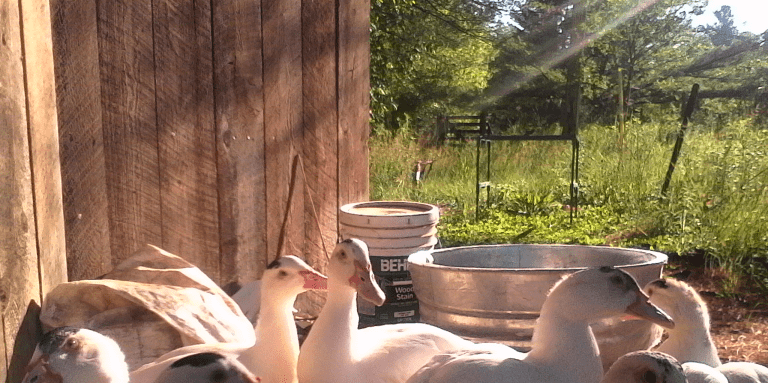
Several weeks ago, we had a problem with our coop security and something got in during the night and attacked our beautiful little flock of adolescent Muscovies. My husband came in in the morning and told me that two of my ducks were dead. “Actually,” he said, “one of them is still kind of twitching and sort of looks like a zombie duck.”
Zombie duck, as it turned out, was not dead at all. It had a massive gaping wound in its head and a torn side. When I went to bury it, it began flapping desperately, laboured breaths wheezing through lungs clogged with fluid. I took it outside and settled it down in the grass, and then sat with it, stroking its back and trying to keep it comfortable. After a while, it settled, glassy eyed, with its head lying in the grass.
A quick Google search revealed that with this kind of injury euthanasia was indicated in almost all cases. There was a small chance that a trip to the vet would yield a different result, but the harsh reality of farming is that a duck’s life has a fixed price. A single trip to the vet, just to have the duck looked at, would have completely destroyed any chance of realizing a profit this year for the entire duck operation. Any actual treatment would have put me in the hole.
So I had two basic options: leave the duck to die naturally, or put it to death. Allow it to suffer, or kill it quickly and be done with it. I knew that I was leaving for my kids’ birthday party in Toronto in less than an hour, and that leaving it to die would mean leaving a dying duck in the care of my rather sensitive older children. I went and fetched my machete.
I understand the appeal behind euthanasia and assisted suicide. It’s easier. It’s strangely peaceful. There’s a kind of odd duality to it: that on the one hand, you accept and reconcile yourself with the inevitability of death, and on the other hand, you gain some control over it. You surrender on your own terms.
If I’d had to sit vigil with the duck, it would have disrupted my plans and I might have had to go through the process of accepting the death of something that I loved over and over again – sorrow tends to come in waves of resistance and acceptance, rather like contractions when you’re giving birth. By taking control over the process I was able to sit there, with my hand on the duck’s back, until I was ready and then I was able to get it over with quick.
Now, here’s the thing. With a duck, all of this is perfectly reasonable. It makes sense. A duck’s life has a utilitarian value, as opposed to an absolute value. Even if I love my ducks (and I do), at the end of the day I know that one way or another most of them are going to perish at my hand. So a whole host of external factors could reasonably be brought into play: the cost of caring for the duck, the feelings of my children, my own emotional state, other plans that I had already made.
And the truth is, all of these factors mattered. It’s possible, unlikely but possible, that with enough time and money and care the duck could have survived. But it’s survival just wasn’t valuable enough to be worth hoping for.
On the other hand, two weeks ago, we had a kitten that was falling over, crying constantly, and looked like she was about to die. Her mother is a barn cat, and she had her kitten right in the middle of that unseasonable cold snap back in April. So she killed them – all of them, that is, except for this little one that we managed to rescue. The mother did not bond with her surviving kitten at all. For a while, we were able to force the mother to feed the kitten by locking them in the same room, but ultimately the mother stopped nursing. We didn’t realize that this had happened, because she would still come in to get the special treats that we were giving her as a reward for caring for her baby. We didn’t realize how dangerously malnourished the kitten was until she was too weak even to try to drink.
In this case, she was suffering: alternately lying back with a glazed look and looking as if she might give up the ghost at any minute, and waking to mew piteously. The same temptation was there as with the duck: just quietly and quickly end her misery. But this particular kitten had special value to my daughter, who had tried so hard to rescue her and keep her alive.
So we mixed up some emergency kitten formula and I used an eye dropper to drop it back into her throat. At first it just dribbled out her mouth, but eventually she began to swallow. Then a little more. After I’d got a few droppers full into her, we nested her on top of a heating pad and let her sleep. I woke her up in the middle of the night and fed her some more, and in the morning I took her to the vet – nevermind that vet bills for kittens weren’t really in the budget for the month.
This is a pet. Her value does not come from any kind of utilitarian calculation. Her value is not contingent on any particular outcome; she’s valuable just because she is loved.
Obviously, in both cases here, we are looking at animals, not at human beings, but even among animals there’s a scale in the way that we value life. Both the duck and the cat have a value of sorts, and in both cases that value is contingent, not ontological. But the duck’s value is utilitarian, economical, whereas the cat’s value is rooted in the irrational fact of its being loved.
This means that the kind of calculations that were performed before deciding to ends the ducks’ life weren’t appropriate to the cat. Spending sixty dollars to have the kitten looked at by a vet, and another thirty on top of that for kitten formula and a little baby kitten bottle made sense precisely because there is no utility to the cat’s life. Somehow, the very fact that she is a more or less completely useless creature whose only function is to get underfoot, attack my feet while I’m sleeping, and leave small turdlets in odd places places her outside of the realm of utilitarian calculations.
The cost of treatment; the sorrow that my daughter felt when she cradled her little kitty, sure that it was about to die; the interruption of my plans and the inconvenience of getting up in the middle of the night to force drops of milk into the tiny creature; even the piteousness of the kitten’s own sufferings: these things didn’t really matter. What mattered was that there was a beloved life that had a chance, however slim, of making it.
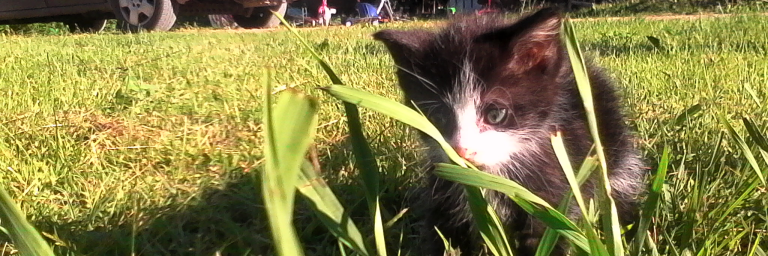
A healthy and recovered kitten stalking moths in the garden.
My concern, then, about medical aid in dying is that I think there’s a very, very high likelihood that in many cases human life will become the object of utilitarian calculations. There will be doctors looking at the resources that it takes to keep a person alive, and administrators looking at their budgets, and even if it is done in a gentle way there will be conversations that are geared towards helping a person decide that it’s time to push off and open up a bed for someone else. There will be family members who are tired to sitting vigil at a deathbed, and even if they do it lovingly, they will start to ask “What are living for anyway? You’re in pain. Everything’s been said. Why not just let go?” There will be others, in other families, who are not so gentle in letting their elders know that they are no longer wanted here.
And there will be the dying themselves. We are trained, especially in a capitalist culture, to value ourselves for our accomplishments, our abilities, our contributions, our utility. We internalize the idea that our value is based in what we do. How many people with terminal illnesses will interpret a busy doctor’s rushed demeanour, or a relative’s look of boredom, as a signal that they have overstayed their welcome? How much pressure to devalue ourselves in our final illness will come not from those around us, but from our own insecurities, our fear of burdening others?
Yes, there are those cases where a person is in pain that cannot be managed. There are always hard cases. But to me the great risk in legalizing assisted dying is that in doing so we reduce the value of human life to a utilitarian calculation. We deprive the human person of her or his most essential characteristic: that of being a being who exists, and is valued, not for any purpose but simply because we are loved.
Image credit: Just in case it isn’t obvious, these are pictures of my ducks and my kitten taken on my phone.
Stay in touch! Like Catholic Authenticity on Facebook:
Previous Post

June 22, 2016
Spectacularly Disabled
Next Post

June 27, 2016 A God Worth Wishing For: A Response to Friendly Atheist
Browse Our Archives
Select a Category Abuse Beauty Charity Chastity Current Events Faith Family Feminism Fiction Humility Humour Identity Justice Perseverence Philosophy Poverty Sexuality trauma Uncategorized Virtues Wombats
Select a Month February 2020 November 2019 October 2019 August 2019 July 2019 June 2019 May 2019 April 2019 March 2019 February 2019 October 2018 September 2018 August 2018 July 2018 June 2018 May 2018 April 2018 March 2018 February 2018 January 2018 December 2017 November 2017 October 2017 September 2017 August 2017 July 2017 June 2017 May 2017 April 2017 March 2017 February 2017 January 2017 December 2016 November 2016 October 2016 September 2016 August 2016 July 2016 June 2016 May 2016 April 2016 March 2016 February 2016 January 2016 December 2015 November 2015 October 2015 September 2015 August 2015 July 2015 June 2015
Follow Us!
TAKE THE
Religious Wisdom Quiz
I destroyed the world but saved eight people and many animals in a floating vessel. What am I?
Select your answer to see how you score.
A great storm God's judgment The deluge The flood
Books by This Author Books by Melinda Selmys
Support this
Column


Related posts from Catholic Authenticity



Is There A Gay Problem in the Priesthood?

Humanae Vitae and the Scandal of Abuse
TRENDING AT PATHEOS Catholic

Rejecting Doom: Christian Hope And Human Action
Christianity is a religion of hope. We are to have hope and...

It’s What Comes From Within Which Matters
One of the most difficult things for us to understand is why...

Why I Choose the Eucharist Over the Sermon
Choose the Eucharist, Not the Sermon What are we supposed to get...

5 Design Elements Found in Spiritually Rooted Homes
Putting Spirituality Into Home Decor Our homes are more than our living...

Credo: A Story of God Told with the...
About 10 years ago, I began to imagine a personal "Credo" that...

The Anatomy of Divine Revelation in Catholic Thought
The claim that God has made Himself known to human beings is...
view all Catholic blogs
Ad-Free & Subscriber Log-In Subscription Support
- About Us
- 2026 Calendar
- Videos
- Podcasts
- Library of World Religions
- Faith In Media Tracker
- Advertise With Us
- Write for Us
- Privacy Policy
- Terms of Service
- Do Not Sell My Data
- Contact Us
- Radiant Digital
- Manage Newsletter Subscriptions
- Unsubscribe From Notifications
- Sitemap
Copyright 2008-2026, Patheos. All rights reserved.
Subscription Support Ad-Free & Subscriber Log-In
Follow Patheos