
BuddhistCatholicContemplativeEvangelicalGeneral ChristianHinduJewishLatter-day SaintMuslimNew VisionsProgressive Christian
Beliefs
- Buddhist
- Catholic
- Contemplative
- Evangelical
- General Christian
- Hindu
- Jewish
- Latter-day Saint
- More Voices
- Muslim
- New Visions
- Pagan
- Progressive Christian
Topics
- Religion News
- Food and Religion
- Sports and Religion
- Religious Art
- Religious Music and Entertainment
- Religious Events
- History and Religion
- Style and Religion
- Politics and Religion
- Women in Religion
- Recreation Outdoors and Religion
- Business Finance and Religion
- Careers Workplace and Religion
- Education and Religion
- Family Parenting and Religion
- Health Fitness and Religion
- Home and Religion
- Relationships and Religion
- Technology and Religion
- Travel and Religion
Columnists
- Buddhist Columnists
- Business Finance and Religion Columnists
- Careers Workplace and Religion Columnists
- Catholic Columnists
- Contemplative Columnists
- Education and Religion Columnists
- Evangelists Columnists
- Family Parenting and Religion Columnists
- General Christian Columnists
- Health Fitness and Religion Columnists
- Hindu Columnists
- History and Religion Columnists
- Home and Religion Columnists
- Jewish Columnists
- More Voices Columnists
- Latter Day Columnists
- Muslim Columnists
- New Visions Columnists
- Nonreligious Columnists
- Pagan Columnists
- Politics and Religion Columnists
- Progressive Columnists
- Recreation Outdoors and Religion Columnists
- Relationships and Religion Columnists
- Religion News Columnists
- Religious Art Columnists
- Religious Events Columnists
- Religious Music and Entertainment Columnists
- Sports and Religion Columnists
- Style and Religion Columnists
- Technology and Religion Columnists
- Travel and Religion Columnists
- Women in Religion Columnists
Resource Library
- 2026 Calendar
- Library of World Religions
- The 100 Most Holy Places on Earth
- Patheos Answers
- Podcasts
- Videos
- Faith Leaders Database
- Anglican Episcopalian
- Bahai
- Baptist
- Buddhism
- Christianity
- Confucianism
- Eastern Orthodoxy
- Hinduism
- Holiness and Pentecostal
- ISKCON
- Islam
- Judaism
- Lutheran
- Methodist
- The Church of Jesus Christ of Latter-day Saints
- New Age
- Paganism
- Presbytarian and Reformed
- Protestantism
- Religion Behind the Scenes
- Roman Catholic
- Scientology
- Shia Islam
- Sikhism
- Sufism
- Sunni Islam
- Taoism
- Zen
- See all religions
Research Tools
 Ad-Free & Subscriber Log-In Subscription Support
Ad-Free & Subscriber Log-In Subscription Support
Follow Patheos 

- Trending:
- Forgiveness
- |
- Marriage
- |
- Consciousness
- |
- Death Penalty
- |
- Election
- |
- Halloween
 Catholic Authenticity
-
Categories
- Home
- Catholic
- St. Joseph versus Toxic Masculinity
St. Joseph versus Toxic Masculinity
Last updated on: March 20, 2016 at 5:47 pm by Melinda Selmys
St. Joseph versus Toxic Masculinity 2016-03-20T17:47:09-04:00 Melinda Selmys
Patheos Explore the world's faith through different perspectives on religion and spirituality! Patheos has the views of the prevalent religions and spiritualities of the world.
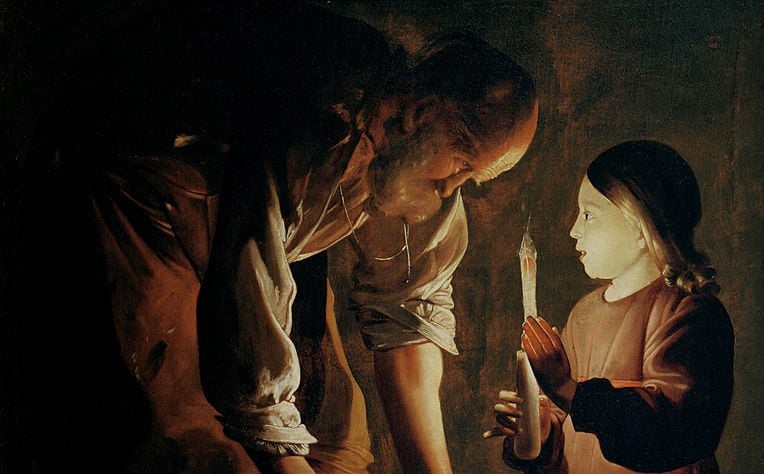
I should have written this yesterday, for the feast of St. Joseph, but it didn’t occur to me to do so until this morning.
St. Joseph is one of a small handful of Saints that I’ve felt a kind of personal connection to. There are Saints that I like and that I pray to as distant figures in heaven, historical personages who I admire and wish to imitate, writers whose works I find illuminating or inspiring. Then there are a few that sometimes seem…there’s no word for it except “present.” St. Joseph is one of those.
Generally I encounter him when I’m most fed up with my marriage and with men generally. When I just want to get away and live the independent feminist dream. When I feel like I’ve been patient enough and have put up with enough and I’m through. That’s when St. Joe shows up.
So, yesterday there was a meme circulating for his feast day with the caption: My favourite St. Joseph quote: ” ”
It had never occurred to me before, but yes. With other Saints that I’ve felt to be present in some particular trial or need, I’ve always had a sense of words. Therese of Lisieux offering friendship. St. Lawrence making fun of me for taking myself too seriously. Gerard Manley Hopkins playing with the plasticity of whatever it is that serves for language in Heaven (that one was kind of mind-blowing and sadly my attempts to explain or describe it in dull, quotidian old English have never come even close to capturing it. And yes, I do know that GMH is not a canonized saint.)
With St. Joseph, always silence. Just being there. Steady. Reliable. Considerate. No, more than just steady. Steadying.
St. Joseph is probably, more than anyone, the person who has convinced me that masculinity does not have to be toxic or oppressive. It doesn’t have to be about being in control, or asserting authority, or proving oneself to other men. St. Joe is definitely not a coward. He’s not lukewarm. He’s not a sentimental milquetoast. But he’s also not a swaggerer. When his family is threatened, he doesn’t get himself a sword so that he can fantasize about taking down Herod. He quietly moves them to a safer place in the night. His concern is not to look cool and impress other guys, it’s to do what will actually keep his family safest.
When he finds out that his bride-to-be is pregnant, in spite of the fact that he lives in a highly patriarchal society and tongues are bound to wag, he thinks “How can I deal with this quietly and mercifully?” The fact that he would naturally presume that she had cheated on him almost disappears from the text. His masculine ego is not front and center. This is not about proving that Joseph is a man, and that he will be respected. There’s no evidence that he tried to figure out who had been taking his woman behind his back, or that he had any particular desire for revenge. Instead he Bible tells us that he had two concerns: first, to obey the law. Second, to avoid disgracing her.
St. Joseph’s masculinity is not self-assertive. It’s the kind of masculinity that St. Paul calls for when he tells husbands that they “ought to love their wives as their own bodies.” (Eph 5:28) A masculinity that is focused on the needs of others rather than the gratification of desire, appetites and ego. You can’t imagine St. Joseph bragging to his buddies, or making demeaning comments about women, bullying catamites, or hiding out in his mancave with a stash of pornographic papyrus. When the Angel says, “So, Joe, God impregnated your wife. Don’t be afraid to go ahead and marry her,” he doesn’t bristle or get offended. He doesn’t drown his sorrows at the bar, or go out and blow a bunch of money on a hot new chariot to prove that he’s still the man. He’s a one donkey guy — and his pregnant wife gets to ride the donkey.
He also doesn’t seem to be someone who needs to constantly talk about himself, much less someone who needs to talk over others. People often marvel at how little Mary says in the Gospels. St. Joseph says nothing. We know him only by his actions, which basically involve obeying God and taking care of others.
From a worldly point of view, St. Joseph fails as a man. He is not wealthy. He doesn’t fight the bad guys and win. He flees under cover of darkness. He’s a cuckhold. He doesn’t assert his sexual rights over Mary. He’s not a stud. He doesn’t show off his intelligence. Most of what he does can be described using words that have historically been attributed to femininity: silence, caring, consideration, submission, obedience, humility.This is a masculinity that I can respect. A masculinity that safeguards, supports, upholds, behaves with quiet courage and makes no bid for the limelight. A masculinity that doesn’t need to attack womanhood or forcefully assert its strength or superiority. A masculinity which is deeply Christian and deeply traditional, and yet which bears little resemblance to much of the chauvinist crap that often presents itself as authentic Christian manhood.
Image detail “St. Joseph the Carpenter” by Georges de La Tour – Web Gallery of Art: Image Info about artworkhttp://www.magnificat.com/lifeteen/ image, Public Domain, https://commons.wikimedia.org/w/index.php?curid=540154
Previous Post

March 19, 2016
Do Pediatricians Believe that Transgender Affirmation is Child Abuse?
Next Post
April 10, 2016 Amoris Laetitia Needs to Give Sinners More Stick, Less Carrot, Yeah?
Browse Our Archives
Select a Category Abuse Beauty Charity Chastity Current Events Faith Family Feminism Fiction Humility Humour Identity Justice Perseverence Philosophy Poverty Sexuality trauma Uncategorized Virtues Wombats
Select a Month February 2020 November 2019 October 2019 August 2019 July 2019 June 2019 May 2019 April 2019 March 2019 February 2019 October 2018 September 2018 August 2018 July 2018 June 2018 May 2018 April 2018 March 2018 February 2018 January 2018 December 2017 November 2017 October 2017 September 2017 August 2017 July 2017 June 2017 May 2017 April 2017 March 2017 February 2017 January 2017 December 2016 November 2016 October 2016 September 2016 August 2016 July 2016 June 2016 May 2016 April 2016 March 2016 February 2016 January 2016 December 2015 November 2015 October 2015 September 2015 August 2015 July 2015 June 2015
Follow Us!
TAKE THE
Religious Wisdom Quiz
I am twelve men sent to explore the Promised Land, but only two gave a good report. Who are we?
Select your answer to see how you score.
Explorers The twelve spies Leaders of Israel Messengers
Books by This Author Books by Melinda Selmys
Support this
Column


Related posts from Catholic Authenticity

Sex Positive: How I Learned To Stop Worrying...


The Lord Has Worked Marvels For Me: Open...

The Central Spiritual Struggle of Women: Open Letter,...
TRENDING AT PATHEOS Catholic

Rejecting Doom: Christian Hope And Human Action
Christianity is a religion of hope. We are to have hope and...

It’s What Comes From Within Which Matters
One of the most difficult things for us to understand is why...

Why I Choose the Eucharist Over the Sermon
Choose the Eucharist, Not the Sermon What are we supposed to get...

5 Design Elements Found in Spiritually Rooted Homes
Putting Spirituality Into Home Decor Our homes are more than our living...

Credo: A Story of God Told with the...
About 10 years ago, I began to imagine a personal "Credo" that...

The Anatomy of Divine Revelation in Catholic Thought
The claim that God has made Himself known to human beings is...
view all Catholic blogs
Ad-Free & Subscriber Log-In Subscription Support
- About Us
- 2026 Calendar
- Videos
- Podcasts
- Library of World Religions
- Faith In Media Tracker
- Advertise With Us
- Write for Us
- Privacy Policy
- Terms of Service
- Do Not Sell My Data
- Contact Us
- Radiant Digital
- Manage Newsletter Subscriptions
- Unsubscribe From Notifications
- Sitemap
Copyright 2008-2026, Patheos. All rights reserved.
Subscription Support Ad-Free & Subscriber Log-In
Follow Patheos