
BuddhistCatholicContemplativeEvangelicalGeneral ChristianHinduJewishLatter-day SaintMuslimNew VisionsProgressive Christian
Beliefs
- Buddhist
- Catholic
- Contemplative
- Evangelical
- General Christian
- Hindu
- Jewish
- Latter-day Saint
- More Voices
- Muslim
- New Visions
- Pagan
- Progressive Christian
Topics
- Religion News
- Food and Religion
- Sports and Religion
- Religious Art
- Religious Music and Entertainment
- Religious Events
- History and Religion
- Style and Religion
- Politics and Religion
- Women in Religion
- Recreation Outdoors and Religion
- Business Finance and Religion
- Careers Workplace and Religion
- Education and Religion
- Family Parenting and Religion
- Health Fitness and Religion
- Home and Religion
- Relationships and Religion
- Technology and Religion
- Travel and Religion
Columnists
- Buddhist Columnists
- Business Finance and Religion Columnists
- Careers Workplace and Religion Columnists
- Catholic Columnists
- Contemplative Columnists
- Education and Religion Columnists
- Evangelists Columnists
- Family Parenting and Religion Columnists
- General Christian Columnists
- Health Fitness and Religion Columnists
- Hindu Columnists
- History and Religion Columnists
- Home and Religion Columnists
- Jewish Columnists
- More Voices Columnists
- Latter Day Columnists
- Muslim Columnists
- New Visions Columnists
- Nonreligious Columnists
- Pagan Columnists
- Politics and Religion Columnists
- Progressive Columnists
- Recreation Outdoors and Religion Columnists
- Relationships and Religion Columnists
- Religion News Columnists
- Religious Art Columnists
- Religious Events Columnists
- Religious Music and Entertainment Columnists
- Sports and Religion Columnists
- Style and Religion Columnists
- Technology and Religion Columnists
- Travel and Religion Columnists
- Women in Religion Columnists
Resource Library
- 2026 Calendar
- Library of World Religions
- The 100 Most Holy Places on Earth
- Patheos Answers
- Podcasts
- Videos
- Faith Leaders Database
- Anglican Episcopalian
- Bahai
- Baptist
- Buddhism
- Christianity
- Confucianism
- Eastern Orthodoxy
- Hinduism
- Holiness and Pentecostal
- ISKCON
- Islam
- Judaism
- Lutheran
- Methodist
- The Church of Jesus Christ of Latter-day Saints
- New Age
- Paganism
- Presbytarian and Reformed
- Protestantism
- Religion Behind the Scenes
- Roman Catholic
- Scientology
- Shia Islam
- Sikhism
- Sufism
- Sunni Islam
- Taoism
- Zen
- See all religions
Research Tools
 Ad-Free & Subscriber Log-In Subscription Support
Ad-Free & Subscriber Log-In Subscription Support
Follow Patheos 

- Trending:
- Forgiveness
- |
- Marriage
- |
- Consciousness
- |
- Death Penalty
- |
- Election
- |
- Halloween
 Catholic Authenticity
-
Categories
- Home
- Catholic
- Depart From Me, You Evildoers
Depart From Me, You Evildoers
Last updated on: December 17, 2015 at 1:16 pm by Melinda Selmys
Depart From Me, You Evildoers 2015-12-17T13:16:57-04:00 Melinda Selmys
Patheos Explore the world's faith through different perspectives on religion and spirituality! Patheos has the views of the prevalent religions and spiritualities of the world.
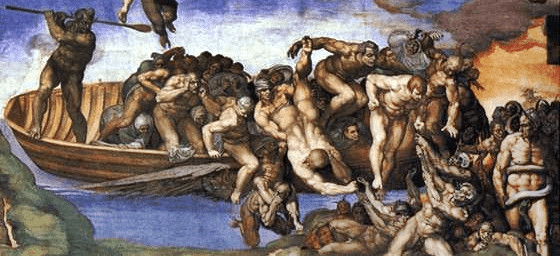
One of the most chilling passages in scripture is in Matthew 7, when Christ says “Not everyone who says to me, ‘Lord, Lord,’ will enter the kingdom of heaven, but only the one who does the will of my Father who is in heaven. Many will say to me on that day, ‘Lord, Lord, did we not prophesy in your name and in your name drive out demons and in your name perform many miracles?’ Then I will tell them plainly, ‘I never knew you. Away from me, you evildoers!’ (7:21-23)
In Matthew, this saying is incorporated into the Sermon on the Mount, but Luke, in chapter 13, offers a similar text but has Christ presenting it as part of a discourse after being challenged by the leader of a synagogue for healing a woman on the Sabbath. Assuming that Luke’s context is correct (many biblical scholars believe that Matthew organized disparate sayings of Christ into a single sermon to give us the famous tour de force delivered from a mountaintop), there’s good reason to believe that Christ is talking here very specifically about those who are openly and publicly devout, but who have not grasped the principles of mercy.
Regardless of context, the text is quite damning. The “evildoers” that Christ sends away are obviously religious people. They’ve prophesied, driven out demons, and even performed miracles in Christ’s name. Now, let’s be real here: how many of us can honestly make those claims? And how often are we impressed by people who can? But here’s the rub. Christ strongly implies that in spite of their spectacular and apparent spiritual gifts, these people did not do the will of the Father.
To get what He’s talking about here, I’d like to suggest two other relevant texts. The first is Matthew 21. Here, we know that He’s speaking to the leaders in the Temple in Jerusalem who have just being trying to trip Him up. Again, His remarks are in response to devout, religious people who conspicuously practice their faith. He says: “What do you think? There was a man who had two sons. He went to the first and said, ‘Son, go and work today in the vineyard.’
“‘I will not,’ he answered, but later he changed his mind and went.
“Then the father went to the other son and said the same thing. He answered, ‘I will, sir,’ but he did not go.
“Which of the two did what his father wanted?”
“The first,” they answered.” (21:28-31)
In this text, Christ returns to the theme of doing the Father’s will. And again, He contrasts those who make a show of obedience with those who actually obey. But here’s the thing, if we go back to Matthew 7 it’s clear that the show of obedience might include things like prophecy, casting out demons, and miracles. The son who does not do the will of the father might, in fact, appear to be an incredibly devout and holy man. Yet it is the son who says “Fuck you, I won’t do what you tell me” and then…well…goes out and does as he’s told – who is praised as having done the father’s will.
A visiting priest over the summer last year reflected on this specifically in the context of some young atheist students that he had worked with serving the poor in South America. He pointed out that these people, even though on the surface they rejected God, were in fact like the second son, making real sacrifices in order to follow the teachings of the God that they rejected. He also pointed out that these were sacrifices which many of us sitting in the pews were not actually willing to make.
The good news is that there are probably a lot of people who we are inclined to fear for as lost who are getting into heaven. While it’s certainly true that large portions of Western culture have rejected Christianity as such, there are also many secular people who have internalized the values that Christ taught – even if they’re ignorant that Christ is the source of those values. In so far as that ignorance is genuine and non-culpable, these people often resemble the obedient son.
The bad news…well, the bad news is that there are also a lot of people who think of themselves as righteous who kind of aren’t. The categories that we use to judge people, including ourselves, are often based on appearances. We become enamoured with the image of piety, and this easily leads to a kind of self-absorbed faith in which spiritual gifts and experiences become more important than the actual practice of love for our neighbours.
Christ is quite clear as to what this looks like:
“When the Son of Man comes in his glory, and all the angels with him, he will sit on his glorious throne. All the nations will be gathered before him, and he will separate the people one from another as a shepherd separates the sheep from the goats. He will put the sheep on his right and the goats on his left.
“Then the King will say to those on his right, ‘Come, you who are blessed by my Father; take your inheritance, the kingdom prepared for you since the creation of the world. For I was hungry and you gave me something to eat, I was thirsty and you gave me something to drink, I was a stranger and you invited me in, I needed clothes and you clothed me, I was sick and you looked after me, I was in prison and you came to visit me.’
“Then the righteous will answer him, ‘Lord, when did we see you hungry and feed you, or thirsty and give you something to drink? When did we see you a stranger and invite you in, or needing clothes and clothe you? When did we see you sick or in prison and go to visit you?’
“The King will reply, ‘Truly I tell you, whatever you did for one of the least of these brothers and sisters of mine, you did for me.’
“Then he will say to those on his left, ‘Depart from me, you who are cursed, into the eternal fire prepared for the devil and his angels. For I was hungry and you gave me nothing to eat, I was thirsty and you gave me nothing to drink, I was a stranger and you did not invite me in, I needed clothes and you did not clothe me, I was sick and in prison and you did not look after me.’
“They also will answer, ‘Lord, when did we see you hungry or thirsty or a stranger or needing clothes or sick or in prison, and did not help you?’
“He will reply, ‘Truly I tell you, whatever you did not do for one of the least of these, you did not do for me.’
“Then they will go away to eternal punishment, but the righteous to eternal life.” (Matt 25:31-46)
Note that in this rather scandalous account of the Last Judgement, there’s no theology exam. The Son of Man doesn’t seem especially concerned about whether or not the folks He’s judging can discern the finer shades of ultramontanism or neo-gnosticism. He doesn’t say ‘Depart from me, you who are accursed, into the eternal fire prepared for the devil and his angels. For you sang tacky 1970s Jesuit hymns at Mass and received the Eucharist in your hand.”
Moreover, He describes a judgement in which both groups are surprised. Those who did the will of the father are kind of shocked by His verdict. They don’t know that when they fed the hungy, gave water to the thirsty, invited the stranger, gave clothes to the naked, and visited the sick and imprisoned that they were ministering to Christ. On the other hand, those who are condemned are equally stunned – having failed to recognize Christ in the hungry, the thirsty, the stranger, the naked, the sick and the imprisoned.
This is not some scandalous liberalism that tries to reduce the gospel to socialism. Remember that Christ’s audience did not have access to the full text of the New Testament. Clearly, in choosing to describe the last judgement in this way, He chose to emphasize the things that He felt were important for the devout audience at the Temple to hear. If we look back to Matthew 7, Matthew 25 provides us with the key, missing piece of information: what, exactly, were these highly religious people who cast out demons in Christ’s name missing? The answer, is that they were missing the heart of the gospel, the love of Christ’s little ones – specifically, the love of those who are not successful, who cannot pull themselves up by their own bootstraps, who have been afflicted, who have been driven from their homes, who have put into prison. Those who we refer to today as the “marginalized,” and who Pope Francis describes as existing on “the existential peripheries.”
The gospel call to concrete love expressed through acts of solicitude and kindness, more than acts of scrupulous religiosity, is not some liberal heresy. It is the explicit teaching of Christ who reminds us, always, that God desires mercy not sacrifice.
Image by Michelangelo [Public domain], via Wikimedia Commons. Detail from the Last Judgement

Browse Our Archives
Select a Category Abuse Beauty Charity Chastity Current Events Faith Family Feminism Fiction Humility Humour Identity Justice Perseverence Philosophy Poverty Sexuality trauma Uncategorized Virtues Wombats
Select a Month February 2020 November 2019 October 2019 August 2019 July 2019 June 2019 May 2019 April 2019 March 2019 February 2019 October 2018 September 2018 August 2018 July 2018 June 2018 May 2018 April 2018 March 2018 February 2018 January 2018 December 2017 November 2017 October 2017 September 2017 August 2017 July 2017 June 2017 May 2017 April 2017 March 2017 February 2017 January 2017 December 2016 November 2016 October 2016 September 2016 August 2016 July 2016 June 2016 May 2016 April 2016 March 2016 February 2016 January 2016 December 2015 November 2015 October 2015 September 2015 August 2015 July 2015 June 2015
Follow Us!
TAKE THE
Religious Wisdom Quiz
Which book of the Bible has the most chapters?
Select your answer to see how you score.
Psalms Proverbs Genesis Isaiah
Books by This Author Books by Melinda Selmys
Support this
Column


Related posts from Catholic Authenticity

The Lord Has Worked Marvels For Me: Open...

The Central Spiritual Struggle of Women: Open Letter,...

An Open Letter to the Young Rad-Trad Women

Maybe It's Okay That Man Should Be Alone
TRENDING AT PATHEOS Catholic

Rejecting Doom: Christian Hope And Human Action
Christianity is a religion of hope. We are to have hope and...

It’s What Comes From Within Which Matters
One of the most difficult things for us to understand is why...

Why I Choose the Eucharist Over the Sermon
Choose the Eucharist, Not the Sermon What are we supposed to get...

5 Design Elements Found in Spiritually Rooted Homes
Putting Spirituality Into Home Decor Our homes are more than our living...

Credo: A Story of God Told with the...
About 10 years ago, I began to imagine a personal "Credo" that...

The Anatomy of Divine Revelation in Catholic Thought
The claim that God has made Himself known to human beings is...
view all Catholic blogs
Ad-Free & Subscriber Log-In Subscription Support
- About Us
- 2026 Calendar
- Videos
- Podcasts
- Library of World Religions
- Faith In Media Tracker
- Advertise With Us
- Write for Us
- Privacy Policy
- Terms of Service
- Do Not Sell My Data
- Contact Us
- Radiant Digital
- Manage Newsletter Subscriptions
- Unsubscribe From Notifications
- Sitemap
Copyright 2008-2026, Patheos. All rights reserved.
Subscription Support Ad-Free & Subscriber Log-In
Follow Patheos