
BuddhistCatholicContemplativeEvangelicalGeneral ChristianHinduJewishLatter-day SaintMuslimNew VisionsProgressive Christian
Beliefs
- Buddhist
- Catholic
- Contemplative
- Evangelical
- General Christian
- Hindu
- Jewish
- Latter-day Saint
- More Voices
- Muslim
- New Visions
- Pagan
- Progressive Christian
Topics
- Religion News
- Food and Religion
- Sports and Religion
- Religious Art
- Religious Music and Entertainment
- Religious Events
- History and Religion
- Style and Religion
- Politics and Religion
- Women in Religion
- Recreation Outdoors and Religion
- Business Finance and Religion
- Careers Workplace and Religion
- Education and Religion
- Family Parenting and Religion
- Health Fitness and Religion
- Home and Religion
- Relationships and Religion
- Technology and Religion
- Travel and Religion
Columnists
- Buddhist Columnists
- Business Finance and Religion Columnists
- Careers Workplace and Religion Columnists
- Catholic Columnists
- Contemplative Columnists
- Education and Religion Columnists
- Evangelists Columnists
- Family Parenting and Religion Columnists
- General Christian Columnists
- Health Fitness and Religion Columnists
- Hindu Columnists
- History and Religion Columnists
- Home and Religion Columnists
- Jewish Columnists
- More Voices Columnists
- Latter Day Columnists
- Muslim Columnists
- New Visions Columnists
- Nonreligious Columnists
- Pagan Columnists
- Politics and Religion Columnists
- Progressive Columnists
- Recreation Outdoors and Religion Columnists
- Relationships and Religion Columnists
- Religion News Columnists
- Religious Art Columnists
- Religious Events Columnists
- Religious Music and Entertainment Columnists
- Sports and Religion Columnists
- Style and Religion Columnists
- Technology and Religion Columnists
- Travel and Religion Columnists
- Women in Religion Columnists
Resource Library
- 2026 Calendar
- Library of World Religions
- The 100 Most Holy Places on Earth
- Patheos Answers
- Podcasts
- Videos
- Faith Leaders Database
- Anglican Episcopalian
- Bahai
- Baptist
- Buddhism
- Christianity
- Confucianism
- Eastern Orthodoxy
- Hinduism
- Holiness and Pentecostal
- ISKCON
- Islam
- Judaism
- Lutheran
- Methodist
- The Church of Jesus Christ of Latter-day Saints
- New Age
- Paganism
- Presbytarian and Reformed
- Protestantism
- Religion Behind the Scenes
- Roman Catholic
- Scientology
- Shia Islam
- Sikhism
- Sufism
- Sunni Islam
- Taoism
- Zen
- See all religions
Research Tools
 Ad-Free & Subscriber Log-In Subscription Support
Ad-Free & Subscriber Log-In Subscription Support
Follow Patheos 

- Trending:
- Forgiveness
- |
- Marriage
- |
- Consciousness
- |
- Death Penalty
- |
- Election
- |
- Halloween
 Catholic Authenticity
-
Categories
- Home
- Catholic
- Trans Women are From Pluto
Trans Women are From Pluto
Last updated on: November 21, 2015 at 5:37 pm by Melinda Selmys
Trans Women are From Pluto 2015-11-21T17:37:49-04:00 Melinda Selmys
Patheos Explore the world's faith through different perspectives on religion and spirituality! Patheos has the views of the prevalent religions and spiritualities of the world.

There was a comment that was left a while back that I never got around to answering because it was too complex for a com-box. It concerned the claim that reproductive sex (male and female) is a fact, not a social construct.
The commenter pointed out that categories are socially constructed, even if they are based on facts – and this is basically true. However, since the question is highly fraught when it comes to matters of sexuality, I’d like to begin with a relatively uncontroversial example before diving into the politics of male and female.
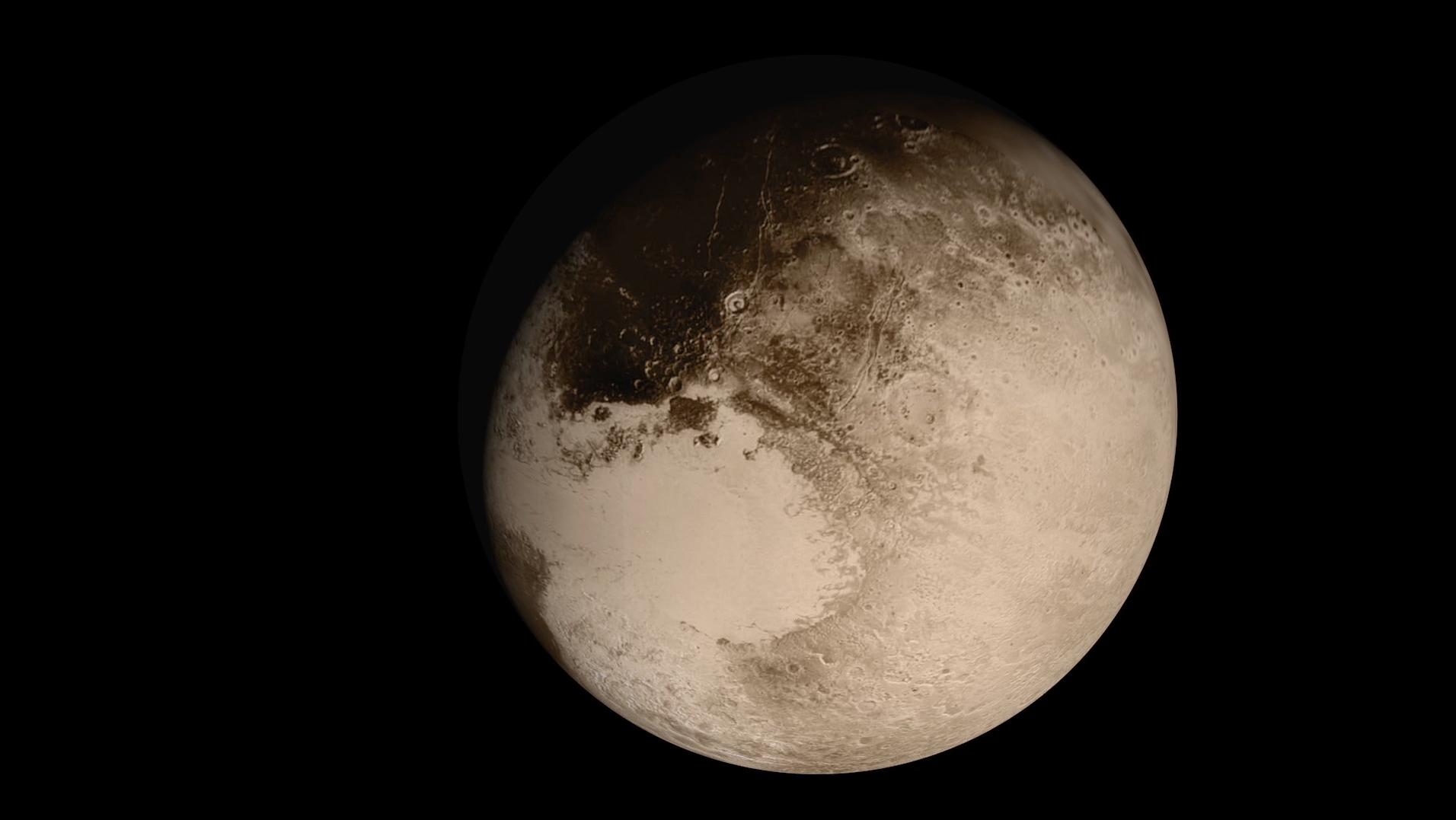
So, let’s take as our example the ongoing kerfuffle over whether or not Pluto is a planet.
Basically, the answer to this question is one of definition: what do we consider to be the essential properties of a planet? Is it important for a planet to have a regular elliptical orbit? For it to have sufficient mass to be able to hold an atmosphere? Is size the important thing? Roundness? Possessing sufficient gravitation to have cleared its orbit of other debris? And should tradition play a role in deciding the question?
Once you have a definition of a planet, it becomes possible to categorize Pluto – but the definition is, of course, variable over time and it depends largely on factors that have very little to do with the nature of Pluto itself. For example, in the ancient world Earth would not have been considered a planet, and the sun and moon would have been. Basically, a planet was an extraterrestrial body that moved in a regular way through the heavens and was not a star.
There was nothing “wrong” about this definition, but it certainly arose from a very different kind of worldview, and a very different cosmology, than the one we have today. Encoded within the ancient definition of planet was an assumption that the frame of reference for observing the heavens was basically geocentric. Although geocentrism is now usually looked on with contempt, there’s actually a sense in which it’s a very reasonable way of looking at the universe: geocentric conceptions privilege the subjective experience of the observer, whereas modern conceptions privilege the scientific elegance of an objective model.
Thing is, the decision to see the scientific model as more “true” than the observer’s immediate experience is essentially, in itself, a product of certain social conditions. The intellectual habit of trying to look at things from an external, objective paradigm is the result of a complex series of academic and social developments that we roughly designate as “modernity.”
There is, however, every possibility that as we move forward we will see a return to systems of thought that privilege the subjective. Indeed, this has arguably already happened in the philosophical world, where the epistemological problems with “objectivity” as a concept have led to the development of more subject-centered approaches to truth.
In any case, the point is that categories are not only a construct imposed on information to give it structure and meaning – they are also a reflection of the values, needs and beliefs of a particular culture or subculture. So, in the case of Pluto, geologists have a different set of priorities than physicists, and both of these groups have different priorities than elementary school teachers. All 3 of these groups do have a vested interest in the question, but they will all privilege different types of data as a result of their particular context.
The same is clearly the case in the controversy over the definition of male and female. You have a number of different groups coming to the table, each with their own values and priorities. For trans people, the primary concern is their ability to live in accordance with their inner sense of identity without facing stigma, discrimination or exclusion. For radical feminists, the concerns centre around the ways in which women’s bodies become the focus of oppressive and discriminatory practices, and the ways in which gender serves as a mechanism for women’s marginalization. For traditional Christians, the concerns have to do with a sacramental understanding of marriage and the role of male and female in the order of creation, and with the valuation of reproduction as a manifestation of respect for the dignity of human life.
None of these concerns are stupid, trivial or evil. More to the point, none of them are marginal concerns: for each of the groups involved, the questions at stake in the definition of male and female are intimately connected with the most fundamental values of the people involved. For all three groups, these are questions that have very significant practical implications.
For trans people, social stigma and exclusion often means suicidal depression, transmisogynistic violence, lack of access to employment, sexual assault and harassment, and discrimination in a variety of settings, from health-care, to immigration, to criminal justice. Appeals to “biological sex” are routinely used to justify putting trans people, and especially trans women, into dangerous situations from men’s prisons to men’s restrooms, where they are vulnerable to assault and abuse.
For radical feminists, the erasure of identifiably female bodies, and of early female socialization, from the discourse involves legitimizing gender roles and conventions that often harm women: for a trans woman to “feel” like a woman implies that there is a way that being a woman is supposed to feel. If people born with male bodies, and socialized as men, are granted the right to define their feelings as “being a woman,” this undermines the feminist project to wrest the right to define womanhood out of male hands. It also means that violent and predatory males can redefine themselves as women by fiat and thus gain access to women’s safe spaces.
For traditional Christians, the attempt to sever the linkage between sex and reproduction represents a dangerous social experiment with widespread and catastrophic effects. These include the dehumanization and killing of huge numbers of unborn children, single mothers and their children left in poverty, spouses abandoned and children traumatized by widespread divorce, and so on. Christian parents feel increasingly powerless to protect their families and children from the suffering associated with these evils. For them, the legitimization of trans identities implies the final elimination of reproduction from our understanding of male and female, and thus a total devaluation of the means by which new human beings come to be.
These groups define male and female, masculinity and femininity, man and woman differently because they are concerned primarily with the real needs and sufferings of different groups of people, and also because they see the world in very different ways. Each of them wants to achieve a social consensus around the definition of male and female that will provide the greatest security for the things that they value most.
No social consensus is possible, though, without a dialogue that recognizes the legitimacy of differing points of view. The present situation – which consists largely of hysteria and name-calling from all three camps – can only lead to social turmoil, trenchant and punitive politics, the proliferation of hate, and the perpetuation of a situation in which nobodies priorities or needs are being met.
Image courtesy of Wikipedia “PIA19873-Pluto-NewHorizons-FlyingPastImage-20150714” by NASA/Johns Hopkins University Applied Physics Laboratory/Southwest Research Institute – http://photojournal.jpl.nasa.gov/jpeg/PIA19873.jpg. Licensed under Public Domain via Commons – https://commons.wikimedia.org/wiki/File:PIA19873-Pluto-NewHorizons-FlyingPastImage-20150714.jpg#/media/File:PIA19873-Pluto-NewHorizons-FlyingPastImage-20150714.jpg


Next Post

November 25, 2015 Against Nature and Other Abominations
Browse Our Archives
Select a Category Abuse Beauty Charity Chastity Current Events Faith Family Feminism Fiction Humility Humour Identity Justice Perseverence Philosophy Poverty Sexuality trauma Uncategorized Virtues Wombats
Select a Month February 2020 November 2019 October 2019 August 2019 July 2019 June 2019 May 2019 April 2019 March 2019 February 2019 October 2018 September 2018 August 2018 July 2018 June 2018 May 2018 April 2018 March 2018 February 2018 January 2018 December 2017 November 2017 October 2017 September 2017 August 2017 July 2017 June 2017 May 2017 April 2017 March 2017 February 2017 January 2017 December 2016 November 2016 October 2016 September 2016 August 2016 July 2016 June 2016 May 2016 April 2016 March 2016 February 2016 January 2016 December 2015 November 2015 October 2015 September 2015 August 2015 July 2015 June 2015
Follow Us!
TAKE THE
Religious Wisdom Quiz
True or False: Moses was hidden in a basket among the reeds of the Nile River as a baby.
Select your answer to see how you score.
TRUE FALSE
Books by This Author Books by Melinda Selmys
Support this
Column


Related posts from Catholic Authenticity

Sex Positive: How I Learned To Stop Worrying...


The Central Spiritual Struggle of Women: Open Letter,...

An Open Letter to the Young Rad-Trad Women
TRENDING AT PATHEOS Catholic

Rejecting Doom: Christian Hope And Human Action
Christianity is a religion of hope. We are to have hope and...

It’s What Comes From Within Which Matters
One of the most difficult things for us to understand is why...

Why I Choose the Eucharist Over the Sermon
Choose the Eucharist, Not the Sermon What are we supposed to get...

5 Design Elements Found in Spiritually Rooted Homes
Putting Spirituality Into Home Decor Our homes are more than our living...

Credo: A Story of God Told with the...
About 10 years ago, I began to imagine a personal "Credo" that...

The Anatomy of Divine Revelation in Catholic Thought
The claim that God has made Himself known to human beings is...
view all Catholic blogs
Ad-Free & Subscriber Log-In Subscription Support
- About Us
- 2026 Calendar
- Videos
- Podcasts
- Library of World Religions
- Faith In Media Tracker
- Advertise With Us
- Write for Us
- Privacy Policy
- Terms of Service
- Do Not Sell My Data
- Contact Us
- Radiant Digital
- Manage Newsletter Subscriptions
- Unsubscribe From Notifications
- Sitemap
Copyright 2008-2026, Patheos. All rights reserved.
Subscription Support Ad-Free & Subscriber Log-In
Follow Patheos