
BuddhistCatholicContemplativeEvangelicalGeneral ChristianHinduJewishLatter-day SaintMuslimNew VisionsProgressive Christian
Beliefs
- Buddhist
- Catholic
- Contemplative
- Evangelical
- General Christian
- Hindu
- Jewish
- Latter-day Saint
- More Voices
- Muslim
- New Visions
- Pagan
- Progressive Christian
Topics
- Religion News
- Food and Religion
- Sports and Religion
- Religious Art
- Religious Music and Entertainment
- Religious Events
- History and Religion
- Style and Religion
- Politics and Religion
- Women in Religion
- Recreation Outdoors and Religion
- Business Finance and Religion
- Careers Workplace and Religion
- Education and Religion
- Family Parenting and Religion
- Health Fitness and Religion
- Home and Religion
- Relationships and Religion
- Technology and Religion
- Travel and Religion
Columnists
- Buddhist Columnists
- Business Finance and Religion Columnists
- Careers Workplace and Religion Columnists
- Catholic Columnists
- Contemplative Columnists
- Education and Religion Columnists
- Evangelists Columnists
- Family Parenting and Religion Columnists
- General Christian Columnists
- Health Fitness and Religion Columnists
- Hindu Columnists
- History and Religion Columnists
- Home and Religion Columnists
- Jewish Columnists
- More Voices Columnists
- Latter Day Columnists
- Muslim Columnists
- New Visions Columnists
- Nonreligious Columnists
- Pagan Columnists
- Politics and Religion Columnists
- Progressive Columnists
- Recreation Outdoors and Religion Columnists
- Relationships and Religion Columnists
- Religion News Columnists
- Religious Art Columnists
- Religious Events Columnists
- Religious Music and Entertainment Columnists
- Sports and Religion Columnists
- Style and Religion Columnists
- Technology and Religion Columnists
- Travel and Religion Columnists
- Women in Religion Columnists
Resource Library
- 2026 Calendar
- Library of World Religions
- The 100 Most Holy Places on Earth
- Patheos Answers
- Podcasts
- Videos
- Faith Leaders Database
- Anglican Episcopalian
- Bahai
- Baptist
- Buddhism
- Christianity
- Confucianism
- Eastern Orthodoxy
- Hinduism
- Holiness and Pentecostal
- ISKCON
- Islam
- Judaism
- Lutheran
- Methodist
- The Church of Jesus Christ of Latter-day Saints
- New Age
- Paganism
- Presbytarian and Reformed
- Protestantism
- Religion Behind the Scenes
- Roman Catholic
- Scientology
- Shia Islam
- Sikhism
- Sufism
- Sunni Islam
- Taoism
- Zen
- See all religions
Research Tools
 Ad-Free & Subscriber Log-In Subscription Support
Ad-Free & Subscriber Log-In Subscription Support
Follow Patheos 

- Trending:
- Forgiveness
- |
- Marriage
- |
- Consciousness
- |
- Death Penalty
- |
- Election
- |
- Halloween
 Catholic Authenticity
-
Categories
- Home
- Catholic
- One Hell of a Bird: Doctor Who, Fear of Labour and the Grueling Virtue of Perseverance
One Hell of a Bird: Doctor Who, Fear of Labour and the Grueling Virtue of Perseverance
Last updated on: November 29, 2015 at 11:12 pm by Melinda Selmys
One Hell of a Bird: Doctor Who, Fear of Labour and the Grueling Virtue of Perseverance 2015-11-29T23:12:15-04:00 Melinda Selmys
Patheos Explore the world's faith through different perspectives on religion and spirituality! Patheos has the views of the prevalent religions and spiritualities of the world.
This blog entry will in fact have Catholic content after the fangirling. Promise.
If you’re a Doctor Who fan and you haven’t seen the newest episode, I disrecommend reading the rest of this blog entry because you really do just need to see it without spoilers. If you’re not a Doctor Who fan
a) what’s wrong with you?
b) you may want to consider making an exception this week
c) I will give you a free pass if you’re one of those people who can’t handle scary.
Okay, so this week’s episode, Heaven Sent, provides the kind of existential horror that is absolutely my favourite, and also that has been kind of lacking in the more recent seasons of Who. The premise (and this is where you must stop reading if you haven’t seen it and there is any chance that you will) is that the Doctor has been trapped inside of a somewhat surreal prison and is being stalked by death in the form of a nightmare from his childhood. He spends most of the episode exploring his strange prison, confronting his fear of death, and trying to unravel the mystery of where he is and how he can get out. In the process, he discover that “the stars are wrong.” That is to say, they are as they would be 7000 years into the future from where he started off, but he’s sure that he hasn’t time traveled. So how did the stars change?
Slowly, it emerges that the stars haven’t changed. That actually he’s been living out the same sequence of events over and over and over again for 7000 years.
It begins with him teleporting into a teleport chamber, and ends when he has been finally touched by death, is dying, and hooks himself into the teleport device, burning his body pheonix-like to provide the energy to teleport himself into the chamber again. Repeat. Endless loop. For 7000 years. 12000 years. 260 000 years. A billion years. Two billions years.
On each repeat he achieves precisely one thing: he finds the TARDIS locked behind a wall of stone that is harder than diamond, and he punches the wall as hard as he can. And slowly, over the course of geological periods of time, he punches through it. (The idea comes from the story The Shepherd Boy by the Brothers Grimm, where the boy has a question put to him by a king: how many seconds in eternity.)
Anyways, I could blog about how the story could be read as a really neat portrayal of purgatory – one that is uniquely accessible to the postmodern imagination. Or I could talk about the archetypal significance of the tower where the Doctor is trapped. Or the theme of grief. But what I want to talk about is the virtue of perseverance, because that’s kind of what struck me the most on a personal level.
There comes a point in the story when the Doctor realizes what’s happening. He understands his situation. Moreover, he remembers all of the past times that he went through this cycle of fear, excruciating effort, and then death and rebirth. He goes to his happy place, which is basically the TARDIS in his head, and he kind of spends a couple of minutes flapping about in a panic saying “I can’t do this. I can’t do this again.” And along with this comes one of those terrible moral questions, “Why, just this once, can’t I lose?”
So this particular scene struck me particularly because he was articulating more or less the same thoughts that I’ve been having about the fact that I’m going to have to go through labour again. It’s weird, because you’d think that if you’ve done a thing and gotten through it lots of times before that you’d be less scared. That over time, it would become easier.
And that is kind of how a lot of fiction deals with the repeated experience of some known quantity of suffering. The hero, who has faced this kind of thing dozens of times before, is inured. He can just shrug it off. It’s the side characters who haven’t been there, done that, who are afraid.
Yet a lot of the time that’s not actually how it works. The virtue of perseverance isn’t the virtue of becoming a superhero who, through long suffering, becomes wholly numbed to pain. In fact, there’s a certain kind of very specific fear that comes from having to go through something again. The person who merely fears the unknown can always tell herself “maybe it won’t be that bad.” The person who remembers the last time, and the time before that, and the time before that knows exactly how bad it’s going to be.
There’s also a kind of adventure in facing something for the first time, or even for the second or third time depending on how it goes. On some level, you kind of want to know if you can handle it. The bravado of a new recruit is kind of a combination of that wishful thinking – it won’t be that bad – with a sense of excitement – I’m going to go in there and prove myself.
The veteran doesn’t have that. At some point, everything’s been proven. You know that you can do it. You also know how much it’s going to hurt. And you know that you don’t want to have to go through that again.
Which is why perseverance is a difficult virtue.It carries with it a particular kind of panic that can’t be calmed in the ordinary ways. You can’t trivialize what lies ahead, and you can’t rely on pride to get you through it. So you’re left with this situation where you know that you have to do it, but you also feel like you can’t.
So how do you get out of that?
I’d like to have some kind of brilliant insight on this question, but the truth is that I don’t. The fundamental answer is kind of a platitude: you have to somehow find hope. How, exactly, that works is going to be different from person to person. In the Doctor’s case, he creates an imaginary Clara who tells him he can win. In mine, I usually find some work of art where perseverance leads through suffering to triumph.
What’s essential is that somehow your focus of attention shifts. It’s not that you stop seeing the suffering ahead, it’s that you see through it to the goal on the other side. The limits of the constricted world in which fear dwells and thrives are broadened so that there is something outside of the fear. And then it becomes possible to do it again.
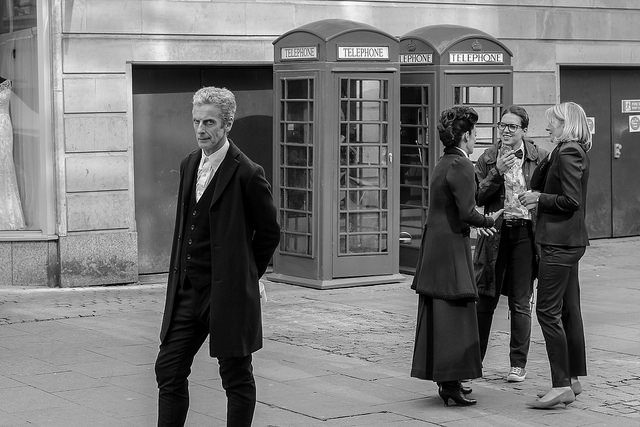
“Peter Capaldi as Doctor Who filming (season 8) in Cardiff June 2014” by Shaun Smith is licensed under CC BY-SA 2.0
Previous Post

November 25, 2015
Against Nature and Other Abominations
Next Post

December 3, 2015 How Many People Should Die for This Fantasy?
Browse Our Archives
Select a Category Abuse Beauty Charity Chastity Current Events Faith Family Feminism Fiction Humility Humour Identity Justice Perseverence Philosophy Poverty Sexuality trauma Uncategorized Virtues Wombats
Select a Month February 2020 November 2019 October 2019 August 2019 July 2019 June 2019 May 2019 April 2019 March 2019 February 2019 October 2018 September 2018 August 2018 July 2018 June 2018 May 2018 April 2018 March 2018 February 2018 January 2018 December 2017 November 2017 October 2017 September 2017 August 2017 July 2017 June 2017 May 2017 April 2017 March 2017 February 2017 January 2017 December 2016 November 2016 October 2016 September 2016 August 2016 July 2016 June 2016 May 2016 April 2016 March 2016 February 2016 January 2016 December 2015 November 2015 October 2015 September 2015 August 2015 July 2015 June 2015
Follow Us!
TAKE THE
Religious Wisdom Quiz
What city did Paul visit where the people worshiped "an unknown god"?
Select your answer to see how you score.
Corinth Rome Ephesus Athens
Books by This Author Books by Melinda Selmys
Support this
Column


Related posts from Catholic Authenticity

Is It A Sin to be Scandalized by...


Privilege Does Not Mean You Are Bad

TRENDING AT PATHEOS Catholic

Rejecting Doom: Christian Hope And Human Action
Christianity is a religion of hope. We are to have hope and...

It’s What Comes From Within Which Matters
One of the most difficult things for us to understand is why...

Why I Choose the Eucharist Over the Sermon
Choose the Eucharist, Not the Sermon What are we supposed to get...

5 Design Elements Found in Spiritually Rooted Homes
Putting Spirituality Into Home Decor Our homes are more than our living...

Credo: A Story of God Told with the...
About 10 years ago, I began to imagine a personal "Credo" that...

The Anatomy of Divine Revelation in Catholic Thought
The claim that God has made Himself known to human beings is...
view all Catholic blogs
Ad-Free & Subscriber Log-In Subscription Support
- About Us
- 2026 Calendar
- Videos
- Podcasts
- Library of World Religions
- Faith In Media Tracker
- Advertise With Us
- Write for Us
- Privacy Policy
- Terms of Service
- Do Not Sell My Data
- Contact Us
- Radiant Digital
- Manage Newsletter Subscriptions
- Unsubscribe From Notifications
- Sitemap
Copyright 2008-2026, Patheos. All rights reserved.
Subscription Support Ad-Free & Subscriber Log-In
Follow Patheos