
BuddhistCatholicContemplativeEvangelicalGeneral ChristianHinduJewishLatter-day SaintMuslimNew VisionsProgressive Christian
Beliefs
- Buddhist
- Catholic
- Contemplative
- Evangelical
- General Christian
- Hindu
- Jewish
- Latter-day Saint
- More Voices
- Muslim
- New Visions
- Pagan
- Progressive Christian
Topics
- Religion News
- Food and Religion
- Sports and Religion
- Religious Art
- Religious Music and Entertainment
- Religious Events
- History and Religion
- Style and Religion
- Politics and Religion
- Women in Religion
- Recreation Outdoors and Religion
- Business Finance and Religion
- Careers Workplace and Religion
- Education and Religion
- Family Parenting and Religion
- Health Fitness and Religion
- Home and Religion
- Relationships and Religion
- Technology and Religion
- Travel and Religion
Columnists
- Buddhist Columnists
- Business Finance and Religion Columnists
- Careers Workplace and Religion Columnists
- Catholic Columnists
- Contemplative Columnists
- Education and Religion Columnists
- Evangelists Columnists
- Family Parenting and Religion Columnists
- General Christian Columnists
- Health Fitness and Religion Columnists
- Hindu Columnists
- History and Religion Columnists
- Home and Religion Columnists
- Jewish Columnists
- More Voices Columnists
- Latter Day Columnists
- Muslim Columnists
- New Visions Columnists
- Nonreligious Columnists
- Pagan Columnists
- Politics and Religion Columnists
- Progressive Columnists
- Recreation Outdoors and Religion Columnists
- Relationships and Religion Columnists
- Religion News Columnists
- Religious Art Columnists
- Religious Events Columnists
- Religious Music and Entertainment Columnists
- Sports and Religion Columnists
- Style and Religion Columnists
- Technology and Religion Columnists
- Travel and Religion Columnists
- Women in Religion Columnists
Resource Library
- 2026 Calendar
- Library of World Religions
- The 100 Most Holy Places on Earth
- Patheos Answers
- Podcasts
- Videos
- Faith Leaders Database
- Anglican Episcopalian
- Bahai
- Baptist
- Buddhism
- Christianity
- Confucianism
- Eastern Orthodoxy
- Hinduism
- Holiness and Pentecostal
- ISKCON
- Islam
- Judaism
- Lutheran
- Methodist
- The Church of Jesus Christ of Latter-day Saints
- New Age
- Paganism
- Presbytarian and Reformed
- Protestantism
- Religion Behind the Scenes
- Roman Catholic
- Scientology
- Shia Islam
- Sikhism
- Sufism
- Sunni Islam
- Taoism
- Zen
- See all religions
Research Tools
 Ad-Free & Subscriber Log-In Subscription Support
Ad-Free & Subscriber Log-In Subscription Support
Follow Patheos 

- Trending:
- Forgiveness
- |
- Marriage
- |
- Consciousness
- |
- Death Penalty
- |
- Election
- |
- Halloween
 Catholic Authenticity
-
Categories
- Home
- Catholic
- Work Without Representation: Giving Power to Women in the Church
Work Without Representation: Giving Power to Women in the Church
Last updated on: October 25, 2015 at 9:10 am by Melinda Selmys
Work Without Representation: Giving Power to Women in the Church 2015-10-25T09:10:17-04:00 Melinda Selmys
Patheos Explore the world's faith through different perspectives on religion and spirituality! Patheos has the views of the prevalent religions and spiritualities of the world.
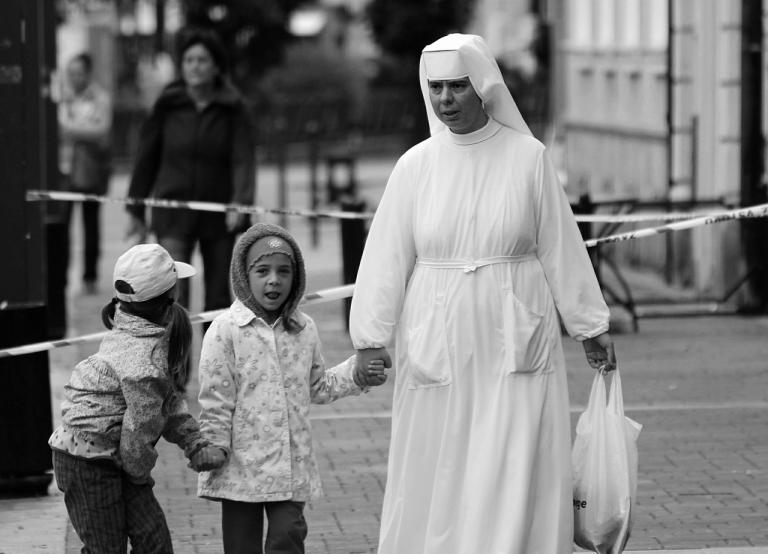
I’ve been mostly avoiding writing about the Synod, because I’ve honestly just been too tired, but the most recent controversy is one that I’m actually interested in. It recently came to light that a non-ordained man had been admitted as a voting member of the Synod – a move that I definitely applaud since it’s a small step towards reducing clericalism in Church decision making. The guy is still a celibate with religious vows, so apparently we’re some steps away from allowing people with families to have a real say in how the Church deals with family life. But the more important question, which has been raised, is why a male religious, and no women?
The Church knows that She has a problem with patriarchy. For as long as I’ve been a Catholic, and I believe going back to Vatican II, there’s been a lot of talk in the highest circles – and even in the official documents of the Church – about the need for greater inclusion of women. A lot of words have been spoken. Nice things have been said. Feet have been shuffled. And the bottom line is that half a decade later, we’re still dealing with this problem.
Now, before I have anyone jumping on my head I am not suggesting that we should institute women’s ordination. The Sacraments have a specific form, and they can’t just be changed for the sake of political convenience. But it’s clear that there are ways that the institutional structures of the Church can be changed in order to provide women with actual power, and I think it’s hugely problematic that this isn’t being done.
I would go so far as to say that the failure to meaningfully include female voices is a significant contributing factor to most of the major issues the Church is struggling with today. From the rejection of the teaching on contraception, to the lack of community and fellowship in our parishes, to the crisis of the family, I honestly don’t think that real progress is going to be made without harnessing the incredible and largely untapped resources of what John Paul II called “the feminine genius.”
Simply put, women’s spiritual energy has always been a major factor in the health of the Church. By energy here I don’t mean something New Agey: I mean the very practical application of women’s effort, determination and care in our spiritual communities. I mean women’s religious orders that provide for the education of children, the care of the sick, and the support of the poor. I mean women’s activity in building the community of the parish. I mean all of the prayers that get pumped out by the incredible spiritual powerhouse of the old rosary ladies. I mean the regular, day-to-day business of attending to the details of Christian life.
Women have always done that stuff in the Church, just as they’ve always done it in the domestic sphere and in the world. Women’s emotional and spiritual labour has always provided the necessary foundation on which spiritual communities are built.
This is crisis for the Church today because, with the advent of feminism, women have learned that they have this power – and we’ve learned to use it to say “No.” We’ve learned that we can exercise a veto. And this isn’t a bad thing: it’s actually an opportunity, a call to repentance, and a chance to heal systems of domination and sin that have arisen out of a male-dominated culture.
The fact that the historical exclusion of women is sinful is one that has been recognized, in theory, by Church authorities – most notably, by John Paul II in his letter on the Dignity and Vocation of Women. In Theology of the Body, he provides new ways of understanding the Christian tradition surrounding marriage, understanding it as a Sacrament of “mutual subjugation,” rather than as a codification of the subjugation of women under men. Theologically speaking, the Church has made tremendous progress towards recognizing women’s right to be included and respected as equal to men.
Thing is, words just ain’t enough. The vast majority of women living in today’s culture are still living in the thick of a massive cultural shift – a shift from a male-dominated world in which women are functionally inferior, to one in which equality is a practically realized norm. Women are fighting these battles in every arena of life. We are struggling to be heard on equal terms in the boardroom, struggling to create systems that don’t economically penalize our bodies and our fertility, struggling to get our husbands to change their share of diapers and wash their share of dishes.
We’re all pretty thoroughly aware that men do not make these changes easily, or, for the most part, willingly. We know about lip service. And we know that in a lot of cases the only way to bring about change is to make it absolutely clear that we will not put up with the status quo.
I think that the bottom line is, this is what is happening in our churches. Women are refusing to work without representation. As a group, women have said “No.” No, we will not organize the parish dinner, and run the parish lottery, and host the parish ladies’ night, and staff the children’s liturgy, and pop out the next generation of good Catholics, and pray, pray, pray for vocations and for the needs of the Church unless, until, we actually get a say.
And we can see the effect of this. Many of our Catholic communities are functionally ghost towns, where a few elderly parishioners soldier on in hope of better days. Everyone talks of parish level renewal, but nobody seems to be able to come up with a coherent strategy for bringing it about. Catholic marriage is in crisis, and increasingly our children are growing up to leave the faith.
Why? Because the traditional work of women isn’t being done. And it isn’t being done, not because the women are lazy, or faithless, or ungrateful, but because we are overwhelmingly tired of being expected to work without a voice. We’ve stopped putting up with being silent, obedient partners in our marriages, and with being second-rate citizens in the political sphere – so why would we continue to put up with it in the Church?
We know systems of power will always seek to maintain the status quo for as long as possible (even if they involve individually good people who are individually sympathetic to the cause of the oppressed.) And we know that the most effective non-violent solution to this problem is refusal to submit. The conscientious withholding of work has always been a morally appropriate response to continuing injustice – and I think it’s tacitly the response that Catholic women have adopted to the hierarchy’s foot-dragging about real inclusion for women in the power-structures of the Church.
With the inclusion of a layman in the voting membership of the Synod the Church demonstrated that it is possible to include non-clergy in decision-making processes. That means, women could have been included – and more importantly, that they can be included in the future. It’s time for the Church to stop talking about it and actually do this, because the problems that are facing Her cannot be solved by men alone.
Photo courtesy of Pixabay
Previous Post
October 13, 2015
Porn for the Privileged: My Article About Sex Work at First Things
Next Post

October 26, 2015 World Table: New Commenting System Coming to Catholic Authenticity
Browse Our Archives
Select a Category Abuse Beauty Charity Chastity Current Events Faith Family Feminism Fiction Humility Humour Identity Justice Perseverence Philosophy Poverty Sexuality trauma Uncategorized Virtues Wombats
Select a Month February 2020 November 2019 October 2019 August 2019 July 2019 June 2019 May 2019 April 2019 March 2019 February 2019 October 2018 September 2018 August 2018 July 2018 June 2018 May 2018 April 2018 March 2018 February 2018 January 2018 December 2017 November 2017 October 2017 September 2017 August 2017 July 2017 June 2017 May 2017 April 2017 March 2017 February 2017 January 2017 December 2016 November 2016 October 2016 September 2016 August 2016 July 2016 June 2016 May 2016 April 2016 March 2016 February 2016 January 2016 December 2015 November 2015 October 2015 September 2015 August 2015 July 2015 June 2015
Follow Us!
TAKE THE
Religious Wisdom Quiz
Which book of the Bible contains the "Armor of God" passage?
Select your answer to see how you score.
Colossians Ephesians Galatians Romans
Books by This Author Books by Melinda Selmys
Support this
Column


Related posts from Catholic Authenticity

Sex Positive: How I Learned To Stop Worrying...


The Lord Has Worked Marvels For Me: Open...

The Central Spiritual Struggle of Women: Open Letter,...
TRENDING AT PATHEOS Catholic

Rejecting Doom: Christian Hope And Human Action
Christianity is a religion of hope. We are to have hope and...

It’s What Comes From Within Which Matters
One of the most difficult things for us to understand is why...

Why I Choose the Eucharist Over the Sermon
Choose the Eucharist, Not the Sermon What are we supposed to get...

5 Design Elements Found in Spiritually Rooted Homes
Putting Spirituality Into Home Decor Our homes are more than our living...

Credo: A Story of God Told with the...
About 10 years ago, I began to imagine a personal "Credo" that...

The Anatomy of Divine Revelation in Catholic Thought
The claim that God has made Himself known to human beings is...
view all Catholic blogs
Ad-Free & Subscriber Log-In Subscription Support
- About Us
- 2026 Calendar
- Videos
- Podcasts
- Library of World Religions
- Faith In Media Tracker
- Advertise With Us
- Write for Us
- Privacy Policy
- Terms of Service
- Do Not Sell My Data
- Contact Us
- Radiant Digital
- Manage Newsletter Subscriptions
- Unsubscribe From Notifications
- Sitemap
Copyright 2008-2026, Patheos. All rights reserved.
Subscription Support Ad-Free & Subscriber Log-In
Follow Patheos